
MELU-223 · Lesson 2 of 12 · 18 min
Eligibility for the Master Electrician License
▶ Video coming soon A video version of this lesson is on the way.
Nadia's first job was to prove she could sit the exam at all. She pulled out the folder where she had kept every pay stub and registration card since 2016, and Lars pulled out the company's job records. "The department doesn't take your word for it," he said. "It takes your employer's word, on its form, backed by records. And it counts more than hours. It wants to know what kind of work you did." Nadia had assumed eligibility was a matter of time served. By the end of the afternoon she understood that Minnesota looks at both how long and how varied.
This lesson explains the three routes to Class A master eligibility in the Minnesota Electrical Act, the way Minnesota Rules count and categorize experience, what experience is acceptable and how it is verified, and how reciprocity can substitute for the exam in limited cases. The figures come from the Act (section 326B.33) and the department's experience requirements page as they stood in 2026.
The three routes in the Act
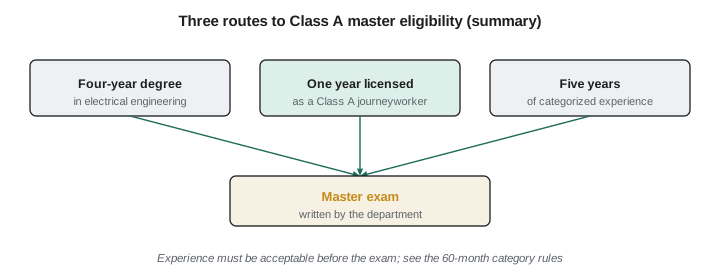
Section 326B.33, subdivision 1, sets out the qualifications for a Class A master electrician license. An applicant qualifies by meeting any one of three conditions. The first is graduation from a four-year electrical course at an accredited college or university. The second is at least one year of experience, acceptable to the commissioner, as a licensed journeyworker. The third is at least five years of experience in planning, laying out, supervising and installing wiring, apparatus or equipment for electrical light, heat and power. All three routes end at the same place: approval to take the master exam, which must be passed before a license is issued.
In practice most candidates use the second or third route. A journeyworker who has held a Class A journeyworker license for at least a year, with acceptable experience during that year, meets the second route even though the journeyworker license itself required four years of experience. A person who has never held a journeyworker license, for example an electrician who worked for years in another state, might instead document five years of qualifying experience under the third route.
Experience is counted in months and categories
The department's experience page, summarizing the rules, describes the master requirement as a minimum total of 60 months, with minimums and caps in specific categories of work. The categories exist to make sure a master has seen the whole job, not only the installation side. The candidate must show at least two months each in planning installations for light, heat and power, laying out installations, and supervising installations, and at least twelve months in wiring and installing. Other categories, such as maintaining and repairing, line work, elevators, technology circuits and process control circuits, can contribute but have no minimum, and each category has a cap on how many months it can contribute.
| Category of experience | Minimum months | Maximum credit (months) |
|---|---|---|
| Planning installation (light, heat, power) | 2 | 12 |
| Laying out installation | 2 | 12 |
| Supervising installation | 2 | 12 |
| Wiring and installing | 12 | 48 |
| Maintaining and repairing | 0 | 24 |
| Line work | 0 | 3 |
| Installing elevators | 0 | 6 |
| Technology circuits or systems | 0 | 6 |
| Process control circuits or systems | 0 | 12 |
The caps matter more than candidates expect. Someone whose whole career has been maintenance in a plant could have ten years of work and still not reach 60 creditable months, because maintenance contributes at most 24 months and wiring and installing needs at least 12 of its own. Likewise a technician who spent years on low-voltage systems can credit only six months of technology circuit work toward the master total.
# Creditable master experience under the category caps (illustrative check)
caps = {"planning": 12, "layout": 12, "supervising": 12, "wiring": 48,
        "maintenance": 24, "line": 3, "elevator": 6, "technology": 6, "process": 12}
minimums = {"planning": 2, "layout": 2, "supervising": 2, "wiring": 12}

def creditable(months):
    total = sum(min(m, caps[c]) for c, m in months.items())
    short = [c for c, need in minimums.items() if months.get(c, 0) < need]
    return total, short

nadia = {"planning": 6, "layout": 8, "supervising": 10, "wiring": 72, "maintenance": 14}
total, short = creditable(nadia)
print("Creditable months:", total)
print("Category minimums met:", not short)
print("Meets 60-month total:", total >= 60 and not short)Creditable months: 86 Category minimums met: True Meets 60-month total: True
Run on Nadia's records, the check shows why the caps matter: she has 72 months of wiring and installing, but only 48 can count, so her creditable total is 86 months rather than 110. She qualifies easily under the five-year route as well as under the journeyworker route, which gives her a safety margin if any month is questioned.
What experience is acceptable
Not every month of electrical work counts. The rule defines acceptable experience by where and for whom it was gained. Experience counts when it was gained while employed by a licensed electrical contractor. It can count when gained in Minnesota for an employer who is exempt from licensing or is not a contractor, but only if the work was inspected or, for exempt work, the department determined after its own inspection that the work was substantially equal to work done for a licensed contractor. Experience outside Minnesota counts based on the employer's certification and a department determination, and experience in the United States armed forces counts based on a military certification and a department determination.
The department's licensing basics page adds a practical point: credit generally applies if the applicant was registered as an unlicensed electrician in Minnesota after January 1, 2009, worked for a licensed contractor or registered employer, or had verifiable work for a licensed contractor in another state. Registration matters because it creates a record. Months worked without registration in Minnesota are much harder to prove and may not be accepted.
Two limits catch candidates out. Experience in foreign countries is capped at 12 months. And experience gained during the school term of a full-time two-year electrical course does not count; the course itself may earn education credit for some licenses, but the master section of the experience page lists no education credit. Finally, experience must be acceptable before the applicant takes the exam. A candidate cannot sit the exam on the promise that the last few months will be completed later.
How experience is verified
Experience is documented on the department's work experience forms, completed and signed by the employer, and uploaded with the online application. Each form covers a period with one employer and breaks the months into the categories in the table above. The department compares the forms with its own records, such as registration and license history, and may ask for more. Lars has signed dozens of these forms over the years, and he gave Nadia his rule: "Describe what you actually did, in the categories they use, and make sure the dates match your registration."
When an employer has gone out of business or will not sign, the department may accept other evidence, but the process is slower. Candidates who changed employers often should collect signed forms as they go rather than trying to reconstruct a decade of work at the end.
Planning, layout and supervision in practice
The three small categories, planning, laying out and supervising, are where journeyworkers most often come up short on paper even though they have done the work. Planning means deciding what an installation needs before anyone pulls wire: working out loads, choosing service and feeder sizes, deciding on circuit counts and locations, and selecting equipment. Laying out means turning that plan into a physical arrangement on the job, marking box and panel locations, routing raceways and cables, and coordinating with other trades. Supervising means directing other workers, assigning tasks, checking their work and being answerable for it.
Many electricians do some of this every week without anyone writing it down. A lead on a small crew who reads the prints, decides the home runs and checks the apprentice's terminations is planning, laying out and supervising. The work experience form gives the employer a place to record it, but only if the employer knows the work happened. Nadia went through Crow River's job files with Lars and found that she had been lead on the Sartell lake home additions, on two farm shop services near Cold Spring, and on the remodel of a small office building in Waite Park. Each of those jobs supported months in the planning, layout and supervising categories.
If a candidate genuinely lacks experience in one of the small categories, the remedy is to get it rather than to stretch the form. A conversation with the employer about taking the lead on a few jobs, with real responsibility for planning and supervision, is better than an application that the department questions. Misstating experience on a signed form is a serious matter for the employer who signs it and for the applicant who submits it.
Keeping records as you go
The best time to document experience is while it is happening. Nadia keeps a simple spreadsheet with one row per job: dates, address, permit number, her role, and an estimate of time spent in each category. When a job closes she notes the inspection approvals. The permit numbers make her records easy to check against the department's own data, and the role column makes it easy for an employer to fill out a form years later. Candidates who move between employers should ask each employer to sign a form when they leave, while the supervisor who knows the work is still there.
Registration and license history also feed the record. A registered unlicensed electrician renews every year, and the renewal itself requires a work experience verification form, so a person who kept registration current since 2009 has a year-by-year trail. The journeyworker license adds another layer, since it could only have been issued after the department accepted four years of experience.
Reciprocity
Section 326B.33, subdivision 20, allows the commissioner, with the board's approval, to issue a personal license without an examination under an agreement with another state. The applicant must hold a valid comparable license in that state, must have held it continuously for at least one year, must not have failed the same or a higher class of Minnesota exam, and must not have allowed a Minnesota personal license to lapse for two years or more. Reciprocity depends on an agreement existing with the particular state and for the particular license class, so it is not a general path for out-of-state electricians. Anyone hoping to use it should confirm with the department which agreements are in effect.
Worked problem
Testing the routes for a new hire
Crow River is interviewing Marcus, who holds a master license in another state but no Minnesota license. He has worked eleven years, mostly wiring and installing, with about two years each of layout and supervision and six months of planning. Which Minnesota routes might work for him?
Show solution
- The journeyworker route needs one year as a licensed Minnesota journeyworker, which he does not have.
- The five-year route needs 60 creditable months with the category minimums: he has well over 12 months of wiring, at least 2 months each of planning, layout and supervision, and caps would still leave far more than 60 months.
- His out-of-state experience counts on his employer's certification and a department determination.
- Reciprocity is possible only if Minnesota has an agreement with his state for the master class and he meets its conditions.
Answer: He can likely apply under the five-year route with certified out-of-state experience; reciprocity is an option only if an agreement covers his state.
Common mistakes
MistakeCounting total years and ignoring the categories.
InsteadThe master requirement has category minimums and caps; check that planning, layout, supervising and wiring minimums are met.
MistakeAssuming school-term months in a full-time electrical program count as experience.
InsteadExperience during the school term of a full-time two-year course gets no credit.
MistakeApplying with months still to be completed.
InsteadExperience must be acceptable before the exam.
MistakeRelying on unregistered Minnesota work.
InsteadRegister as an unlicensed electrician so your experience is on record.
Summary and key terms
- Class A master eligibility: a four-year electrical degree, one year as a licensed journeyworker, or five years of qualifying experience.
- Experience is counted in months with category minimums (planning, layout, supervising, wiring) and caps (for example maintenance at 24 months).
- Acceptable experience is gained with licensed contractors, or under conditions for exempt, out-of-state and military work.
- Foreign experience is capped at 12 months and school-term months in a full-time program do not count.
- Reciprocity requires an agreement with the other state and at least a year of continuous licensure there.
- Acceptable experience
- Experience that meets the rule's conditions on employer and inspection.
- Category minimum
- The least experience required in a given type of work for the master license.
- Credit cap
- The most months a category may contribute toward the total.
- Work experience form
- The employer-signed form documenting months and categories of experience.
- Reciprocity
- A license issued without exam under an agreement with another state.
Practice problems
Work each problem on paper first, then reveal the answer to check.
How many creditable months of wiring and installing can count toward the master total?
Show answer
At most 48.
What is the minimum experience as a licensed journeyworker under the second route?
Show answer
One year.
How long must a reciprocity applicant have held the other state's license?
Show answer
At least one year, continuously.
Lesson quiz · 5 questions
Score 60% or more to complete this lesson.
Create a free account to save your progress, take quizzes and earn a certificate.