
MELU-223 · Lesson 3 of 12 · 18 min
Applying, approval and booking the exam
▶ Video coming soon A video version of this lesson is on the way.
On a Sunday in early September 2026, Nadia sat at Crow River's office computer with Becky Lindgren beside her and logged in to iMS, the Department of Labor and Industry's online licensing system. Her journeyworker license was already linked to her account, so the system knew who she was. What it did not yet know was why she thought she was ready to be a master. "Upload the forms Lars signed," Becky said, "and read every screen before you click next. The department is good about telling you what's missing, but every missing piece costs a week."
This lesson walks through the application from account setup to the day the exam is scheduled: what goes into the application, how the department reviews it, what happens when something is missing, how the exam is booked, and what happens after a pass or a fail. Minnesota is unusual in that the department itself writes and gives the electrical exams rather than contracting with a national testing company, so the steps run through the department from start to finish.
Setting up the application
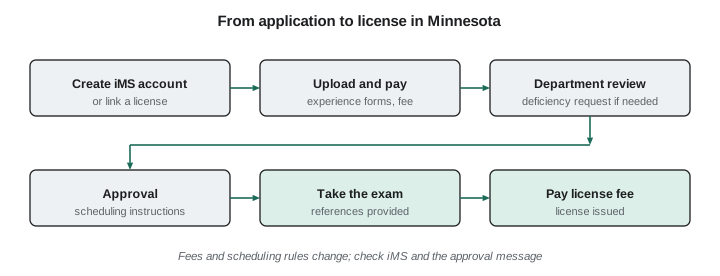
Applications and renewals for Minnesota electrical licenses are made online through iMS. A first-time applicant creates an account, and someone who already holds a registration or license links it to the account so the department can see their history. The master exam application asks for identifying information, the license class sought, and the basis of eligibility: the degree route, the journeyworker route or the experience route described in lesson 2. The applicant uploads supporting documents, most importantly the employer-signed work experience forms, and pays the application and examination fee.
For Nadia the application was short, because her eligibility rested on her Class A journeyworker license, held since March 2021, and the department already had that record. She uploaded work experience forms for her years at Crow River anyway, as Lars advised, so that the department could see experience in every category if it chose to check. A candidate relying on the five-year route, or on out-of-state or military experience, should expect to upload more and to wait longer.
Review and deficiencies
The department reviews the application against the eligibility rules. Reviewers check that the experience forms cover the required months, that the category minimums are met, that the dates are consistent with registration and license history, and that the experience is the acceptable kind. If something is missing or unclear, the department tells the applicant what it needs. The usual problems are forms that do not break experience into categories, gaps between employers, dates that overlap, and out-of-state experience without the employer's certification.
A deficiency is not a denial. It is a request for more information, and the fastest way through it is to answer exactly what was asked, with documents rather than explanations. Becky keeps a copy of every form Crow River has signed for an employee, which has saved more than one applicant a frantic search for a former supervisor.
Experience must be acceptable before the exam, which means the review has to finish before scheduling. Candidates who plan to test on a particular date, for example before an employer's deadline or before a code change, should apply early enough to absorb a round of questions.
Approval and scheduling
Once the application is approved, the department sends instructions for scheduling the exam. The department gives its electrical exams at its own testing sites, and exam preparation providers describe sittings at the department's St. Paul office and at regional locations. The approval message explains how to choose a date and location, what identification to bring and what is provided at the exam. Exam preparation providers also report that applicants may reschedule only once; treat the first date you choose as a real commitment.
| Step | Who acts | Typical issue to watch |
|---|---|---|
| Create or link iMS account | Applicant | Link an existing registration or license so history shows |
| Upload experience forms and pay | Applicant and employers | Categories filled in, dates match registration |
| Review | Department licensing unit | Deficiency requests for missing or inconsistent forms |
| Approval and scheduling | Department, then applicant | Choose date and site; limited rescheduling |
| Exam | Applicant | Bring required identification; references are provided |
| License fee and issuance | Applicant, then department | Pay after passing to receive the license |
Fees are paid in two stages. The application and examination fee is paid when applying; the department's licensing basics page lists 50 dollars for the journeyworker exam, and candidates should check iMS for the master figure. After passing, the applicant receives payment instructions for the license fee itself, and the license is issued once that fee is paid.
# Planning backward from a target exam date (illustrative planning only)
from datetime import date, timedelta

target_exam = date(2026, 10, 20)
review_allowance = timedelta(weeks=4)    # time for review and one round of questions
scheduling_lead = timedelta(weeks=2)     # time between approval and an open seat

apply_by = target_exam - scheduling_lead - review_allowance
print("Target exam date:", target_exam.isoformat())
print("Apply no later than:", apply_by.isoformat())
print("Weeks of study after applying:", (target_exam - apply_by).days // 7)Target exam date: 2026-10-20 Apply no later than: 2026-09-08 Weeks of study after applying: 6
The allowances in the planning example are Crow River's own rule of thumb, not department figures. Review times vary with the season and with the complexity of the application. Nadia applied in early September with the goal of testing in October, after the department's switch to the 2026 NEC on September 8, so that she would study one edition and be tested on it.
Choosing when to test
Timing is a strategic choice, not just a matter of the next open seat. The biggest timing question in 2026 was the code edition. The department moved its licensing exams to the 2026 NEC on September 8, 2026. A candidate who had studied the 2023 edition for months had a reason to test before that date, while a candidate starting fresh had every reason to study the 2026 edition and test after it. Nadia chose the second path because her continuing education in 2025 had already introduced the 2026 changes and because every permit Crow River filed after August 17, 2026 would be judged under the 2026 edition anyway.
Other timing questions are personal and seasonal. Electrical work in Minnesota is busiest from spring through fall, and many candidates find it easier to study in the winter. On the other hand, the first renewal date for a master license falls on the last day of February of an odd-numbered year, so a license issued in late 2026 reaches its first renewal deadline within a few months. Lesson 11 explains renewal, but the practical point here is to ask the department how the first term is handled for a newly issued license so the first renewal is not a surprise.
Test-day logistics
The approval message lists what to bring and what is forbidden. Expect to need current government-issued photo identification that matches the name on the application exactly; a mismatch between a married name and an old license name is a classic way to be turned away. Exam preparation providers report that personal books and materials are not allowed and that electronic devices, including phones, are not allowed in the building, because the department provides the references and a basic calculator. Leave the phone in the truck.
Plan the trip as carefully as the study. A regional site may be an hour or more away, and Minnesota roads in late fall can turn slow without warning. Arrive early enough to check in calmly. Bring water and a snack if allowed for breaks, and dress in layers, since testing rooms are not always the temperature you would choose. These details sound trivial, but a candidate who arrives flustered from a late start loses the first fifteen minutes of a long exam to nerves.
Working with the licensing unit
The licensing unit answers questions by phone and email, and its staff deal with thousands of applications. Questions get the best answers when they are specific: give the license number, the application number and the exact issue, such as whether experience as a maintenance electrician at a particular plant was gained for an exempt employer. Keep copies of every message and note the date and the name of the person you spoke with. If the answer affects eligibility, ask for it in writing.
Special arrangements
The Act requires each applicant for a personal license to pass an examination developed and given by the commissioner. It allows an oral examination only when a certified teacher or another qualified professional provides a written statement that the applicant has a reading disability. Applicants who need other accommodations for a disability should ask the department well before booking, with documentation, so arrangements can be made at the testing site.
After the exam
A candidate who passes pays the license fee and receives a master license. A candidate who fails receives notice of the result. Exam preparation providers summarizing the department's process report that a failing applicant may submit a new application, with a new fee, 30 days after notice of the failure. A fail does not erase the applicant's eligibility, but each new attempt is a new application, so the 30-day wait and the review and scheduling time all come around again.
A fail is also information. Before reapplying, a candidate should list the topics that felt slow or unfamiliar during the exam while the memory is fresh: which calculations took too long, which parts of the laws and rules booklet were hard to find, which code articles needed several lookups. That list becomes the study plan for the next attempt, and the 30-day wait becomes useful study time rather than lost time. Lesson 12 describes a miss log that serves the same purpose during practice.
The fail also matters for reciprocity: an applicant who has failed the same or a higher class of Minnesota exam cannot later use a reciprocity agreement for that license. Candidates from other states who are unsure whether reciprocity applies should settle that question before sitting the Minnesota exam.
Linking the new license to the company
Passing the exam does not by itself change Crow River's contractor license. When Nadia becomes the responsible licensed master, the company updates its contractor record with the department to designate her, and the statute requires that applications and renewals include a verified statement that the designation rules are met. Lesson 8 covers the contractor license, and lesson 7 covers the responsible master's duties.
Worked problem
Reading a deficiency letter
Two weeks after Nadia applies, a coworker named Tomas receives a deficiency request on his own master application. It says his forms from a former employer show 30 months but do not break them into categories, and his supervising months total one. What should he do?
Show solution
- Category breakdowns are required because the master rule has category minimums.
- He needs at least two months of supervising experience; one month falls short.
- He should ask the former employer to complete a corrected form showing the categories.
- If he truly has only one month of supervising, he needs more qualifying experience before the exam, unless he qualifies by another route such as a year as a licensed journeyworker.
Answer: Get a corrected form with categories; if supervising experience is genuinely short, gain more or rely on another route before testing.
Common mistakes
MistakeWaiting until the last minute to apply for a specific exam date.
InsteadAllow time for review and at least one round of deficiency questions.
MistakeAssuming you can reschedule freely.
InsteadProviders report only one reschedule; choose the first date carefully.
MistakeBringing your own tabbed code book.
InsteadThe department provides the references at the exam; personal books are not allowed (see lesson 4).
MistakeExpecting the contractor record to update automatically when you pass.
InsteadThe company must designate the new responsible master with the department.
Summary and key terms
- Minnesota master applications are made online through iMS with employer-signed experience forms.
- The department reviews eligibility and sends deficiency requests when forms are incomplete or inconsistent.
- After approval, candidates schedule with the department, which writes and gives its own exams.
- Fees come in two stages: application and exam, then the license fee after passing.
- A failing applicant may reapply with a new fee after 30 days (provider summary), and a fail blocks later reciprocity for that class.
- iMS
- The department's online license management system.
- Deficiency request
- A notice asking an applicant for missing or corrected information.
- Approval
- The department's confirmation that an applicant is eligible to schedule the exam.
- License fee
- The fee paid after passing, before the license is issued.
- Oral exam
- An exam read aloud, allowed only with a written statement of a reading disability.
Practice problems
Work each problem on paper first, then reveal the answer to check.
Through what system are Minnesota electrical license applications made?
Show answer
iMS, the department's online license management system.
When is an oral exam allowed under the Act?
Show answer
Only with a written statement from a certified teacher or other qualified professional that the applicant has a reading disability.
What must a company do after its new master passes?
Show answer
Designate the new responsible licensed master on its contractor record with the department.
Lesson quiz · 5 questions
Score 60% or more to complete this lesson.
Create a free account to save your progress, take quizzes and earn a certificate.