
MELU-220 · Lesson 9 of 12 · 19 min
Contracts and mechanics' liens in Maryland
▶ Video coming soon A video version of this lesson is on the way.
Patapsco Ridge finished the electrical work on a two-story office building in Columbia on August 28, 2026. The owner, a small real estate company, had hired a general contractor, and Patapsco Ridge was the general contractor's electrical subcontractor on a 64,000-dollar subcontract. By November the general contractor had stopped answering calls, and 21,500 dollars was still unpaid, including retainage. Marisol pulled the subcontract and the job file and wrote two dates on the whiteboard in Walt's office: December 26 and February 24. "The first one is the notice to owner," she said. "Miss it and we have no lien. The second is the petition. Miss that and we have no lien either."
This lesson covers contracts and payment protection for Maryland electrical contractors. It starts with the contract terms that prevent disputes, then explains Maryland's mechanics' lien law in Title 9, Subtitle 1 of the Real Property Article: who may claim a lien, what property it reaches, the subcontractor's notice to owner within 120 days, the petition to the circuit court within 180 days, the court's process, enforcement within one year, the special rules for single-family dwellings, and how payment bonds replace liens on public projects. It also touches the related trust fund and prompt payment rules. Lien law is strict about deadlines and form, and every real claim deserves review by a construction lawyer.
Contracts that prevent disputes
Most payment problems start in the contract. A sound electrical contract or subcontract defines the scope and exclusions, names the drawings, specifications and code edition, sets the price, payment schedule and retainage, describes how change orders are requested and approved, assigns responsibility for permits and utility fees, states warranty and insurance terms, and sets out how disputes are resolved. In Maryland, a subcontract also cannot take away the subcontractor's lien rights: under Real Property 9-113, a provision in a subcontract that waives the right to claim a mechanics' lien, or to sue on a contractor's payment bond, is void.
Change orders deserve their own rule. On the Columbia job, the general contractor asked for an additional circuit run to a rooftop unit that the drawings had not shown. Renee wrote a change order with the price and had it signed before the crew started. That single page later made the change part of the undisputed balance, not part of an argument.
| Contract term | Why it matters |
|---|---|
| Scope and exclusions | Defines what the price covers |
| Drawings, specifications and code edition | Sets the standard for the work |
| Price, schedule and retainage | Sets when money is due |
| Written change orders | Prevents disputes over extra work |
| Permits and utility fees | Assigns approval costs |
| Lien rights | Cannot be waived in a subcontract under 9-113 |
How a Maryland mechanics' lien works
A mechanics' lien is a claim against real property that secures payment for work or materials furnished to improve it. Under Real Property 9-102, a building, and the land it sits on to the extent needed for its use, is subject to a lien for the payment of debts for work done and materials furnished for or about the building. For an existing building that is repaired, rebuilt or improved, the lien is available only if the work amounts to at least fifteen one-hundredths of the building's value. That threshold rarely matters for new construction but can defeat a lien for a small service call or minor remodel.
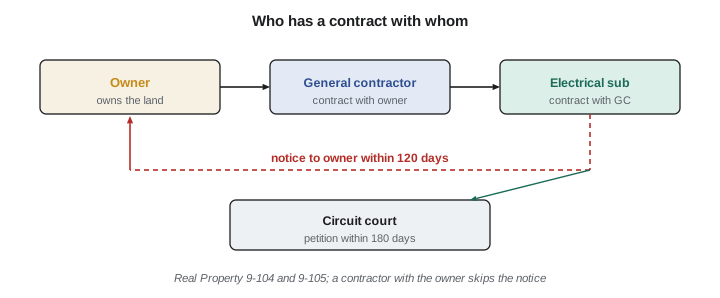
Two kinds of claimants appear in the statute. A contractor is a person who contracts directly with the owner. A subcontractor is a person who contracts with anyone other than the owner, such as a general contractor's electrical sub or a supplier to that sub. The difference decides whether a notice to owner is required. In Maryland, unlike some states, the lien is not established simply by recording a document. It is established by a court order after a petition, which is why the process involves the circuit court from the start.
The subcontractor's notice to owner
Under Real Property 9-104, a subcontractor is not entitled to a lien unless it gives the owner written notice within 120 days after doing the work or furnishing the materials. The notice must be substantially in the form the statute sets out. It identifies the subcontractor, describes the building, states the total amount earned and the amount unpaid, describes the work or materials and when they were furnished and for whom, and includes a declaration under penalties of perjury signed by an individual. It must be sent by registered or certified mail, return receipt requested, or personally delivered by the subcontractor or its agent. If notice cannot be delivered because the owner is absent or for similar reasons, it may be posted on the front door of the building within the 120 days, in the presence of a competent witness. When there are several owners, notice to any one of them is enough.
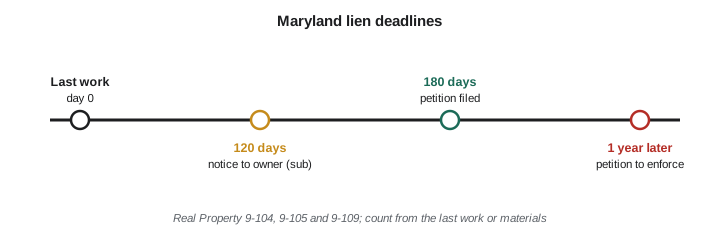
Once the owner receives a proper notice, the owner may withhold from the contractor the amount the owner reasonably believes is owed to the subcontractor. That is the purpose of the notice: it warns the owner before the owner pays the general contractor the money the subcontractor is owed. On the Columbia job, Patapsco Ridge's last work was August 28, 2026, so its notice to owner had to be delivered no later than December 26, 2026. Marisol prepared it in early November and sent it by certified mail the same week, with a copy hand-delivered to the owner's office.
The petition within 180 days
Under Real Property 9-105, a person who wishes to establish a lien must file proceedings in the circuit court for the county where the land is located within 180 days after the work has been finished or the materials furnished. The petition must state the names and addresses of the petitioner and the owner, the nature or kind of work done or materials furnished and when, the amount claimed, a description of the land and, for a subcontractor, facts showing that the notice to owner was properly given. It must be supported by an affidavit setting out the facts and by copies of the key documents, such as the subcontract, invoices and the notice.
A contractor who contracted directly with the owner does not give a notice to owner, but must still file the petition within 180 days. For Patapsco Ridge on the Columbia job, 180 days after August 28, 2026 is February 24, 2027. The petition must be on file by then, and filing early is better, because the court process takes time and the claim gains nothing by waiting.
# Maryland lien deadline planner (study aid; a lawyer should confirm each date)
from datetime import date, timedelta
last_work = date(2026, 8, 28)
notice_by = last_work + timedelta(days=120)
petition_by = last_work + timedelta(days=180)
print("last work or materials:", last_work)
print("subcontractor notice to owner by:", notice_by)
print("petition filed in circuit court by:", petition_by)
print("enforce within one year after the petition is filed")last work or materials: 2026-08-28 subcontractor notice to owner by: 2026-12-26 petition filed in circuit court by: 2027-02-24 enforce within one year after the petition is filed
The court's process
The petition starts a court process that moves quickly. Under Real Property 9-106, the court reviews the petition and may order the owner to show cause, within the time the order sets after service, why a lien should not attach. If the owner does not file an affidavit disputing the facts, the court may treat the petitioner's facts as admitted. The court may then establish a final lien, deny the lien, or establish an interlocutory lien and set the case for trial, generally within six months. An owner may also seek to release the property from the lien by posting a bond or other security, which lets the owner sell or refinance while the dispute continues.
Establishing the lien does not end the claim. Under Real Property 9-109, the right to enforce a lien expires one year after the petition to establish it was first filed, unless a petition to enforce is filed within that year. Enforcement can lead to a court-ordered sale of the property, though most liens are resolved by payment or settlement long before that. The claimant should also keep its contract claim alive against the party it contracted with, because the lien is security for the debt, not a substitute for it.
Single-family dwellings
Maryland protects homeowners building their own residences. When a single-family dwelling is being built on the owner's land for the owner's own residence, a subcontractor's notice is still due within 120 days, but a subcontractor is not entitled to a lien if the owner has already paid the contractor in full before receiving the notice. The subcontractor's lien also cannot exceed the amount the owner still owes the contractor when the notice is given. For electrical subcontractors working for home builders, that means the notice should go out early, before the owner has paid the builder everything, and ideally as soon as payments slow.
Releases, trust funds and prompt payment
Several related rules surround the lien statute. Under Real Property 9-114, a contractor who has been paid in full must give the owner signed releases of lien from each subcontractor and supplier. Under Subtitle 2 of Title 9, money paid to a contractor or subcontractor for work done by others is generally held in trust for those parties, and officers who knowingly misuse it can face personal liability; the trust rules do not apply to some residential contracts. Subtitle 3 sets prompt payment rules for many private contracts, including deadlines for paying undisputed amounts and limits on retainage on larger contracts. These rules give subcontractors leverage when a general contractor holds money it has been paid.
Public projects: payment bonds, not liens
Mechanics' liens generally cannot attach to public property such as a county school, a state office building or a municipal library. Instead, Maryland requires performance and payment security on many public construction contracts, and unpaid subcontractors and suppliers make claims against the payment bond. Bond claims have their own notice and suit deadlines, which differ from lien deadlines and depend on the claimant's place in the contracting chain. On the school lighting job from Lesson 8, Marisol asked the school system for a copy of the general contractor's payment bond on the first day, noted the surety's address and the claim procedure, and calendared the bond deadlines from the start.
Worked problem
Working the Columbia claim
Patapsco Ridge was the general contractor's electrical subcontractor on a Columbia office building, last furnished work on August 28, 2026, and is owed 21,500 dollars, including a signed 3,200-dollar change order. The building is new commercial construction. What must the company do to preserve a lien?
Show solution
- Confirm the 180-day and 120-day deadlines from August 28, 2026: notice to owner by December 26, 2026 and petition by February 24, 2027.
- Prepare the notice to owner in the statutory form, with the amount earned and unpaid and a declaration under penalties of perjury.
- Deliver it by certified or registered mail, return receipt requested, or by personal delivery, and keep proof.
- If not paid, have counsel file the petition in the Howard County circuit court with the affidavit and supporting documents well before February 24, 2027.
- If the court establishes the lien, calendar the one-year enforcement deadline from the petition filing date.
Answer: Deliver the notice to owner by December 26, 2026, file the petition by February 24, 2027, and enforcement within a year of filing.
Common mistakes
MistakeCounting from the invoice date.
InsteadDeadlines run from the last day work was done or materials furnished.
MistakeSending the notice to owner by regular mail.
InsteadUse registered or certified mail with return receipt, or personal delivery, or posting with a witness when allowed.
MistakeThinking a recorded document creates the lien.
InsteadMaryland liens are established by a circuit court after a petition.
MistakeWaiting until the owner pays the builder on a new home.
InsteadA subcontractor's lien on an owner-occupied single-family dwelling is limited to what the owner still owes when notice is given.
MistakeFiling a lien on a public school.
InsteadPublic property generally cannot be liened; claim against the payment bond.
Summary and key terms
- Contracts with clear scope and written change orders prevent most disputes; subcontract lien waivers are void under 9-113.
- Repairs and improvements to existing buildings must meet the value threshold in 9-102.
- A subcontractor must give the owner a notice to owner within 120 days under 9-104.
- Any claimant must petition the circuit court within 180 days under 9-105; enforcement expires one year after the petition under 9-109.
- Single-family dwelling liens are limited, and public projects use payment bonds instead of liens.
- Mechanics' lien
- A court-established claim against improved property securing payment.
- Subcontractor's notice to owner
- A subcontractor's written notice within 120 days, required for a lien.
- Petition to establish
- The circuit court filing within 180 days that starts the lien case.
- Interlocutory lien
- A provisional lien the court sets before a final hearing.
- Payment bond
- Security on public projects that replaces lien rights.
Practice problems
Work each problem on paper first, then reveal the answer to check.
Within how many days must a subcontractor give the notice to owner?
Show answer
120 days after the work or materials.
Within how many days must the petition be filed?
Show answer
180 days after the work is finished or materials furnished.
Where is the petition filed?
Show answer
In the circuit court for the county where the land is located.
How long does the right to enforce last after the petition is filed?
Show answer
One year.
Lesson quiz · 5 questions
Score 60% or more to complete this lesson.
Create a free account to save your progress, take quizzes and earn a certificate.