
MELU-220 · Lesson 2 of 12 · 19 min
Eligibility for the Master Electrician License
▶ Video coming soon A video version of this lesson is on the way.
Renee's first task was not studying code. It was counting years. Walt handed her a legal pad and asked her to list every employer, every supervisor and every type of work since she started in the trade. The list covered two pages: a summer as a helper for a remodeling company in 2015, four years of apprenticeship with Patapsco Ridge from 2016, a journeyperson license in 2021, and five more years of commercial, residential and light industrial work. Next to each entry Walt made her write the name and license number of the master who directed the work. "The board doesn't count years," he said. "It counts supervised years doing the right kind of work, and it counts what you can prove."
This lesson explains who may sit for the Maryland master electrician exam. It covers the seven-year experience requirement in BOP 6-304, what kind of work counts, credit for formal education and apprenticeship, how the journeyperson and apprentice licenses now fit into the path, the reciprocity route for licensees from other states, and how to document experience so the application survives review.
The core requirement: seven years under supervision
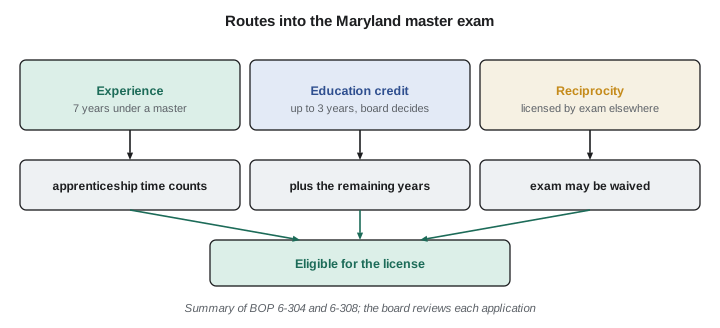
BOP 6-304 sets the master electrician qualifications. An applicant must have worked for at least seven years, regularly and principally providing electrical services for all types of electrical equipment and apparatus, while under the direction and supervision of a master electrician or a similarly qualified employee of a governmental unit. The applicant must also pass the examination the board gives. The words in that sentence each do work, and the board reads them carefully.
Regularly and principally means that electrical work was the applicant's main job during the time claimed, not an occasional task alongside other work. A carpenter who wired a few outlets each month does not earn electrical experience for those months. All types of electrical equipment and apparatus means breadth: services, feeders, branch circuits, motors and controls, lighting, and the range of occupancies a master will be responsible for. Under the direction and supervision of a master means the work was overseen by someone licensed to take responsibility for it, or by a qualified government employee such as an electrician on a public facilities staff. Work done for an unlicensed contractor, or as an unsupervised handyman, generally does not count.
What kind of work counts
The board looks for experience installing, altering and repairing electrical systems for light, heat and power. Work in the board's own sense of electrical services counts; related trades that happen to involve wire may not. In its January 2026 meeting, the board's counsel noted that the board does not consider technician or laborer work to provide the training needed for journeyperson or master licensure. That position matters for candidates who spent years as alarm technicians, appliance installers or general laborers on electrical crews: those years may be valuable, but they may not count toward the seven.
Low-voltage work sits in its own category. The 2020 law created a separate low-voltage electrician license with its own three-year experience requirement. Time spent mainly on low-voltage systems, such as data cabling or audio systems, is experience toward that license. Whether any of it counts toward the master requirement depends on the board's review of the work actually performed, and candidates should not assume it does.
| Experience claimed | Likely treatment (summary) |
|---|---|
| Licensed apprentice work under a master | Counts toward the seven years |
| Licensed journeyperson work under a master | Counts toward the seven years |
| Electrician on a government facilities staff under a qualified supervisor | May count; the statute names qualified government employees |
| Formal electrical program or training | Up to 3 years of credit at the board's discretion |
| Laborer or technician work on an electrical crew | Generally not treated as qualifying training |
| Unsupervised side jobs or unlicensed contracting | Generally does not count |
Credit for education and apprenticeship
BOP 6-304 lets the board credit up to three years of the experience requirement for an applicant who completed a formal course of study or professional training in electrical installation that is comparable to the experience it replaces. The credit is discretionary: the board decides whether a program is comparable and how much credit it earns. A two-year electrical program at a community college might earn substantial credit; a short online course would not. Candidates claiming education credit should submit transcripts and course descriptions showing hours and content.
Apprenticeship gets stronger treatment. The statute requires the board to credit work done as part of an approved electrician apprenticeship program toward the experience requirement. Renee's four years in a registered apprenticeship, with classroom hours at night and supervised work by day, count in full. The apprenticeship also built the documentation trail the board wants: signed work-hour records, classroom transcripts and the sponsor's completion certificate.
How the journeyperson license fits in
Since the state began licensing journeypersons and apprentices in 2021, the expected path into the trade has become clearer. The board's counsel described it in early 2026 as roughly four years working as a licensed apprentice, followed by time as a licensed journeyperson, adding up to the seven years for the master. A regulation already requires an apprentice license before a journeyperson license. In late 2025 the board voted to have its counsel draft a legislative proposal to require a journeyperson license before a candidate may sit for the master exam, and it has also discussed regulatory changes. These are proposals, not current law, as of this course's writing. Candidates should check the board's current requirements when they apply, and those who already hold a journeyperson license are well placed whichever way the proposals go.
The journeyperson license also changes what an experience claim looks like. Before 2021, many candidates' experience lived only in employer letters. Now a candidate's apprentice and journeyperson licenses are on file with the board, with dates. Renee's application could point to her apprentice license from 2016 and her journeyperson license from 2021, which made the board's review of her supervised experience faster and less open to question.
# Count qualifying experience years from an experience log (study aid)
log = [
    ("2015 summer helper, remodeling company (no master)", 0.25, False),
    ("2016-2020 licensed apprentice, Patapsco Ridge", 4.0, True),
    ("2021-2026 licensed journeyperson, Patapsco Ridge", 5.5, True),
]
counted = sum(years for _, years, ok in log if ok)
for entry, years, ok in log:
    print(("counts  " if ok else "excluded"), years, "yr", entry)
print("qualifying years:", counted, "of 7 required")
print("eligible on experience:", counted >= 7)excluded 0.25 yr 2015 summer helper, remodeling company (no master) counts 4.0 yr 2016-2020 licensed apprentice, Patapsco Ridge counts 5.5 yr 2021-2026 licensed journeyperson, Patapsco Ridge qualifying years: 9.5 of 7 required eligible on experience: True
Documenting experience
The application asks for an employment experience record: each employer, dates, the supervising master's name and license number, and a description of the work. The board may ask for verification from employers or supervisors. Weak applications share common problems: gaps in dates, supervisors who cannot be identified, descriptions so vague that the board cannot tell whether the work was electrical, or claims of full-time work during years when the applicant held another full-time job. Strong applications are specific. Renee's described service changes up to 400 amperes, commercial tenant fit-outs, motor control wiring at a water treatment plant and residential rewires, with approximate hours for each.
Walt signed a letter verifying Renee's years at Patapsco Ridge and listing his own master license number. For the 2015 summer, Renee did not claim the time at all. The remodeling company had no master electrician on staff, and claiming it would have invited questions about the rest of the record. She had more than seven qualifying years without it, and a clean application was worth more than three extra months on paper.
When the board asks for more
Some applications come back with questions instead of an approval. The board may ask for a clearer description of the work, a letter from a supervisor it could not reach, pay records showing full-time employment, or proof that a supervisor held a master license during the years claimed. A request for more information is not a denial. It is a chance to fix the record, and a prompt, specific answer usually resolves it. Renee's coworker Devin had his first application returned because his apprenticeship sponsor had changed names after a merger; a one-page letter from the sponsor explaining the change, with the old and new names, settled it within a month.
When the board does deny an application, it explains why, and the applicant may provide more evidence or reapply after gaining more experience. Applicants who believe the board misread the law have the right to the administrative review the board's procedures provide. In practice, the best defense against denial is the log Renee kept from her first year: a page per employer, updated every few months, with supervisors' names and license numbers and short notes on the work.
Planning the years ahead
For an apprentice reading this lesson early in a career, eligibility is a plan as much as a test. Seek breadth on purpose: ask to rotate through service work, commercial fit-outs, motor controls and residential jobs, because the exam and the license assume a master understands all of them. Keep the apprentice and journeyperson licenses current, since lapses create gaps the board must reconcile. Finish any related classroom program, which may earn credit and will certainly help on the exam's theory and calculation questions. And keep copies of everything, because employers close, records disappear and supervisors retire.
Other requirements and character questions
Applications also ask about criminal history and prior discipline in any licensed trade. A record does not automatically bar an applicant, but an applicant who fails to disclose it creates a bigger problem than the record itself. Applicants must also pay the application fee and, after passing, show insurance or choose uninsured status before the license issues. Lesson 3 covers those steps.
Reciprocity from another state
A master electrician licensed by examination in another state may be able to skip the Maryland exam. Under BOP 6-308, the board may waive the exam for an applicant who holds an active license in good standing in a state with an equivalent license, was licensed there by examination, and has seven years of experience under a master or qualified government employee, at least four of them before the other state licensed the applicant. The other state must give Maryland licensees similar treatment. The board's reciprocal agreements with Delaware, Virginia, West Virginia and the District of Columbia carry their own conditions, such as minimum years of licensure.
Reciprocity is not available to an applicant licensed only in another country, and the board decides each case by vote. For a candidate like Renee, who has worked only in Maryland, reciprocity is mostly relevant in reverse: once she holds a Maryland master license obtained by examination, she may be able to use it to seek licenses in neighboring jurisdictions where Patapsco Ridge takes occasional work.
Worked problem
Checking a new hire's eligibility
Patapsco Ridge hires Marcus, who has nine years in the trade: two years as a laborer for a solar installer, three years as a licensed apprentice in Maryland, and four years as a licensed journeyman in Pennsylvania under a master there. He asks whether he can apply for the Maryland master exam now.
Show solution
- Set aside the two laborer years; the board generally does not treat laborer work as qualifying training.
- Count the three years as a licensed apprentice under a master in Maryland.
- Count the four Pennsylvania years if he can document supervision by a master, since the statute does not limit experience to Maryland.
- Total seven qualifying years, which meets BOP 6-304 if the board accepts the documentation.
- Gather employer letters, supervisors' license numbers and work descriptions before applying.
Answer: Marcus appears to meet the seven-year requirement, but only if his out-of-state supervision is documented well.
Common mistakes
MistakeCounting every year in the construction industry.
InsteadOnly regular and principal electrical work under a master or qualified government employee counts.
MistakeAssuming education credit is automatic.
InsteadThe board may credit up to three years for comparable formal study, at its discretion.
MistakeLeaving out a supervisor's license number.
InsteadThe board needs to verify supervision; give names and numbers.
MistakeTreating a proposal as current law.
InsteadThe journeyperson-first proposal was under consideration; check the current rule when applying.
MistakeHiding an old disciplinary matter.
InsteadDisclose it; failing to disclose is the bigger problem.
Summary and key terms
- BOP 6-304 requires seven years of regular and principal electrical work under a master or qualified government employee, plus the exam.
- The board may credit up to three years for comparable formal study or training.
- Approved apprenticeship work must be credited.
- Apprentice and journeyperson licenses now document most of the path; a journeyperson-first rule has been proposed.
- BOP 6-308 allows an exam waiver for qualifying licensees from states that reciprocate.
- Regularly and principally
- Electrical work as the main occupation during the time claimed.
- Qualified government employee
- A government electrician who may supervise qualifying experience.
- Education credit
- Up to three years credited for comparable formal study.
- Experience record
- The application section listing employers, supervisors and work.
- Exam waiver
- Reciprocity that lets an out-of-state licensee skip the Maryland exam.
Practice problems
Work each problem on paper first, then reveal the answer to check.
How many years of experience does the master license require?
Show answer
Seven.
What is the most the board may credit for formal education?
Show answer
Three years.
Must the board credit approved apprenticeship time?
Show answer
Yes.
Name two of the four jurisdictions with Maryland reciprocal agreements.
Show answer
Any two of Delaware, Virginia, West Virginia and the District of Columbia.
Lesson quiz · 5 questions
Score 60% or more to complete this lesson.
Create a free account to save your progress, take quizzes and earn a certificate.