
MELU-220 · Lesson 3 of 12 · 19 min
Applying, approval and booking the exam
▶ Video coming soon A video version of this lesson is on the way.
Renee filed her application on a Sunday evening in March 2026, at the kitchen table with her experience log open beside the laptop. It took two hours, most of it spent typing descriptions of work she had done years earlier and scanning Walt's verification letter. Marisol Vega, Patapsco Ridge's office manager, had warned her about one thing: "Do not guess at dates. If the board finds one wrong date, it starts wondering about all of them." Five weeks later Renee had an approval and a window to schedule her exam. Five months after that, in August, she passed, and her license arrived in September 2026.
This lesson walks through the path from application to license: where and how to apply, what the board reviews, scheduling and taking the exam with the testing vendor, what happens if you fail, and the final steps after passing, including insurance, fees, local license assignment and the duties that begin the day the license issues.
Where to apply
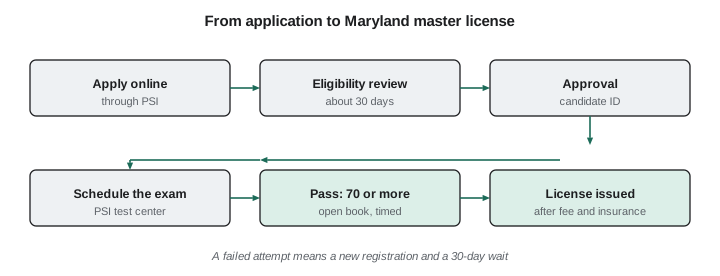
The board uses PSI as its testing vendor, and the master exam application runs through PSI. The board's guidance tells candidates to register with PSI online or by phone, select Maryland and the electrician program, and use the candidate information bulletin for registration forms and the study outline. A notice in the bulletin, effective March 31, 2025, requires applications to be submitted online through PSI. The application collects personal information, the employment experience worksheet described in Lesson 2, education records for any credit claimed, and answers to background questions.
The application is reviewed for eligibility before the candidate may schedule. That order matters. A candidate cannot sit for the master exam simply by paying the exam fee; the board, or staff acting under its policies, must first find that the candidate meets the experience requirement. The state's licensing portal has described a typical approval time of about 30 days, though complicated applications take longer, especially when the board needs to contact past employers or review education credit.
Fees
Candidates pay more than one fee along the way. There is an application fee for the license itself, which the state's licensing portal lists as a small amount, and an examination fee paid to the vendor. The PSI bulletin dated September 2024 sets the examination fee at 65 dollars for the master or journeyperson exam. The bulletin says the exam fee is nonrefundable and not transferable, covers one examination, and is valid for one year. After passing, the candidate pays the license fee to the board. Fees change, so the board's fee page and the current bulletin control.
| Step | Paid to | What it covers (summary) |
|---|---|---|
| Application | The board, through the application process | Review of eligibility |
| Examination | The testing vendor | One sitting, valid for one year |
| Retake | The testing vendor | A new registration and fee for each attempt |
| License | The board | Issuance of the two-year license |
| Renewal | The board | Each two-year renewal, with continuing education |
What the board reviews
Eligibility review focuses on the experience record. Staff check that the dates add up to seven qualifying years, that supervisors are identified and licensed, that the work described is electrical work of the right breadth, and that any education credit is supported by transcripts. They also check the background answers. A complete application moves faster. An application with gaps triggers a request for more information, which stops the clock until the candidate answers.
Renee's application was straightforward because most of her experience was already on file with the board through her apprentice and journeyperson licenses. The approval email gave her a candidate identification and instructions to schedule with PSI. She printed it and put it in the front of her study binder, both as a reminder of the deadline and because the test center would need her to match the name on the approval exactly to her identification.
Scheduling the exam
Approved candidates schedule a seat at a PSI test center through the vendor's website or phone line. PSI offers testing at centers in and near Maryland on a regular calendar. Book early, especially if you need a Saturday seat or a center close to home, and pick a date that leaves time for a full practice exam under timed conditions a week or two before. The bulletin explains rescheduling and cancellation deadlines; missing an appointment without proper notice usually forfeits the fee.
Renee chose a weekday in August at a center about forty minutes from home. She took the day off, drove the route once on a Saturday to time it, and planned to arrive thirty minutes early. Walt laughed at the practice drive until she reminded him he had once missed a county exam because of a closed bridge.
Test day logistics
The test center checks identification against the registration. The bulletin lists the acceptable forms of identification, which generally means a current government-issued photo ID with a signature, and the name must match. Candidates bring their own code book; the center does not supply one. The bulletin limits the reference to the edition it names, sets rules on tabs and highlighting, and bars study guides and loose notes. Phones, watches and bags go in a locker. A basic calculator is usually permitted, within the bulletin's rules on models. Lesson 4 covers the exam format and reference rules in detail.
The exam is computer-based. Candidates receive a short tutorial, then the timed exam, and a score report at the end of the session. A passing report tells the candidate to complete licensing with the board; a failing report shows performance by content area, which is the most useful study guide a candidate will ever get.
Accommodations and special arrangements
Candidates with a documented disability or a condition that affects testing may request accommodations, such as extra time or a separate room. The bulletin explains the request process, which usually requires a form and supporting documentation from a qualified professional, submitted well before the exam date. Requests take time to review, so a candidate who needs one should start the process at application, not the week before the exam. Candidates who need religious accommodation for scheduling should also raise it early.
Keeping the paperwork in order
Marisol kept a folder for Renee's licensing that held every document in the process: a copy of the submitted application, the approval email, the exam registration confirmation, both score reports, the certificate of insurance sent to the board and the license itself. The folder saved time twice. When the board asked for an additional supervisor verification, Marisol had Walt's letter ready to resend. When the Baltimore City permit office later asked for proof of the state license before setting up the company's account, she sent a scan in minutes. A master runs a business that lives on paper, and the licensing file is the first part of it.
Candidates should also keep their own copy of the employment experience worksheet as submitted. If the board later questions a date or a supervisor, the answer must match what was filed. A candidate who changes jobs while an application is pending should report the change, because a new employer may affect insurance and license assignment after the exam.
If you do not pass
Most candidates do not pass the Maryland master exam on a given sitting. The board's May 2026 minutes reported that in April 2026, 20 of 68 master candidates passed, and its long-run figures put the overall pass rate across both exams at a little over a quarter. A failing result is common, not a verdict on a career. Under the bulletin, a candidate who fails may submit a new registration with the fee and schedule again, but must wait 30 days after the most recent exam. Use that month. The score report shows which content areas were weakest; Lesson 12 explains how to turn it into a study plan.
# Plan a retake date and a study window (study aid)
from datetime import date, timedelta
first_exam = date(2026, 6, 4)
earliest_retake = first_exam + timedelta(days=30)
planned_retake = date(2026, 8, 13)
study_days = (planned_retake - first_exam).days
print("earliest allowed retake:", earliest_retake)
print("planned retake:", planned_retake)
print("days to study between attempts:", study_days)
print("weeks:", round(study_days / 7, 1))earliest allowed retake: 2026-07-04 planned retake: 2026-08-13 days to study between attempts: 70 weeks: 10.0
Renee's own path included one of those months. She sat first in early June 2026 and scored 61, nine points short. Her score report showed strength in wiring methods and general equipment and weakness in calculations and theory. She booked the August retake that afternoon, spent ten weeks on load calculations and theory, and passed with 78.
After passing: insurance and the license fee
Passing the exam does not issue the license. Under BOP 6-309, the board notifies a qualified applicant of the fee and the proof of insurance needed before the license issues. A master who will contract for electrical services must show the general liability and property damage coverage required by BOP 6-604: at least 300,000 dollars in general liability and at least 100,000 dollars in property damage coverage, covering the work including completed operations. The insurance may be bought by the master personally or by the master's employer in the electrical business. The insurer must notify the board within 10 days if the policy is canceled.
A master who will not contract may choose an uninsured master status instead, as Lesson 1 described. Renee did not need her own policy: Patapsco Ridge's general liability policy named her as a covered master electrician, and Marisol sent the board a certificate of insurance listing the limits and the company. Lesson 8 returns to insurance and bonding from the company's side.
Assigning a local license
BOP 6-309 also handles an older piece of Maryland's system. An applicant who plans to assign a local license obtained through the state license must name the person, usually the business, to whom it is assigned, and the state license then shows the licensee's name and the name of that business. A license or local registration may be assigned to only one business at a time. For companies like Patapsco Ridge, this is how the permit system knows which master stands behind which company. When Walt retires, the company must make sure Renee's license is the one tied to Patapsco Ridge in each jurisdiction where it pulls permits.
Duties that begin with the license
The license brings obligations immediately. A master must display the license and license number at the principal place of business. Licensees must notify the board within 10 working days of a change in name, address or employment. A master's insurance must stay in force for as long as the master contracts. And the two-year renewal clock starts on the issue date, with continuing education due before the next renewal, as Lesson 11 explains. Renee's license, issued in September 2026, will be due for renewal in September 2028.
Worked problem
Building Renee's timeline
Renee applies online in March 2026, is approved in April, sits first in early June, retakes in August and passes. What are the remaining steps and dates?
Show solution
- Confirm the retake was at least 30 days after the June sitting, as the bulletin requires.
- Submit the license fee and the company's certificate of insurance showing at least 300,000 dollars general liability and 100,000 dollars property damage.
- Name Patapsco Ridge as the business to which the license is assigned where local registration requires it.
- Display the license at the principal place of business once issued in September 2026.
- Calendar renewal for September 2028 and plan the 10 hours of continuing education before then.
Answer: Insurance and fees close out licensing; the renewal and continuing education clock starts at issuance.
Common mistakes
MistakePaying the exam fee before approval and expecting to sit.
InsteadThe board must approve eligibility before scheduling.
MistakeRetaking the exam two weeks after a failure.
InsteadThe bulletin requires a 30-day wait after the most recent exam.
MistakeThinking a passing score issues the license.
InsteadThe license issues after the fee and proof of insurance, or uninsured status.
MistakeAssigning one master's license to two companies.
InsteadA license or local registration may be assigned to only one business at a time.
MistakeMoving without telling the board.
InsteadReport changes in name, address or employment within 10 working days.
Summary and key terms
- Apply online through PSI; the board reviews eligibility before scheduling.
- The September 2024 bulletin sets a 65-dollar exam fee, valid one year for one sitting.
- A failing candidate may retake after 30 days with a new registration.
- After passing, the license issues on payment of the fee and proof of insurance of at least 300,000 and 100,000 dollars, or uninsured status.
- Display the license, report changes within 10 working days and calendar renewal.
- Candidate information bulletin
- The vendor's document that controls exam logistics.
- Eligibility review
- The board's check of experience and background before scheduling.
- Certificate of insurance
- Proof of the general liability and property damage coverage the board requires.
- License assignment
- Naming the business a master's license stands behind.
- Retake wait
- The 30-day minimum between exam attempts.
Practice problems
Work each problem on paper first, then reveal the answer to check.
Who gives the Maryland master exam?
Show answer
PSI, the board's testing vendor.
How long must a candidate wait to retake after failing?
Show answer
30 days.
What insurance limits must a contracting master show?
Show answer
300,000 dollars general liability and 100,000 dollars property damage.
How soon must a licensee report an address change?
Show answer
Within 10 working days.
Lesson quiz · 5 questions
Score 60% or more to complete this lesson.
Create a free account to save your progress, take quizzes and earn a certificate.