
MELU-220 · Lesson 6 of 12 · 19 min
Permits, inspections and the inspection authority
▶ Video coming soon A video version of this lesson is on the way.
The Silver Spring restaurant fit-out was Renee's first job as the master of record after her license issued in September 2026. Walt had pulled every permit for thirty years, and he walked her through the first one in Montgomery County as if he were handing over a set of keys. The application went in online on a Tuesday. Because the property had no open violations, the Department of Permitting Services issued the permit automatically. "That's the easy part," Walt said. "Now you own every inspection on it. The permit has your name on it, not mine."
This lesson explains how electrical permits and inspections work in Maryland: who the inspection authority is for a given address, who may apply for a permit, what work needs one, how inspections are scheduled and passed, how corrections are handled, and how the utility fits in at the end. Because permits and inspections are local, the details change at every county line, so the lesson focuses on patterns and on how to find the local rule quickly.
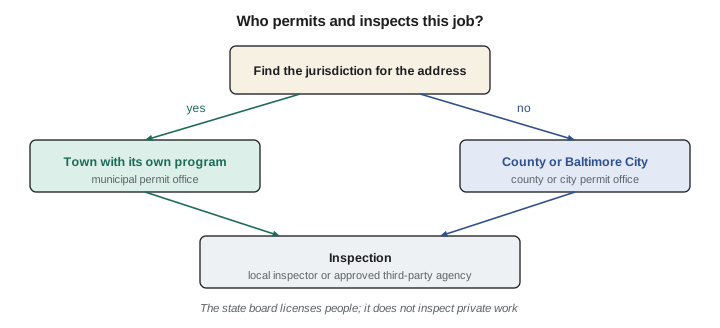
Who is the inspection authority?
For private construction in Maryland, the inspection authority is the local jurisdiction where the work is located: a county, Baltimore City, or a municipality that runs its own permit and inspection program. Montgomery County's Department of Permitting Services, Prince George's County's Department of Permitting, Inspections and Enforcement, and Baltimore City's permit and inspection offices are the best known. Each of the other counties has its own office, and some cities and towns inside those counties run separate programs. The 2020 state law preserved local authority over permits, plan review, inspections and fees, so the state board does not inspect private electrical work.
Finding the right authority starts with the address. A Bowie address is in Prince George's County, but a few municipalities inside counties issue their own permits for some work, and some unincorporated areas are served by county offices in a different town. Patapsco Ridge checks each new address on the county's permit portal before quoting. Some counties also use approved third-party inspection agencies for electrical inspections, in which case the permit comes from the county but the inspector may work for a private agency the county has approved. The permit office tells you which applies.
Who may apply for a permit
Most Maryland jurisdictions require the electrical permit applicant to be a master electrician licensed by the state, often with a local registration or account. Montgomery County states that its electrical permit applicant must hold a valid master license from the State Board of Electricians and that work above 50 volts must be performed by a master electrician with a valid license. Prince George's County requires an account in its online permitting system, and it checks license status when a permit is requested; an expired state license blocks the application. Baltimore City requires electrical permits through its own process and has its own Board of Electrical Examiners and Supervisors under the City Code.
Homeowner permits are a local question. Some jurisdictions allow an owner to obtain a permit for limited electrical work on the owner's own single-family home, subject to conditions such as occupying the home and doing the work personally. Others restrict homeowner work more tightly. A master should never pull a permit for work the master will not supervise, and should never let a client use the master's license number to obtain a permit. Lending a license is grounds for discipline.
What needs a permit
Local codes decide which work needs a permit, and the list is broad. New installations, services, feeders and branch circuits, alterations and extensions, generators, solar systems, electric vehicle charging equipment, swimming pool and spa wiring, and signs generally need permits. Many jurisdictions exempt minor repairs, such as replacing a receptacle or switch with the same type, or replacing a luminaire on an existing outlet. Low-voltage work has its own rules; Montgomery County, for example, issues low-voltage permits for work at 50 volts or less without requiring an electrical license. When in doubt, ask the permit office in writing and keep the answer.
| Work | Typical permit treatment (varies by jurisdiction) |
|---|---|
| New service or service change | Permit required; utility coordination |
| New circuits or wiring in a remodel | Permit required, often with the building permit |
| Generator or solar installation | Permit required; often plan review |
| Electric vehicle charger | Permit required for new circuits or equipment |
| Like-for-like device replacement | Often exempt; check the local code |
| Low-voltage cabling | Separate rules; may need a low-voltage permit |
Plan review
Larger projects need plan review before the permit issues. Commercial work, multifamily buildings, large services, generators and solar systems commonly require electrical drawings, load calculations, panel schedules, one-line diagrams and equipment cut sheets. The reviewer checks the design against the adopted code and amendments and may issue comments that must be resolved. On the restaurant job, the general contractor's engineer prepared the electrical drawings, and the county reviewed them with the building permit; Renee's electrical permit was then tied to the approved plans. Changes during construction usually require a revision submitted for review, not a field decision.
Inspection stages
Most jobs pass through a predictable sequence of inspections. An underground or slab inspection covers buried raceways and grounding before concrete or backfill. A rough-in inspection covers boxes, cables and raceways before walls are closed. A service inspection covers the service equipment, grounding electrode system and bonding before the utility connects. A final inspection covers completed work, devices, labeling and equipment. Larger jobs add inspections for specific systems, and some jurisdictions combine stages for small jobs.
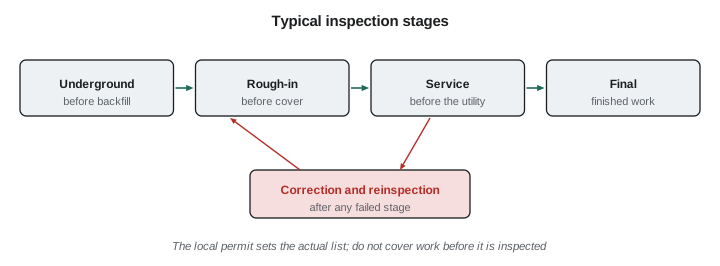
Scheduling is usually online or by phone, through the permit office's system, with the permit number. Work must be ready when the inspector arrives, with the permit card or record available and access arranged. Covering work before it is inspected is one of the costliest mistakes a contractor can make: the inspector may require the covering to be removed, at the contractor's expense, so the work can be seen.
Corrections and failed inspections
A failed inspection results in a correction notice listing the items to fix, often with code references. The contractor corrects the work and schedules a reinspection, which may carry a fee. Disputes about an inspector's reading of the code go first to the inspector's supervisor and then to the local appeals process the adopting ordinance provides. Arguing on site rarely helps. Asking the inspector to explain the basis for a correction, writing it down and checking it later is more productive, and occasionally reveals that the inspector was right about something the crew had been doing wrong for years.
Patterns in corrections matter for a master. Renee reviews every correction notice on Patapsco Ridge jobs at the Monday meeting. If the same item appears twice, it becomes a training topic. In her first month as master, two notices cited missing labeling on panel directories, and a fifteen-minute talk on labeling ended the problem.
The utility connection
A new or changed service is not energized until the utility receives approval from the inspection authority. Maryland's utilities, such as the large investor-owned companies serving central Maryland and the Washington suburbs and the cooperatives in southern and eastern parts of the state, each have their own service requirements for meter locations, service entrance equipment and clearances, published in their service manuals. The master must meet both the code and the utility's requirements. Coordinating early with the utility, especially for a service upgrade or relocation, avoids weeks of delay.
# Track inspections on a permit and flag what is still open (study aid)
inspections = [
    ("underground", "passed", "2026-09-22"),
    ("rough-in", "failed", "2026-10-06"),
    ("rough-in reinspection", "passed", "2026-10-09"),
    ("service", "scheduled", "2026-11-12"),
    ("final", "not scheduled", None),
]
for name, status, when in inspections:
    print(f"{name:24} {status:14} {when or '-'}")
open_items = [n for n, s, _ in inspections if s not in ("passed",)]
print("still open:", ", ".join(open_items))underground passed 2026-09-22 rough-in failed 2026-10-06 rough-in reinspection passed 2026-10-09 service scheduled 2026-11-12 final not scheduled - still open: rough-in, service, final
Permits on projects with a general contractor
On commercial projects, the electrical permit usually sits beside a building permit held by the general contractor. The building permit covers the structure; the electrical permit covers the electrical work and names the master responsible for it. The two are linked: the building's final inspection and the certificate of occupancy depend on the electrical final, and the general contractor's schedule depends on the electrical inspections passing on time. On the restaurant job, Renee attended the weekly coordination meeting so she could tell the general contractor when each electrical inspection was booked, and she asked to see the inspection calendar for the other trades so her crew would not be blocked behind a failed framing or mechanical inspection.
The master's name on the permit means the master answers for the electrical work even when the general contractor directs the schedule. If the general contractor asks the crew to close a ceiling before the electrical rough-in inspection, the answer is no, politely and in writing. If the owner changes the scope, the change goes through the plans and, where needed, a permit revision. Those boundaries protect the master's license and, as Lesson 9 explains, the company's right to be paid.
Inspection timing matters on these jobs too. Many Maryland permit offices schedule inspections for the next business day or within a few days, but busy seasons stretch that, and a general contractor's schedule rarely has slack for it. Renee books inspections as soon as the work is ready, never on a guess that it will be ready, and she tells the general contractor the moment an inspection is confirmed or moved.
Closing out the permit
A permit is not finished until the final inspection passes and the permit is closed in the jurisdiction's system. Open permits cause trouble later: a homeowner selling a house may discover an open permit years afterward, and some jurisdictions block new permits for a contractor with expired open permits. Patapsco Ridge runs a monthly report of open permits for each county and assigns each to a foreman to close.
Expired permits are a related risk. Permits generally expire if work does not start, or stops for a long time, within the period the local code sets. Reactivating an expired permit can require a new application and fee, and in a jurisdiction that has adopted a newer edition in the meantime, the new permit may be governed by the newer code.
Working in Baltimore City
Baltimore City deserves a separate note because its system has deep roots. Its Board of Electrical Examiners and Supervisors, created under Article 13 of the City Code, historically examined and licensed electricians in several classes, including master and restricted categories. Under the 2020 state law, local licensing of masters and journeypersons is limited, but the city still controls electrical permits and inspections and may impose its own registration and permit requirements. A company that is new to city work should set up its permit account and confirm registration requirements before bidding.
Worked problem
Three jurisdictions, one week
In one week Renee needs a service upgrade permit in Bowie, a rough-in inspection in Silver Spring and a permit for a rowhouse rewire in Baltimore City. What does she check for each?
Show solution
- Bowie: confirm the address is served by Prince George's County, log in to the county permitting system and confirm her state license status shows as current.
- Silver Spring: schedule the rough-in through Montgomery County's system with the permit number and confirm the work is open and ready.
- Baltimore City: confirm the company's city permit account and any registration requirement, then apply with the scope and plans the city requires.
- For the service upgrade, contact the utility early about meter and service requirements.
- Record each permit and inspection in the company's open permit log.
Answer: Each job follows its own local system; the master checks access, readiness and utility coordination.
Common mistakes
MistakeAsking the state board to inspect a private job.
InsteadInspections are local; the board licenses people.
MistakeClosing a wall before rough-in inspection.
InsteadUninspected work may have to be uncovered at the contractor's expense.
MistakeLetting a client use your license number for a permit.
InsteadLending a license is grounds for discipline.
MistakeAssuming the utility will connect after the work is done.
InsteadThe utility connects only after inspection approval and its own requirements are met.
MistakeLeaving permits open after the job ends.
InsteadClose every permit with a final inspection.
Summary and key terms
- The inspection authority is the local jurisdiction where the work is located.
- Most jurisdictions require a state-licensed master to apply, often with local registration or an account.
- Local codes set permit triggers; low-voltage work has separate rules.
- Typical inspections are underground, rough-in, service and final, with reinspection after corrections.
- The utility connects only after inspection approval; permits must be closed.
- Inspection authority
- The local office that permits and inspects electrical work.
- Rough-in inspection
- Inspection of wiring before walls or ceilings are closed.
- Correction notice
- The list of items an inspector requires to be fixed.
- Third-party inspection agency
- A private agency approved by a jurisdiction to inspect.
- Permit closeout
- Passing the final inspection and closing the permit record.
Practice problems
Work each problem on paper first, then reveal the answer to check.
Who inspects a private electrical job in Bowie?
Show answer
Prince George's County, the local jurisdiction.
What must Montgomery County's electrical permit applicant hold?
Show answer
A valid state master electrician license.
What happens if work is covered before rough-in inspection?
Show answer
It may have to be uncovered at the contractor's expense.
When does the utility energize a new service?
Show answer
After the inspection authority approves it.
Lesson quiz · 5 questions
Score 60% or more to complete this lesson.
Create a free account to save your progress, take quizzes and earn a certificate.