
MELU-220 · Lesson 10 of 12 · 19 min
Workplace safety law and OSHA for electrical contractors
▶ Video coming soon A video version of this lesson is on the way.
The near miss happened on a Friday afternoon at a light industrial building in Frederick. A Patapsco Ridge journeyperson was adding a breaker to a 480-volt panelboard that the building's maintenance supervisor had said was "off." It was not. The main had been opened, but a second source fed a section of the panel from an emergency generator transfer switch nobody had mentioned. The journeyperson's voltage tester caught it before his hands did. On Monday Renee called the whole company together, put the panel's photo on the screen and said one sentence before anything else: "We test every conductor, every time, no matter who tells us it's off."
This lesson covers the safety law that applies to Maryland electrical contractors. Maryland runs its own occupational safety and health program, Maryland Occupational Safety and Health, known as MOSH, under a state plan approved by federal OSHA. The lesson explains what that means, the standards that matter most for electrical work, the electrically safe work condition, lockout and tagout, NFPA 70E, multi-employer worksites, injury reporting and recordkeeping, and how a master builds a safety program that works on small jobs as well as large ones.
MOSH: Maryland's state plan
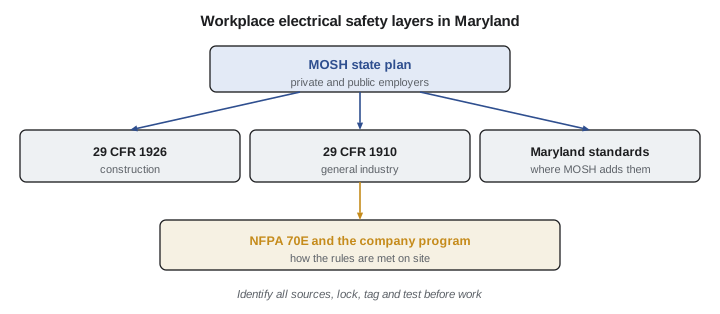
The federal Occupational Safety and Health Act allows states to run their own programs if they are at least as effective as federal OSHA. Maryland does. MOSH, part of the Maryland Department of Labor's Division of Labor and Industry, enforces workplace safety and health standards for private employers in Maryland and also covers state and local government employers. For most purposes, MOSH adopts the federal standards, including the construction standards in 29 CFR 1926 and the general industry standards in 29 CFR 1910, and it can add Maryland-specific standards. MOSH inspectors enforce them, issue citations and penalties, and investigate accidents and complaints.
For a Maryland electrical contractor, that means two practical things. First, the federal standards are still the standards, so national training materials and OSHA publications remain useful. Second, the inspector who arrives after an accident or complaint is from MOSH, the reporting line is MOSH's, and Maryland procedures govern citations and appeals. MOSH also runs a free and confidential consultation service for employers who want help evaluating their workplaces without the risk of citations from the visit.
The standards that matter most
Several groups of standards cover most electrical contracting. The construction electrical standards in Subpart K of 29 CFR 1926 address wiring design and protection, ground-fault protection for temporary wiring on construction sites, safety-related work practices and lockout and tagging of circuits. The general industry standards in Subpart S of 29 CFR 1910 cover electrical safety-related work practices for workers in existing facilities, including qualified and unqualified persons, deenergizing, lockout and tagout, approach distances and protective equipment. The control of hazardous energy standard at 29 CFR 1910.147 covers lockout and tagout of machinery and equipment during service and maintenance. Fall protection, ladders, scaffolds, aerial lifts, excavation and hazard communication standards apply to electrical crews just as they do to other trades.
Which set applies depends on the work. New construction, alteration and repair are construction work under Part 1926. Maintenance in an operating facility, like the panel work in Frederick, can fall under Part 1910. Many electrical jobs include both, and a company program should satisfy both. When in doubt, follow the stricter practice.
| Standard | What it covers (summary) |
|---|---|
| 29 CFR 1926 Subpart K | Electrical work on construction sites, including temporary wiring and lockout |
| 29 CFR 1910 Subpart S | Electrical safety-related work practices in existing facilities |
| 29 CFR 1910.147 | Control of hazardous energy during service and maintenance |
| 29 CFR 1926 Subpart M | Fall protection on construction sites |
| 29 CFR 1904 | Recording and reporting injuries and illnesses |
| NFPA 70E | Consensus practices for electrical safety in the workplace |
The electrically safe work condition
The central rule of electrical safety is to work deenergized. OSHA's work practice standards require that live parts be deenergized before an employee works on or near them, unless deenergizing would create a greater hazard or is infeasible because of equipment design or operational limits. Convenience is not a reason to work energized. NFPA 70E describes how to create an electrically safe work condition: identify all sources of supply from up-to-date drawings and labels, open the disconnecting means for each source, verify that the disconnect has opened, apply lockout devices, test each phase conductor for absence of voltage with a properly rated tester, verifying the tester works before and after, and ground conductors where stored energy or induced voltage could be present.
Every step in that sequence would have caught the Frederick hazard. Identifying all sources from drawings would have revealed the transfer switch. Testing each conductor did catch it. The company's procedure now adds a specific question to every job in an existing building: "What else feeds this equipment?" The maintenance supervisor is asked, the drawings are checked and the equipment labels are read before anyone opens a cover.
Lockout and tagout
Lockout places a lock on an energy-isolating device so the equipment cannot be energized until the lock is removed. Tagout places a warning tag on the device. OSHA requires a written energy control program, procedures for each type of equipment, training for authorized and affected employees, and periodic inspection of the procedures. Each worker places a personal lock and removes only that lock. When several trades work on the same equipment, group lockout procedures let each worker keep personal control. On a construction site, the general contractor and each employer must coordinate so that one trade does not re-energize equipment another trade is working on.
NFPA 70E and arc flash
NFPA 70E is a consensus standard rather than a regulation, but OSHA and MOSH use it as evidence of recognized hazards and feasible protections, and contracts and facility owners often require it. It describes how to assess shock and arc flash risk, how to set approach boundaries, how to select protective equipment, and how to label equipment with arc flash information. It also requires that justified energized work be done under an energized electrical work permit with documented controls. A Maryland electrical contractor should have a written program based on the current edition of NFPA 70E, train its workers on it and update it when the standard changes.
Multi-employer worksites
Construction sites usually have several employers. Under OSHA's multi-employer citation policy, which MOSH applies in substance, an employer can be cited not only for exposing its own workers but also for creating a hazard, for controlling a site where a hazard exists, or for correcting hazards. A general contractor that controls the site has a duty to make reasonable efforts to detect and correct hazards. An electrical contractor that leaves an open, energized panel on a shared site exposes other trades and can be cited for it. Temporary power is a common example: the electrical contractor that installs temporary wiring usually owns its condition, including ground-fault protection and damaged cords.
Reporting and recordkeeping
MOSH requires employers to report a work-related fatality within 8 hours. A work-related in-patient hospitalization, an amputation or the loss of an eye must be reported within 24 hours. Reports go to MOSH by phone, using the numbers it publishes for business hours and after hours. Most employers with more than 10 employees must keep records of work-related injuries and illnesses on the OSHA 300 log and related forms, post the annual summary from February 1 through April 30, and keep the records for five years; employers with 10 or fewer employees are partially exempt from routine recordkeeping but must still report serious events. Employers must also display the MOSH poster where employees can see it.
Workers' compensation reporting runs on a separate track. As Lesson 8 explained, a Maryland employer must report qualifying injuries to the Workers' Compensation Commission within the time the law sets. A single serious injury can therefore trigger a MOSH report, an entry on the OSHA 300 log, a report to the Commission and a notice to the company's insurer. Patapsco Ridge's injury checklist lists all four, so nothing is missed in a stressful moment.
# Injury reporting deadlines (study aid; confirm current MOSH and Commission rules)
from datetime import datetime, timedelta
event = datetime(2026, 10, 2, 14, 30)
deadlines = {
    "fatality to MOSH": timedelta(hours=8),
    "in-patient hospitalization, amputation or eye loss to MOSH": timedelta(hours=24),
    "first report to Workers' Compensation Commission (qualifying injury)": timedelta(days=10),
}
for what, delta in deadlines.items():
print(f"{what}: by {(event + delta).isoformat(' ', 'minutes')}")fatality to MOSH: by 2026-10-02 22:30 in-patient hospitalization, amputation or eye loss to MOSH: by 2026-10-03 14:30 first report to Workers' Compensation Commission (qualifying injury): by 2026-10-12 14:30
Building a safety program that works
A safety program is a set of habits more than a binder. Patapsco Ridge's program includes a written electrical safety and lockout program, job hazard reviews before work starts, weekly toolbox talks, annual qualified-person training with documented skills checks, a tester verification routine, arc-rated clothing for every electrician who might open energized equipment, and a rule that any worker can stop a job for a safety concern without penalty. Renee reviews near misses as carefully as injuries, because near misses are free lessons. The Frederick panel became a toolbox talk the next week and a permanent line on the job checklist.
Training matters for apprentices especially. New workers do not know what they do not know, and they often hesitate to question a journeyperson or a customer. Patapsco Ridge's first-day orientation teaches every new apprentice three rules: never trust that equipment is off without testing it, never work alone on energized equipment, and always ask. MOSH's consultation service and outreach training can support that work for smaller companies that lack a full-time safety staff.
Small jobs need the same discipline as large ones. Many electrical injuries happen on service calls and residential work, where a single electrician works alone and no safety manager is present. Patapsco Ridge requires the same test-before-touch routine on a homeowner's panel as on a commercial switchboard, and it gives every service electrician a tester, a lock kit and arc-rated clothing in the van, so the safe choice is always the easy one.
Inspections, citations and appeals
MOSH may inspect a workplace after a complaint, a referral, a reported accident or as part of a targeted program. Inspectors present credentials, hold an opening conference, walk the site, interview workers and review records, and hold a closing conference. Citations describe the violation, the standard, the abatement date and the proposed penalty. Employers may contest citations within the period and through the procedure Maryland law provides. Abating the hazard promptly, documenting the correction and cooperating professionally usually produce better outcomes than arguing on site.
Repeat violations cost more than first ones, and a pattern of violations follows a company into its insurance renewals and into bid prequalification forms that ask about safety history. Many owners and general contractors also ask for a company's injury rates before awarding work. A strong safety record is therefore part of the business case for a safety program, not just a legal duty.
Worked problem
The Frederick near miss
A journeyperson was told a 480-volt panel was off. The main was open, but a section was fed from a generator transfer switch. His tester found voltage. No one was hurt. What should Renee do?
Show solution
- Stop the work and create an electrically safe work condition by identifying and isolating all sources, including the transfer switch.
- Lock and tag every source, then test each conductor for absence of voltage with a verified tester.
- Review the near miss with the crew and the building's maintenance supervisor, and ask for updated drawings and labels.
- Add a step to the company checklist requiring identification of all sources for work in existing buildings.
- Record the near miss in the company's safety log; no MOSH report is required because no one was injured or hospitalized.
Answer: Treat the near miss as a lesson: isolate all sources, test every conductor and update the procedure.
Common mistakes
MistakeAssuming federal OSHA inspects Maryland private employers.
InsteadMOSH, Maryland's state plan, enforces safety for private and public employers in Maryland.
MistakeTrusting a customer's word that equipment is off.
InsteadIdentify all sources, lock, tag and test for absence of voltage.
MistakeWorking energized because shutdown is inconvenient.
InsteadConvenience is not a justification; deenergize unless infeasible or more hazardous.
MistakeMissing the 8-hour fatality report.
InsteadReport fatalities to MOSH within 8 hours, and serious injuries within 24 hours.
MistakeLeaving temporary wiring unchecked on a shared site.
InsteadThe installing employer can be cited for hazards it created.
Summary and key terms
- MOSH enforces workplace safety in Maryland under a state plan, for private and public employers.
- Key standards include 29 CFR 1926 Subpart K, 29 CFR 1910 Subpart S and 1910.147, supported by NFPA 70E.
- Work deenergized in an electrically safe work condition unless energized work is justified.
- Multi-employer sites create duties for creating, exposing, controlling and correcting employers.
- Report fatalities within 8 hours and hospitalizations, amputations or eye loss within 24 hours.
- MOSH
- Maryland Occupational Safety and Health, the state plan program.
- Electrically safe work condition
- Equipment isolated, locked, tested and grounded as needed.
- Lockout and tagout
- Locks and tags that prevent re-energizing during work.
- NFPA 70E
- The consensus standard for workplace electrical safety.
- Multi-employer worksite
- A site where several employers share responsibility for hazards.
Practice problems
Work each problem on paper first, then reveal the answer to check.
Who enforces workplace safety for a private Maryland contractor?
Show answer
MOSH.
Within how many hours must a fatality be reported?
Show answer
8 hours.
Within how many hours must an amputation be reported?
Show answer
24 hours.
Name the first step in creating an electrically safe work condition.
Show answer
Identify all sources of supply.
Lesson quiz · 5 questions
Score 60% or more to complete this lesson.
Create a free account to save your progress, take quizzes and earn a certificate.