
MELU-220 · Lesson 1 of 12 · 20 min
How electrical licensing works in Maryland
▶ Video coming soon A video version of this lesson is on the way.
Walt Kessler started Patapsco Ridge Electric in a two-bay garage in Ellicott City in 1994. Thirty-two years later the company has eighteen electricians and apprentices, three vans that spend most of their days in Howard and Anne Arundel counties, and a growing list of jobs in Montgomery County, Prince George's County and Baltimore City. Walt is planning to retire, and the company's future depends on Renee Okafor, his lead foreman. Renee began as an apprentice in 2016, earned her journeyperson license in 2021 and has run crews since 2023. When Walt first told her she should sit for the master exam, she asked the question every candidate asks: who actually decides whether I can do this work in Maryland, the state or the county?
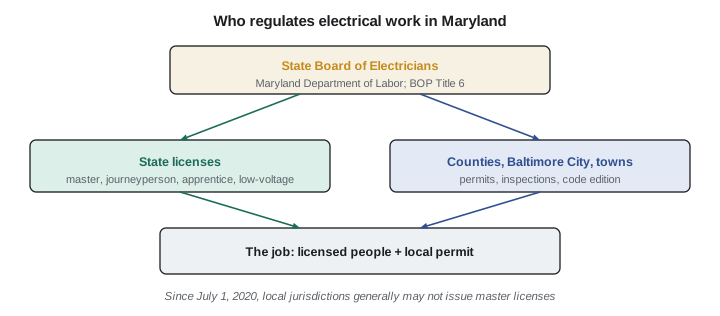
The honest answer is both, and the way they share the work has changed in the last few years. This lesson maps the system: the State Board of Electricians and the law it administers, the license classes the state issues, what changed in 2020 when the legislature moved most electrician licensing to the state, and what counties and Baltimore City still control. Later lessons go deeper into each piece. Here the goal is a clear picture of who does what, so that every later rule has a place to sit.
The State Board of Electricians
Electrician licensing in Maryland is governed by Title 6 of the Business Occupations and Professions Article of the Maryland Code, often cited as BOP Title 6. The law creates the State Board of Electricians, which sits within the Maryland Department of Labor and is supported by its occupational and professional licensing staff. For many years the board was called the State Board of Master Electricians, because master electricians were the only class it licensed. Chapter 591 of the Acts of 2020 renamed it the State Board of Electricians, changed its membership and gave it authority over journeyperson, low-voltage and apprentice licensing as well. You will still see the older name on some forms, older study guides and websites, so treat the two names as the same board at different points in its history.
The board's work falls into a few broad areas. It sets qualifications and approves applicants for examination. It contracts with a testing vendor, currently PSI, to give the license exams. It issues and renews state licenses, keeps records of insurance for master electricians, approves continuing education providers and courses, hears complaints and disciplines licensees, and adopts regulations in the Code of Maryland Regulations under Title 09, Subtitle 09. The board meets monthly, and its published minutes are a useful window into how it reads the law, what proposals it is considering and how many candidates are passing the exams.
Board membership reflects the trade and the public. Under the 2020 law, the board has nine members: six master electricians drawn from regions of the state, one electrical inspector, one low-voltage electrician and one consumer member. Montgomery County has its own master electrician seat. The mix matters to candidates in a practical way: the people who decide hard questions about experience credit and discipline include working electricians and an inspector who see the same jobsites you do.
The license classes
The state now issues several classes of electrician license. A master electrician license allows the holder to provide electrical services and to take responsibility for a business's electrical work, including obtaining permits where the local jurisdiction allows it and supervising journeypersons and apprentices. A journeyperson electrician license allows the holder to provide electrical services under the direction of a master electrician. An apprentice license covers people learning the trade under supervision; the board began accepting apprentice and journeyperson applications on July 1, 2021. A low-voltage electrician license covers work on systems below the voltage thresholds the statute sets, generally 50 volts nominal, with special treatment for audio equipment and fire alarm systems in single-family dwellings.
The master license has one more feature that matters for business owners. A master electrician who actively contracts must carry the general liability and property damage insurance required by BOP 6-604. A master who does not carry insurance may hold an uninsured master electrician license instead. Under Chapter 187 of the Acts of 2023, that license has two statuses. In the authorized-to-work status, the holder keeps up continuing education and may work, but only at the journeyperson level, without pulling permits or supervising others. In the unauthorized-to-work status, the holder sets the license aside while out of the field and does not need continuing education or insurance until returning to active work.
| License class | What it allows (summary) | Typical path |
|---|---|---|
| Apprentice | Work under supervision while learning | Register with the board and an employer |
| Journeyperson | Provide electrical services under a master | About 4 years of supervised experience plus the exam |
| Master | Take responsibility for electrical work and supervise others | 7 years of experience plus the exam, with insurance |
| Uninsured master | Hold the master license without insurance; limited work | Master license plus the chosen status |
| Low-voltage | Work on systems below the statutory thresholds | 3 years of low-voltage experience plus the exam |
What changed in 2020
Before 2020, Maryland's system was unusually local. Counties, Baltimore City and some municipalities had their own electrical boards that tested and licensed master electricians. A master licensed by a county could obtain a state license by showing the county license, and the state license then made it possible to work in other jurisdictions that accepted it. A contractor working across several counties often carried a stack of local licenses and registrations, each with its own renewal date and fee.
Chapter 591 of 2020 moved the center of gravity to the state. Starting July 1, 2020, local jurisdictions generally may not issue master or journeyperson licenses. A jurisdiction that already issued those licenses before that date may continue only if it meets the reporting and examination requirements in the law, and a jurisdiction that did not previously license those classes must seek authorization from the state board. Local jurisdictions must report licensing and exam data to the state each year. The same law created the state journeyperson and low-voltage licenses and directed the Department of Labor to set apprentice license requirements by regulation.
The change did not end local involvement. Local boards and permit offices kept their authority over permits, plan review, inspections and fees, and they may take disciplinary action other than revoking a state license, reporting their enforcement activity to the state board. Many jurisdictions still require a state-licensed master to register locally before pulling permits there. The board's own guidance says that local jurisdictions may require a registration to provide electrical services, and it tells licensees to check with each county or city where they plan to work.
What local jurisdictions still control
Every electrical job in Maryland is permitted and inspected by someone, and that someone is almost always local. Montgomery County's Department of Permitting Services, Prince George's County's Department of Permitting, Inspections and Enforcement, Baltimore City's permit and inspection offices and the permit offices of the other counties and many municipalities decide what needs a permit, who may apply, which code edition applies and when inspections happen. Montgomery County, for example, states that work above 50 volts must be performed by a master electrician with a valid license, and that its electrical permit applicant must hold a valid master license from the state board. Prince George's County requires its own online permit account and has historically offered limited license categories through its licensing center. Baltimore City has its own Board of Electrical Examiners and Supervisors under Article 13 of the City Code.
Local jurisdictions also adopt the electrical code. Maryland does not adopt the NEC statewide for private construction, so each county or city chooses its edition and any local amendments on its own schedule. Lesson 5 covers this in depth. For now, notice the pattern: the state decides who may do electrical work, and local jurisdictions decide how the work is permitted, which code edition governs it and whether it passes inspection.
Reciprocity and working near the borders
Patapsco Ridge does an occasional job in the District of Columbia and northern Virginia, and Maryland's reciprocity rules matter to companies like it. The board reports reciprocal agreements with Delaware, Virginia, West Virginia and the District of Columbia, each with its own conditions, such as years of licensure or the exam the applicant passed. BOP 6-308 also lets the board waive the exam for a master or journeyperson licensed by examination in another state, if the applicant meets Maryland's experience standard and the other state offers similar treatment to Maryland licensees. Reciprocity is a separate application with its own review, not an automatic right, and a local license that was converted to a state license by reciprocity generally cannot be used to obtain a license in another state.
Complaints, discipline and penalties
The board's licensing power comes with enforcement power. Anyone can file a complaint with the board: a homeowner who believes work was done badly, an inspector who finds unlicensed work or a competitor who sees a company advertising electrical services without a master. The board investigates, and it may reprimand, suspend or revoke a license, or impose a civil penalty. The 2020 law expanded the grounds for discipline to include working outside the scope of the license held and failing to complete a contract without justification, and it set misdemeanor fines for unlicensed practice that rise for repeat violations, along with civil penalties for each violation.
When the board evaluates a complaint about the quality of work, it measures the installation against minimum electrical standards consistent with the most recent edition of the NEC, which the law directs it to enforce within 18 months of each edition's publication. That standard is separate from the local permit code, and the two can differ for a time when a county is still enforcing an older edition. Lesson 5 explains how that gap works in practice. For a master, the practical lesson is that a job can draw attention from two directions at once: the local inspector who must approve it and the state board that licenses the people responsible for it.
Reading the primary sources
Study guides summarize, and summaries go stale. Renee learned to check three primary sources before trusting any rule. The first is the statute itself, BOP Title 6, which the General Assembly's website publishes section by section. The second is the board's regulations in COMAR Title 09, Subtitle 09, and the board's web pages for licensing, renewal, insurance and continuing education. The third is the testing vendor's current candidate information bulletin, which controls the exam details. For permits and code editions, the fourth source is each local jurisdiction's own permit office. When two sources seem to disagree, the newer primary source usually wins, and a phone call to the board or the permit office settles the rest.
Where the exam fits
The master exam is the gate between years of experience and the license. Candidates apply to the board through the testing vendor, the board reviews experience, and approved candidates schedule a timed, open-book exam built on the National Electrical Code. A passing candidate then submits proof of insurance and the license fee, or chooses uninsured status, and the board issues the license. Lessons 2 through 4 walk through eligibility, the application and the exam. The board's exam statistics show why preparation matters: its minutes report that only a minority of candidates pass on any given month's sitting, and its long-run figures put the overall pass rate well below half.
Worked problem
Mapping Renee's next three jobs
Renee's crew has three jobs next month: a restaurant fit-out in Silver Spring, a townhouse service upgrade in Bowie and a rowhouse rewire in Baltimore City. Walt holds the company's state master license today. Who licenses the people on each job, and who permits and inspects the work?
Show solution
- The State Board of Electricians licenses Walt as master and Renee and the crew as journeypersons and apprentices on all three jobs.
- Silver Spring is in Montgomery County, so the permit and inspections run through the Department of Permitting Services, and the permit applicant must hold a valid state master license.
- Bowie is in Prince George's County, so the permit goes through the county's permitting department and its online system.
- The rowhouse is in Baltimore City, so the city's permit office and electrical inspectors handle the permit and inspections, and the company checks any city registration requirement first.
- For each job, the crew confirms which NEC edition the jurisdiction enforces before planning the work.
Answer: One state licenses everyone; three different local offices permit and inspect the three jobs.
Common mistakes
MistakeThinking the county still licenses master electricians.
InsteadSince July 1, 2020, local jurisdictions generally may not issue master or journeyperson licenses, though some may continue with state approval.
MistakeAssuming a state license alone is enough to pull a permit anywhere.
InsteadMany jurisdictions require local registration or account setup first.
MistakeTreating the State Board of Master Electricians and the State Board of Electricians as different agencies.
InsteadThey are the same board; the name changed in 2020.
MistakeAssuming Maryland has one statewide NEC edition.
InsteadLocal jurisdictions adopt the code edition and amendments.
MistakeContracting with an uninsured master license.
InsteadAn uninsured master may not contract or pull permits; insurance is required to contract.
Summary and key terms
- BOP Title 6 governs electrician licensing, administered by the State Board of Electricians in the Maryland Department of Labor.
- The state issues master, journeyperson, apprentice and low-voltage licenses, plus an uninsured master status.
- Since July 1, 2020, local jurisdictions generally may not issue master or journeyperson licenses.
- Local jurisdictions control permits, plan review, inspections, fees and the code edition, and may require registration.
- Reciprocity exists with several neighboring jurisdictions, each with conditions.
- State Board of Electricians
- The Maryland board that licenses electricians under BOP Title 6.
- BOP Title 6
- The Maryland statute governing electricians.
- Local registration
- A county or city requirement to record a state license before working there.
- Uninsured master electrician
- A master license status without the required insurance, with limits on work.
- Reciprocity
- Recognition of another jurisdiction's license, subject to conditions.
Practice problems
Work each problem on paper first, then reveal the answer to check.
Which board licenses master electricians in Maryland?
Show answer
The State Board of Electricians.
Since what date have local jurisdictions generally been barred from issuing master licenses?
Show answer
July 1, 2020.
Who decides which NEC edition applies to a job in Bowie?
Show answer
Prince George's County, the local jurisdiction.
What can a master with an authorized-to-work uninsured status not do?
Show answer
Pull permits, supervise others or work above the journeyperson level.
Lesson quiz · 5 questions
Score 60% or more to complete this lesson.
Create a free account to save your progress, take quizzes and earn a certificate.