
MELU-220 · Lesson 12 of 12 · 19 min
Practice exam review and test-day strategy
▶ Video coming soon A video version of this lesson is on the way.
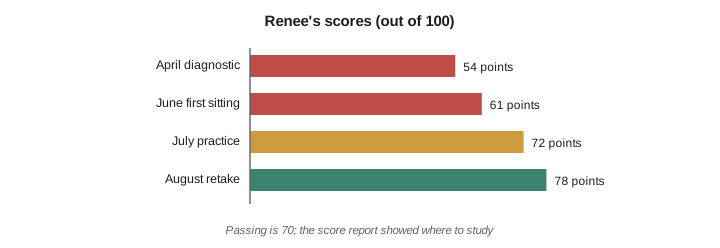
Renee's first full practice exam, in April 2026, came back at 54 out of 100. She had expected worse in some places and better in others. Wiring methods and equipment were strong, close to the scores she would need. Calculations were at 13 of 30 and theory at 11 of 20. Walt looked at the breakdown and shrugged. "You've wired buildings for ten years," he said. "The exam knows that. What it doesn't know yet is whether you can do the math under a clock." Her first real sitting in June came back at 61, with the same pattern. Her August retake came back at 78. This lesson is about what happened in between.
This final lesson turns everything else in the course into a plan. It covers how to use practice exams as diagnostics, how to analyze results by content area and by cause of error, how to build a study plan weighted to the master exam's outline, how to practice calculations and lookups until they are fast, and how to run test day from the night before to the last flagged question.
Start with a diagnostic
The first practice exam should be a diagnostic taken under real conditions: the same NEC edition the bulletin names, a permitted calculator, no notes and a strict 240-minute clock for a full-length set. The score matters less than the breakdown. Sort every question into the bulletin's eight content areas and compute a score for each. Compare each area's score with its weight. A weak area with a large weight, like calculations at 30 points, deserves far more study time than a weak area with a small weight, like special communications at 2.
Renee's diagnostic showed clear priorities. Calculations and theory together carried 50 points and she had earned 24 of them. The remaining six areas carried 50 points and she had earned 30. Raising calculations and theory to about three quarters of their points would add about 14 points, enough to pass with a margin, while perfect scores in the other areas could add no more than 20.
Analyze errors by cause
Content areas show where points are lost; causes show why. After each practice exam, label every wrong answer with one cause. A knowledge gap means you did not know the rule or concept. A lookup failure means you knew where to look but did not find it in time, or found the wrong section. A method error means you set up a calculation wrong. An arithmetic or entry error means the method was right and the number was wrong. A reading error means you answered a different question from the one asked. A time error means you ran out of time or guessed to save it.
Each cause has a different cure. Knowledge gaps need study. Lookup failures need tab placement and timed lookup drills. Method errors need worked examples until the steps are automatic. Arithmetic errors need a checking habit. Reading errors need the underlining routine from Lesson 4. Time errors need pacing practice. Renee's April errors were mostly method and time errors in calculations, which told her to work more problems faster, not to reread the code.
| Cause of error | What it looks like | Cure |
|---|---|---|
| Knowledge gap | Did not know the rule or concept | Study the topic and its code article |
| Lookup failure | Could not find the rule in time | Tabs, index practice and timed drills |
| Method error | Set up the calculation wrong | Work examples until the steps are automatic |
| Arithmetic or entry | Right method, wrong number | Check each result and each entry |
| Reading error | Answered a different question | Underline key words before answering |
| Time error | Ran out of time or guessed | Pacing practice and a two-pass routine |
Build a weighted study plan
A good plan spends time where points are available. For a candidate who is weak in calculations and theory, that might mean half of all study hours on those two areas for the first several weeks, with the rest spread across the other areas in proportion to their weight and the candidate's scores. The plan should include at least three more full-length timed exams before test day, spaced out so each one measures progress. Between them, short timed sets of ten to twenty questions on single areas build speed.
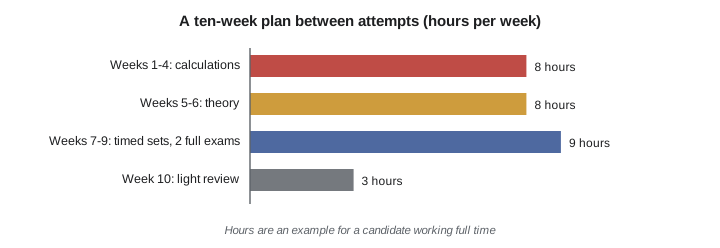
Renee had ten weeks between her June sitting and her August retake. She studied about eight hours a week, more in the weeks before full-length exams. Weeks one through four went mostly to calculations: dwelling and commercial load calculations, conductor sizing with adjustments, voltage drop, motor circuits and transformer problems. Weeks five and six added theory review from her apprenticeship textbooks. Weeks seven through nine mixed timed sets from every area and two full-length exams. Week ten was light review and rest.
Calculation practice
Calculations reward routine. For each problem type, write a short method card: the inputs, the steps and the code articles each step uses. Then work problems from the card until you no longer need it. Time each problem and record the time. The goal is accuracy first, then speed, then both under pressure. Many calculation questions also rest on basic electrical relationships that should be instant: Ohm's law, power in single-phase and three-phase circuits, and the voltage drop formula with a conductor constant.
# Basic relationships behind many exam calculations (study aid; inputs illustrative)
import math
V, I, pf = 208, 40, 0.9
print("single-phase power, W:", round(V * I * pf))
print("three-phase power, W:", round(math.sqrt(3) * V * I * pf))
# Voltage drop, single-phase: VD = 2 * K * I * L / CM  (K about 12.9 for copper, ohm-cmil per foot)
K, L, CM = 12.9, 150, 26240
vd = 2 * K * I * L / CM
print("single-phase voltage drop, V:", round(vd, 2), "on a 240 V circuit is", round(vd / 240 * 100, 1), "parts per 100")
# Three-phase drop uses sqrt(3) in place of 2
print("three-phase voltage drop, V:", round(math.sqrt(3) * K * I * L / CM, 2))single-phase power, W: 7488 three-phase power, W: 12970 single-phase voltage drop, V: 5.9 on a 240 V circuit is 2.5 parts per 100 three-phase voltage drop, V: 5.11
Code-based calculations, such as dwelling service loads or motor feeder sizing, follow the methods in the relevant articles. Learn the sequence of steps in each method and where each factor comes from in the book. When you miss one, rework it from the start rather than reading the answer key's solution; the act of redoing it is what builds the routine.
Lookup drills
Lookups improve with deliberate practice. Take a list of thirty short code questions, set a timer for one minute each and find the answer in your exam book. Record which ones took longer than a minute and why. If the index failed you, note the term you should have used. If a tab was missing, add one. Repeat with new questions weekly. By test day, the common lookups, such as definitions, branch circuit and feeder rules, overcurrent protection, grounding and bonding, conductor ampacity and motors, should be reflexes.
Studying with a full-time job
Most master candidates study while running crews, and Renee was no exception. She found that short daily sessions beat long weekend ones: forty-five minutes before work on calculation problems, when she was freshest, and a timed set of twenty questions two evenings a week. Saturdays were for full-length exams every second or third week. She told Walt and her family the schedule in advance, which made it easier to protect. On weeks when a job ran late, she cut the session short rather than skipping it, because the routine mattered more than the minutes.
Study partners help when they are used well. Renee met every other Thursday with two other candidates from the county electrical association. Each brought five problems the others had not seen, and they worked them under a timer and then explained their methods aloud. Explaining a method exposes gaps that silent study hides. The group also kept one another honest about the schedule, which is the hardest part of preparing alone.
Choosing practice material
Practice questions vary widely in quality. Good material matches the bulletin's outline and the bulletin's NEC edition, explains why each answer is right with a code reference, and includes full-length timed sets. Weak material tests trivia, uses an outdated edition or gives answers without explanations. Before buying a practice set, check its edition and look at a sample. When a practice answer disagrees with your reading of the code, trust the code in the exam edition, and note the question so you can ask an instructor.
The final week
The final week is for confidence, not cramming. Take the last full-length exam no later than five or six days before the real one, review it and then switch to short, light sessions on your strongest material. Check the bulletin one more time for identification, arrival time and reference rules. Inspect your code book for any loose notes or pages that would fail the check-in rules. Confirm your calculator meets the bulletin's requirements and has a fresh battery. Plan the route and the arrival time.
Test day
Arrive early, fed and rested. At check-in, present identification that matches the registration exactly and your permitted code book. Use the tutorial time to settle in. When the clock starts, run the two-pass routine: in the first pass, answer quick knowledge questions immediately, answer single-lookup questions with one disciplined lookup, and flag long calculations or uncertain lookups to return to. Keep an eye on time at set checkpoints, such as question 30 by about 75 minutes and question 60 by about 155 minutes. In the second pass, work the flagged questions in order of how quickly you expect to solve them. In the last minutes, make sure every question has an answer, because blank answers score nothing.
Stay steady when a question looks unfamiliar. Every candidate meets a few. Read it again, find the key term, try the index once and, if it does not yield quickly, choose the best answer, flag it and move on. One hard question is worth the same as one easy question, and the exam is passed by collecting the easy and medium ones reliably.
After the exam
A pass starts the licensing steps in Lesson 3: the fee, proof of insurance or an uninsured status, and the license. A fail starts the 30-day wait and a new plan built from the score report, which shows exactly which areas to target. Many successful Maryland masters passed on a second or third attempt. Renee framed both of her score reports and hung them beside her license in the Patapsco Ridge office, the failing one first.
Using what you learned
The exam measures a minimum, and the license begins a career of responsibility for other people's safety and money. The habits that pass the exam, reading carefully, checking each answer, knowing where the rules live and working calculations methodically, are the same habits that pass inspections, win bids and keep crews safe. Renee now runs Patapsco Ridge's apprentice study group on Thursday nights, using the same diagnostic and error-cause method on the journeyperson exam.
Worked problem
Building a plan from a diagnostic
A candidate's diagnostic shows these area scores: calculations 12 of 30, theory 12 of 20, wiring and protection 10 of 14, wiring methods 10 of 13, equipment 7 of 9, special occupancies 5 of 8, special equipment 2 of 4, special communications 1 of 2. The total is 59. Where should study time go?
Show solution
- Compute points available in each area: calculations 18, theory 8, special occupancies 3, wiring and protection 4, wiring methods 3, and smaller amounts elsewhere.
- Note that calculations alone hold 18 missing points, more than all other areas but theory combined.
- Plan about half the study hours for calculations and a quarter for theory.
- Use the remaining time on short timed sets across the other areas.
- Retest with a full-length exam after three to four weeks and adjust.
Answer: Weight the plan toward calculations and theory, where most of the missing points are.
Common mistakes
MistakeTaking practice exams without reviewing them.
InsteadReview every wrong answer and label its cause.
MistakeStudying all areas equally.
InsteadWeight study by the outline's points and your missing points.
MistakeRereading the code when the errors are method errors.
InsteadWork calculation problems until the method is automatic.
MistakeCramming the night before.
InsteadUse the final week for light review and rest.
MistakeLeaving questions blank.
InsteadAnswer every question; blanks score nothing.
Summary and key terms
- Start with a timed diagnostic and score each content area.
- Label each wrong answer by cause, and use the cure that matches.
- Weight study toward high-value weak areas, especially calculations and theory.
- Drill calculations and lookups until they are routine, and take several full-length timed exams.
- On test day, use a two-pass routine with time checkpoints and answer every question.
- Diagnostic exam
- A first timed practice exam used to find weak areas.
- Cause of error
- The reason a question was missed, used to choose a fix.
- Weighted plan
- A study plan that spends time where points are available.
- Method card
- A short written sequence of steps for a calculation type.
- Time checkpoint
- A planned point to check progress against the clock.
Practice problems
Work each problem on paper first, then reveal the answer to check.
What should a diagnostic exam's breakdown be compared with?
Show answer
The outline's point weights.
Which content area carries the most points on the master exam?
Show answer
Calculations.
What should you do with a hard question in the first pass?
Show answer
Choose the best answer, flag it and move on.
How long must you wait to retake after failing?
Show answer
30 days.
Lesson quiz · 5 questions
Score 60% or more to complete this lesson.
Create a free account to save your progress, take quizzes and earn a certificate.