
MELU-220 · Lesson 8 of 12 · 19 min
Contractor licensing, insurance and bonding
▶ Video coming soon A video version of this lesson is on the way.
When Patapsco Ridge bid its first public job, a school gymnasium lighting retrofit for a county school system, Marisol spent more time on the bid package than Renee spent on the estimate. The package asked for proof of the master license, the company's registration with the State Department of Assessments and Taxation, a certificate of insurance with the school system named as additional insured, a workers' compensation certificate, a bid bond and, if the company won, performance and payment bonds. "Being a good electrician gets you the license," Marisol said. "Being a good business gets you the job."
This lesson covers the business side of electrical contracting in Maryland: how electrical licensing relates to contractor licensing, when a home improvement license is needed, business registration and local trader's licenses, the insurance the board requires, workers' compensation, and the bonds that contracts and public owners require. Some of these are state law, some are local and some come from contracts, and a master needs to know which is which.
No separate state electrical contractor license
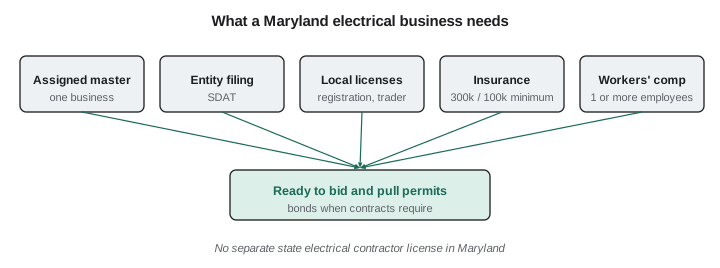
Maryland does not issue a separate state electrical contractor license. A business offers electrical services through a master electrician whose license is assigned to it, as Lessons 3 and 7 explained. The master's license, the insurance the board requires and the local registrations that tie the license to the business together play the role that a contractor license plays in some other states. That makes the master the legal anchor of the company: without an assigned master, a company generally cannot offer electrical services or obtain electrical permits.
Maryland also has no general statewide contractor license for commercial building work. Some local jurisdictions license or register contractors for certain trades or require a business license, and public owners prequalify bidders for their own projects. Commercial general contractors are therefore not licensed by the state in the way electricians are, but the electrical work on their projects must still be done under a licensed master.
Home improvement work and the MHIC
Residential remodeling in Maryland is regulated by the Maryland Home Improvement Commission, which licenses home improvement contractors and salespeople under the Business Regulation Article. A contractor who performs or sells home improvement work on existing residential property generally needs a home improvement license. The law exempts several groups, including electricians, plumbers and heating and air-conditioning contractors who are required by state or local law to meet competency or experience standards, hold a current state or local license in that occupation, and act only within the scope of that occupation.
The exemption covers most of what Patapsco Ridge does in houses: service upgrades, rewiring, lighting, circuits and electric vehicle chargers. It does not cover work outside electrical scope. When a homeowner asked Patapsco Ridge to manage a whole basement finish, including framing, drywall and flooring, Renee had two choices: subcontract the electrical work to the homeowner's general contractor, or have the company obtain a home improvement license and comply with that law's contract and guaranty fund rules. The Commission also notes that a licensed master electrician must make the electrical connection on solar installations, even when the installer holds a home improvement license for the rest of the work.
Business registration and local licenses
A corporation or limited liability company must be formed with, and file annual reports with, the State Department of Assessments and Taxation. Many Maryland businesses also need a trader's or business license issued through the clerk of the circuit court in the county where they operate, depending on what they sell; Montgomery County's guidance, for example, directs electrical businesses to the circuit court for business license applications and renewals. Counties may also require the local registration of the master's license discussed earlier, and some municipalities have their own business licenses. A company that works across many jurisdictions should list every one of these on its compliance sheet.
| Requirement | Who requires it | What it covers (summary) |
|---|---|---|
| Master license assigned to the business | State Board of Electricians | Who may provide and take responsibility for electrical services |
| General liability and property damage insurance | State Board of Electricians (BOP 6-604) | At least 300,000 and 100,000 dollars |
| Workers' compensation | State law (Labor and Employment Article Title 9) | Employees' work injuries |
| Entity registration and annual report | State Department of Assessments and Taxation | Corporations and LLCs |
| Local registration and business licenses | Counties, Baltimore City, municipalities | Permits and local business activity |
| Bonds | Contracts and public owners | Bids, performance and payment |
Insurance the board requires
BOP 6-604 requires a master who contracts to provide electrical services to carry at least 300,000 dollars in general liability coverage and at least 100,000 dollars in property damage coverage, including completed operations. The master may buy it personally, or the employer may buy it. Apprentices and journeypersons working under the master's control do not need separate policies. The board will not issue or renew a contracting master's license without proof of insurance, the insurer must tell the board within 10 days of cancellation, and the board notes on each license whether the holder meets the insurance requirement. Proof of the required insurance can also satisfy a local bond requirement.
The board's limits are minimums. General contractors and public owners usually require more, often a million dollars or more per occurrence, plus umbrella coverage, commercial auto, and additional insured status for the owner and general contractor. Marisol reviews the insurance clause in every contract before Renee signs it, because a contract that requires coverage the company does not have is a breach waiting to happen.
Workers' compensation
Maryland's workers' compensation law, in Title 9 of the Labor and Employment Article and administered by the Maryland Workers' Compensation Commission, generally requires every employer with one or more covered employees to carry coverage. There is no small-employer exemption for an electrical company with even one employee, and part-time and seasonal workers count. Coverage may be purchased from a private insurer or the Chesapeake Employers' Insurance Company, or provided through approved self-insurance.
Two rules matter especially in construction. First, under the statutory employer provision, a principal contractor that subcontracts part of its own work can be liable for compensation owed to an uninsured subcontractor's employee, as if it had hired that worker directly. That is why general contractors demand workers' compensation certificates from electrical subcontractors, and why Patapsco Ridge demands them from the low-voltage company it occasionally subcontracts to. Second, an employer that fails to insure faces penalties after a hearing, an order to insure and possible criminal charges, and loses the protection of the exclusive remedy, so an injured worker may sue the employer for damages. Penalties were increased by recent amendments, and the Commission's current guidance should be checked for the amounts.
Sole proprietors are outside coverage by default but may elect to cover themselves. Corporate officers and LLC members are generally covered unless the law allows them to opt out. Employers must post the Commission's notice, report injuries to the Commission within the time the law sets, generally within 10 days after notice of an injury that causes disability of more than three days, and cooperate with claims. Lesson 10 returns to injury reporting from the safety side.
Bonds
A bond is a promise by a surety to pay if the contractor fails to perform or pay. Bid bonds guarantee that a winning bidder will sign the contract and provide the required bonds. Performance bonds guarantee completion of the work. Payment bonds guarantee payment to subcontractors and suppliers, and on public projects they replace the mechanics' lien rights those parties would have on private work, as Lesson 9 explains. Maryland law requires performance and payment security on many public construction contracts above dollar thresholds set in the State Finance and Procurement Article, often called the Little Miller Act, and counties and municipalities set their own requirements for their projects.
Some local jurisdictions have historically required a license or permit bond from electrical contractors. BOP 6-604 provides that proof of the insurance the board requires may satisfy a local bond requirement, which reduces duplication. A surety's willingness to bond a company depends on its finances, experience and record, so bonding capacity is something a growing company builds over years, through clean financial statements and successful projects.
# Quick insurance and bond check against a contract's requirements (study aid; values illustrative)
company = {"general liability": 1_000_000, "property damage": 500_000, "umbrella": 2_000_000, "bond capacity": 750_000}
board_min = {"general liability": 300_000, "property damage": 100_000}
contract = {"general liability": 1_000_000, "umbrella": 5_000_000, "bond capacity": 600_000}
for k, v in board_min.items():
    print("board", k, "OK" if company[k] >= v else "SHORT")
for k, v in contract.items():
    have = company.get(k, 0)
print("contract", k, "OK" if have >= v else f"SHORT by {v - have:,}")board general liability OK board property damage OK contract general liability OK contract umbrella SHORT by 3,000,000 contract bond capacity OK
Contracts and risk
Insurance and bonds manage risk; contracts allocate it. Electrical subcontracts often include indemnity clauses requiring the electrical contractor to defend and hold the general contractor harmless, waiver of subrogation, and requirements to name others as additional insureds. Some clauses go further than the company's insurance will cover. A master should read these clauses, have them reviewed when they are unusual and negotiate changes before signing. Lesson 9 covers payment terms and lien rights in contracts.
When the company subcontracts
Electrical companies sometimes hire subcontractors of their own: a low-voltage firm for data cabling, a trenching company for an underground feeder, or another electrical contractor to add crew on a large job. Each subcontract shifts some risk and creates some new risk. Before Patapsco Ridge lets a subcontractor on site, Marisol collects its license information, a certificate of general liability insurance naming Patapsco Ridge as additional insured, a workers' compensation certificate she verifies with the Commission's coverage lookup, and a signed subcontract with scope, schedule, payment terms and safety requirements. If the subcontractor performs electrical work, its workers must hold the Maryland licenses that work requires, and Renee remains responsible for the work done under her permits.
Payment terms deserve the same care as insurance terms. A subcontract that pays only when the owner pays the general contractor shifts the owner's credit risk onto the electrical company, and long retainage periods tie up cash the company needs for payroll. Marisol flags both before Renee signs, and Lesson 9 explains how Maryland's lien and prompt payment laws help when payment stalls. Insurance, bonds and payment terms together decide how much risk a single job can put on the company.
Keeping the business compliant
Compliance is a calendar. Patapsco Ridge's sheet has twenty-six lines: the master licenses, each county registration, the trader's license, the annual report, the general liability, auto, umbrella and workers' compensation policies, the surety relationship and each employee's license. Marisol reviews it on the first business day of each month. Renewals are started sixty days before expiration, and certificates of insurance are reissued for each new contract. The sheet takes an hour a month and has prevented every lapse since Walt started it.
Worked problem
The school lighting bid
Patapsco Ridge bids a county school gymnasium lighting retrofit. The bid documents require a bid bond, performance and payment bonds if awarded, general liability of 1,000,000 dollars per occurrence, workers' compensation and the school system as additional insured. What must Marisol and Renee confirm?
Show solution
- Confirm Renee's master license is current and assigned to Patapsco Ridge, with the board-required insurance on file.
- Confirm the company's general liability meets the 1,000,000-dollar contract requirement, well above the board minimum.
- Obtain a workers' compensation certificate and confirm coverage for all employees.
- Ask the surety for a bid bond and confirm capacity for performance and payment bonds at the contract amount.
- Arrange for the school system to be named as additional insured if the company wins.
Answer: The bid needs the master license, contract-level insurance, workers' compensation and bonding capacity, not just the board minimums.
Common mistakes
MistakeLooking for a state electrical contractor license.
InsteadMaryland uses the assigned master license, insurance and local registration instead.
MistakeTaking on a full remodel under the electrician exemption.
InsteadThe home improvement exemption covers only work within electrical scope.
MistakeSkipping workers' compensation for a single employee.
InsteadMaryland generally requires coverage for one or more employees.
MistakeTreating the board's insurance minimums as enough for every contract.
InsteadContracts often require much higher limits and additional insureds.
MistakeHiring an uninsured subcontractor.
InsteadUnder the statutory employer rule, the principal contractor may be liable for its workers' injuries.
Summary and key terms
- Maryland has no separate state electrical contractor license; an assigned master, insurance and local registration fill that role.
- Licensed electricians are exempt from home improvement licensing only within electrical scope.
- Entities register with SDAT; local trader's licenses and registrations may apply.
- Workers' compensation is generally required with one or more employees, and principal contractors can be liable for uninsured subcontractors.
- Bonds come from contracts and public owners; insurance proof may satisfy a local bond requirement.
- MHIC
- The Maryland Home Improvement Commission, which licenses home improvement contractors.
- Statutory employer
- A principal contractor liable for an uninsured subcontractor's injured employee.
- Additional insured
- A party added to a contractor's liability policy by contract.
- Payment bond
- A surety's guarantee of payment to subcontractors and suppliers.
- Little Miller Act
- Maryland's requirement for security on many public construction contracts.
Practice problems
Work each problem on paper first, then reveal the answer to check.
Does Maryland issue a separate state electrical contractor license?
Show answer
No.
How many employees trigger Maryland's workers' compensation requirement?
Show answer
One or more covered employees.
Does the electrician exemption from home improvement licensing cover drywall and flooring?
Show answer
No; only work within electrical scope.
What can proof of the board-required insurance substitute for?
Show answer
A local bond requirement.
Lesson quiz · 5 questions
Score 60% or more to complete this lesson.
Create a free account to save your progress, take quizzes and earn a certificate.