
MELU-220 · Lesson 5 of 12 · 19 min
The NEC as adopted in Maryland and local amendments
▶ Video coming soon A video version of this lesson is on the way.
In February 2026 Patapsco Ridge had two kitchen remodels running at the same time, eleven miles apart. One was in Howard County, the other just across the line in Baltimore County. The plans were almost identical: new countertop receptacles, an island, a range circuit and under-cabinet lighting. Devin Shaw, the senior apprentice, asked why the two permit packages cited different code editions. Renee pulled up both county websites and showed him. "There's no single Maryland electrical code," she said. "Each county picks its own edition and its own changes, on its own schedule. You check the jurisdiction before you check the book."
This lesson explains how the National Electrical Code becomes law in Maryland. Unlike states that adopt one electrical code statewide, Maryland leaves electrical code adoption for private construction to counties, Baltimore City and the municipalities that run their own permit programs. The lesson covers how local adoption works, how local amendments are made and found, how the State Board of Electricians uses the NEC for its own enforcement, why editions differ across the state at any given moment, and how a master manages that on the job and for the exam.
Why there is no single statewide electrical code
Maryland does have statewide building standards. The Maryland Building Performance Standards, administered by the Department of Labor, adopt model building codes such as the International Building Code, the International Residential Code and the energy conservation code, and local jurisdictions must adopt and enforce them with any local amendments the law allows. The NEC is not part of that package. The Department of Labor's own summary of county codes lists each jurisdiction's electrical code in a separate column headed as the local electrical code, because each jurisdiction adopts it separately.
As a result, electrical code adoption is a local legislative act. A county council or city government adopts a specific NFPA 70 edition by ordinance or regulation, usually with an administrative chapter of its own and a list of amendments. The adopting jurisdiction sets an effective date and often a transition period. Montgomery County, Prince George's County, Baltimore City, Baltimore County, Anne Arundel County, Howard County and the other counties each do this on their own schedule, and so do some municipalities that run their own permit and inspection programs.
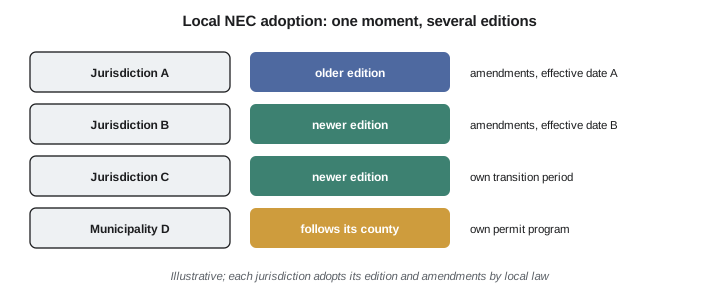
A snapshot of the patchwork
The Department of Labor's summary of county codes, dated August 2023, shows how uneven the picture can be. At that time it listed the 2017 NEC for Montgomery County, Prince George's County, Baltimore City, Anne Arundel County and Frederick County, and the 2020 NEC for Baltimore County and Howard County. Since then several jurisdictions have adopted newer editions, and county legislation from 2024 and 2025 shows more updates in progress. A summary like this is a useful starting point, but it ages quickly. The only reliable source for a given job is the jurisdiction's current adopted code and its permit office.
| Question | Where to find the answer |
|---|---|
| Which NEC edition applies to this permit? | The jurisdiction's adopted electrical code and permit office |
| What local amendments apply? | The adopting ordinance or regulation and the local code |
| When does a new edition take effect? | The adoption's effective date and transition rules |
| Which edition governs a permit issued last year? | Usually the edition in effect when the permit was issued |
| Which edition does the exam test? | The current PSI candidate information bulletin |
How local amendments work
Local amendments come in a few common types. Administrative amendments replace or add to the NEC's administrative provisions with local rules on permits, inspections, fees, plan review and who may apply. Technical amendments change specific installation requirements, either adding a requirement the jurisdiction wants or relaxing one it considers unnecessary locally. Deletions remove a provision entirely, and some jurisdictions delay the effective date of particular new requirements to give contractors and suppliers time to adjust.
Amendments are published as part of the local code, usually in the county code chapter or regulation that adopts the NEC. They are not printed in the NFPA book. A master must therefore read two documents for every job: the NEC edition in force and the local amendment list. When the two conflict, the local amendment controls for that jurisdiction. Patapsco Ridge's job binders include a printed copy of each jurisdiction's current amendment list for exactly that reason.
Amendments also explain why two jobs with identical plans can need different work. In Renee's two kitchens, the difference came from the editions, not from amendments: one county's newer edition brought changes in kitchen receptacle and island requirements, while the other's older edition did not. A crew that wires both jobs from habit will get one of them wrong.
The state board's use of the NEC
The State Board of Electricians does not adopt a construction code for permits, but the NEC still matters at the state level. Under the 2020 law, the board must enforce minimum electrical standards consistent with the most recent edition of NFPA 70 within 18 months after each edition is issued. The board applies those standards when it evaluates complaints about licensees' work. Its continuing education requirements are also built on the NEC or local variants adopted by local boards.
That arrangement can create a gap. A county may still enforce an older edition on permits while the board's complaint standard has moved to a newer one. Board members and members of the public raised the problem at the January 2026 meeting, noting the confusion when jurisdictions use different editions and the conflicts that can arise when state and local cycles are not aligned. The board's executive director noted that most local jurisdictions adopt a new edition within about a year, some immediately and others within months, and that permits issued before a transition generally continue under the prior code. The board discussed the timing of enforcement of the 2023 and 2026 editions and planned to clarify its timeline with the counties.
Which edition applies to a given job
For a permitted job, the governing edition is almost always the one the jurisdiction enforced when the permit was issued. A job permitted in March under the older edition is usually inspected under that edition even if the county adopts a newer one in April, until the permit expires. Large projects with long schedules can therefore be built under an edition that is several years old by completion. Some jurisdictions let an applicant choose the newer edition during a transition, and some require it for permits applied for after a certain date.
When a job crosses a jurisdiction line, as a feeder serving a building across a county border might, the permit office for each part decides. Renee has handled that once, for a farm property that straddled Howard and Carroll counties. Each county permitted the work on its side, and the crew followed each county's edition for its part of the installation.
# Look up the governing edition for a job from a jurisdiction list (study aid; values illustrative)
from datetime import date
adoptions = {
    "County A": [(date(2021, 1, 1), "2017"), (date(2024, 7, 1), "2020")],
    "County B": [(date(2022, 3, 1), "2020"), (date(2025, 9, 1), "2023")],
}
def edition(county, permit_date):
    current = None
    for start, ed in adoptions[county]:
        if permit_date >= start:
            current = ed
    return current
for county, d in [("County A", date(2024, 6, 15)), ("County A", date(2024, 8, 1)), ("County B", date(2026, 2, 10))]:
print(county, d, "-> NEC", edition(county, d))County A 2024-06-15 -> NEC 2017 County A 2024-08-01 -> NEC 2020 County B 2026-02-10 -> NEC 2023
Studying for the exam versus working on the job
The exam has its own edition, set by the PSI bulletin. In the bulletin dated September 2024, that was the 2020 NEC, and the board has discussed testing on a newer edition when appropriate. The exam does not test local amendments, which differ from county to county. So a candidate prepares on one edition while working under one or more others, and must keep them apart. Renee kept her exam book clean of job notes and kept her job book separate, with sticky flags for the Howard County amendments she used most.
Changes between editions matter in both places. On the job, a new edition can change receptacle locations, ground-fault and arc-fault protection, surge protection, labeling and other details. On the exam, a candidate who learned a rule from a newer edition may choose the wrong answer for an older-edition question. When studying, note any rule you know from job experience and confirm it in the exam edition before relying on it.
Keeping current as a master
Keeping track of code adoption is part of the master's job. Patapsco Ridge's routine is simple. Marisol subscribes to the permit office mailing lists for each county where the company works. Renee reviews announcements of new adoptions and amendment lists, updates the jurisdiction sheet and briefs the crews at the next Monday meeting. When a new edition is adopted, the company buys copies, schedules a continuing education course covering the changes, and checks its standard estimates and material lists for anything that the new edition changes.
Inspectors are a resource too. Most Maryland inspectors will answer a question about how their jurisdiction reads a rule before work begins, and asking early is far cheaper than a failed inspection. Renee keeps notes of those answers in the job file, with the inspector's name and the date.
Reading an adoption ordinance
An adoption ordinance or regulation is short compared with the code it adopts, and it repays a careful reading. Look first for the edition and the effective date. Then look for the sections that replace the NEC's administrative chapter with local permit and inspection rules, the list of technical amendments, any provisions deleted entirely and any transition rule for permits applied for before the effective date. Many ordinances also name the local appeals board that hears disputes over the code's application. Renee reads each new ordinance with a highlighter and writes a one-paragraph summary for the crews in plain language: what changed, from when, and what the crews must do differently.
Ordinances also change after adoption. A county may amend its electrical code between editions to fix a problem, add a requirement for electric vehicle readiness or adjust a permit rule, and those mid-cycle changes are easy to miss because no new NEC edition accompanies them. Renee checks each county's code page for amendment dates every quarter, not only when a new edition is announced.
Low-voltage and other special rules
Local rules also differ on permits for low-voltage work, generators, solar installations and electric vehicle charging equipment. Montgomery County, for example, issues low-voltage permits for work at 50 volts or less, such as fire alarm, cable television, telephone, audio and data wiring, without requiring an electrical license, while requiring a master for work above 50 volts. Other jurisdictions draw the lines differently. The NEC edition governs how the work is installed; the local rules decide who may do it and what permit it needs.
Worked problem
Two kitchens, two editions
Patapsco Ridge is wiring nearly identical kitchens in two counties. County H enforces a newer NEC edition with a short amendment list; County B enforces an older edition. Both permits were issued in February 2026. How should Renee plan the work?
Show solution
- Confirm each county's adopted edition and amendments on its website or with the permit office.
- Note that each permit is governed by the edition in effect when it was issued.
- Review the kitchen and island receptacle and protection requirements in each edition separately.
- Prepare separate material lists and brief each crew on the differences.
- Keep the amendment list for each county in its job binder for the inspection.
Answer: Each kitchen follows its own county's edition and amendments; habit from one job cannot be carried to the other.
Common mistakes
MistakeAssuming Maryland adopts the NEC statewide.
InsteadLocal jurisdictions adopt the NEC edition and amendments for private construction.
MistakeStudying the exam from the job edition.
InsteadStudy the edition the PSI bulletin names.
MistakeApplying a new edition to a permit issued earlier.
InsteadPermits usually continue under the edition in effect when issued.
MistakeReading only the NFPA book.
InsteadLocal amendments are in the local code, not in the NEC.
MistakeIgnoring the board's standard.
InsteadThe board evaluates complaints against standards consistent with the most recent NEC within 18 months of issuance.
Summary and key terms
- Maryland's building performance standards do not include the NEC; local jurisdictions adopt it.
- Each jurisdiction adopts an edition, an effective date and local amendments.
- Local amendments are found in the local code, and they control in that jurisdiction.
- The board enforces minimum standards consistent with the most recent NEC within 18 months of issuance.
- The exam tests the bulletin's edition and not local amendments.
- Local adoption
- A county or city's legal act adopting an NEC edition.
- Local amendment
- A change to the NEC made by the adopting jurisdiction.
- Effective date
- The date a newly adopted edition begins to govern permits.
- Transition
- The period when old and new editions overlap.
- Building performance standards
- Maryland's statewide building codes, which do not include the NEC.
Practice problems
Work each problem on paper first, then reveal the answer to check.
Who adopts the NEC for a private job in Annapolis?
Show answer
The local jurisdiction, through its adopted code.
Where are local amendments published?
Show answer
In the local code that adopts the NEC.
Within how long must the board align its standards with a new NEC edition?
Show answer
18 months.
Which edition does the master exam test?
Show answer
The edition named in the current PSI bulletin.
Lesson quiz · 5 questions
Score 60% or more to complete this lesson.
Create a free account to save your progress, take quizzes and earn a certificate.