
MELU-220 · Lesson 7 of 12 · 19 min
Duties and responsibilities of the Master Electrician License holder
▶ Video coming soon A video version of this lesson is on the way.
Two weeks after Renee became the master of record for Patapsco Ridge, a homeowner in Columbia called about a breaker that kept tripping on a basement circuit the company had installed in 2019. Renee had not been on that job. Walt had been the master then, and the foreman had since moved to Virginia. Renee went out anyway, found an undersized conductor spliced onto a new circuit by a previous owner's handyman, and fixed it at no charge. Afterward she told Walt why she had gone. "The company's name is on that panel, and now my license stands behind the company. If the board ever got a complaint about one of our jobs, I'd want to be the one who'd already looked."
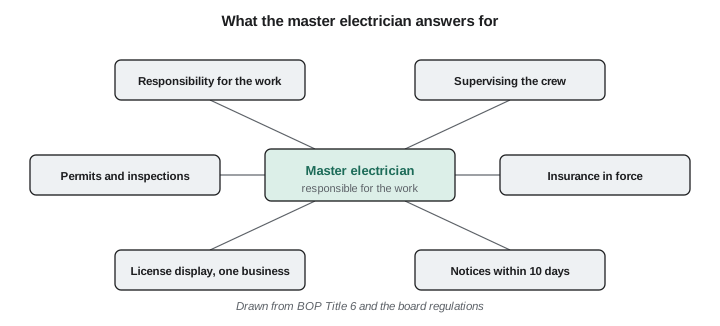
This lesson covers what a Maryland master electrician license holder is responsible for: the work itself, the people who perform it, the business the license is assigned to, the insurance that must stay in force, the records and notices the board expects, and the conduct the board can discipline. The responsibilities come from BOP Title 6, the board's regulations in COMAR Title 09, Subtitle 09, and the local codes that govern permits.
Responsibility for the work
A master electrician takes responsibility for the electrical work done under the master's license. When the master pulls a permit, the permit names the master, and the local authority expects the master to see that the work meets the adopted code and amendments. When the board evaluates a complaint, it measures the work against minimum standards consistent with the most recent NEC, and it looks to the master who was responsible. That responsibility does not depend on whether the master personally installed each conductor; it depends on whether the master directed and supervised the work properly.
Good masters build that responsibility into routine. Renee reviews every job's scope and load calculation before work starts, visits each active job at least weekly, checks rough-in work before inspections are scheduled, reads every correction notice and signs off on finals. On small jobs she relies on experienced journeypersons for daily supervision, but she sets the standards and checks the results.
Supervising journeypersons and apprentices
Maryland's licensing structure assumes a chain of supervision. Journeypersons provide electrical services under the direction of a master. Apprentices work under supervision while learning, and since 2021 the state has licensed apprentices, so an apprentice on a Maryland job should hold the apprentice license the board's regulations require. The board has said publicly that it struggles to find people working without a license or apprentice registration, which is a reminder that a master who puts unlicensed workers on a job takes a real risk. The board's regulations set the details of apprentice supervision, and a master should read them and check every new hire's license status before the first day of work.
Supervision also means training. The board credits experience earned under the direction and supervision of a master, so the quality of that supervision shapes the next generation of journeypersons and masters. Patapsco Ridge pairs each first-year apprentice with one journeyperson for at least the first six months, rotates second-year apprentices through service, commercial and residential work, and keeps work-hour records that apprentices can later use in their own license applications.
| Worker | Maryland license | Supervision (summary) |
|---|---|---|
| Apprentice | Apprentice license under board regulations | Works under a licensed journeyperson or master |
| Journeyperson | State journeyperson license | Works under the direction of a master |
| Master | State master license with insurance | Responsible for the work and the business |
| Uninsured master, authorized to work | Master license, uninsured status | Works at the journeyperson level; may not supervise |
| Laborer or helper | None | May not perform electrical work that requires a license |
The license and the business
A master's license stands behind a business. Under BOP 6-309, an applicant who will assign a local license through the state license names the business on the application, and the state license shows the licensee's name and the business. A license or local registration may be assigned to only one business at a time. A master who leaves a company, or a company that loses its master, must update the assignment, and a company without a master generally cannot continue to offer electrical services or pull permits until a new master is assigned.
The master must also display the license and license number at the principal place of business. When Walt retires, Patapsco Ridge will reassign its registrations to Renee's license in each county, update the board's records, and replace the framed license in the front office. Walt plans to keep his own license active in uninsured, unauthorized-to-work status, which lets him return to work later after meeting the continuing education and insurance requirements.
Insurance that stays in force
A master who contracts to provide electrical services must keep the insurance required by BOP 6-604 in force: at least 300,000 dollars in general liability and at least 100,000 dollars in property damage coverage, covering the work and completed operations. The coverage may be purchased by the master or by the master's employer, and it does not cover work the master does outside that employment. If a policy is canceled, the insurer must tell the board within 10 days, and a master without coverage may not contract. A master who moonlights on weekend jobs outside the employer's business is uninsured for that work and is exposed both to discipline and to personal liability.
Notices and records
The 2020 law requires licensees to notify the board within 10 working days of a change in name, address or employment. A master who changes employers must also handle the insurance and license assignment changes that follow. Masters should keep records that prove compliance: permits, inspection results, correction notices and how they were resolved, apprentice and journeyperson license checks, continuing education certificates and insurance certificates. When the board investigates a complaint, those records are the master's best evidence.
# Check a crew list against license status before a job starts (study aid; data illustrative)
from datetime import date
today = date(2026, 11, 10)
crew = [
    ("Devin Shaw", "journeyperson", date(2027, 4, 30)),
    ("Ana Ruiz", "apprentice", date(2026, 10, 31)),
    ("Kyle Brandt", "apprentice", date(2028, 1, 15)),
]
for name, kind, expires in crew:
    ok = expires >= today
print(f"{name:12} {kind:14} expires {expires} {'OK' if ok else 'EXPIRED - do not assign'}")Devin Shaw journeyperson expires 2027-04-30 OK Ana Ruiz apprentice expires 2026-10-31 EXPIRED - do not assign Kyle Brandt apprentice expires 2028-01-15 OK
Conduct the board can discipline
The board may reprimand, suspend or revoke a license and impose civil penalties for violations of Title 6 and its regulations. The 2020 law expanded the grounds to include practicing outside the scope of the license held and failing to complete a contract without justification. Other common problems include lending a license or permit to someone else, allowing unlicensed people to perform licensed work, fraud or misrepresentation in obtaining a license or in dealings with customers, gross negligence or incompetence, and violations of local codes that the local authority reports. Local boards may take disciplinary action short of revoking a state license and must report enforcement activity to the state board.
Penalties can be significant. The 2020 law made unlicensed practice a misdemeanor with fines that rise for repeat violations, and it allows civil penalties for each violation. Beyond the formal penalty, discipline appears in public records and can affect a company's insurance, bonding and reputation. The board's case decisions, summarized in its minutes, show the range: revocations of local registrations, civil penalties for unlicensed work and reprimands for permit violations.
Working within scope
Scope matters both for license classes and for related trades. A master license covers electrical work; it does not authorize plumbing, gas fitting or general building work, which have their own licenses in Maryland. A low-voltage license covers work below the statutory thresholds and does not authorize line-voltage work. On home improvement jobs, the Maryland Home Improvement Law exempts licensed electricians acting within the scope of their occupation, but a master who takes on a whole kitchen remodel, including carpentry and cabinets, may need a home improvement license for the work outside electrical scope. Lesson 8 covers that question in more detail.
Fixing problems quickly
Mistakes happen on every job. What distinguishes a good master is how quickly they are found and fixed. Correction notices should be resolved promptly and documented. Customer complaints should be answered in writing with a plan. Hazards found after a job, like the spliced conductor in Columbia, should be corrected even when the cause was someone else, at least to the point of making the installation safe and telling the owner what was found. Many complaints to the board start with a customer who felt ignored, not with a technical violation.
Records also protect the master personally. A complaint can arrive years after a job, when memories have faded and the foreman has moved on. The permit history, the inspection approvals and the job notes show what was installed, who supervised it and what the inspector accepted. Patapsco Ridge keeps closed job files for at least as long as its insurance and contract records, and Renee adds a short closeout note to each one.
When the master leaves: succession
Because a Maryland electrical business depends on its master, losing the master can stop the business overnight. A master who retires, changes employers, falls ill or dies leaves the company without the license its permits and registrations depend on. Companies with one master are especially exposed. Patapsco Ridge's succession plan, written the month Renee passed, sets out the steps: reassign the company's local registrations to Renee's license in each jurisdiction, notify the board of the change in employment and assignment, update the certificate of insurance to name Renee, transfer open permits as each jurisdiction's rules allow, and tell the general contractors and customers on open jobs who the new master of record is.
The plan also covers the longer term. Walt wants at least two masters on staff within three years, so Patapsco Ridge is paying for Devin's journeyperson exam preparation and will support his master application when he qualifies. A company with two masters can survive the loss of one without missing a permit.
Responsibility for safety on the job
A master's responsibilities also reach the safety of the people doing the work. Maryland employers are covered by the Maryland Occupational Safety and Health program, and the master who directs the work usually sets the practices that decide whether electricians work on energized equipment, how lockout and tagout are done and whether the crew has the protective equipment it needs. Lesson 10 covers the safety rules. For this lesson, the point is simple: the master's supervision duty includes making sure the crew knows the company's safety procedures and follows them on every job, not only on large commercial sites.
Worked problem
A foreman's request
A Patapsco Ridge foreman asks Renee whether a new hire, who says he has eight years of experience in Virginia but holds no Maryland license, can work alone on a small residential job while his application is pending. What should Renee do?
Show solution
- Check whether the new hire holds any Maryland license; he does not.
- Recognize that performing licensed electrical work without a Maryland license, alone, would expose the company and Renee to discipline.
- Help him apply for the appropriate Maryland license, including any reciprocity route available from Virginia.
- Until a license issues, assign him only work that does not require a license, or have him work under direct supervision as the board's rules allow.
- Record the decision and the license check in the personnel file.
Answer: He cannot work alone on licensed work until he holds the right Maryland license; Renee supervises and helps him apply.
Common mistakes
MistakeSigning permits for jobs you do not supervise.
InsteadThe master is responsible for work done under the master's permit and license.
MistakeAssuming an apprentice's license is current.
InsteadCheck every license before assigning work.
MistakeContracting a weekend job outside the employer's insurance.
InsteadThe employer's policy does not cover outside work; the master would be uninsured.
MistakeForgetting to update the business assignment after changing jobs.
InsteadA license may be assigned to only one business at a time; update it and notify the board within 10 working days.
MistakeIgnoring a customer complaint.
InsteadAnswer promptly in writing; many board complaints begin with a customer who felt ignored.
Summary and key terms
- The master takes responsibility for the electrical work done under the master's license and permits.
- Journeypersons work under a master; licensed apprentices work under supervision.
- A license or local registration may be assigned to only one business at a time, and the license must be displayed.
- Contracting masters must keep the required insurance in force.
- Report changes within 10 working days; the board can discipline and impose penalties.
- Master of record
- The master named on a permit and responsible for the work.
- Supervision
- Directing and checking the work of journeypersons and apprentices.
- License assignment
- The business a master's license stands behind.
- Scope of license
- The kind of work a license authorizes.
- Civil penalty
- A monetary penalty the board may impose for violations.
Practice problems
Work each problem on paper first, then reveal the answer to check.
May one master's license be assigned to two businesses at once?
Show answer
No.
Where must a master display the license?
Show answer
At the principal place of business.
Does the employer's insurance cover a master's outside weekend jobs?
Show answer
No.
Name one ground for discipline added by the 2020 law.
Show answer
Working outside the scope of the license, or failing to complete a contract without justification.
Lesson quiz · 5 questions
Score 60% or more to complete this lesson.
Create a free account to save your progress, take quizzes and earn a certificate.