
MELU-220 · Lesson 11 of 12 · 19 min
Renewal and continuing education
▶ Video coming soon A video version of this lesson is on the way.
Walt has a story he tells every new master. In 2009 he let a county registration lapse by eleven days because the renewal notice went to an old post office box. A permit application bounced, a job start slipped a week and a general contractor never called Patapsco Ridge again. "The license was fine," he says. "The registration wasn't. Nobody cares which one you forgot." When Renee's master license issued in September 2026, the first thing Marisol did was add three lines to the company's compliance sheet: the license expiration in September 2028, the continuing education deadline before it, and the insurance certificate the board would need at renewal.
This lesson covers keeping a Maryland master license and the company's related registrations current: the two-year renewal cycle, the 10 hours of continuing education required for a master, what counts and who may provide it, the online limit, insurance at renewal, the uninsured statuses, late renewal, audits, and a company calendar that prevents lapses.
The two-year cycle
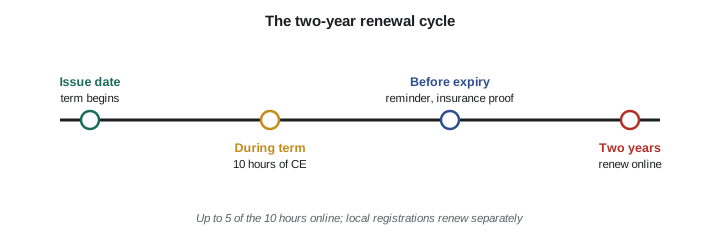
Maryland electrician licenses are issued for two-year terms. The state's licensing portal lists the master license term as two years, and the board renews licenses through its online renewal system. Because the term runs from the issue date, each licensee has a personal deadline; Renee's license, issued in September 2026, expires in September 2028. The board mails a renewal reminder before expiration, but the duty to renew belongs to the licensee, and a missed reminder is not an excuse. Licensees who have not received a reminder about a month before expiration should contact the board.
Renewal requires three things for an active master who contracts: payment of the renewal fee, completion of the required continuing education, and proof of the insurance required by BOP 6-604. The board will not renew a contracting master's license without proof of insurance, and the 2020 law made proof of continuing education a condition of renewal. A false certification of continuing education is grounds for discipline.
Continuing education: 10 hours for a master
The board's continuing education requirement for a master electrician is 10 hours per two-year renewal cycle. A journeyperson needs 5 hours. The 2020 law requires the board to set continuing education by regulation and to base it on the National Electrical Code or local variants adopted by local boards, with courses on practical techniques, installation procedures and other relevant topics. In practice, approved courses cover NEC changes and application, other NFPA codes and standards the state uses, and the Maryland laws and regulations that govern licensees.
Courses must come from providers the board has approved. The board's approved provider list includes colleges, apprenticeship programs, trade associations and private training companies. Its monthly minutes show the approval process at work: the board reviews provider applications, instructor qualifications, curricula and hours before approving, and an organization is not an approved provider until the board has approved its documentation. A course from an unapproved provider does not count, however good it is.
Online and classroom hours
The board allows part of the requirement to be completed online. The state's licensing portal states that up to 5 of the 10 hours may be taken online. For a master, that means at least half the requirement comes from classroom or in-person instruction. Journeypersons, whose total is 5 hours, can generally complete their requirement online. Check the board's current rule before planning, because online limits are a common subject of change.
Renee plans her hours early in the cycle. In 2027 she will take a five-hour online course on NEC changes, and in early 2028 a one-day classroom course from an approved provider on Maryland law and code application. Spreading the hours means a sick day or a canceled class in the final month cannot cost her the license.
| Item | Master electrician | Journeyperson |
|---|---|---|
| Renewal term | 2 years from issue | 2 years from issue |
| Continuing education per cycle | 10 hours | 5 hours |
| Online hours that may count | Up to 5 | Generally all 5 |
| Insurance at renewal | Required to contract (BOP 6-604) | Not required separately when working under a master |
| Provider | Board-approved only | Board-approved only |
Choosing courses that are worth the time
Ten hours every two years is a minimum, and the hours are most valuable when they match the company's work. A master whose crews do mostly residential service work gains more from a course on dwelling services, ground-fault and arc-fault protection and load calculations than from a general survey. A company moving into solar, battery storage or electric vehicle charging should choose courses on those articles of the code and on the utilities' interconnection practices. Renee asks three questions before signing up: is the provider approved, does the course cover the edition our counties enforce or are about to adopt, and will the crews see this work in the next two years?
Continuing education can also serve the whole company. Patapsco Ridge hosts an approved provider for a classroom day each spring, open to its journeypersons and apprentices as well as its masters. The journeypersons earn their hours, the apprentices hear the same material, and the company spends one day on training instead of scattering people across a dozen online courses. The shared day also gives Renee a chance to add a company session afterward on what the crews see in local inspections.
When the code changes during a cycle
A two-year renewal cycle and a three-year code cycle never line up neatly. A master may complete hours on one NEC edition and then find that a county has adopted the next one months later. The board's continuing education rules focus on hours from approved courses based on the NEC and Maryland law, not on a particular edition for every hour, but practical sense says to learn each new edition before the counties where you work adopt it. The board's 2026 discussions of enforcing the 2023 and 2026 editions are a reminder that the schedule is moving. When a county announces an adoption date, plan at least part of the next cycle's hours around the changes.
Insurance at renewal
For a contracting master, renewal and insurance go together. The board needs a current certificate showing at least 300,000 dollars in general liability and 100,000 dollars in property damage coverage. When the employer buys the insurance, as Patapsco Ridge does, the company's insurance agent sends the certificate. If the master changes employers during the term, the new employer's insurance must be on file, and the board must be notified of the change of employment within 10 working days. A lapse in coverage mid-term matters even before renewal, because the insurer must notify the board of a cancellation and a master without coverage may not contract.
Uninsured statuses at renewal
Masters who will not contract can renew in an uninsured status. Under Chapter 187 of 2023, the uninsured master electrician license has two statuses, each renewed on the two-year cycle. In the authorized-to-work status, the holder completes the 10 hours of continuing education and may work at the journeyperson level but may not pull permits or supervise; holders are subject to random audits. In the unauthorized-to-work status, the holder shelves the license with no continuing education or insurance requirement. Before returning to active work, the holder must complete 10 hours of continuing education and meet the insurance requirement of the license applied for.
Walt will use the unauthorized-to-work status when he retires. It keeps his license alive without the cost of insurance or continuing education, and if he ever wants to help on a job again, he can complete the hours and return to an insured status.
# Two-year renewal planner for a master (study aid)
from datetime import date
issued = date(2026, 9, 15)
expires = date(issued.year + 2, issued.month, issued.day)
plan = [("online NEC changes course", 5, date(2027, 3, 10)), ("classroom Maryland law and code", 5, date(2028, 2, 20))]
done = sum(h for _, h, d in plan if d < expires)
print("license expires:", expires)
for name, hours, when in plan:
    print(f"  {when}: {name} ({hours} h)")
print("hours planned before expiration:", done, "of 10")
print("start renewal by:", date(expires.year, expires.month - 2, 1))license expires: 2028-09-15 2027-03-10: online NEC changes course (5 h) 2028-02-20: classroom Maryland law and code (5 h) hours planned before expiration: 10 of 10 start renewal by: 2028-07-01
Late renewal and reinstatement
A license that is not renewed by its expiration date expires, and an expired master may not provide electrical services, pull permits or be assigned to a business until it is restored. The board's rules provide for late renewal and reinstatement, usually with additional fees and with all continuing education and insurance requirements met, and a license that has been expired for a long time can require more, up to reapplication. The board's minutes include reinstatement requests where licensees explained lapses and showed completed continuing education. The simplest rule is not to need one: renew early.
An expired license also has immediate business consequences. Permit systems check license status. Prince George's County's online system, for example, will not accept a permit application from a license it shows as expired. Open permits under an expired license can stall inspections, and general contractors may treat a lapse as a default under the subcontract.
Local registrations renew separately
State renewal does not renew local registrations. Counties and cities that require a state master to register locally set their own renewal dates, fees and sometimes their own continuing education or documentation rules. Walt's 2009 lapse was a county registration, not the state license. A company working in several jurisdictions must track each registration separately, update each when the master changes, and make sure each reflects the current state license number and expiration date.
Changing jobs during a term deserves a checklist of its own. A master who moves to a new company must notify the board within 10 working days, make sure the new employer's insurance is on file, update the business assignment and any local registrations, and confirm that continuing education already completed is documented. None of this waits for renewal; each step affects whether the master may contract and pull permits the day the new job starts.
Audits and recordkeeping
The board may audit continuing education compliance, and its rules for the authorized-to-work uninsured status specifically mention random audits. Keep every course completion certificate for at least the full cycle and preferably longer, with the provider's name and approval information, the course title, the date and the hours. Patapsco Ridge scans certificates into each licensee's folder the day they arrive. When the board asked one of the company's journeypersons for proof after a renewal, Marisol sent the certificates within an hour.
The company renewal calendar
A company's renewal calendar should list every licensed person with license class, number, expiration and continuing education status; every local registration with its renewal date; the trader's license, the entity's annual report and each insurance policy and bond. Each line should name the person responsible and a start date at least sixty days before expiration. Marisol's calendar sends reminders at ninety, sixty and thirty days, and the Monday meeting reviews anything inside thirty days. The calendar is dull, and it is the reason nothing has lapsed at Patapsco Ridge since 2009.
Renewal is also a natural time to look ahead. When a county adopts a new NEC edition, Renee schedules the crew's continuing education to cover the changes before the effective date. When an apprentice approaches the journeyperson exam, the calendar shows when to start preparation. And when a master's license approaches renewal, the company checks that the master's insurance, business assignment and local registrations all match.
Worked problem
Renee's renewal plan
Renee's master license issued September 15, 2026, and expires two years later. Patapsco Ridge insures her. What does her renewal plan include?
Show solution
- Calendar expiration on September 15, 2028, with renewal started by July 2028.
- Complete 10 hours from board-approved providers, with no more than 5 online.
- Confirm the company's certificate of insurance shows at least 300,000 and 100,000 dollars and is on file with the board.
- Renew online and pay the renewal fee before expiration.
- Check each county registration's own renewal date and update any that tie to her license.
Answer: Ten approved hours spread across the term, insurance on file and every local registration tracked separately.
Common mistakes
MistakeAssuming every license at the company renews on the same date.
InsteadEach license runs two years from its own issue date.
MistakeTaking all 10 hours online.
InsteadOnly up to 5 of the master's 10 hours may be online.
MistakeUsing an unapproved provider.
InsteadOnly board-approved providers count.
MistakeForgetting the county registration.
InsteadLocal registrations renew separately from the state license.
MistakeWorking on an expired license while renewal is pending.
InsteadAn expired master may not provide services or pull permits until restored.
Summary and key terms
- Maryland licenses renew every two years from the issue date.
- Masters need 10 hours of continuing education per cycle, up to 5 online; journeypersons need 5.
- Courses must be from board-approved providers and based on the NEC and related law.
- Contracting masters must show insurance at renewal; uninsured statuses are available.
- Local registrations renew separately; keep certificates for audits.
- Renewal term
- The two-year period of a Maryland license.
- Continuing education
- Approved coursework required for renewal.
- Approved provider
- A course provider approved by the board.
- Unauthorized-to-work status
- An uninsured master status that shelves the license.
- Reinstatement
- Restoring an expired license under the board's rules.
Practice problems
Work each problem on paper first, then reveal the answer to check.
How long is a Maryland master license term?
Show answer
Two years.
How many hours of continuing education does a master need each cycle?
Show answer
10 hours.
How many of those hours may be online?
Show answer
Up to 5.
Do local registrations renew with the state license?
Show answer
No; they renew separately.
Lesson quiz · 5 questions
Score 60% or more to complete this lesson.
Create a free account to save your progress, take quizzes and earn a certificate.