
MELU-220 · Lesson 4 of 12 · 18 min
The exam format and the references allowed
▶ Video coming soon A video version of this lesson is on the way.
On a Thursday night in April, Renee sat at the Patapsco Ridge conference table with a stopwatch, a calculator and a code book with fresh tabs. Walt had bought a set of practice questions and printed forty of them. "Two minutes and forty seconds each," he said. "That's your budget. Go." She finished thirty-one before the stopwatch ran out, and four of the nine she missed were questions she had answered correctly in practice the week before, given more time. That night she learned what every open-book candidate learns: the book is allowed, but the clock decides how much of it you can use.
This lesson describes the Maryland master electrician exam as the vendor's bulletin sets it out: the number of questions and points, the time limit, the passing score, the content outline, the single permitted reference and the rules for it. It then builds a pacing and lookup strategy suited to the exam's weight on calculations.
The exam at a glance
The PSI bulletin for the Maryland master and journeyperson electrician exams, updated September 1, 2024, describes the master exam as 90 scored questions worth 100 points, with 240 minutes allowed. The passing score is 70. The exam is open book, with one permitted reference: the National Electrical Code, NFPA 70, in the edition the bulletin names, which was the 2020 edition in that bulletin. The test center does not provide the code book; candidates bring their own. Study guides, handwritten notes and other references are not allowed in the testing room.
The gap between 90 questions and 100 points is worth noticing. The content outline's question counts add up to 100, which matches the point total, while the bulletin says the exam has 90 scored questions. The bulletin does not explain the difference in detail; one reasonable reading is that some items carry more weight than others. For study purposes, the outline's numbers show the relative weight of each area, and the passing standard is 70 of 100 points. Candidates who want certainty about scoring should ask the vendor.
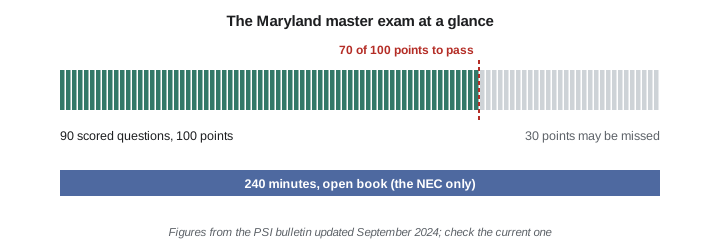
| Feature | Master exam (September 2024 bulletin) |
|---|---|
| Scored questions | 90, worth 100 points |
| Time allowed | 240 minutes |
| Passing score | 70 |
| Format | Computer-based, open book |
| Permitted reference | NFPA 70, the edition named in the bulletin (2020 in that bulletin) |
| Retake | After 30 days, with a new registration and fee |
The content outline
The bulletin divides the master exam into eight content areas. Electrical theory carries 20 points; wiring and protection, 14; wiring methods and materials, 13; equipment for general use, 9; special occupancies, 8; special equipment, 4; special communications, 2; and calculations, 30. Two things stand out. First, calculations are the largest single area, nearly a third of the exam. Second, theory carries a fifth. Together, theory and calculations make up half of the points, and neither can be answered by a fast lookup alone. A candidate who can find any article in the code but cannot work a service load calculation or a voltage drop problem will struggle to reach 70.
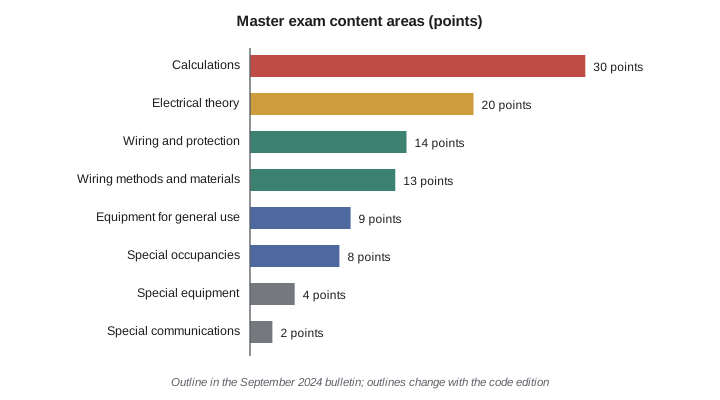
The remaining areas map onto the structure of the code itself. Wiring and protection follows Chapter 2: branch circuits, feeders, services, overcurrent protection, and grounding and bonding. Wiring methods and materials follows Chapter 3: cable and raceway types, boxes, conductor ampacity and fill. Equipment for general use follows Chapter 4: cords, switches, panelboards, luminaires, appliances, motors and transformers. Special occupancies, special equipment and special communications follow Chapters 5, 6 and 8. Knowing where each area lives in the book is the first step toward finding answers quickly.
The reference: one book, used well
Because only the NEC is permitted, every other aid a candidate relies on in practice, from a pocket guide to a calculation app, stays at home. That makes the code book itself the most important tool on exam day. The bulletin sets rules on what may be in or on it. Permanent tabs are generally allowed, and so is highlighting and underlining, but loose notes, inserted pages and written explanations are not. Read the bulletin's exact rule, because test centers enforce it at check-in, and a candidate whose book is refused must test without it or not at all.
Buy the edition the bulletin names, even if your county enforces a different edition on the job. In 2026, many Maryland jurisdictions enforce the 2020 or 2023 NEC on permits, and the 2026 edition has been published, but the exam tests the edition in the bulletin. Renee's study book was a 2020 edition; her work truck carried the 2023 edition that Howard County was enforcing. Lesson 5 explains why job editions differ across Maryland.
Pacing: the math of 240 minutes
Two hundred forty minutes for 90 questions is about 2 minutes and 40 seconds per question on average. That sounds generous until you account for calculations, which take longer, and lookups, which take longer still when the book is unfamiliar. A sound plan separates questions into three kinds: those you can answer from knowledge in under a minute, those that need one lookup, and those that need a multistep calculation. Answer the first kind immediately, the second kind with one disciplined lookup, and the third kind in a second pass if they will take more than about four minutes.
# Pacing plan for a 240-minute, 90-question exam (study aid)
total_min, questions = 240, 90
print("average minutes per question:", round(total_min / questions, 2))
plan = {"quick knowledge": (35, 1.0), "single lookup": (30, 2.5), "calculation": (25, 4.5)}
used = 0
for kind, (n, minutes) in plan.items():
    used += n * minutes
    print(f"{kind}: {n} questions x {minutes} min = {n * minutes:.0f} min")
print("planned minutes:", round(used), "of", total_min)
print("reserve for review:", round(total_min - used), "min")average minutes per question: 2.67 quick knowledge: 35 questions x 1.0 min = 35 min single lookup: 30 questions x 2.5 min = 75 min calculation: 25 questions x 4.5 min = 112 min planned minutes: 222 of 240 reserve for review: 18 min
The reserve matters. A candidate who budgets the full 240 minutes for first answers has no time to return to flagged questions. Renee's plan left 22 minutes for review: enough to revisit eight or ten flagged items and check answer entries. The computer-based format lets candidates flag questions and return to them, which supports a two-pass approach.
Lookups: index, tabs and article numbers
Fast lookups come from three habits. The first is the index: most code questions contain a key term, and the index takes you to the right section faster than flipping. The second is tabs placed at the articles the outline weighs heavily, such as definitions in Article 100, branch circuits in Article 210, feeders and services in Articles 215 and 230, overcurrent protection in Article 240, grounding and bonding in Article 250, conductors in Article 310 and motors in Article 430. The third is knowing chapter structure well enough to go straight to the right article without the index for common topics.
Practice lookups with the exact book you will bring. A candidate who studied from a borrowed copy and bought a fresh book the week before loses the muscle memory of where things sit on the page. Renee tabbed her 2020 edition in April and used only that book for every practice set through August.
Calculations: the 30-point area
The calculations area covers the arithmetic a master does on the job: dwelling and commercial service and feeder load calculations, conductor sizing with ampacity adjustments, voltage drop, motor branch circuit and feeder sizing, box and raceway fill, and transformer calculations. Each problem draws on code tables and rules, but the exam rewards fluency with the method more than skill at finding a table. Candidates should work problems until the steps are automatic, then time them. Lesson 12 offers a study plan built around this area.
A calculator is permitted within the bulletin's rules. It should be a simple, silent, nonprogrammable model, and the candidate should practice with the same one. A calculator that the test center rejects at check-in is a disaster on a 30-point section.
Theory: the 20-point area
Theory questions test the fundamentals behind installations: Ohm's law and power relationships, series and parallel circuits, single-phase and three-phase systems, power factor, transformer ratios, and the behavior of motors and capacitors. Many of these questions cannot be looked up in the code, because the code does not teach theory. Candidates whose apprenticeship classroom work is years behind them should plan for review here. A theory question answered from understanding takes 30 seconds; the same question attempted by guesswork takes longer and fails more often.
Reading the question before the book
Many wrong answers on open-book exams come from reading too fast, not from failing to find the rule. Exam questions are precise. They ask for a minimum or a maximum, a dwelling or a commercial occupancy, a copper or an aluminum conductor, a continuous or a noncontinuous load. A single word changes which rule applies. Renee trained herself to underline the key words on her scratch sheet before opening the book: the occupancy, the material, the load type and what the question actually asks for. It cost her ten seconds per question and saved several points per practice exam.
Answer choices deserve the same care. Exam writers build wrong choices from common mistakes: the value for the wrong conductor material, the result before a required adjustment, or the answer to a nearby but different question. When a calculated answer matches a choice exactly, check that the method was right, not only the arithmetic. When no choice matches, recheck the inputs before guessing. And never leave a question blank, because an unanswered item scores the same as a wrong one.
How the master exam compares with the journeyperson exam
Many Maryland candidates now take the journeyperson exam before the master exam, and comparing them shows what the master exam adds. The same bulletin describes the journeyperson exam as 70 questions in 210 minutes, also open book with the same reference rules, passing at 70. Its outline puts more weight on wiring and protection and special communications and has no separate calculations area. The master exam adds a 30-point calculations area and gives more weight to equipment and special occupancies. A candidate who passed the journeyperson exam comfortably should not assume the master exam will feel the same; the calculations are what make it harder.
What the score report tells you
Every candidate leaves the test center with a score report. A passing report states the result and directs the candidate to complete licensing. A failing report shows the total score and performance in each content area. That breakdown is precise feedback. A candidate who scores well in wiring methods but poorly in calculations should not spend the next month rereading Chapter 3. Keep every report, because the trend across attempts and practice exams shows whether study time is going to the right place.
Worked problem
Setting Renee's pacing targets
Renee's practice exams show she spends about 1 minute on knowledge questions, 2.5 minutes on single lookups and 5 minutes on calculations. Her mix is about 35 knowledge, 30 lookup and 25 calculation questions. Does her plan fit in 240 minutes with a reserve?
Show solution
- Knowledge questions: 35 times 1 minute is 35 minutes.
- Lookups: 30 times 2.5 minutes is 75 minutes.
- Calculations: 25 times 5 minutes is 125 minutes.
- Total: 235 minutes, leaving only 5 minutes for review.
- To build a reserve, she must bring calculations down to about 4.5 minutes each or move slow calculations to a second pass.
Answer: Her plan barely fits; faster calculations or a stricter second pass would create a review reserve.
Common mistakes
MistakeBringing the job-site edition of the NEC.
InsteadBring the edition the bulletin names, even if the county enforces another.
MistakeTreating the exam as a lookup race.
InsteadTheory and calculations are half the points and need fluency, not just lookups.
MistakeAdding handwritten notes to the code book.
InsteadLoose notes and written explanations are not allowed; follow the bulletin's rules on tabs and highlighting.
MistakeSpending the whole 240 minutes on first answers.
InsteadLeave a reserve for flagged questions.
MistakeBuying a new calculator the day before.
InsteadPractice with the same permitted model you will use.
Summary and key terms
- The September 2024 bulletin describes 90 scored questions worth 100 points in 240 minutes, passing at 70.
- The exam is open book with one reference, NFPA 70 in the named edition, brought by the candidate.
- Calculations carry 30 points and theory 20 points in the outline.
- Average time is about 2 minutes 40 seconds per question; plan a two-pass approach with a reserve.
- Study the bulletin's edition, not necessarily the job edition.
- Content outline
- The bulletin's list of areas and their weights.
- Permitted reference
- The only book allowed in the testing room, the NEC in the named edition.
- Two-pass approach
- Answering quick items first and returning to slow or flagged items.
- Lookup
- Finding a rule in the code during the exam.
- Calculations area
- The largest content area, covering load, sizing and drop calculations.
Practice problems
Work each problem on paper first, then reveal the answer to check.
How many minutes does the master exam allow?
Show answer
240 minutes.
What is the passing score?
Show answer
70.
Which content area carries the most points?
Show answer
Calculations, with 30.
May a candidate bring a study guide into the testing room?
Show answer
No; only the permitted NEC edition.
Lesson quiz · 5 questions
Score 60% or more to complete this lesson.
Create a free account to save your progress, take quizzes and earn a certificate.