
MELU-218 · Lesson 9 of 12 · 20 min
Contracts and Private Works Act privileges in Louisiana
▶ Video coming soon A video version of this lesson is on the way.
In the spring of 2025, Bayou Teche finished the electrical work on a new veterinary clinic in Carencro as a subcontractor to a general contractor that then ran into money trouble. The owner had paid the general contractor most of the contract price. The general contractor had not paid Bayou Teche the last 64,000 dollars. Celeste had pulled the parish mortgage records before the job started and found the notice of contract the owner had filed. When the owner filed a notice of termination at substantial completion, she put the date on the whiteboard in her office and filed Bayou Teche's statement of claim three weeks later. Within two months, the owner's lender insisted the claim be cleared, and Bayou Teche was paid. "Up north they call it a mechanic's lien," Remy told Nadia. "Here it's a privilege, and the clock is a lot shorter than people think."
This lesson covers the contracts an electrical contractor signs and the terms that matter most, change orders and prompt payment, Louisiana's Private Works Act at La. R.S. 9:4801 and following, privileges and claims against the owner, the notice of contract and notice of termination, the deadlines for filing a statement of claim, notices of nonpayment, enforcement, and the payment bond remedies that apply on public projects. Lien law in other states uses the term mechanic's lien; Louisiana's statute uses privilege, and the exam does too.
The contract comes first
Most payment disputes are decided by the contract, not by privilege law, so a qualifying party who will run a company should read contracts as carefully as code books. The core terms are the scope of work, the price or pricing method, the schedule, how changes are handled, how and when payment is made, retainage, warranty, insurance and indemnity, and how disputes are resolved. On a subcontract, the general contractor's form often includes pay-if-paid or pay-when-paid language, flow-down clauses that pass the owner's terms to the subcontractor, and notice requirements for claims. Louisiana courts have generally been reluctant to read a clause as making payment depend entirely on the owner paying unless the contract says so clearly, but the wording of each contract matters.
Change orders deserve their own rule. Any change to the scope, price or schedule should be written and signed before the work is done, or as soon as possible after an emergency change. Unwritten changes are the most common source of disputes in electrical contracting, and a privilege claim or lawsuit is much stronger when every dollar claimed matches a signed document. Louisiana also has prompt payment provisions for private construction that, as summarized by trade sources, require a contractor to pay its subcontractors and suppliers within a short period after the contractor receives payment for their work, with penalties for unjustified delay. Check the current statute for the period and the penalty.
| Contract term | Why it matters to an electrical contractor |
|---|---|
| Scope and drawings | Defines what is included and what is extra |
| Payment and retainage | Sets when money arrives and how much is held back |
| Change orders | Controls how extra work is priced and approved |
| Pay-if-paid or pay-when-paid | May tie the subcontractor's payment to the owner paying the prime |
| Insurance and indemnity | Sets required coverage and who bears certain losses |
| Dispute resolution | Sets mediation, arbitration or court, and notice deadlines for claims |
Privileges and claims under the Private Works Act
The Private Works Act gives those who perform work or supply materials for a private construction project two kinds of protection. Under section 9:4801, contractors, laborers, sellers of materials, lessors of equipment and certain design professionals have a privilege on the immovable, meaning the land and building being improved, to secure what they are owed. Under section 9:4802, subcontractors, laborers, suppliers and lessors who are not in a contract with the owner have a claim against the owner and the contractor for what they are owed, and that claim is secured by the privilege. The privilege follows the property, so it can protect a subcontractor even when the general contractor cannot pay.
Louisiana is a civil law state, and its property vocabulary differs from other states. An immovable is roughly what other states call real property. A privilege is a right of a creditor to be paid from a property ahead of some other creditors. The parish mortgage records are where notices and claims affecting immovables are recorded. Knowing these terms helps on the Business and Law exam, which uses them.
The notice of contract
Section 9:4811 deals with the notice of contract. When the contract price for a private project exceeds 100,000 dollars, the owner is expected to file a notice of contract in the mortgage records of the parish before work begins. The notice identifies the owner, the contractor, the property and the contract, and the owner may attach a payment bond from a surety. If the owner files a timely notice of contract with a proper bond, the owner is generally relieved of personal liability to subcontractors and suppliers who have no contract with it, and they look to the bond instead. If the owner fails to file a required notice or bond, the owner can be exposed to claims for amounts it has already paid the general contractor.
For the subcontractor, the notice of contract matters because it changes the deadlines. Before starting a job, Celeste checks the parish mortgage records for a notice of contract, notes whether a bond is attached and records the details in the job file. That one search tells her which set of deadlines will apply.
The notice of termination and the deadlines
When the work is substantially complete or the owner accepts it, the owner may file a notice of termination in the mortgage records. That filing starts the short clock. As summarized by continuing legal education materials and lien services, when a notice of contract was filed, subcontractors, suppliers and other claimants who are not the general contractor must file a statement of claim or privilege within 30 days after the notice of termination is filed, and the general contractor has 60 days. When no notice of contract was filed, claimants generally have 60 days after the notice of termination is filed, or after substantial completion or abandonment. Other deadlines measured from substantial completion apply when no notice of termination is filed. The exact rules are in section 9:4822, and the deadlines are strict.
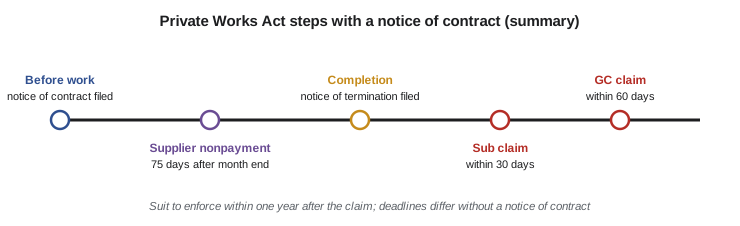
| Event | With a notice of contract | Without a notice of contract |
|---|---|---|
| Owner files notice of termination | Starts the clock | Starts the clock |
| Subcontractor or supplier files claim | Within 30 days after the notice of termination | Within 60 days after the notice of termination or substantial completion |
| General contractor files claim | Within 60 days after the notice of termination | Within 60 days after the notice of termination or substantial completion |
| Suit to enforce | Within one year after the claim is filed | Within one year after the claim is filed |
Notices of nonpayment
Some claimants must give notice during the job. As summarized by lien services, a supplier who sells materials to a subcontractor, rather than to the general contractor, must deliver a notice of nonpayment to the owner and the contractor within 75 days after the last day of the month in which the materials were delivered, in order to preserve its claim. Equipment lessors must give notice to the owner and contractor within a short period after the equipment is first placed on the site. Residential projects have their own notice rules. An electrical contractor that buys from a supply house should expect the supplier to send these notices and should not be offended when they arrive; they are routine.
Bayou Teche is usually the subcontractor, not the supplier to a subcontractor, so the notice of nonpayment is mostly something it receives from its own suppliers. When it hires its own subcontractors, such as a trenching firm, it should keep track of their suppliers' notices so that payments can be made in a way that clears them.
# Private Works Act deadlines (simplified study aid; confirm with La. R.S. 9:4801 and following and a lawyer)
from datetime import date, timedelta
import calendar
def month_end(d):
    return date(d.year, d.month, calendar.monthrange(d.year, d.month)[1])
delivery = date(2026, 3, 11)
nonpay_by = month_end(delivery) + timedelta(days=75)
termination_filed = date(2026, 6, 22)
sub_claim_by = termination_filed + timedelta(days=30)
gc_claim_by = termination_filed + timedelta(days=60)
claim_filed = date(2026, 7, 14)
suit_by = date(claim_filed.year + 1, claim_filed.month, claim_filed.day)
print("supplier delivery:", delivery, "-> notice of nonpayment by", nonpay_by)
print("notice of termination filed:", termination_filed)
print("subcontractor claim by:", sub_claim_by, " general contractor claim by:", gc_claim_by)
print("claim filed:", claim_filed, "-> suit by about", suit_by)supplier delivery: 2026-03-11 -> notice of nonpayment by 2026-06-14 notice of termination filed: 2026-06-22 subcontractor claim by: 2026-07-22 general contractor claim by: 2026-08-21 claim filed: 2026-07-14 -> suit by about 2027-07-14
The study aid counts days simply. A real claim should be filed well inside each deadline, after a lawyer has confirmed the count and the content. The useful lesson is the order: find the notice of contract at the start, watch for the notice of termination, file the statement of claim within the short window, and sue within a year if the claim is not paid.
Filing and enforcing a claim
A statement of claim or privilege is a written statement that identifies the claimant, the property, the work or materials furnished and the amount owed, and it is filed in the mortgage records of the parish where the property is located. The claimant also delivers a copy to the owner as the statute requires. If the claim is not paid, the claimant must bring a suit to enforce it and record a notice of the pending suit within one year after the statement of claim is filed, or the privilege is lost. Owners and lenders often bond around a claim, substituting a bond for the property so that the sale or financing can proceed.
Public projects
Privileges cannot be placed on public property such as a school, a parish courthouse or a state building. For public work, Louisiana's Public Works Act, which begins at La. R.S. 38:2241, requires the contractor to provide a payment bond, and subcontractors and suppliers protect themselves by filing a sworn statement of their claim with the public entity and giving notice as the act requires. The deadlines are usually measured from the public entity's recorded acceptance of the work and are short. A contractor on public work should learn the steps from the bond documents and a lawyer at the start of the job, not after a payment is missed.
Worked problem
Protecting a payment on a private project
Bayou Teche is a subcontractor on a 1.8-million-dollar private office building. The owner filed a notice of contract with a payment bond before work began. Bayou Teche's last invoice of 41,000 dollars has not been paid, and the owner files a notice of termination on June 22. What should Celeste do?
Show solution
- Confirm the notice of contract and bond in the parish mortgage records and note the notice of termination date.
- Because a notice of contract was filed, a subcontractor must file its statement of claim within 30 days after the notice of termination, so by about July 22.
- File the statement of claim in the parish mortgage records and deliver it as the statute requires, and notify the surety on the payment bond.
- If the claim is not paid, bring suit and record a notice of pendency within one year after filing the claim.
Answer: File the statement of claim within 30 days of the notice of termination, notify the surety, and sue within a year if unpaid.
Common mistakes
MistakeCalling it a mechanic's lien and assuming other states' deadlines apply.
InsteadLouisiana uses privileges under the Private Works Act, with its own short deadlines.
MistakeWaiting months after the notice of termination to file.
InsteadWith a notice of contract, a subcontractor generally has 30 days.
MistakeSkipping the mortgage records search at the start of the job.
InsteadCheck for a notice of contract and bond before starting; it sets the deadlines.
MistakeTrying to file a privilege on a public school.
InsteadUse the payment bond remedies of the Public Works Act.
Summary and key terms
- Most payment disputes are decided by the contract, so read scope, payment, changes, retainage and claim notice terms carefully.
- The Private Works Act gives privileges on the immovable and claims against the owner and contractor for unpaid work and materials.
- An owner files a notice of contract before work when the contract exceeds 100,000 dollars, and a payment bond with it protects the owner.
- After a notice of termination, subcontractors and suppliers generally have 30 days to file a claim when a notice of contract was filed, and 60 days when none was filed.
- A suit to enforce must be brought within one year after the claim is filed; on public projects, payment bond claims under La. R.S. 38:2241 replace privileges.
- Privilege
- Louisiana's term for a creditor's right to be paid from a property, similar to a lien.
- Immovable
- Land and buildings, roughly what other states call real property.
- notice of contract
- A filing in the parish mortgage records identifying a private construction contract.
- notice of termination
- A filing by the owner that the work is substantially complete or accepted, starting the claim period.
- Statement of claim
- The filing that preserves a claimant's privilege and claim.
Practice problems
Work each problem on paper first, then reveal the answer to check.
What does Louisiana call a mechanic's lien?
Show answer
A privilege under the Private Works Act.
Above what contract price is a notice of contract expected?
Show answer
Above 100,000 dollars.
With a notice of contract filed, how long does a subcontractor have to file a claim after the notice of termination?
Show answer
30 days.
Within how long after filing a claim must suit be brought?
Show answer
Within one year.
Lesson quiz · 5 questions
Score 60% or more to complete this lesson.
Create a free account to save your progress, take quizzes and earn a certificate.