
MELU-218 · Lesson 6 of 12 · 19 min
Permits, inspections and the inspection authority
▶ Video coming soon A video version of this lesson is on the way.
Bayou Teche's first job in New Orleans was a small one: new lighting, receptacles and a panel replacement for a coffee shop on Magazine Street. Nadia had worked in the city before, but always as a journeyman, never as the person responsible for the permit. In Lafayette she knew the permit counter staff by name and knew how the inspectors liked their rough-in. In New Orleans she had to learn the city's online permit system, its inspection request process and its rule that the company's Class A holder pulls the permit. Remy, who had done work in twenty parishes over his career, gave her one piece of advice: "Every parish enforces the same code, but no two parishes run their permit office the same way. Call first."
This lesson covers who enforces the uniform construction code in Louisiana, how electrical permits are issued, the kinds of inspections an electrical contractor schedules, third-party providers, plan review including the Office of State Fire Marshal's role, what happens when work fails inspection, and how a contractor working across parishes keeps track of each office's procedures.
Who enforces the code
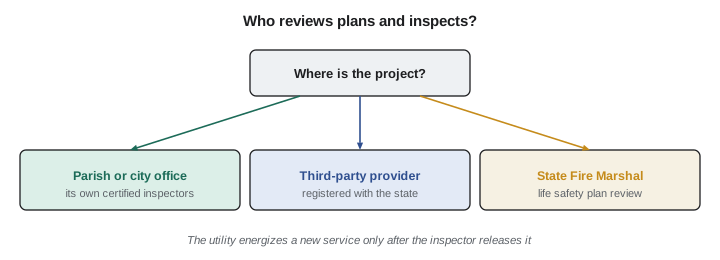
Louisiana's uniform construction code is enforced by local governments: parishes and municipalities. Each one either operates its own code enforcement office, staffed by certified building officials and inspectors, or contracts with a third-party provider registered with the state to perform plan review and inspections. Some small municipalities rely on the parish, and some parishes contract the work out. The result is that the inspection authority for a project depends on where the project is, and the first question on any new job is which office has jurisdiction.
The state board does not inspect electrical installations, and neither does the electric utility, although the utility has its own service requirements and will not energize a new service without the local inspector's release. The Office of State Fire Marshal reviews plans for many commercial and public buildings for life safety and fire protection, and its review may cover fire alarm and emergency systems that electrical contractors install. A project may therefore involve the local permit office, the State Fire Marshal and the utility, each with its own requirements.
Electrical permits
An electrical permit authorizes specific electrical work at a specific address. The local office sets who may apply. Many offices require the applicant to be a licensed contractor in the right classification, or, in jurisdictions that license individual electricians, a local master electrician working for a registered contractor. In New Orleans, the company's Class A master electrical license holder is the responsible person for electrical permits. Some jurisdictions allow homeowners to pull permits for work on their own homes, under conditions they set.
Permit applications usually ask for the address, the owner, the contractor and its license number, the scope of work, the service size and the value of the work, and, for larger projects, approved plans. Fees are set by the local office, often based on the value of the work or the number of circuits and devices. The 2026 act summarized in lesson 5 includes a permit fee provision effective January 1, 2027; check how it affects the offices where you work.
| Inspection | When it happens | What the inspector looks for in general |
|---|---|---|
| Temporary power | Before temporary service is energized | Safe temporary installation and ground-fault protection |
| Underground or slab | Before trenches or slabs are covered | Raceways, depth, bonding of steel and grounding electrodes |
| Rough-in | Before walls and ceilings are closed | Boxes, wiring methods, conductor sizes, support and fire-rated penetrations |
| Service | Before the utility connects | Service equipment, grounding and bonding, clearances and labeling |
| Final | When the work is complete | Devices, covers, labeling, protection and overall code compliance |
Plan review
Commercial projects generally need plan review before a permit issues. The designer submits drawings and specifications to the local office or its third-party provider, and the reviewer checks them for code compliance. For many commercial and public buildings, the Office of State Fire Marshal also reviews the plans for life safety, and the local office may require proof of that review before issuing the building permit. Electrical drawings typically show the service, panel schedules, one-line diagram, load calculations, lighting and power plans, emergency systems and fire alarm layout. Residential projects often need less review, but the local office decides.
A contractor who bids a design-build job may be responsible for producing the electrical drawings itself, within the limits of the engineering law on which drawings need a licensed engineer. A contractor who builds from someone else's drawings should read the plan review comments, because they often contain conditions that change the work.
Requesting inspections
Most offices take inspection requests online or by phone, with a cutoff time for next-day inspections. The permit card or job number is posted at the site, and the work must be accessible and ready. An inspector who arrives to find the work covered, incomplete or inaccessible may fail the inspection and charge a reinspection fee. Bayou Teche's foremen request inspections only after walking the work with a checklist, and they keep a copy of the approved plans on site.
# Tracking inspections on a small commercial job (illustrative)
inspections = [
    ("underground", "pass", 0),
    ("rough-in", "fail", 1),
    ("rough-in", "pass", 0),
    ("service", "pass", 0),
    ("final", "fail", 1),
    ("final", "pass", 0),
]
reinspect_fee = 75
fails = sum(1 for _, result, _ in inspections if result == "fail")
fees = sum(n * reinspect_fee for _, _, n in inspections)
print("inspections requested:", len(inspections))
print("failed inspections:", fails)
print("reinspection fees paid:", fees, "dollars")
print("first-time pass share:", round((len(inspections) - 2 * fails) / (len(inspections) - fails), 2))inspections requested: 6 failed inspections: 2 reinspection fees paid: 150 dollars first-time pass share: 0.5
Reinspection fees are small compared with the cost of a crew waiting for a pass, an owner delaying occupancy, or drywall that has to come down. Tracking first-time pass rates by foreman and by type of inspection shows where training would help.
When work fails
An inspector who finds a violation issues a correction notice or a failed inspection report that lists what must be fixed. The contractor corrects the work and requests a reinspection. Disagreements about the code should be raised politely with the inspector first, with the code section in hand; if they cannot be resolved, most offices have a supervisor or building official who can rule, and the uniform code provides for appeals. Arguing in the field rarely helps. A well-documented written question usually does.
Work done without a required permit can lead to a stop-work order, fines, a requirement to open finished walls for inspection, and complaints to the board. A contractor that repeatedly works without permits may face board discipline. The safest rule is that permitted work does not start until the permit is issued and posted.
Working across parishes
A contractor working in several parishes keeps a short profile for each office: who may apply for permits, how to apply, fee schedules, inspection request cutoffs, any local registration for state-licensed contractors, and contacts. Because state-licensed electrical contractors are exempt from local examination, the profile is mostly about procedures and fees, not exams. Bayou Teche keeps its profiles in a shared folder and updates them after each new job. When Nadia started in New Orleans, she added the city's requirements for the Class A license, insurance certificates naming the city and the online permit system.
Plan review comments and conditions
Plan review comments are worth reading line by line. A reviewer may approve plans with conditions, such as adding emergency lighting in a corridor, relocating a panel out of a storage room, providing a surge protective device, or showing a fault current calculation for the service. Those conditions become part of the permit, and the inspector will look for them in the field. A contractor who prices the job from the original drawings and never sees the comments can find itself doing unpaid work, or failing an inspection for something the plans said it would do.
Bayou Teche's estimators ask for the plan review comments before they finalize a price, and the project manager gives a copy to the foreman with the approved drawings. When a comment changes the scope, the company asks the general contractor or owner for a change order before doing the work, as lesson 9 explains.
Third-party providers
Louisiana law allows parishes and municipalities to contract with private firms for plan review and inspection, and in some places a project owner may hire a registered third-party provider when the local government does not provide the service. The provider's inspectors must be certified for the work they inspect, and they apply the same uniform code. For the contractor, the difference is mostly procedural: inspection requests may go to the provider rather than to a government office, the fees may be billed differently, and the provider's inspector may cover a large area and schedule visits in blocks. Knowing who the provider is and how it schedules saves days on a tight job.
Utilities and service releases
The electric utility is not the inspector, but it controls the last step for any new or upgraded service. Utilities serving Louisiana publish service requirements covering meter locations, service entrance equipment, clearances, grounding at the meter and the documentation they need before they will set a meter or make a connection. Most will not energize a new service until the local inspector has released it, and many have their own forms and lead times. A contractor who leaves the utility to the end of the job can wait weeks for a connection after the final inspection passes. Bayou Teche contacts the utility as soon as the service size and location are known, and it puts the utility's requirements on the drawings the foreman uses.
Utility requirements and code requirements sometimes overlap or differ. When they do, both must be met, and a question to the utility's service planner and the inspector early in the job usually settles how. Temporary power for construction also needs coordination with the utility, and on many sites it needs its own inspection before it is energized.
Records that protect the contractor
Every permit file should hold the permit, the approved plans and comments, every inspection result, correction notices and how they were resolved, the utility release and the final approval. Photographs of rough-in work before cover are inexpensive and valuable; they answer questions years later about what is inside a wall, and they help in warranty disputes and when an owner adds work. Bayou Teche's foremen photograph each room before drywall and file the pictures by address and date.
Worked problem
First job in a new parish
Bayou Teche wins a contract to wire a small office building in a parish where it has never worked. The building needs plan review. What should Nadia check before the crew mobilizes?
Show solution
- Find out whether the parish has its own code office or uses a third-party provider, and how to apply for the electrical permit.
- Confirm whether the parish requires local registration or fees from state-licensed contractors.
- Check whether State Fire Marshal plan review applies and whether it has been completed.
- Read the plan review comments and order any changes to the work.
- Learn the inspection request process and cutoff times, and post the permit before work starts.
Answer: Identify the inspection authority, register and pay fees, confirm plan reviews, read comments and post the permit before starting.
Common mistakes
MistakeAssuming the state board inspects electrical work.
InsteadLocal governments or their third-party providers inspect; the board licenses contractors.
MistakeStarting rough-in before the permit is issued.
InsteadDo not start permitted work until the permit is issued and posted.
MistakeCovering work before the rough-in inspection.
InsteadRequest and pass the inspection before closing walls or ceilings.
MistakeArguing a code point at length in the field.
InsteadRaise it politely with the code section, then in writing with the building official if needed.
Summary and key terms
- Parishes and municipalities enforce the uniform code through their own offices or registered third-party providers.
- The Office of State Fire Marshal reviews plans for life safety on many commercial and public buildings.
- Local offices set who may apply for electrical permits, how inspections are requested and the fees.
- Common electrical inspections are temporary power, underground, rough-in, service and final.
- Work that requires a permit should not start until the permit is issued and posted.
- Inspection authority
- The office with jurisdiction to review plans and inspect work at a location.
- Third-party provider
- A private firm registered to perform plan review or inspection for a jurisdiction.
- Plan review
- Checking drawings and specifications for code compliance before a permit issues.
- Correction notice
- An inspector's written list of items to fix before reinspection.
- Rough-in inspection
- The inspection of wiring before walls and ceilings are closed.
Practice problems
Work each problem on paper first, then reveal the answer to check.
Who inspects electrical work on a Louisiana project?
Show answer
The parish or city code office, or its registered third-party provider.
Which state office reviews plans for life safety on many commercial buildings?
Show answer
The Office of State Fire Marshal.
Which inspection must happen before walls are closed?
Show answer
The rough-in inspection.
Who pulls electrical permits for a company in New Orleans?
Show answer
The company's Class A master electrical license holder.
Lesson quiz · 5 questions
Score 60% or more to complete this lesson.
Create a free account to save your progress, take quizzes and earn a certificate.