
MELU-218 · Lesson 7 of 12 · 19 min
Duties and responsibilities of the Electrical Contractor and Master Electrician Licenses holder
▶ Video coming soon A video version of this lesson is on the way.
In April, a compliance investigator from the state board stopped at a Bayou Teche job site in Youngsville, a strip retail center where the company was a subcontractor to a general contractor from Texas. The investigator was not there for Bayou Teche. He was checking every contractor on the site, and he found that the drywall subcontractor was working above its threshold without a license and that the general contractor's license had been issued to a different company name than the one on the contract. Bayou Teche's paperwork was in order: the license number on the subcontract, a copy of the license in the foreman's truck, workers' compensation certificates on file with the general contractor. Remy used the visit as a lesson. "When you're the qualifying party," he told Nadia, "those are your problems too, not just Celeste's."
This lesson covers the responsibilities that come with holding the state Electrical classification as a qualifying party and with holding a local master license such as the New Orleans Class A: the qualifying party's role in the business, supervision, using the license only for the licensed entity, license numbers on bids and contracts, notifying the board of changes, working within the classification, permits and local supervision rules, and the main grounds for discipline.
What a qualifying party is responsible for
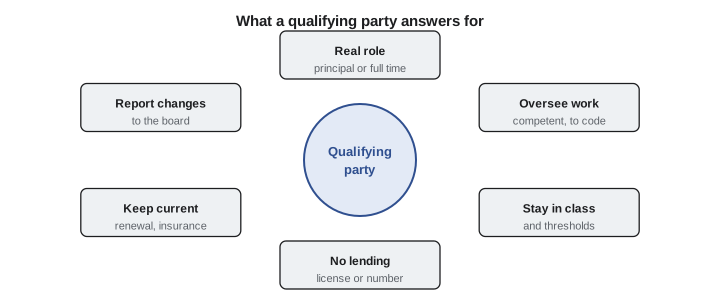
The qualifying party is the person whose knowledge the board relied on when it licensed the business. Because the statute requires the qualifying party to be a principal or full-time employee, the board expects that person to take part in the business's work and to be in a position to see that it is done properly. In practice, a qualifying party for the Electrical classification is expected to supervise or oversee the company's electrical work, to make sure that the company works within its classification and its thresholds, and to keep the company's license in good standing.
The board treats a qualifying party who lends a name to a business without any real involvement as a serious problem, because it defeats the purpose of the exam requirement. A qualifying party who takes a job with another company, or retires, must be replaced, and the business should notify the board of the change in the way its rules require. Remy's plan to add Nadia before he leaves is the clean way to do this.
| Duty | What it means in practice |
|---|---|
| Be a real principal or full-time employee | On the payroll or in ownership, with a real role in the work |
| Oversee the electrical work | See that work is done competently and to code |
| Work within the classification | Bid and perform only the kinds of work the license covers |
| Use the license only for the licensed entity | No lending the license or its number to another business |
| Keep the license current | Renew on time, keep insurance and financial requirements met |
| Report changes | Tell the board about changes in qualifying parties, ownership, name or address |
Working within the classification and thresholds
The Electrical classification covers electrical work, not general construction. A company that holds only the Electrical classification should not bid a whole building as the prime contractor if the work includes general construction above the board's thresholds; it would need a building construction classification or would have to work under a licensed general contractor. Similarly, a company that holds only a subclassification, such as Telecommunications Low Voltage, should not bid power wiring. Bidding work outside the license is one of the most common reasons the board opens a case.
Thresholds matter for subcontractors too. A general contractor that hires an unlicensed electrical subcontractor for work above 10,000 dollars may be in violation itself. Bayou Teche checks the licenses of its own subcontractors, such as a fire alarm firm or a trenching company, and expects general contractors to check its license.
License numbers on bids and contracts
Louisiana law and the board's rules expect licensed contractors to identify their license on bids and contracts, and public bid laws require bidders on many public projects to show their license number on the bid. The board's materials also warn owners to check a contractor's license before signing. Bayou Teche's practice is to print the license number and classification on its letterhead, proposals, contracts and invoices, and to give the number on every permit application.
On public projects, a bid from a contractor without the right license may be rejected, and the contract awarded to an unlicensed contractor may be challenged. That is another reason the qualifying party should keep track of which classifications the company holds and whether the license is current on the bid date.
Supervision and the local master
Local licenses carry their own supervision rules. In New Orleans, a Class D journeyman must work under a Class A contractor, and only one Class A holder is allowed per company. The Class A holder is responsible for the permits pulled under the license and for the work done by the company in the city. Other jurisdictions that license individuals set their own rules on who may do electrical work and how helpers and trainees are supervised. A qualifying party whose company works in those jurisdictions should know the local rules and make sure crews are staffed to meet them.
Even where no local rule requires it, supervision is the practical core of the job. Nadia's plan for 2027 is to walk each active job at least weekly, review every service and panel schedule before rough-in, and keep a standing agenda for foremen's meetings that covers inspection results, safety and changes in the code. Remy did most of this informally for thirty years. She wants it written down, so that it survives her own vacation.
Grounds for discipline
The board's statute lists grounds on which it may discipline a licensee. In general terms, they include contracting without the required license or classification, contracting above the license's limits, misrepresenting facts on an application, problems with the qualifying party arrangement, abandoning a contract without cause, failing to pay for materials or labor in a way that harms the owner, gross negligence or misconduct, and violating the board's rules. Penalties can include fines, probation, suspension and revocation. Unlicensed contracting can also lead to court action and, in some cases, to the loss of the right to be paid under the contract. The specific wording is in the statute.
# A self-audit before each bid (simplified study aid)
license = {"classifications": {"Electrical"}, "expires": "2027-08-31", "qualifying_party_active": True}
bids = [
    ("Clinic electrical package", {"Electrical"}, "2027-03-15"),
    ("Clinic as prime, whole building", {"Electrical", "Building Construction"}, "2027-03-15"),
    ("Retail center low voltage", {"Electrical"}, "2027-09-10"),
]
for name, needed, bid_date in bids:
    missing = needed - license["classifications"]
    current = bid_date <= license["expires"] and license["qualifying_party_active"]
    if missing:
        print(name, "-> do not bid: missing", ", ".join(sorted(missing)))
    elif not current:
        print(name, "-> renew the license before the bid date")
    else:
print(name, "-> OK to bid")Clinic electrical package -> OK to bid Clinic as prime, whole building -> do not bid: missing Building Construction Retail center low voltage -> renew the license before the bid date
Records and cooperation with the board
A licensed business should keep the records that show it complied: contracts, change orders, permits, inspection results, insurance certificates, payroll records and correspondence with owners. When the board's investigators ask for information, a prompt, complete and honest response is the best way to close a matter. The board also expects licensees to keep their contact information current so that notices reach them.
A qualifying party is also responsible to customers in ways the board's rules do not spell out. Owners rely on the license as evidence that the contractor knows the work. Honest estimates, written change orders, prompt correction of defects and clear warranty terms protect the company's reputation and keep complaints from reaching the board.
Subcontractors and their licenses
When Bayou Teche hires its own subcontractors, it takes on a duty to check their licenses. A general contractor or electrical contractor that hires an unlicensed subcontractor for work above that trade's threshold may face board action itself, and the unlicensed subcontractor's work may be uninsured. The check is easy: the board's online license search shows each contractor's classifications and status. Celeste prints the result and files it with the subcontract, along with the subcontractor's insurance certificates, before the subcontractor sets foot on the site.
The same check works in reverse. General contractors and owners increasingly ask for a copy of the license, the classifications and the qualifying party's name at prequalification. A qualifying party who keeps that information ready, along with the company's safety record and insurance certificates, makes it easy for customers to choose the company.
Advertising and the company name
The board expects a licensed business to contract in the name under which it is licensed. A company that operates under a trade name should register it and make sure the board's records connect it to the licensed entity. Advertising that suggests a license or classification the company does not hold can become a board matter. Bayou Teche's trucks, website and proposals all show the same legal name and license number, which avoids any question about who the customer is dealing with. When the company considered adding a second trade name for its generator work, Celeste checked with the board first how to list it.
Conflicts between customers and the code
A qualifying party will sometimes be asked by a customer to cut a corner: skip a permit on a small job, reuse an undersized feeder, leave out a required protective device, or cover work before an inspection. The answer has to be no, politely and in writing if needed. The license, the company's insurance and the qualifying party's own reputation depend on it. Remy's line for these conversations was simple: "I can do it the right way for this price, or I can explain to the inspector why I didn't. Only one of those ends well for both of us."
When a customer insists, the qualifying party should document the conversation, decline the work or the part of it that cannot be done properly, and keep a copy in the job file. Saying no to a customer is uncomfortable. Explaining to the board why the company did work it knew was wrong is much worse.
Planning for the qualifying party's absence
A company with a single qualifying party is exposed if that person is sick, quits or dies. The board's rules give a business a limited period to replace a qualifying party who leaves, and work in the classification may be restricted until a replacement qualifies. A prudent company trains a second person to the point where they could pass the exams, and some keep two qualifying parties on the license. Bayou Teche's plan is to have one of its senior foremen sit the Electrical trade exam within two years of Nadia, so that the company is never one resignation away from losing its license.
Worked problem
Is this bid within the license?
A long-time customer asks Bayou Teche to act as prime contractor for a 180,000-dollar renovation of its office, of which 70,000 dollars is electrical work and the rest is framing, drywall, ceilings and finishes. Bayou Teche holds only the Electrical classification. What should Nadia do?
Show solution
- The electrical work is within the Electrical classification.
- The general construction work is well above the board's thresholds and is not covered by the Electrical classification.
- Bayou Teche should not sign as prime unless it holds the right building classification; it can bid the electrical package to a licensed general contractor instead.
- If the customer insists, Nadia should check with the board before bidding.
Answer: Bid only the electrical package, or work under a licensed general contractor, unless the company holds the needed building classification.
Common mistakes
MistakeLending the company's license number to a friend's business.
InsteadA license may be used only by the licensed entity.
MistakeBidding a whole building with only the Electrical classification.
InsteadBid within the classification or work under a properly licensed prime.
MistakeLetting the qualifying party leave without telling the board.
InsteadReport the change and qualify a replacement as the rules require.
MistakeLeaving the license number off proposals and contracts.
InsteadShow the license number on bids, contracts and permit applications.
Summary and key terms
- A qualifying party is a real principal or full-time employee who oversees the electrical work and keeps the license in good standing.
- A company must bid and perform only the work its classifications cover.
- License numbers should appear on bids, contracts and permit applications, and public bids often require them.
- Local masters, such as a New Orleans Class A holder, are responsible for permits and work under local rules.
- The board may fine, suspend or revoke a license for unlicensed contracting, misrepresentation, misconduct and rule violations.
- Grounds for discipline
- The statutory reasons the board may penalize a licensee.
- Classification limits
- The kinds of work a license covers and the thresholds that apply.
- Responsible master
- The local master electrician answerable for a company's permits and work in a jurisdiction.
- Compliance investigator
- Board staff who check licenses on job sites and follow up on complaints.
- Lending a license
- Allowing another business to use a license or license number it does not hold.
Practice problems
Work each problem on paper first, then reveal the answer to check.
Can a company with only the Electrical classification bid a whole office renovation as prime?
Show answer
Not if the general construction work is above the board's thresholds; it needs the right classification.
In New Orleans, under whom must a Class D journeyman work?
Show answer
A Class A contractor.
Name two grounds for board discipline.
Show answer
For example, contracting without the right license and misrepresenting facts on an application.
Where should a license number appear?
Show answer
On bids, contracts, proposals and permit applications.
Lesson quiz · 5 questions
Score 60% or more to complete this lesson.
Create a free account to save your progress, take quizzes and earn a certificate.