
MELU-218 · Lesson 5 of 12 · 19 min
The NEC as adopted in Louisiana and state amendments
▶ Video coming soon A video version of this lesson is on the way.
In February, Nadia ran into a question that her practice set and her job site answered differently. The practice question was based on the 2023 edition of the National Electrical Code, because that was the edition exam preparation providers listed for the trade exam. The plan reviewer in Lafayette, reviewing a medical office Bayou Teche was bidding, was still working from the 2020 edition, because that was the edition the state had adopted. "So which one do I learn?" she asked Remy. "Both," he said, "and you learn which one applies where. That's part of the job." She started a page in her notebook titled "Which code, which date."
This lesson covers how the NEC becomes law in Louisiana, the Louisiana State Uniform Construction Code and the council that has adopted it, the edition in force in 2026 and the move toward the 2023 edition, the new commission created by the legislature in 2026, how state amendments and local enforcement fit in, and how to tell which edition applies to a given project. It does not reproduce code text; candidates should study the code itself from a licensed copy.
A statewide uniform code
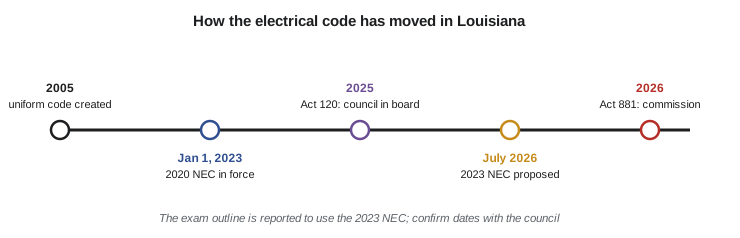
Louisiana adopted a statewide building code in 2005, after Hurricanes Katrina and Rita showed how uneven construction standards had become across the state. The law created the Louisiana State Uniform Construction Code and a council to adopt and update it. The code is made up of model codes published by national organizations, chiefly the International Code Council's building, residential, existing building, mechanical, plumbing, fuel gas and energy codes, together with the National Electrical Code published by the National Fire Protection Association. Parishes and municipalities enforce the uniform code; they do not choose their own base codes.
The council adopts each edition by rule, usually with a set of Louisiana amendments, and publishes the rules in the Louisiana Register and the Louisiana Administrative Code. For an electrical contractor, the result is that one edition of the NEC, with any state amendments, applies to projects across the state at a given time, and the effective date of each adoption decides which edition a project uses.
The edition in force in 2026
The International Code Council's adoption summary reports that the council adopted the 2020 NEC, together with the 2021 International Building Code and International Residential Code, effective January 1, 2023, with Louisiana amendments. The 2021 energy code followed later in 2023. In 2026 the council's July meeting agenda included proposed rules to adopt the 2023 NEC and the 2024 editions of the International Codes. When this course was written, the effective date of that change had not been confirmed. A project permitted under the 2020 adoption stays under it; a project permitted after a new adoption takes effect follows the new edition.
Exam preparation providers list the 2023 NEC as the code reference for the board's Electrical trade exam. That is not unusual. Exam vendors often update their outlines when a new edition is published, or when an adoption is expected, so the exam and the job sites can be one edition apart for a while. A candidate studies the edition the bulletin lists, and a working electrician follows the edition the permit office enforces.
| Question | Where to find the answer | Notes |
|---|---|---|
| Which NEC edition does the exam use? | The PSI candidate information bulletin | Reported as the 2023 NEC |
| Which NEC edition applies to my project? | The adoption rule and the permit date | 2020 NEC from January 1, 2023, until a new adoption takes effect |
| Are there Louisiana amendments? | The adoption rule in the Louisiana Register and Administrative Code | Read the amendments with the code |
| Has the local office added anything? | The parish or city permit office | Under the 2026 law, locals may not amend mandatory provisions |
| Which edition did the plans use? | The plan review comments | Ask the reviewer if unclear |
The 2025 and 2026 changes in governance
Two acts of the legislature changed who oversees the code. Act 120 of 2025 placed the uniform construction code council within the state contractor licensing board. Act 881 of 2026, according to a summary by a Louisiana law firm, went further and created the Louisiana Uniform Construction Code Commission in the Office of the Governor. As summarized, the commission has 18 members, the board's executive director serves as its executive director, and it meets in January, April, July and October. The act lists the codes that make up the mandatory uniform code, including the NEC, and provides that local governments may not amend the mandatory provisions.
The same summary reports that, under the 2026 act, the codes in effect on the date of the original permit application govern the project, and that a permit fee provision takes effect January 1, 2027. Because these are recent changes described in secondary sources, candidates should read the act itself or the commission's notices for the details. For the exam, the safe knowledge is that Louisiana has a mandatory statewide code that includes the NEC, that the state adopts editions by rule with amendments, and that locals enforce rather than rewrite it.
State amendments
When the council adopts an edition, it may amend the model code to fit Louisiana. Amendments to the building and residential codes have dealt with wind design, flood provisions and other topics specific to the state. Amendments to the electrical code, where they exist, appear in the adoption rule. A contractor should read the adoption rule for the edition in force rather than relying on summaries, and should check whether any amendment touches the work at hand, such as dwelling unit requirements, temporary power or equipment in flood-prone areas.
Local governments enforce the code and set their own permit procedures, fees and inspection schedules. Before the 2026 act, the law allowed some local variation. Under the act as summarized, locals may not amend the mandatory provisions of the uniform code. Local ordinances on other topics, such as licensing of individual electricians and registration of contractors, continue to vary.
What changed from 2020 to 2023
The 2023 NEC reorganized several parts of the code, so a candidate who learned the 2020 edition needs to retrain lookups as well as rules. Among the broad changes: most definitions were gathered into Article 100, which changes where a candidate looks for a defined term; some requirements for systems above 1000 volts were moved into new articles; the rules for limited-energy and low voltage systems were restructured; and the ground-fault circuit-interrupter and arc-fault rules were expanded in several places. The details of each change are in the code and in commentary from publishers and training providers, and they are beyond the scope of this lesson.
The practical effect is that a code book tabbed for the 2020 edition will not work on an exam that uses the 2023 edition, and the reverse. Nadia bought a 2023 NEC for the exam and kept the company's 2020 books for daily work, with a sticker on each cover saying which edition it was.
# Which NEC edition governs a project? (simplified study aid based on the vesting rule as summarized)
from datetime import date
adoptions = [(date(2023, 1, 1), "2020 NEC with Louisiana amendments")]
proposed = (date(2027, 1, 1), "2023 NEC (proposed; effective date unconfirmed)")
def edition_for(app_date, include_proposed=False):
    table = adoptions + ([proposed] if include_proposed else [])
    current = "earlier edition"
    for start, name in sorted(table):
        if app_date >= start:
            current = name
    return current
for d in [date(2022, 11, 3), date(2026, 5, 18), date(2027, 2, 9)]:
print(d, "->", edition_for(d), "| if the proposed date held:", edition_for(d, True))2022-11-03 -> earlier edition | if the proposed date held: earlier edition 2026-05-18 -> 2020 NEC with Louisiana amendments | if the proposed date held: 2020 NEC with Louisiana amendments 2027-02-09 -> 2020 NEC with Louisiana amendments | if the proposed date held: 2023 NEC (proposed; effective date unconfirmed)
The study aid uses a placeholder date for the proposed adoption because, when this course was written, the date had not been confirmed. The lesson is the method: find the adoption dates, find the date of the original permit application, and pick the edition in force on that date. When the answer matters, confirm it with the permit office in writing.
Other codes an electrician meets
The NEC is not the only code that affects electrical work. The building and residential codes contain requirements for smoke alarms, emergency lighting, means of egress and fire-resistance-rated assemblies that electricians must respect. The energy code has lighting power and control requirements. The fire code and the Office of State Fire Marshal's rules affect fire alarm work and life safety systems. A qualifying party should know where those requirements live, even if the electrical trade exam focuses on the NEC.
Reading an adoption rule
An adoption rule is short compared with the codes it adopts. It names each code and edition, states the effective date, and lists the amendments by section, either as replacement text, additions or deletions. Reading one takes an hour and is worth doing for each new adoption. Nadia keeps a printed copy of the current adoption rule in the front of the company's code book, with each amended section marked in the code itself by a colored flag, so that nobody applies the model code where Louisiana has changed it.
The rule may also contain transition language that says how projects already in design or permitting are treated. Under the 2026 act as summarized, the governing date is the original permit application. A contractor bidding work near an adoption date should ask the designer which edition the drawings follow and confirm with the permit office which edition it will enforce, and put the answer in writing in the bid.
Where the code meets the exam
Exam questions about Louisiana's code adoption are usually simple: which organization publishes the NEC, which body adopts the code in Louisiana, which edition is in force, and whether local governments may change it. Questions about the NEC itself are where the time goes. The edition gap means that a candidate who works every day under the 2020 NEC must be careful on the exam to answer from the 2023 edition. Nadia's old-edition misses in her practice sets came almost entirely from rules she knew well from work that had moved or changed in 2023.
Worked problem
Two projects, two editions
Bayou Teche has two projects. A clinic in Lafayette had its permit application filed in March 2026. A warehouse in Broussard will have its permit application filed after a new adoption takes effect. Which edition applies to each, and what should Nadia do about the exam?
Show solution
- The clinic's application was filed while the 2020 adoption was in force, so it follows the 2020 NEC with Louisiana amendments.
- The warehouse follows whatever edition is in force on its application date, which will be the newer one if the adoption has taken effect.
- The exam follows the edition listed in the bulletin, reported as the 2023 NEC.
- Nadia keeps separate books for each edition and labels them clearly.
Answer: The clinic uses the 2020 NEC, the warehouse uses the edition in force on its application date, and the exam uses the edition in the bulletin.
Common mistakes
MistakeAssuming the exam uses the same NEC edition as current permits.
InsteadCheck the bulletin; in 2026 the exam was reported as using the 2023 NEC while permits used the 2020 NEC.
MistakeAssuming each parish chooses its own electrical code.
InsteadLouisiana has a mandatory statewide code; locals enforce it.
MistakeReading the NEC without the Louisiana amendments.
InsteadRead the adoption rule and its amendments with the code.
MistakeUsing a 2020-tabbed book on a 2023-based exam.
InsteadTab a new book for the edition the exam uses.
Summary and key terms
- Louisiana has a mandatory statewide uniform construction code that includes the NEC.
- The 2020 NEC took effect January 1, 2023, with the 2021 International Codes and Louisiana amendments.
- In 2026 the council proposed adopting the 2023 NEC; confirm the effective date.
- Act 120 of 2025 and Act 881 of 2026 changed the council's governance, and the 2026 act bars local amendments to mandatory provisions, as summarized.
- The edition in force on the date of the original permit application governs a project, while the exam follows the bulletin's edition.
- Uniform construction code
- Louisiana's mandatory statewide set of building codes, including the NEC.
- Adoption rule
- The rule by which the state adopts a code edition and its amendments.
- Amendment
- A state change to a model code, published with the adoption.
- Vesting
- The rule that a project is governed by the codes in force on a set date, such as the permit application date.
- Model code
- A code published by a national organization for adoption by governments.
Practice problems
Work each problem on paper first, then reveal the answer to check.
Which NEC edition did Louisiana adopt effective January 1, 2023?
Show answer
The 2020 NEC, with Louisiana amendments.
Which edition do exam preparation providers list for the trade exam?
Show answer
The 2023 NEC.
Under the 2026 act as summarized, may a parish amend the mandatory provisions of the code?
Show answer
No.
What date decides which edition governs a project under the 2026 act, as summarized?
Show answer
The date of the original permit application.
Lesson quiz · 5 questions
Score 60% or more to complete this lesson.
Create a free account to save your progress, take quizzes and earn a certificate.