
MELU-218 · Lesson 1 of 12 · 21 min
How electrical licensing works in Louisiana
▶ Video coming soon A video version of this lesson is on the way.
Remy Fontenot started Bayou Teche Electric, LLC in a rented bay off the Evangeline Thruway in Lafayette in 1992. Thirty-four years later the company has eighteen electricians and helpers, eight trucks, a shop near the airport and a steady mix of work: tenant build-outs in Lafayette and Broussard, service upgrades for rice dryers and crawfish processors in Acadia and Vermilion parishes, school additions as a subcontractor, generator transfer switches after every storm season, and a growing number of electric vehicle chargers and battery systems. One humid Monday in October, Remy asked his lead electrician, Nadia Guidry, to stay after the morning safety talk. "I'm sixty-four," he said. "The state board licenses this company for electrical work because I passed the exams and I'm the qualifying party. When I step back, the license needs a new one. I'd like it to be you." He handed her a printout of the classifications page from the Louisiana State Licensing Board for Contractors and a list of the books the trade exam allows.
Nadia had started as a helper in 2012, earned a journeyman license from the City of New Orleans while she worked there after school, and moved home to Lafayette in 2018 to run crews for Remy. She had already worked through the master electrician core courses on the National Electrical Code, load calculations, grounding and bonding, motors and transformers, special occupancies, and business and law. This course takes that preparation and applies it to Louisiana: who licenses electrical contractors and electricians, how the two exams work, which edition of the code is enforced, how permits and inspections are handled by parishes and cities, and the Louisiana law on contracts, privileges, workers' compensation, safety and renewal that a qualifying party is expected to know.
Two layers: the business and the person
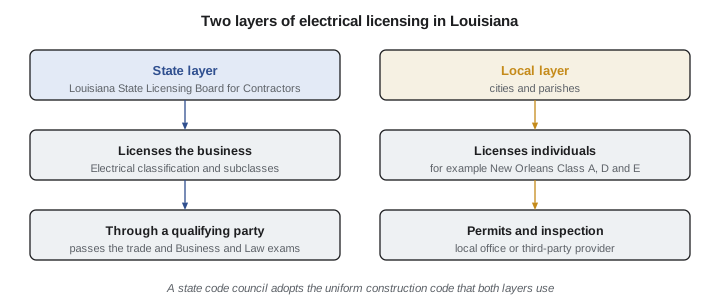
Louisiana regulates electrical work in two layers, and much of the confusion candidates bring to this course comes from mixing them up. The first layer is the state contractor license. The Louisiana State Licensing Board for Contractors, usually shortened to LSLBC or simply the board, licenses businesses that contract for construction work. It sorts that work into classifications, and electrical work is a major classification of its own. A business that holds the Electrical classification has shown the board that it has a qualifying party who passed the required exams, that it meets the financial requirements, and that it has the insurance the law requires.
The second layer is the individual electrician. Louisiana does not issue a statewide master or journeyman electrician license to individuals. Instead, many cities and parishes license individual electricians themselves. New Orleans, for example, issues a Class A master electrical license, a Class D journeyman electrical license and a Class E electrician trainee license through its Department of Safety and Permits. Secondary sources describe similar local programs in other parishes, such as Jefferson Parish and East Baton Rouge Parish. The details vary from place to place, so a contractor who works in several parishes needs to know what each one asks for.
That split explains the long name of this course. The state credential that most candidates mean when they say they want to become a Louisiana master electrician is the qualifying party role for a contractor licensed in the Electrical classification. The local credential that carries the word master in its name is a city or parish license such as the New Orleans Class A. Many electricians hold both. Nadia will need the first to replace Remy as the company's qualifying party, and she wants the second because Bayou Teche has started bidding work in New Orleans.
The state board and its classifications
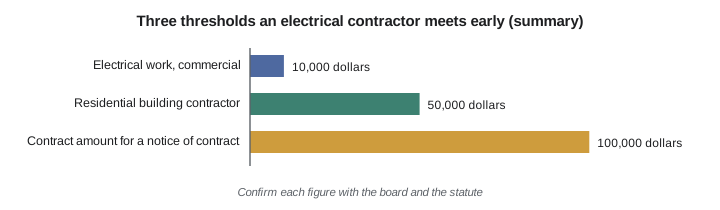
The contractor licensing law begins at La. R.S. 37:2150 in Title 37 of the Revised Statutes. It creates the board, defines the kinds of contractors it licenses and sets the thresholds above which a license is required. The board's classifications page lists the major classifications and their subclassifications. Electrical work appears as its own major classification, which the board lists with a trade exam. Under the board's guidance, a contractor needs the Electrical classification to perform electrical work on a commercial project when the value of that work, including labor and materials, is above 10,000 dollars.
The board also lists several narrower subclassifications related to electrical work. Electrical Controls, Instrumentation and Calibration and Electrical Transmission Lines each carry their own trade exam. Telecommunications Low Voltage is listed without a trade exam, but the board notes that low voltage cabling run through walls, ceilings or floors needs the Electrical classification. Labor-only subclassifications cover businesses that supply labor without materials. A candidate preparing for this course is aiming at the full Electrical classification, which covers all of those narrower kinds of work.
| Credential | Who issues it | What it covers |
|---|---|---|
| Electrical classification | State board (LSLBC) | A business contracting for commercial electrical work above the threshold |
| Electrical subclassifications | State board (LSLBC) | Narrower work such as controls and instrumentation or transmission lines |
| Residential building contractor | State board (LSLBC) | Residential construction above its own threshold |
| Qualifying party | Named on the state license | The person who passed the exams for the business |
| Class A master electrical license | City of New Orleans | The responsible master for a company doing electrical work in the city |
| Class D journeyman license | City of New Orleans | Electrical work under a Class A contractor |
The qualifying party
Louisiana licenses the business, but a person has to earn the license for it. That person is the qualifying party. Under La. R.S. 37:2156.1, a business must name a qualifying party for each classification it holds and for the business and law requirement. The qualifying party passes the exams on the business's behalf and must be a principal of the business or a full-time employee. If the qualifying party leaves, the license depends on naming and qualifying a replacement. That is why Remy's retirement is a licensing event, not just a staffing change: without a qualifying party who has passed the Electrical trade exam, Bayou Teche could lose the classification its work depends on.
Two exams stand between Nadia and that role. The first is the trade exam for the Electrical classification, an open-book test on the National Electrical Code and related references. The second is the Business and Law exam, which every applicant must pass and which covers Louisiana licensing law, contracts, liens and privileges, taxes, labor law, insurance and business management. Lessons 3 and 4 cover how to book them and what they look like.
Residential work
Residential construction is handled differently. The board licenses residential building contractors when the total cost of a residential project is above 50,000 dollars, and it handles smaller home improvement work through a separate registration. The board's classifications page does not list a separate residential electrical subclassification. An electrical contractor that works on homes generally works as a subcontractor to a licensed residential builder or holds the Electrical classification for its own work, and local electrician licensing and permits apply on top of that. Candidates who plan to work mostly on homes should check with the board which registration or license fits their business model.
A state license and local exams
One provision of the licensing law matters a great deal to electrical contractors who work in more than one parish. Section 37:2156.1 says that electrical, mechanical and plumbing contractors licensed by the state board, and their employees, are not required to go through local examination procedures and may work in any jurisdiction after paying the local fees. In plain terms, a state-licensed electrical contractor does not have to sit a separate parish exam to contract for electrical work there. Local permits, inspections, fees and registrations still apply, and some cities still license individual electricians for other purposes, so the contractor's office should call each jurisdiction before the first job there.
New Orleans shows how this works in practice. Its Class A master electrical license can be issued on the strength of an ICC electrical contractor exam result, or on the strength of a statewide license from the board together with a letter naming the qualifying party. Only one Class A holder is allowed per company. For Bayou Teche, that means Nadia's state exams can carry into New Orleans without a separate city exam, as long as the city's other conditions are met. Lesson 8 covers the insurance New Orleans asks for.
Codes, permits and inspectors
Louisiana has a statewide building code, the Louisiana State Uniform Construction Code, which includes the National Electrical Code. A state council has adopted the code editions, and parishes and cities enforce them through their own permit and inspection offices or through registered third-party providers. As of 2026 the state was moving toward newer editions and a new commission structure created by the legislature. Lesson 5 covers the editions and lesson 6 covers who issues permits and who inspects.
The board is not the inspector. It licenses contractors, investigates unlicensed contracting and disciplines licensees, but it does not inspect electrical installations. The parish or city permit office, or its third-party provider, does that. Keeping the two roles straight helps on the Business and Law exam and in real disputes, because a complaint about the quality of an installation and a complaint about who was allowed to do it go to different offices.
# Which state credential applies? (simplified study aid; confirm with the board)
def state_need(kind, electrical_value, residential_total=0):
    if kind == "commercial":
        if electrical_value > 10000:
            return "Electrical classification (state board)"
        return "Below the state threshold; local rules still apply"
    if kind == "residential":
        if residential_total > 50000:
            return "Residential builder license for the prime; electrical sub follows board and local rules"
        return "Check home improvement registration and local rules"
    return "Ask the board"

jobs = [("Dental office fit-out", "commercial", 48500, 0),
        ("Small sign circuit", "commercial", 6200, 0),
        ("New house, 310,000 dollars total", "residential", 22000, 310000),
        ("Kitchen remodel", "residential", 4800, 38000)]
for name, kind, val, total in jobs:
print(name, "->", state_need(kind, val, total))Dental office fit-out -> Electrical classification (state board) Small sign circuit -> Below the state threshold; local rules still apply New house, 310,000 dollars total -> Residential builder license for the prime; electrical sub follows board and local rules Kitchen remodel -> Check home improvement registration and local rules
The study aid is deliberately simple. Real projects raise harder questions: whether a set of small contracts on one site is one project, whether owner-supplied equipment counts toward the value, and how local rules apply below the state threshold. Its value is the habit of asking two questions on every job: which state credential covers this work, and what does the parish or city require on top of it.
What the board enforces
The board can deny, suspend or revoke licenses, issue fines and pursue contractors who work without a license. Its compliance staff visit job sites, follow up on complaints from owners and competitors, and check whether contractors on permits and public bids are properly licensed. Common problems include working above the threshold without the right classification, letting a license lapse, losing a qualifying party without replacing one, and bidding through a company name that does not match the license. Lesson 7 covers the qualifying party's duties and the main grounds for discipline.
Worked problem
Sorting out what Nadia needs
Bayou Teche holds the state Electrical classification with Remy as qualifying party. Nadia holds a New Orleans Class D journeyman license from her years in the city. Remy will retire in 2027, and the company wants to keep its state license and start pulling permits in New Orleans. What does Nadia need?
Show solution
- To keep the state classification, the company needs a new qualifying party who passes the Electrical trade exam and the Business and Law exam and who is a principal or full-time employee.
- Her Class D license is a local journeyman credential; it does not qualify the company with the state board.
- Once she is the qualifying party on the state license, New Orleans can issue her a Class A license on the strength of that license and a qualifying party letter, if the city's other conditions are met.
- She should confirm each step with the board and the city before relying on it.
Answer: Pass both state exams and become the qualifying party, then apply to New Orleans for the Class A license using the state license.
How this course is organized
The lessons follow the path Nadia will take. Lesson 2 covers eligibility for the two credentials. Lesson 3 covers applying to the board, approval and booking the exams. Lesson 4 covers the format of the trade exam and the references allowed. Lesson 5 covers the NEC as adopted in Louisiana. Lesson 6 covers permits and inspection. Lesson 7 covers the duties of a qualifying party and a local master. Lesson 8 covers licensing conditions, insurance and bonding. Lesson 9 covers contracts and privileges under the Private Works Act. Lesson 10 covers safety law and workers' compensation. Lesson 11 covers renewal. Lesson 12 is a practice exam review and a test-day plan.
Common mistakes
MistakeAssuming Louisiana issues a statewide master electrician license to individuals.
InsteadThe state board licenses contracting businesses; master and journeyman licenses for individuals are issued by cities and parishes such as New Orleans.
MistakeTreating a New Orleans Class D journeyman license as a state credential.
InsteadIt is a city license; it does not qualify a business with the state board.
MistakeThinking a state license removes the need for local permits.
InsteadThe state license removes local examination for electrical contractors; permits, inspections and fees still apply.
MistakeTreating the board as the electrical inspector.
InsteadThe board licenses and disciplines contractors; parishes, cities and their providers inspect.
Summary and key terms
- The Louisiana State Licensing Board for Contractors licenses businesses in classifications; Electrical is a major classification with its own trade exam.
- The Electrical classification is needed for commercial electrical work valued above 10,000 dollars, according to the board.
- A qualifying party passes the exams for the business and must be a principal or full-time employee.
- Individual master and journeyman licenses are issued by cities and parishes, such as the New Orleans Class A and Class D.
- State-licensed electrical contractors are not subject to local examination procedures but still pay local fees and follow local permit rules.
- LSLBC
- The Louisiana State Licensing Board for Contractors, which licenses contracting businesses.
- Classification
- A category of construction work the board licenses, such as Electrical.
- Qualifying party
- The person who passes the required exams on behalf of a licensed business.
- Business and Law exam
- The exam every applicant must pass on Louisiana licensing law and business practice.
- Class A license
- The New Orleans master electrical license held by one responsible person per company.
Practice problems
Work each problem on paper first, then reveal the answer to check.
Which agency licenses an electrical contracting business in Louisiana?
Show answer
The Louisiana State Licensing Board for Contractors.
Above what value of electrical work on a commercial project does the board require the Electrical classification?
Show answer
Above 10,000 dollars, including labor and materials.
Who passes the exams for a licensed business?
Show answer
Its qualifying party, who must be a principal or full-time employee.
Does a state-licensed electrical contractor need to pass a separate parish exam?
Show answer
No; the statute exempts it from local examination procedures, but local fees and permits still apply.
Lesson quiz · 5 questions
Score 60% or more to complete this lesson.
Create a free account to save your progress, take quizzes and earn a certificate.