
MELU-218 · Lesson 10 of 12 · 19 min
Workplace safety law and OSHA for electrical contractors
▶ Video coming soon A video version of this lesson is on the way.
Bayou Teche had gone four years without a lost-time injury when a helper on a Lafayette warehouse job reached into a panel that a foreman had told him was dead. The main breaker was off, but a second feeder from a generator transfer switch was still live, and the helper took a shock through his hand. He was back at work in three days, and the company reported the injury to its insurer the same week. Remy called the whole company into the shop the next Monday. "Off is not the same as safe," he said. "We test before we touch, every time, on every conductor." Nadia wrote the company's new lockout and testing procedure that month, and she has used the incident in every safety talk since.
This lesson covers who enforces workplace safety for Louisiana electrical contractors, the OSHA standards that matter most for electrical work, an electrically safe work condition, arc flash and the role of NFPA 70E, the hierarchy of controls, injury records and reporting to OSHA, the Louisiana workers' compensation law and its reporting duties, and incident rates. The OSHA construction standards are also a reference on the trade exam, as lesson 4 explains.
Who enforces workplace safety
Louisiana does not operate a state OSHA plan for private employers, so federal OSHA enforces workplace safety standards for private electrical contractors in the state through its area offices. Federal OSHA can inspect a job site after a complaint, a referral, a serious injury report or a targeted program, and it can issue citations and penalties. The state board's rules expect licensees to follow safety laws, and serious safety failures can become part of a board case, but the board does not enforce OSHA standards itself.
Workers' compensation is a separate system. It does not set safety rules; it provides benefits to injured workers and protects employers from most lawsuits by their employees. But it is closely tied to safety, because the cost of a company's insurance reflects its injury history.
| Standard | Where it is | What it covers in general |
|---|---|---|
| Electrical, construction | 29 CFR 1926 Subpart K | Installation safety, ground-fault protection, lockout and tagging on construction sites |
| Electrical, general industry | 29 CFR 1910 Subpart S | Safe work practices and installation rules in operating facilities |
| Control of hazardous energy | 29 CFR 1910.147 | Lockout and tagout during servicing and maintenance in general industry |
| Fall protection | 29 CFR 1926 Subpart M | Protection when working at heights on construction sites |
| Ladders and scaffolds | 29 CFR 1926 Subparts X and L | Safe use of ladders and scaffolds |
| Recordkeeping and reporting | 29 CFR 1904 | Injury logs and reporting of severe injuries |
An electrically safe work condition
The safest electrical work is done on equipment that has been put into an electrically safe work condition. In general terms, that means identifying every source of supply, opening the disconnecting devices, verifying that the disconnects are open, applying locks and tags, testing each conductor and circuit part for the absence of voltage with a properly rated tester that has been checked on a known source, and grounding where stored or induced energy could be present. The Lafayette incident happened because one source was missed and nobody tested before touching.
OSHA's rules require deenergizing before work unless deenergizing would create a greater hazard or is infeasible, and they require qualified persons, appropriate protective equipment and safe work practices when energized work is justified. NFPA 70E, the Standard for Electrical Safety in the Workplace, is a consensus standard that many employers use to meet OSHA's general requirements. It sets out risk assessments for shock and arc flash, approach boundaries, energized work permits and selection of protective equipment. OSHA does not adopt NFPA 70E by reference, but it has used it as evidence of recognized hazards and feasible protections.
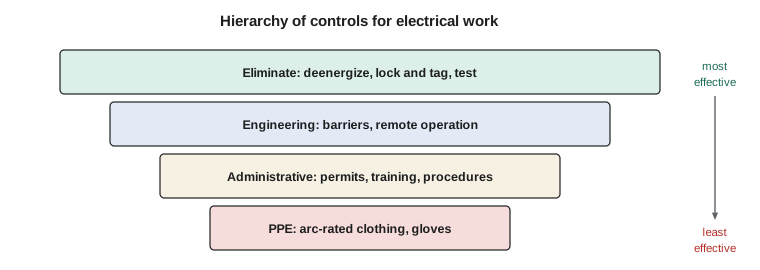
The hierarchy of controls
Safety professionals rank controls by how reliably they protect workers. Elimination comes first: if the equipment is deenergized and tested, there is no shock or arc flash hazard. Engineering controls come next, such as barriers, remote racking and remote switching. Administrative controls, such as procedures, permits, training and signs, depend on people following them. Personal protective equipment is last, because it reduces harm only after something has gone wrong. A good electrical safety program puts most of its effort at the top of the hierarchy.
Training and qualified persons
OSHA requires that workers who face electrical hazards be trained in the practices that protect them, and it distinguishes qualified persons, who are trained to work on or near exposed energized parts, from unqualified persons, who must stay away from them. Training should cover the company's lockout and testing procedure, approach boundaries, protective equipment and its care, emergency response and first aid. Records of training should be kept. Nadia's program requires every helper to complete a classroom session and a field demonstration before working near any panel, and every journeyman to repeat the lockout demonstration once a year.
Injury records and reporting to OSHA
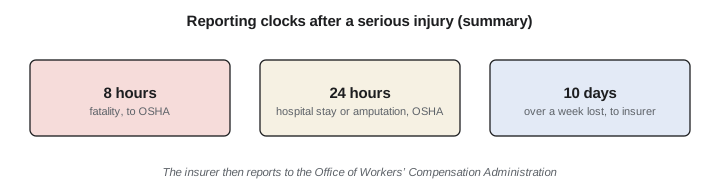
Employers covered by OSHA's recordkeeping rule keep a log of recordable work-related injuries and illnesses, complete an incident report for each, and post an annual summary. Many small employers and some low-hazard industries are partially exempt from keeping the log, but construction contractors with more than ten employees generally are not. All employers must report to OSHA a work-related fatality within 8 hours, and an in-patient hospitalization, an amputation or the loss of an eye within 24 hours.
Louisiana workers' compensation
Louisiana's workers' compensation law, beginning at La. R.S. 23:1021, provides medical treatment and wage benefits to employees injured in the course and scope of employment, and in return limits most lawsuits by employees against their employers. Under La. R.S. 23:1306, an employer must report to its insurer within 10 days of actual knowledge of an injury that results in death or in lost time of more than one week, and the insurer reports electronically to the Office of Workers' Compensation Administration. Many employers report every injury to their insurer promptly, whatever its severity, because prompt reporting helps claims and avoids disputes.
The Lafayette helper's injury caused three days of lost time, so the 10-day statutory report was not triggered, but Bayou Teche reported it to its insurer that week anyway. Remy's rule is simple: if someone is hurt, the office knows by the end of the day, the insurer knows by the end of the week, and the OSHA log entry, if one is needed, is made within the time the rule allows.
# Incident rates for a year (simplified study aid)
hours_worked = 38 * 2000
recordable_cases = 3
dart_cases = 1
trir = recordable_cases * 200000 / hours_worked
dart = dart_cases * 200000 / hours_worked
print("hours worked:", hours_worked)
print("total recordable incident rate:", round(trir, 2))
print("days away, restricted or transferred rate:", round(dart, 2))hours worked: 76000 total recordable incident rate: 7.89 days away, restricted or transferred rate: 2.63
The 200,000 in the formula is the number of hours 100 full-time workers work in a year, so the rates are cases per 100 workers. General contractors and owners often ask for these rates, along with the experience modification factor, when they prequalify subcontractors. A company with high rates may be excluded from bidding, which is one more reason safety and the business are linked.
A written safety program
A written safety program puts the company's rules in one place: the policy statement, responsibilities, the lockout and testing procedure, energized work rules, protective equipment, fall protection, ladders, excavations, vehicles, hazard communication, emergency action and incident investigation. It should be short enough to be read and specific enough to be followed. Weekly toolbox talks, job hazard analyses for unusual tasks and incident reviews keep it alive.
Ground-fault protection on construction sites
OSHA's construction standards require employers to protect workers from ground faults on temporary wiring and cord-and-plug equipment, either with ground-fault circuit interrupters on receptacle outlets that are not part of the permanent wiring or, where allowed, with an assured equipment grounding conductor program. GFCI protection is the common choice. Cords and tools are inspected before use, and damaged cords are removed from service. On many sites the temporary power is the first electrical work done and the last thing anyone thinks about, which is why it causes so many shocks. Nadia's foremen test the GFCIs on temporary panels at the start of every week and log the result.
Fall protection and ladders
Falls cause more serious construction injuries than electrical contact, and electricians spend much of their day on ladders and lifts. OSHA's construction standards require fall protection at set heights, safe ladder selection and setup, and training for workers who use scaffolds and aerial lifts. For electricians the most important rules in practice are using ladders made for electrical work, which have nonconductive side rails, setting extension ladders at the right angle and securing them, and using a harness and lanyard in boom lifts. The ladder fall in this lesson's example is typical: a stepladder used too high, on an uneven floor, with no one holding it.
OSHA inspections
An OSHA inspection usually begins with an opening conference in which the compliance officer explains the reason for the visit and the scope. The officer may walk the site, interview workers, review records such as the injury log and training records, and take photographs. At the closing conference the officer discusses apparent violations. Citations, if any, are issued in writing and list the standard, the classification of the violation and the proposed penalty, with time limits for correcting the hazard and for contesting the citation. A contractor should know in advance who will meet the officer, where the records are kept, and when to call the company's lawyer.
Multi-employer worksites raise their own questions. OSHA can cite the employer that created a hazard, the employer whose workers were exposed, the employer responsible for correcting it and the employer with general supervisory authority, such as a general contractor. An electrical subcontractor can therefore be cited for a hazard its own workers did not create if they were exposed and it did nothing. The practical answer is to report hazards to the general contractor in writing and to keep crews away from them until they are corrected.
Worked problem
Responding to an injury
A Bayou Teche electrician falls from a ladder on a Monday and is admitted to the hospital overnight. He is expected to miss two weeks of work. What reports are due?
Show solution
- The in-patient hospitalization must be reported to OSHA within 24 hours.
- The injury results in lost time of more than one week, so the employer must report to its insurer within 10 days of actual knowledge under La. R.S. 23:1306.
- The case is recordable, so it goes on the OSHA log within the time the recordkeeping rule allows.
- The company should investigate the cause and correct it, such as ladder selection or setup.
Answer: Report to OSHA within 24 hours, report to the insurer within 10 days, record the case and investigate it.
Common mistakes
MistakeTreating an open main breaker as proof that a panel is dead.
InsteadIdentify every source, lock and tag, and test every conductor before touching.
MistakeAssuming Louisiana has a state OSHA plan for private employers.
InsteadFederal OSHA covers private employers in Louisiana.
MistakeRelying on protective equipment instead of deenergizing.
InsteadUse the hierarchy of controls and deenergize where possible.
MistakeWaiting to report a lost-time injury to the insurer.
InsteadReport within 10 days of actual knowledge when the statute applies, and sooner in practice.
Summary and key terms
- Federal OSHA enforces workplace safety for private electrical contractors in Louisiana.
- Key standards include 1926 Subpart K, 1910 Subpart S, 1910.147 and the fall protection, ladder and recordkeeping rules.
- An electrically safe work condition requires identifying sources, opening disconnects, locking, tagging and testing for absence of voltage.
- Fatalities are reported to OSHA within 8 hours and in-patient hospitalizations, amputations and eye losses within 24 hours.
- Under La. R.S. 23:1306, an employer reports to its insurer within 10 days of actual knowledge of an injury causing death or more than a week of lost time.
- Electrically safe work condition
- A state in which equipment is deenergized, locked, tagged and tested.
- NFPA 70E
- The consensus standard for electrical safety in the workplace.
- Qualified person
- A worker trained to work on or near exposed energized parts.
- TRIR
- The total recordable incident rate per 100 full-time workers.
- OWCA
- The Office of Workers' Compensation Administration in the Louisiana Workforce Commission.
Practice problems
Work each problem on paper first, then reveal the answer to check.
Who enforces OSHA standards for a private Louisiana electrical contractor?
Show answer
Federal OSHA.
Within how many hours must an in-patient hospitalization be reported to OSHA?
Show answer
24 hours.
Within how many days must an employer report a death or more than a week of lost time to its insurer?
Show answer
10 days of actual knowledge.
What is the last step before touching a deenergized conductor?
Show answer
Test it for absence of voltage with a checked tester.
Lesson quiz · 5 questions
Score 60% or more to complete this lesson.
Create a free account to save your progress, take quizzes and earn a certificate.