
MELU-218 · Lesson 11 of 12 · 19 min
Renewal and continuing education
▶ Video coming soon A video version of this lesson is on the way.
Every summer for thirty years, Celeste's calendar had the same two entries in red: the renewal of Bayou Teche's state license on the anniversary of its issue, and, since the company started working in New Orleans, the renewal of Remy's Class A license before his birthday. When the company's low voltage subsidiary let its license lapse for six weeks in 2014 because a renewal notice went to an old address, a general contractor withheld payment until the license was reinstated and the board opened a file. Nobody at Bayou Teche wanted to repeat that. Now that Nadia was becoming the qualifying party and would soon hold the Class A license herself, Celeste added a third entry: Nadia's birthday.
This lesson covers how state contractor licenses renew, what the board expects at renewal, continuing education and which license types require it, local license renewals using New Orleans as the example, what happens when a license lapses, and a simple system for keeping every credential and certificate current.
How state licenses renew
The board's materials describe a contractor license as valid for one year at first, after which it can be renewed. Secondary sources describe licenses as expiring on the anniversary of the date they were issued, and some describe renewal terms of one, two or three years after the first year; other secondary sources give a calendar-year date. Because the sources are not consistent, the safe practice is to read the expiration date printed on the license and the board's current renewal instructions, and to start the renewal well before that date. Renewal is done through the board's online system or by the method its instructions describe, with the renewal fee.
At renewal, the board expects the business to confirm that its information is current, that its qualifying parties are still in place, and that it carries the required insurance. A business that has changed its name, address, ownership or qualifying parties should already have reported those changes, but renewal is a good time to check that the board's records match the company's.
| Credential | Term and timing | Continuing education |
|---|---|---|
| State commercial license, including Electrical | One year at first; renews by the expiration date on the license | Not required for commercial licenses, per the board's page |
| State residential building contractor license | Renews by the expiration date on the license | 6 hours each year from a board-approved provider |
| New Orleans Class A master electrical | Annual; expires on the holder's birthday | Check with the city |
| New Orleans Class D journeyman | Annual | Check with the city |
| Other local licenses | Set by each city or parish | Set by each city or parish |
Continuing education
The board's continuing education page says that residential building contractors must complete at least six hours of continuing education each year from a board-approved provider, and must keep their certificates of completion for five years. A residential contractor who also holds a current commercial license in one of four major building and public works classifications is treated as having met the requirement. The page states that commercial contractors, mold remediation contractors and home improvement registrants have no continuing education requirement. The Electrical classification is a commercial classification, so the board does not require continuing education to renew it.
That does not mean a qualifying party should stop learning. The NEC changes every three years, Louisiana adopts new editions on its own schedule, and the 2026 act changed how the code is governed. A local license may carry its own education requirement, and many owners and general contractors expect their subcontractors' supervisors to keep current. Nadia's plan is to take a code update course whenever the state adopts a new edition and to attend at least one safety or business course each year, whether or not anyone requires it.
Local renewals: New Orleans
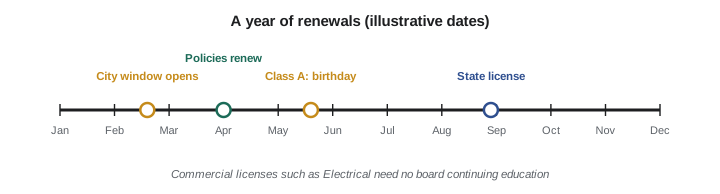
New Orleans lists the renewal terms for its Class A master electrical license on the city's license page. The license is renewed annually and expires on the holder's birthday, with renewal opening 90 days before. The city lists an annual fee of 125 dollars for an active license and 30 dollars for an inactive one, with a delinquent fee of 10 dollars for each month late. A license that has been delinquent for more than a year requires the holder to retake the ICC exam. The holder must also keep the company's insurance certificates current with the city as certificate holder. For the Class D journeyman license, the city lists an annual fee of 60 dollars and a late fee of 5 dollars a month.
Other cities and parishes set their own terms. A contractor that holds local licenses in several places keeps a list of each one's term, renewal window, fee and any education or insurance requirement, alongside its permit office profiles.
# Renewal calendar for one year (illustrative dates)
from datetime import date, timedelta
state_expires = date(2027, 8, 31)
birthday = date(2027, 5, 19)
city_window_opens = birthday - timedelta(days=90)
policies = {"general liability": date(2027, 4, 1), "workers' compensation": date(2027, 4, 1), "auto": date(2027, 10, 15)}
items = [("State license expires", state_expires),
         ("Start state renewal (60 days ahead)", state_expires - timedelta(days=60)),
         ("New Orleans Class A window opens", city_window_opens),
         ("New Orleans Class A expires", birthday)]
items += [("Policy renews: " + k, v) for k, v in policies.items()]
for label, d in sorted(items, key=lambda x: x[1]):
    print(d.isoformat(), label)
months_late = 3
print("Class A fee if paid", months_late, "months late:", 125 + 10 * months_late, "dollars")2027-02-18 New Orleans Class A window opens 2027-04-01 Policy renews: general liability 2027-04-01 Policy renews: workers' compensation 2027-05-19 New Orleans Class A expires 2027-07-02 Start state renewal (60 days ahead) 2027-08-31 State license expires 2027-10-15 Policy renews: auto Class A fee if paid 3 months late: 155 dollars
When a license lapses
A lapsed state license means the business is not licensed for the work its classifications covered. Bidding or performing work above the thresholds while unlicensed can lead to penalties from the board, problems with permits, withheld payments and challenges to contracts. The board's rules provide for reinstatement of an expired license, with fees and conditions that depend on how long it has been expired; a license that has been expired for a long time may require the applicant to meet current requirements again, which can include exams. A lapsed local license can stop permits in that jurisdiction, and in New Orleans a Class A license delinquent for more than a year requires a new ICC exam.
The most common causes of lapses are ordinary: a notice sent to an old address, a renewal left to the last day, an insurance certificate that expired the week before, or a qualifying party who left without a replacement. Each has a simple fix: keep contact information current with the board, renew early, track insurance renewals, and plan qualifying party changes in advance.
A system for staying current
Celeste's system has four parts. A single calendar holds every expiration date: the state license, each local license, every insurance policy, every bond that renews and each qualifying party's birthday where a local license depends on it. A checklist for each renewal lists the documents needed. Reminders go out at 90, 60 and 30 days. And after each renewal, a copy of the new license or certificate goes into the binder and to every party that needs it, such as general contractors and city offices. The system takes an hour a month and has kept the company's licenses current for ten years.
Nadia added one more step for herself as the incoming qualifying party: a yearly review, each January, of the board's rules page, the code council's or commission's notices, and the PSI bulletin, so that she knows what has changed in the rules she is responsible for.
Renewal is also a review
Celeste treats each renewal as a short review of the company's licensing position. Before she files, she checks that the classifications on the license are still the ones the company needs, and whether it should add or drop any. She confirms that the qualifying parties are still in place and still have the required relationship with the business. She compares the insurance on file with the board to the current policies. She checks that the company's name, address and ownership match the Secretary of State record. And she looks at the year ahead: any planned change in ownership, any new market such as public work or a new city, and any qualifying party who may retire or leave.
That review takes less than an hour, and it is how the company caught, two years ago, that its old low voltage subclassification was no longer needed because the Electrical classification covered the same work. Dropping it saved a renewal fee and an extra set of paperwork every year.
Code updates without a requirement
Because the board does not require continuing education for the Electrical classification, the responsibility for staying current falls on the qualifying party. A practical plan includes a code update course after each new state adoption, reading the changes summary for each NEC edition, an annual safety refresher on lockout, arc flash and the OSHA rules that matter most, and one business course a year on topics such as contracts, estimating or payroll. Trade associations, the major code training publishers and the electrical apprenticeship programs offer these courses in Louisiana and online.
Nadia also plans to keep a short log of what she learns each year, the courses, the articles she reread, the code changes she taught her foremen. If a local jurisdiction or a customer ever asks for evidence of training, the log is ready, and it helps her plan the next year.
Changes between renewals
Some changes cannot wait for renewal. The board's rules require licensees to report certain changes, such as a change of qualifying party, a change of address, a change in the business's name or legal form, and certain changes in ownership, within the time the rules set. Converting from a partnership to a limited liability company, or merging with another business, may require a new license rather than an update. A company planning any of these changes should call the board first and ask what filing is required and how long it will take.
Worked problem
Planning Nadia's first renewal year
Nadia becomes the qualifying party on April 15, 2027, and receives her New Orleans Class A license on May 3. Her birthday is May 19. The company's state license expires August 31. Which renewals come first, and what should Celeste schedule?
Show solution
- The New Orleans Class A license expires on Nadia's birthday, May 19; check whether a license issued so close to the birthday runs to the following year's birthday and confirm with the city.
- The state license renews by August 31, so Celeste starts the renewal by early July.
- No board continuing education is required for the Electrical classification, but the insurance certificates must be current at each renewal.
- Celeste adds all of these to the calendar with reminders at 90, 60 and 30 days.
Answer: Confirm the first Class A term with the city, renew the state license by August 31, and calendar every date with reminders.
Common mistakes
MistakeAssuming the Electrical classification requires continuing education from the board.
InsteadThe board's page says commercial licenses have no continuing education requirement; check local licenses separately.
MistakeRelying on renewal notices arriving in the mail.
InsteadCalendar every expiration date and renew early.
MistakeLetting a New Orleans Class A license stay delinquent for more than a year.
InsteadA delinquency of more than a year requires retaking the ICC exam.
MistakeForgetting that insurance certificates must be current at renewal.
InsteadTrack policy renewals and send new certificates to the board and city.
Summary and key terms
- State contractor licenses are valid for one year at first and renew by the expiration date shown on the license; confirm terms with the board.
- The board requires six hours of continuing education each year for residential building contractors, and none for commercial licenses such as Electrical.
- The New Orleans Class A license renews annually on the holder's birthday, with a 90-day window and monthly late fees.
- A Class A license delinquent for more than a year requires a new ICC exam.
- A single calendar with reminders, checklists and copies of every renewal keeps a company's credentials current.
- Renewal
- Extending a license for a new term by meeting the requirements and paying the fee.
- Lapse
- The expiration of a license that was not renewed in time.
- Reinstatement
- Restoring an expired license under the board's rules.
- Continuing education
- Approved courses some licenses require for renewal.
- Delinquent fee
- A late charge added for renewing after the expiration date.
Practice problems
Work each problem on paper first, then reveal the answer to check.
Does the board require continuing education to renew the Electrical classification?
Show answer
No; its page says commercial licenses have no continuing education requirement.
How many hours of continuing education does a residential building contractor need each year?
Show answer
Six hours from a board-approved provider.
When does a New Orleans Class A license expire?
Show answer
On the holder's birthday each year.
What happens if a Class A license is delinquent for more than a year?
Show answer
The holder must retake the ICC exam.
Lesson quiz · 5 questions
Score 60% or more to complete this lesson.
Create a free account to save your progress, take quizzes and earn a certificate.