
MELU-218 · Lesson 4 of 12 · 19 min
The exam format and the references allowed
▶ Video coming soon A video version of this lesson is on the way.
Nadia's first timed practice set did not go well. She answered 41 of 80 questions in the four hours she had set herself, got 33 of them right, and spent almost half an hour on a single motor question because she could not find the right table in her code book. That evening Remy came by with the copy of the NEC he had used for his own exam in 1992, its pages soft and its tabs long gone. "The test isn't about what you know," he said. "It's about how fast you can find what you know. You can bring the book. So the book has to work for you." They spent the next weekend tabbing a new code book, reading the bulletin's rules on what could be written in it, and building a pacing plan.
This lesson describes the two exams a qualifying party for the Electrical classification takes: the Electrical trade exam and the Business and Law exam. It covers the reported format of each, the references allowed, the rules for tabs and notes, how to prepare the books, calculators, and a pacing plan. The details here come from the board's pages, NASCLA's listing and exam preparation providers; the current PSI candidate information bulletin is the authority, and candidates should check every point in it.
The Electrical trade exam
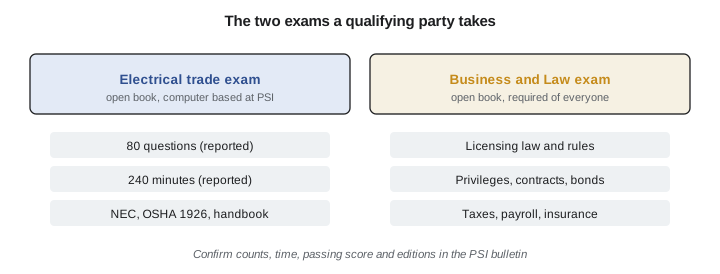
Exam preparation providers describe the board's Electrical trade exam, listed by some of them as Electrical Work (Statewide), as an open-book, computer-based exam of 80 questions with 240 minutes allowed and a passing score of 70. Those same sources list the references as the 2023 edition of the National Electrical Code, the OSHA construction standards in 29 CFR Part 1926, and an electrical reference handbook such as Ugly's Electrical References. Confirm each of these points, especially the code edition, in the current bulletin, because Louisiana was still enforcing the 2020 NEC in late 2026 while the exam outline had moved to the 2023 edition. Lesson 5 explains that gap.
An 80-question, four-hour exam gives a candidate three minutes per question on average. That sounds generous until a question needs a lookup in three places and a calculation. Questions cover the topics in the content outline: general requirements and definitions, wiring methods and materials, branch circuits and feeders, services, overcurrent protection, grounding and bonding, equipment for general use, motors and controls, special occupancies and equipment, load calculations, and safety. The outline gives the approximate number of questions in each area, which tells a candidate where to spend study time.
| Feature | Electrical trade exam (reported) | Business and Law exam |
|---|---|---|
| Delivered by | PSI, computer based | PSI, computer based |
| Books | Open book: NEC, OSHA 1926, reference handbook | Open book: the board-approved business and law reference |
| Questions | 80 | See the current bulletin |
| Time | 240 minutes | See the current bulletin |
| Passing score | 70 | See the current bulletin |
| Waived by reciprocity? | May be, under an agreement | Never |
The Business and Law exam
The Business and Law exam tests the knowledge a business owner needs in Louisiana. Its content outline covers topics such as the contractor licensing law and the board's rules, business organization, contracts and bidding, the Private Works Act and privileges, public works law, insurance, bonds, taxes, payroll and labor law, workers' compensation, safety and recordkeeping, and financial management such as estimating, cash flow and accounting basics. It is open book, using a business and law reference named in the bulletin. Every applicant must pass it, including those who qualify for the trade exam by reciprocity or by a national exam.
Electricians who are strong on the code are sometimes surprised by this exam. The questions are not hard in the way a load calculation is hard, but they cover unfamiliar ground: depreciation, payroll tax deposits, lien deadlines, the difference between an S corporation and a limited liability company, retainage and what a payment bond does. The best preparation is to read the reference once with care, tab it by topic and then work timed practice sets, just as for the trade exam.
What the books may contain
Open-book exams have rules about what the books may contain. Exam preparation providers describe the board's rules as allowing permanent tabs and highlighting while not allowing loose papers or removable notes. Permanent tabs are generally tabs that are glued or taped so that they cannot be moved or used to carry notes. Handwritten notes in the margins, sticky notes, inserted pages and removable flags are commonly not allowed. The bulletin's wording is what the test center will apply, so read it before you mark a single page.
Nadia and Remy followed a simple rule: if a mark would help someone cheat, leave it out; if it only helps you find something, it is probably allowed, but check. They used permanent adhesive tabs for each article group, colored highlighting for key definitions, and no writing beyond what the bulletin allows. Remy also recommended buying a fresh copy rather than tabbing a book full of old notes, so that nothing in it could cause trouble at the door.
Tabbing the code book
A good tab layout follows the way the exam asks questions. Tabs at the start of each chapter help with the first jump, and tabs at the most-used articles help with the second: definitions, branch circuits, feeders, branch-circuit and feeder calculations, services, overcurrent protection, grounding and bonding, wiring methods, conductors, boxes, motors, transformers, hazardous locations, health care, swimming pools and the chapter 9 tables. Many candidates also tab the index, because the index is the fastest way into an unfamiliar topic.
The exam also lists the OSHA construction standards and an electrical handbook. Tab the OSHA book at the electrical subpart, fall protection, ladders and scaffolds, excavations, and the general rules on training and recordkeeping. Tab the handbook at the conversion tables, conductor and conduit tables, motor and transformer formulas and voltage drop. The handbook is often faster than the code book for formulas, but code questions must be answered from the code.
Pacing
A pacing plan turns the four hours into checkpoints. The two-pass method, covered in more detail in lesson 12, works well on open-book exams. On the first pass, answer every question you can answer from memory or with one quick lookup, mark the rest and keep moving. On the second pass, work the marked questions in order of how close you are to the answer. Leave no question blank, because a blank is always wrong and a guess may not be.
# Pacing checkpoints for an 80-question, 240-minute exam (reported format; confirm in the CIB)
questions, minutes = 80, 240
per_q = minutes / questions
print("average minutes per question:", per_q)
need = int(questions * 0.70 + 0.999)
print("correct answers needed for a score of 70:", need)
first_pass = 150
print("on an even pace, questions reached by minute", first_pass, ":", int(first_pass / minutes * questions))
for done in (20, 40, 60, 80):
print(f"by question {done}: about {done * per_q:.0f} minutes elapsed on an even pace")average minutes per question: 3.0 correct answers needed for a score of 70: 56 on an even pace, questions reached by minute 150 : 50 by question 20: about 60 minutes elapsed on an even pace by question 40: about 120 minutes elapsed on an even pace by question 60: about 180 minutes elapsed on an even pace by question 80: about 240 minutes elapsed on an even pace
The output shows why pacing matters. At an even pace a candidate reaches question 40 at about two hours. A candidate who spends half an hour on one question, as Nadia did in her first set, has to make that time up somewhere. The two-pass method protects against that by making sure every easy question is answered before the hard ones take time.
Calculators and other items
The bulletin describes the calculator allowed, generally a silent, battery-operated, non-programmable calculator without a printer, alphabetic keys or text storage. Phones, smart watches and other electronic devices are not allowed in the testing room. Scratch paper or an erasable board may be provided by the test center and collected at the end. Candidates should practice with the same calculator they will use, including square roots and the order of operations for three-phase formulas.
Reading the content outline
The content outline is the most useful single page a candidate can own. It lists the topic areas and, for each one, the approximate number of questions. A topic with twelve questions deserves more study time and more tabs than one with two. The outline also hints at the kinds of questions to expect: an area titled with the word calculations will have arithmetic, and an area that lists specific equipment will have lookups in the articles for that equipment. Nadia copied the outline into a table, added a column for her own confidence in each area from one to five, and used it to decide what to study each week.
The Business and Law outline works the same way. Its areas map to chapters of the reference, and the weight of each area tells a candidate where to spend time. Many candidates underweight the financial management area because it feels far from electrical work, then find that it carries a fair share of the questions.
Practice with the real books
Practice only with the books you will carry into the exam, tabbed the way they will be on exam day. Lookups depend on muscle memory: where a tab sits, how far into an article a table appears, which page an index entry points to. Practicing with a borrowed copy, a different edition or an online version builds the wrong habits. Remy's advice was to treat the exam books as tools that live in one bag and come out only for study and for the exam, so that they are never marked up on a job site or left in a truck in July.
The handbook deserves the same care. Learn which formulas and tables it has and where they are, and when to trust it. A handbook is a convenience; when a question asks what the code requires, the answer must come from the code. Practicing with both books on the desk teaches which one to reach for.
Worked problem
Building a tab plan from the outline
The content outline Nadia downloaded lists about 12 questions on load calculations, 10 on grounding and bonding, 9 on wiring methods and 8 on motors, with the remainder spread over other topics. She has 50 permanent tabs. How should she allocate them?
Show solution
- Put chapter tabs at the start of each NEC chapter first, which uses 9 tabs and handles the first jump in every lookup.
- Put article tabs on the most heavily tested articles: calculations, grounding and bonding, the main wiring method articles and motors.
- Tab the index and the chapter 9 tables, which many questions use.
- Use the remaining tabs for OSHA 1926 and the handbook formulas.
- Check the bulletin's tab rules before applying any of them.
Answer: Chapter tabs first, then the heavily tested articles, then the index and tables, then OSHA and the handbook, all within the bulletin's rules.
Common mistakes
MistakeBuying the NEC edition that is enforced on jobs rather than the one the bulletin lists.
InsteadBuy exactly the editions the bulletin lists for the exam.
MistakeWriting notes in the margins of the code book.
InsteadUse only the marks the bulletin allows, such as permanent tabs and highlighting.
MistakeSpending half an hour on one question.
InsteadMark it, move on and come back on the second pass.
MistakeIgnoring the Business and Law exam because it seems easy.
InsteadRead and tab its reference and work timed practice sets.
Summary and key terms
- The Electrical trade exam is reported as open book, 80 questions, 240 minutes, with a passing score of 70.
- Its references are reported as the 2023 NEC, OSHA 29 CFR 1926 and an electrical reference handbook.
- The Business and Law exam is open book on a board-approved reference and is required of every applicant.
- Permanent tabs and highlighting are generally allowed; loose papers and removable notes generally are not.
- A pacing plan and the two-pass method protect the time needed to answer every question.
- Open book
- An exam on which listed references may be used.
- Permanent tab
- A tab fixed to the page so it cannot be moved or used for notes.
- Content outline
- The list of topics and the approximate number of questions on each.
- Two-pass method
- Answering easy questions first, marking the rest and returning to them.
- Non-programmable calculator
- A basic calculator without memory for text or programs.
Practice problems
Work each problem on paper first, then reveal the answer to check.
How many minutes per question does an 80-question, 240-minute exam allow on average?
Show answer
Three minutes.
How many correct answers are needed to score 70 on 80 questions?
Show answer
56.
Which document sets the editions of the references allowed?
Show answer
The current PSI candidate information bulletin.
What should a candidate do with a question that needs a long lookup on the first pass?
Show answer
Mark it and come back on the second pass.
Lesson quiz · 5 questions
Score 60% or more to complete this lesson.
Create a free account to save your progress, take quizzes and earn a certificate.