
MELU-218 · Lesson 8 of 12 · 19 min
Contractor licensing, insurance and bonding
▶ Video coming soon A video version of this lesson is on the way.
Celeste kept a binder she called "the certificates." In it were Bayou Teche's state license, its New Orleans paperwork, the workers' compensation and general liability certificates, the commercial auto policy, the umbrella, and the bonds the company had posted on public jobs over the last five years. Each certificate had a renewal date written on the tab in red. When Nadia asked what she needed to know about insurance, Celeste opened the binder and said, "All of it. Half the contracts we sign say we have to carry something, and if we let one lapse, the general contractor stops paying until we fix it. The board and the city both want to see these too." They spent an afternoon going through the binder page by page.
This lesson covers the licensing conditions that a licensed electrical contractor must keep up after the license is issued, the insurance the law and the city of New Orleans require, the insurance that contracts usually require, bonds for public and private work, the financial requirements that continue after licensing, and how to keep certificates and bonds in order.
Keeping the license in good standing
A Louisiana contractor license is not a one-time achievement. The business must keep a qualifying party, keep the required insurance in force, renew on time, report changes in its name, address, ownership and qualifying parties, and keep meeting the financial requirements the board applies at renewal or when it asks. A license that lapses for any of these reasons can leave the company unable to bid, unable to pull permits, and exposed to penalties for any work done while unlicensed. Lesson 11 covers renewal; this lesson covers the money and insurance side.
| Coverage or bond | Required by | Notes |
|---|---|---|
| Workers' compensation | La. R.S. 23:1031 and the board | Required with one or more employees |
| General liability | The board for residential licenses; New Orleans; most contracts | Residential minimum reported raised to 500,000 dollars in 2026; New Orleans at least 500,000 dollars |
| Commercial auto | Contracts and prudence | Covers the company's vehicles |
| Umbrella or excess liability | Many larger contracts | Adds limits above the primary policies |
| Bid bond | Public owners and some private owners | Guarantees the bidder will sign the contract |
| Performance and payment bonds | Public works law and many contracts | Protect the owner and those who supply labor and materials |
Workers' compensation
Louisiana's workers' compensation law, beginning at La. R.S. 23:1031, makes employers responsible for benefits to employees injured on the job, and requires them to secure that responsibility with insurance or approved self-insurance. A contractor with one or more employees needs coverage, and the board's application asks for proof. The city of New Orleans asks for a workers' compensation certificate naming the city as certificate holder, or a notarized affidavit if the contractor has no employees. General contractors usually ask subcontractors for certificates before they start work, because a general contractor can be treated as a statutory employer and become responsible for an uninsured subcontractor's injured workers.
Workers' compensation premiums are based on payroll and on classification codes that reflect the risk of the work, adjusted by an experience modification factor that compares the company's loss history with others in the same trade. A company with fewer and less costly claims earns a lower factor and pays less. Lesson 10 covers safety programs and how they affect that factor.
General liability
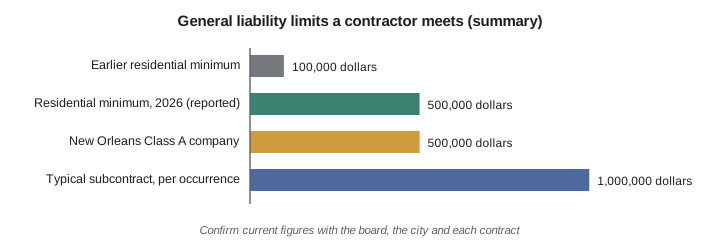
General liability insurance covers claims by third parties for bodily injury and property damage caused by the contractor's operations or completed work. For an electrical contractor, typical claims include a fire traced to a connection, damage to a customer's property during work, and injuries to the public at a job site. Section 37:2156.1 requires residential and home improvement applicants to carry at least 100,000 dollars, and secondary sources report that Act 757 of 2026 raises the residential minimum to 500,000 dollars effective August 1, 2026. New Orleans requires general liability coverage of at least 500,000 dollars for a Class A license holder's company, with the city as certificate holder.
Contracts often ask for much more. A typical commercial subcontract asks for one million dollars per occurrence and two million in the aggregate, with the owner and general contractor added as additional insureds, primary and noncontributory wording and a waiver of subrogation. Those terms have specific meanings in insurance policies, and a contractor should have its agent review every contract's insurance section before signing.
Bonds
A bond is a three-party promise. The contractor, called the principal, buys a bond from a surety company, which promises the owner, called the obligee, that the contractor will do what the bond covers. If the contractor fails, the surety pays and then seeks repayment from the contractor and, usually, its owners under an indemnity agreement. A bond is not insurance for the contractor; it is credit. A surety looks at the company's financial statements, work in progress, experience and the owners' personal finances before writing bonds.
Three kinds of bonds matter most. A bid bond guarantees that a low bidder will sign the contract and provide the required performance and payment bonds; it is often written for a share of the bid amount. A performance bond guarantees that the contractor will complete the work according to the contract. A payment bond guarantees that the contractor will pay its subcontractors and suppliers. Louisiana's public works law requires performance and payment bonds on many public contracts, and payment bond claims replace privileges on public property. Private owners often require bonds on larger jobs, and the Private Works Act gives an owner who files a payment bond with the notice of contract protection against privilege claims, as lesson 9 explains.
# Bonding capacity rule of thumb (simplified study aid; sureties use their own methods)
working_capital = 420000
net_worth = 690000
single_job_factor = 10
aggregate_factor = 20
single_from_wc = working_capital * single_job_factor
aggregate_from_wc = working_capital * aggregate_factor
print("rough single-job limit from working capital:", single_from_wc)
print("rough aggregate program from working capital:", aggregate_from_wc)
print("net worth on the statement:", net_worth)
backlog = [1250000, 860000, 2100000]
print("current bonded backlog:", sum(backlog))
print("room left in the rough program:", aggregate_from_wc - sum(backlog))rough single-job limit from working capital: 4200000 rough aggregate program from working capital: 8400000 net worth on the statement: 690000 current bonded backlog: 4210000 room left in the rough program: 4190000
Sureties use many methods, and the rule of thumb in the study aid is only one way of thinking about capacity. The point for a qualifying party is that bonding capacity grows with working capital, net worth and a clean record, and shrinks with losses, slow receivables and too much work in progress. The same financial statement the board sees is the one the surety studies.
Financial requirements after licensing
The board's net worth requirement applies at application, and the board may ask for updated financial information in other circumstances, such as a change of qualifying party, an added classification or a complaint. Keeping clean annual financial statements prepared by an accountant helps with all of these, and with bonding and bank credit too. Celeste schedules Bayou Teche's year-end statement with its CPA so that a statement less than 12 months old is always available.
Keeping certificates current
Certificates of insurance show coverage at a moment; they do not change the policy. A contractor should keep a list of who holds its certificates, the renewal date of each policy, and any contract that requires notice of cancellation. When policies renew, the agent sends new certificates to every holder. A lapse, even for a day, can breach contracts, stop payments and leave the company uninsured for a claim. Celeste's red-ink renewal dates are a simple system that works.
A contractor should also collect certificates from its own subcontractors and keep them current, because it may be responsible as a statutory employer for an uninsured subcontractor's workers and because an uninsured subcontractor's losses can land on its own policy.
Builder's risk and other coverage
Several other kinds of coverage come up on construction projects. Builder's risk insurance covers the building under construction against loss from fire, wind and other causes, and is usually bought by the owner or general contractor; a subcontractor should know whether its installed materials and stored equipment are covered. Inland marine or equipment coverage protects tools and equipment that move from job to job. Professional liability may be needed when the company does design-build work and produces drawings. Pollution coverage sometimes appears in contracts for work around hazardous materials. In a state where storms are a regular part of business, Bayou Teche also reviews its coverage for flood and wind damage to its own shop and stock each spring.
None of these is required by the board for an electrical contractor, but each may be required by a contract or be prudent for the business. A good agent reviews them with the company once a year, not only when a contract asks.
How sureties look at a contractor
Sureties underwrite contractors much as banks do, but with a focus on the ability to finish work. They look at the financial statement prepared by a CPA, the schedule of work in progress showing each job's contract amount, billings, costs and expected profit, the company's history of completing jobs, its management and the qualifying party's experience, its bank line of credit, and the owners' personal finances. They expect the indemnity agreement to be signed by the company and usually by its owners and their spouses. A change in the company's ownership or qualifying party, such as Remy's retirement, is something the surety will want to hear about early.
Celeste had already called the surety. Its underwriter asked for Nadia's resume, the succession plan and a copy of the updated operating agreement when it was signed, and said the company's bonding program would continue as long as the financial picture did not change.
Worked problem
Reading a subcontract's insurance section
A general contractor's subcontract asks Bayou Teche for workers' compensation, general liability of one million dollars per occurrence and two million aggregate with the owner and general contractor as additional insureds, commercial auto of one million dollars, an umbrella of five million dollars, and a payment and performance bond for the full subcontract amount. What should Nadia and Celeste do?
Show solution
- Send the insurance section to the agent and ask whether the current policies meet each requirement, including the additional insured wording.
- Check whether the company carries a five-million-dollar umbrella; if not, ask the agent for the cost and decide whether to price it into the bid.
- Ask the surety whether it will write the bonds and at what rate, and include the premium in the price.
- Negotiate any requirement that is unusual or too costly before signing, not after.
Answer: Have the agent and surety confirm each requirement before signing, price any added coverage and bonds into the bid, and negotiate the rest.
Common mistakes
MistakeTreating a performance bond as insurance for the contractor.
InsteadA bond is credit; the surety recovers losses from the contractor and its owners.
MistakeLetting a policy lapse between renewal and new certificates.
InsteadTrack renewal dates and send new certificates before the old ones expire.
MistakeHiring an uninsured subcontractor.
InsteadCollect current certificates, because the prime can be treated as a statutory employer.
MistakeSigning a subcontract without reading the insurance section.
InsteadHave the agent review it before signing.
Summary and key terms
- A license stays in good standing only if the business keeps a qualifying party, insurance, renewals, reporting and financial requirements current.
- Workers' compensation is required with one or more employees under La. R.S. 23:1031.
- Residential licenses carry a statutory liability minimum, reported raised to 500,000 dollars in 2026; New Orleans requires at least 500,000 dollars for Class A companies.
- Bid, performance and payment bonds are credit from a surety, and payment bonds replace privileges on public projects.
- Contracts often require much higher limits and specific wording; read them with an agent before signing.
- Surety
- The company that issues a bond and promises the obligee the contractor will perform.
- Obligee
- The party protected by a bond, usually the owner.
- Additional insured
- A party added to the contractor's liability policy for claims arising from its work.
- Statutory employer
- A party that can be responsible for workers' compensation of a subcontractor's employees.
- Experience modification factor
- A figure comparing a company's losses with others in its trade, used to adjust premiums.
Practice problems
Work each problem on paper first, then reveal the answer to check.
When does a Louisiana employer need workers' compensation coverage?
Show answer
When it has one or more employees.
What minimum general liability does New Orleans require for a Class A license holder's company?
Show answer
At least 500,000 dollars, with the city as certificate holder.
What does a payment bond guarantee?
Show answer
That the contractor will pay its subcontractors and suppliers.
Who repays the surety if it pays a bond claim?
Show answer
The contractor and, usually, its owners under the indemnity agreement.
Lesson quiz · 5 questions
Score 60% or more to complete this lesson.
Create a free account to save your progress, take quizzes and earn a certificate.