
MELU-218 · Lesson 3 of 12 · 19 min
Applying, approval and booking the exam
▶ Video coming soon A video version of this lesson is on the way.
Celeste had a rule about paperwork for the board: start a month earlier than you think you need to. When Bayou Teche's low voltage subsidiary had changed qualifying parties years before, a missing signature on the financial statement had cost three weeks, and the company had come close to working on a lapsed classification. So in November, a full year before Remy planned to step back, she opened a folder labeled "Nadia QP" and started a checklist. Nadia's part was to study and book the exams. Celeste's part was everything else: the change of qualifying party, the updated financial statement, the insurance certificates and the timing of each step so that the company was never without a qualified person on the license.
This lesson covers the steps from deciding to apply through approval and booking the exams: the forms the board uses, adding or replacing a qualifying party on an existing license, the role of PSI as the board's exam vendor, the candidate information bulletin, scheduling, identification and exam-day rules, results and retakes, and the board's approval of the license. Because the board updates its forms and PSI updates its bulletins, the lesson describes the process in general terms and points to the documents to check.
New license or change of qualifying party
There are two common situations. A new business applying for the Electrical classification files an original application with the board, names its qualifying parties and submits its financial statement, insurance documents and business registration. An existing licensed business that is replacing a qualifying party, as Bayou Teche will, files the board's form for adding or changing a qualifying party, and the new person passes the required exams. In both cases the board needs to see who the qualifying party is, that the person has the required relationship with the business, and that the exams have been passed.
The difference matters for timing. A new business cannot contract above the threshold until the license is issued. An existing business keeps its license while it has a qualifying party, so the safest plan is to qualify the new person before the old one leaves. Celeste's plan is for Nadia to pass both exams and be added as a second qualifying party while Remy is still on the license, and only then to remove Remy. That way the license never depends on a single person who is about to retire.
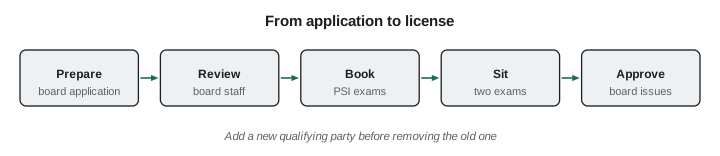
What goes in the application
The board's application for a commercial license asks for the business's legal name and any trade name, its form of organization, its registration with the Louisiana Secretary of State, its principals, its classifications, its qualifying parties and their relationship to the business, the financial statement, and the insurance documents. Applicants also sign statements about criminal history, past license discipline and other matters the board considers. The fee for the application is set by the board and is paid when the application is filed. Secondary sources report fees of roughly 100 dollars for the application and similar amounts for the license itself, but the board's current fee schedule controls.
| Document | Who prepares it | Common problem |
|---|---|---|
| Application form | The business and its principals | Business name does not match Secretary of State records |
| Qualifying party information | The qualifying party | Relationship to the business not shown clearly |
| Financial statement | Accountant, bookkeeper or CPA | Older than 12 months or missing a signature |
| Workers' compensation certificate | The insurance agent | Wrong legal name of the insured |
| Liability certificate | The insurance agent | Limit below the required minimum for the license type |
| Exam score reports | PSI or NASCLA | Not yet received when the application is reviewed |
Celeste's experience is that most delays come from mismatches rather than missing documents. The business name on the insurance certificate must match the name on the application, which must match the Secretary of State record. The financial statement must carry the preparer's signature in the form the statute requires. When everything matches, the board's staff can move the file forward quickly.
PSI and the candidate information bulletin
The board uses PSI, a testing company, to deliver its exams. PSI publishes a candidate information bulletin, often called a CIB, for the board's exams. The bulletin lists each exam, the number of questions, the time allowed, the passing score, the references permitted, the fees and the rules for scheduling, rescheduling, identification and retakes. The board's site links to the bulletins and the content outlines for each classification. Nadia printed both the trade exam outline and the Business and Law outline and pinned them over her desk.
Depending on the current instructions, a candidate may be able to book the exams while the application is being reviewed, or may need an eligibility notice first. Read the bulletin's section on eligibility and scheduling before calling PSI. Exam fees are paid to PSI, not to the board, and they are separate from the board's application and license fees.
Booking the exams
PSI schedules exams online and by phone. Candidates choose a test center and a date, and secondary sources report that the board's trade exams are offered on several days each week. The Electrical trade exam and the Business and Law exam are separate appointments with separate fees. Many candidates take the Business and Law exam first because it is shorter and gives them a feel for the testing center, then book the trade exam a few weeks later. Others do the reverse so that the harder exam is behind them. Either order works if the timing fits the company's plan.
Nadia's plan was to book the Business and Law exam for mid-January and the Electrical trade exam for early March, leaving February for timed practice. Celeste added both dates to the company calendar, along with a reminder for the deadline to reschedule without losing the fee.
# A study and booking plan counted back from the trade exam date (illustrative)
from datetime import date, timedelta
trade_exam = date(2027, 3, 4)
bl_exam = date(2027, 1, 14)
plan = [
    ("Download CIB and outlines", trade_exam - timedelta(weeks=20)),
    ("Order and tab the references", trade_exam - timedelta(weeks=16)),
    ("Business and Law exam", bl_exam),
    ("First timed trade practice set", trade_exam - timedelta(weeks=6)),
    ("Last day to reschedule (check the CIB)", trade_exam - timedelta(days=7)),
    ("Electrical trade exam", trade_exam),
]
for step, d in sorted(plan, key=lambda p: p[1]):
    print(d.isoformat(), "-", step)
print("weeks between the two exams:", (trade_exam - bl_exam).days // 7)2026-10-15 - Download CIB and outlines 2026-11-12 - Order and tab the references 2027-01-14 - Business and Law exam 2027-01-21 - First timed trade practice set 2027-02-25 - Last day to reschedule (check the CIB) 2027-03-04 - Electrical trade exam weeks between the two exams: 7
Identification and test-center rules
Test centers check identification at the door. The bulletin lists the forms of identification accepted, which generally include a current government-issued photo identification with a signature, and the name on it must match the name on the exam registration. Candidates who arrive late or without acceptable identification may be turned away and lose the fee. Personal items such as phones, smart watches, bags and notes are stored outside the testing room. For an open-book exam, the permitted references are inspected before the candidate is seated, and books with notes or tabs that do not meet the rules may be refused. Lesson 4 covers the references.
A calculator is usually allowed if it meets the bulletin's description, which generally means a silent, battery-operated, non-programmable calculator without a printer or text storage. Bring one you know well, with a fresh battery, and check it against the bulletin's wording before exam day.
Results and retakes
PSI exams on computer usually report a score at the end of the session. A candidate who passes receives a score report that is sent to the board or that the candidate submits with the application, depending on the instructions. A candidate who fails receives a report showing performance by content area, which is useful for planning a retake. The bulletin sets the waiting period and fee for a retake. Secondary sources report a passing score of 70 on the Electrical trade exam; confirm it in the current bulletin.
A failed attempt is not a disaster. The diagnostic report shows where the misses came from, and lesson 12 explains how to turn a miss log into a study plan. The bigger risk for a company is timing: if the qualifying party change depends on a pass by a certain date, leave room for a second attempt.
Board approval and issuance
Once the board has the application, the exam results and the supporting documents, its staff review the file and the board approves the license or the change of qualifying party. Secondary sources describe the board approving applications at its regular meetings, so the timing of the meeting can affect when the license or change takes effect. After approval, the board issues the license with a license number, and the company should update its letterhead, bids, contracts and permit records. Lesson 7 covers where the license number must appear.
For Bayou Teche, approval means Nadia is listed as a qualifying party for the Electrical classification and for business and law. Only then will Celeste file the change removing Remy. With the state change approved, Nadia can apply to New Orleans for a Class A license through the city's online application and in-person appointment, using the state license and a qualifying party letter.
Keeping the application file
Celeste keeps a single folder for each application, paper and electronic, with a cover sheet listing every document, the date it was sent, how it was sent and the date the board acknowledged it. When the board's staff call with a question, she can answer in minutes. When a document has to be replaced, such as a certificate that renewed while the application was pending, she knows which version the board has. The folder also becomes the record the company will need the next time a qualifying party changes, which at most companies happens only once a decade, long enough for everyone to forget how it was done.
Nadia's part of the folder is smaller: copies of her exam registrations, her identification, her score reports and her signed qualifying party statements. She also keeps a short note of what she found hard on each exam, written the evening after, for whoever takes the exams next at Bayou Teche.
Worked problem
Timing a change of qualifying party
Remy wants to retire on June 30, 2027. Nadia passes the Business and Law exam on January 14 and the trade exam on March 4. Celeste files the add-qualifying-party form with the score reports on March 8. The board's next meetings are in March, April and May. When should Celeste file to remove Remy?
Show solution
- Add Nadia first, with both score reports and the supporting documents.
- Wait for the board to approve Nadia as a qualifying party, which may happen at the April meeting if the file is complete.
- Once Nadia appears as a qualifying party on the license, file to remove Remy effective at his retirement.
- If Nadia's approval slips, Remy stays on until it is done, so the license is never without a qualifying party.
Answer: After the board approves Nadia, and before June 30, with Remy removed only once Nadia is on the license.
Common mistakes
MistakeRemoving the retiring qualifying party before the new one is approved.
InsteadAdd the new qualifying party first, then remove the old one.
MistakePaying exam fees to the board.
InsteadExam fees go to PSI; application and license fees go to the board.
MistakeArriving with an expired driver's license.
InsteadBring a current government-issued photo identification that matches the registration name.
MistakePlanning the company's transition around a first-attempt pass.
InsteadLeave room in the schedule for a retake.
Summary and key terms
- A new business files an original application; an existing business adds or changes a qualifying party.
- Applications need matching business names, a current financial statement, insurance documents and exam results.
- PSI delivers the board's exams and publishes the candidate information bulletin that sets the rules.
- The trade exam and the Business and Law exam are separate appointments with separate PSI fees.
- The board approves licenses and changes after review, and a company should keep a qualifying party on the license at all times.
- PSI
- The testing company that delivers the board's exams.
- Candidate information bulletin
- PSI's document setting exam content, references, fees and rules.
- Score report
- The document showing a candidate's exam result, used with the application.
- Change of qualifying party
- The board process for adding or removing the person who qualifies a license.
- Content outline
- The list of topics and their weight on an exam.
Practice problems
Work each problem on paper first, then reveal the answer to check.
Who publishes the candidate information bulletin for the board's exams?
Show answer
PSI, the board's exam vendor.
Why add a new qualifying party before removing the old one?
Show answer
So the license is never without a qualifying party.
To whom are exam fees paid?
Show answer
To PSI, separately from the board's fees.
What should a candidate do with a failing score report?
Show answer
Use its content-area breakdown to plan the retake.
Lesson quiz · 5 questions
Score 60% or more to complete this lesson.
Create a free account to save your progress, take quizzes and earn a certificate.