
MELU-218 · Lesson 2 of 12 · 19 min
Eligibility for the Electrical Contractor and Master Electrician Licenses
▶ Video coming soon A video version of this lesson is on the way.
The week after Remy's offer, Nadia sat down with Celeste Broussard, Bayou Teche's office manager for twenty years, to work out what the board would actually ask of her. Celeste had renewed the company's license every year and had once spent three weeks replacing a qualifying party for the company's old low voltage subsidiary, so she knew where the paperwork caught people. "Most electricians think the hard part is the code test," she said, spreading the company's last financial statement on the table. "The code test is the hard part for you. For the company, it's the net worth, the insurance and making sure you're actually on the payroll the way the statute says." Nadia had assumed eligibility meant years of experience. It turned out to mean several different things.
This lesson covers who may serve as a qualifying party, what the business itself must show the board, how experience is treated, the financial and insurance requirements in La. R.S. 37:2156.1, how reciprocity and the national exam fit in, and what a local master license such as the New Orleans Class A asks of the individual. Lesson 3 covers the application steps and lesson 8 covers insurance and bonding in more depth.
Two kinds of eligibility
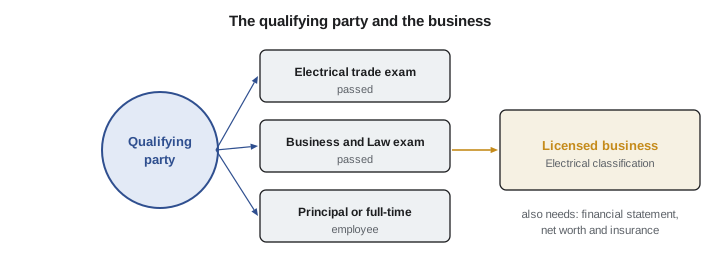
Eligibility for the state Electrical classification has two halves. The person must be able to serve as a qualifying party, and the business must be able to hold the license. A brilliant electrician who works for a company that cannot meet the financial requirements cannot get that company licensed, and a well-capitalized company without a qualified person cannot be licensed either. The board looks at both halves in the same application, but it helps to think about them separately.
| Requirement | Applies to | Summary |
|---|---|---|
| Pass the Electrical trade exam | The qualifying party | Open-book exam on the NEC and related references |
| Pass the Business and Law exam | The qualifying party for that requirement | Required for every applicant, including reciprocity |
| Principal or full-time employee | The qualifying party | Must have a real role in the business |
| Financial statement | The business | Prepared within 12 months by an accountant, bookkeeper or CPA |
| Net worth | The business | 50,000 dollars for commercial and residential licenses, or a letter of credit |
| Workers' compensation | The business | Required when it has one or more employees |
Who can be a qualifying party
Section 37:2156.1 requires every licensed business to have a qualifying party for each classification and for the Louisiana business and law requirement. The qualifying party is the person who takes and passes the exams. The statute requires that person to be a principal of the business or a full-time employee. A principal is an owner, officer or member with a real stake in the company; a full-time employee is on the payroll in a regular, full-time role. The board does not allow a business to rent a qualifying party who has no real connection to the work, and it treats that arrangement as a serious violation.
One business can have different qualifying parties for different classifications, and one person can be the qualifying party for both a trade classification and the business and law requirement. At Bayou Teche, Remy has been both. Nadia will take both exams so she can step into both roles. Celeste noted a practical point: if the company ever wanted to add a classification, such as Electrical Controls, Instrumentation and Calibration, it could do that by having Nadia or another employee pass that subclassification's trade exam.
Is there an experience requirement?
Many states require a set number of years of experience before an applicant may sit for a master or contractor exam. Louisiana's state contractor license is different. The board's published requirements center on the exams, the financial statement, net worth and insurance, and neither the statute section on qualifying parties nor the board's classifications page sets a fixed number of years of electrical experience for the Electrical classification. Some secondary sources describe a multi-year experience requirement, and others say there is none, so this is one of the points to confirm with the board before applying.
Even where the board does not require years of experience, the trade exam effectively does. It is an open-book test on the NEC, and candidates who have not worked through load calculations, grounding and bonding, overcurrent protection and special occupancies in the field generally find it very hard to finish in the time allowed. Local master licenses are a different matter: many city and parish programs require documented experience as a journeyman before an applicant can sit for the master exam. The New Orleans Class A route through the state license does not test again, but a candidate who takes the ICC route sits a full electrical contractor exam.
Financial requirements for the business
Section 37:2156.1 requires an applicant for a commercial or residential license to submit a financial statement prepared within the past 12 months. The statement must be prepared and signed by an accountant, a bookkeeper or a certified public accountant, according to the statute's terms. The business must show a net worth of at least 50,000 dollars for a commercial or residential license; the minimum is lower, 25,000 dollars, for some other license types such as home improvement, mold remediation and labor-only work. Instead of meeting the net worth figure, an applicant may provide an irrevocable letter of credit as the statute allows.
Celeste explained why this matters to an electrician. Net worth is the company's assets minus its liabilities, as shown on the financial statement. A company with a lot of equipment financed on credit and a large line of credit drawn down may have less net worth than its size suggests. A company that just paid out a large distribution to its owners may fall below the line in a year when it would otherwise be fine. Bayou Teche has no trouble meeting the figure, but the timing of the financial statement matters, because it has to be recent when the application is filed.
# Net worth check for a license application (simplified study aid)
assets = {"cash": 186000, "accounts receivable": 412000, "trucks and equipment": 238000, "inventory": 74000}
liabilities = {"accounts payable": 221000, "equipment loans": 139000, "line of credit": 160000, "accrued payroll": 58000}
total_a = sum(assets.values())
total_l = sum(liabilities.values())
net = total_a - total_l
print("total assets:", total_a)
print("total liabilities:", total_l)
print("net worth:", net)
for need, label in [(50000, "commercial or residential"), (25000, "home improvement or labor only")]:
    status = "meets" if net >= need else "below"
print(label, "minimum", need, "->", status)total assets: 910000 total liabilities: 578000 net worth: 332000 commercial or residential minimum 50000 -> meets home improvement or labor only minimum 25000 -> meets
The figures are illustrative, but the arithmetic is the same one the board's reviewers do. A real financial statement has many more lines, and an accountant decides how assets such as receivables and equipment are valued. The point for the exam and for the business is that net worth is a balance sheet figure, not revenue, and that a company with high sales can still fall short if it carries heavy debt.
Insurance at the time of application
The statute requires residential and home improvement applicants to show a certificate of workers' compensation insurance and general liability coverage of at least 100,000 dollars. Secondary sources report that Act 757 of 2026 raises the general liability minimum for residential licensees to 500,000 dollars effective August 1, 2026; candidates should confirm the current figure with the board. For commercial applicants such as electrical contractors, workers' compensation is required whenever the business has one or more employees, under the workers' compensation law at La. R.S. 23:1031 and following. Lesson 8 covers coverage in more detail.
Reciprocity and the national exam
Louisiana accepts some exam results from outside the state. NASCLA, the National Association of State Contractors Licensing Agencies, lists the board as accepting its Electrical Contractor or Master Electrician exam, so a candidate who has passed that national exam may be able to use the result for the trade exam requirement. Exam preparation providers describe reciprocity for contractors licensed in comparable classifications in certain other states, generally with a period of continuous licensure, such as three consecutive years, license verification from the other state and a waiting period. Secondary sources list Alabama, Arkansas, Mississippi, South Carolina, Tennessee and Utah, along with the North Carolina electrical examiners, among the reciprocal agreements. The terms change, so a candidate should confirm them with the board.
One requirement is not waived by reciprocity or the national exam: the Business and Law exam. Every applicant must pass it, because it tests Louisiana-specific law that no other state's exam covers. A contractor moving to Louisiana with a valid license from a reciprocal state should still plan on studying for the Business and Law exam.
Local master licenses
Local master licenses have their own eligibility rules. New Orleans lists two routes to its Class A master electrical license. One route is an ICC Official Results Report showing a pass on the ICC electrical contractor exam. The other is a copy of the applicant's statewide license from the board together with a letter naming the applicant as the qualifying party. The applicant must be at least 18 years old, and only one Class A holder is allowed per company. The company must also carry general liability and workers' compensation coverage at the levels the city sets. For the Class D journeyman license, New Orleans lists an ICC journeyman exam result, a minimum age of 18, and a requirement to work under a Class A contractor.
Other parishes and cities set their own rules, and secondary sources mention local programs in Jefferson Parish and East Baton Rouge Parish among others. Because state-licensed electrical contractors are exempt from local examination procedures, a qualifying party on a state license generally does not need to sit a local exam to contract there. Whether a city still requires its own individual license for the responsible master, as New Orleans does through its state-license route, is a question to put to each jurisdiction.
Worked problem
Checking eligibility for Bayou Teche
Nadia is a full-time salaried employee of Bayou Teche and will become a minority member of the LLC in 2027. The company's latest financial statement, prepared by its CPA nine months ago, shows net worth of about 330,000 dollars. The company has eighteen employees and workers' compensation coverage. Is the company eligible for the Electrical classification with Nadia as qualifying party?
Show solution
- Nadia is a full-time employee now and will be a principal later, so she meets the qualifying party relationship.
- The financial statement is within 12 months and was prepared by a CPA, so it qualifies if it is still within 12 months when filed.
- Net worth of about 330,000 dollars is well above the 50,000-dollar minimum.
- The company has employees and carries workers' compensation, as the law requires.
- What remains is for Nadia to pass the Electrical trade exam and the Business and Law exam.
Answer: Yes, once Nadia passes both exams, provided the financial statement is still current when the application is filed.
Common mistakes
MistakeAssuming the board requires a fixed number of years of experience for the Electrical classification.
InsteadThe published requirements center on exams, finances and insurance; confirm any experience rule with the board.
MistakeUsing a qualifying party who is neither a principal nor a full-time employee.
InsteadThe statute requires a principal or full-time employee.
MistakeTreating revenue as net worth.
InsteadNet worth is assets minus liabilities on a recent financial statement.
MistakeExpecting reciprocity to waive the Business and Law exam.
InsteadEvery applicant must pass the Business and Law exam.
Summary and key terms
- Eligibility has two halves: a qualifying party who passes the exams and a business that meets the financial and insurance requirements.
- The qualifying party must be a principal or a full-time employee of the business.
- Commercial and residential applicants show a financial statement prepared within 12 months and net worth of at least 50,000 dollars, or a letter of credit.
- The board accepts the NASCLA electrical exam and has reciprocal arrangements with some states, but the Business and Law exam is always required.
- Local master licenses, such as the New Orleans Class A, have their own routes, including one based on the state license and a qualifying party letter.
- Principal
- An owner, officer or member with a real stake in the business.
- Net worth
- Total assets minus total liabilities on the financial statement.
- Letter of credit
- A bank's irrevocable promise to pay, accepted in place of the net worth figure.
- Reciprocity
- Recognition of a license or exam result from another state under an agreement.
- NASCLA
- The National Association of State Contractors Licensing Agencies, which offers national contractor exams.
Practice problems
Work each problem on paper first, then reveal the answer to check.
What relationship must a qualifying party have with the business?
Show answer
A principal of the business or a full-time employee.
How recent must the financial statement be?
Show answer
Prepared within the 12 months before the application.
What net worth must a commercial applicant show?
Show answer
At least 50,000 dollars, or an irrevocable letter of credit instead.
Which exam can never be waived by reciprocity?
Show answer
The Business and Law exam.
Lesson quiz · 5 questions
Score 60% or more to complete this lesson.
Create a free account to save your progress, take quizzes and earn a certificate.