
MELU-218 · Lesson 12 of 12 · 19 min
Practice exam review and test-day strategy
▶ Video coming soon A video version of this lesson is on the way.
Six weeks before her trade exam, Nadia sat her second full timed practice set at the kitchen table, with the same calculator, the same tabbed 2023 NEC, the OSHA book and the handbook she would carry into the test center. She finished all 80 questions with eleven minutes to spare and scored 62 correct, six above the 56 she needed for a score of 70. Her first set, in January, had been 33 correct out of 41 attempted. The difference was not that she knew much more code. It was that she had kept a log of every miss, sorted the causes, drilled her lookups and learned to walk away from a question that was eating her time. This lesson is about how she did that and how she planned exam day.
This lesson covers how to use practice sets, how to keep and read a miss log, how to drill lookups, the two-pass method in detail, how to handle calculation and Business and Law questions, the final two weeks of study, and a test-day plan. It applies to both the Electrical trade exam and the Business and Law exam.
Practice sets with a purpose
A practice set is a measurement, not just practice. Take full sets under exam conditions: the same time limit, the same references and calculator, no phone and no breaks beyond what the test center allows. Score the set, then spend at least as long reviewing it as taking it. A candidate who takes five sets and reviews none of them learns less than one who takes two and reviews both thoroughly.
Nadia scheduled four full trade sets and two Business and Law sets between January and early March, with shorter topic drills in between. After each full set she entered every miss in her log before checking any other result.
The miss log
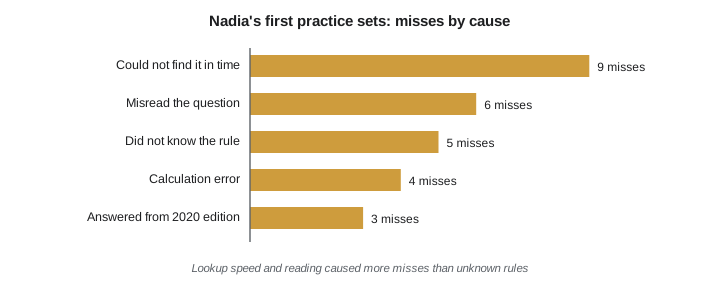
A miss log records, for each question missed or guessed, the topic, the reference where the answer is found, the time spent and the cause of the miss. The causes fall into a few groups: could not find it in time, did not know the rule, misread the question, made a calculation error, or answered from an old code habit. Sorting misses by cause shows what to fix. A candidate who misses mostly because of lookup time needs tab and index drills, not more reading. A candidate who misreads questions needs a reading routine.
| Cause | What it looks like | Fix |
|---|---|---|
| Could not find it in time | Knew the topic, ran out of time looking | Tab and index drills |
| Misread the question | Answered a different question than asked | Underline the ask; read every option |
| Did not know the rule | No idea where to look | Read that article and work topic drills |
| Calculation error | Right method, wrong number | Write each step; check units and the order of operations |
| Old edition habit | Answered from the 2020 NEC | Review the 2023 changes and the relocated definitions |
# Summarizing a miss log (illustrative entries)
from collections import Counter
log = [("lookup", 6), ("misread", 2), ("lookup", 9), ("rule", 4), ("calc", 5), ("lookup", 7),
       ("old edition", 3), ("misread", 1), ("lookup", 11), ("rule", 6), ("calc", 4), ("misread", 2),
       ("lookup", 8), ("rule", 3), ("old edition", 2), ("lookup", 10), ("misread", 3), ("calc", 6),
       ("lookup", 7), ("rule", 5), ("misread", 2), ("lookup", 9), ("old edition", 4), ("calc", 5),
       ("misread", 1), ("rule", 4), ("lookup", 8)]
counts = Counter(cause for cause, _ in log)
minutes = Counter()
for cause, m in log:
    minutes[cause] += m
for cause, n in counts.most_common():
    print(f"{cause:12s} misses: {n:2d}  minutes spent: {minutes[cause]:3d}")
print("total misses:", len(log))lookup misses: 9 minutes spent: 75 misread misses: 6 minutes spent: 11 rule misses: 5 minutes spent: 22 calc misses: 4 minutes spent: 20 old edition misses: 3 minutes spent: 9 total misses: 27
The output tells a clear story. Lookup misses were the most common and took the most time, which means faster lookups would both save minutes and earn points. Misreads were cheap in time but still cost points, which a reading routine fixes. Rule gaps were fewer than Nadia had feared. She spent the next three weeks on lookup drills and a reading routine, with a short daily session on the articles behind her rule misses.
Lookup drills
Lookup speed improves with deliberate practice. A simple drill is to pick a list of twenty topics, such as a conductor ampacity adjustment, a motor branch-circuit size, a box fill calculation, a grounding electrode conductor size or a clearance in front of equipment, and time how long it takes to reach the right rule or table using only tabs and the index. Repeat the drill with the same list until the time falls, then with a new list. Nadia started at about two and a half minutes per lookup and got down to under a minute for most topics.
Index practice matters as much as tabs. The NEC index uses specific terms, and learning how the index words a topic is often the fastest way to an unfamiliar rule. When a lookup fails, note what word would have found it and add it to a short list of index terms to remember.
A reading routine
Misreads are avoidable with a routine. Read the last sentence of the question first to see what is being asked. Underline or note the key facts: the voltage, the phase, the occupancy, the wiring method, whether the question asks for a minimum or a maximum, and any word such as not or except. Read every option before choosing, because two options may look right and only one answers the question as asked. On calculation questions, write the formula and each step on the scratch paper so that a check takes seconds.
The two-pass method in detail
On the first pass, work through the questions in order. Answer every question that can be answered from memory or with one quick lookup, and mark every question that needs more. A rough limit is about two minutes on the first pass; if the answer is not in sight by then, mark it and move on. On the second pass, return to the marked questions, starting with those that seemed closest to an answer. In the final minutes, make sure every question has an answer, because blank answers always score zero.
On an 80-question exam with 240 minutes, Nadia aimed to finish the first pass in about two and a half hours with roughly 55 to 60 questions answered, leaving about an hour and a half for the rest. In her second practice set, that plan left her eleven minutes at the end, which she used to recheck calculation questions.
Business and Law questions
The Business and Law exam rewards the same habits with a different book. Tab the reference by topic, including licensing law, the Private Works Act, public works, contracts, insurance and bonds, workers' compensation, taxes and payroll, safety and recordkeeping, and financial management. Practice the calculations that appear on business exams, such as markup and margin, depreciation, payroll taxes, overhead allocation and break-even. Know the Louisiana terms that differ from other states, such as privilege, immovable and notice of contract. Many candidates find this exam easier once they have learned to navigate the reference.
The last two weeks
In the last two weeks, stop learning new material and start sharpening. Take one final full set at the same time of day as the exam. Work short lookup drills daily. Review the miss log and reread the rules behind recurring misses. Check the references against the bulletin's list one last time, and check the tabs and markings against its rules. Confirm the test center's address, parking and opening time, and the identification required. Sleep matters more in the last week than one more evening of study.
Test day
On exam day, eat a normal meal, arrive early with identification, the permitted references, an approved calculator with a fresh battery and nothing else. Expect the references to be inspected. Once seated, take a minute to settle, check the time and the number of questions, and start the first pass. If a question causes stress, mark it and move on; the next one may be easy. Watch the clock at the checkpoints planned in advance. In the last ten minutes, answer every remaining question. After the exam, whatever the result, write down what felt hard while it is fresh, because the notes help if a retake is needed and help the next candidate in the company.
Calculation questions
Calculation questions are where careful work pays most. Most of them follow a pattern: identify the rule that applies, collect the inputs from the question and the tables, apply any adjustment or correction, and round as the code directs. Writing each step on the scratch paper makes it possible to check the work quickly on the second pass. Common traps include using the wrong table column for the conductor insulation, forgetting an adjustment for the number of current-carrying conductors, rounding too early, and confusing a minimum with a maximum. Nadia's calculation misses in her first sets came mostly from rounding and from skipping one adjustment.
A simple check catches many errors: estimate the answer before calculating. A feeder for a small office should not need conductors larger than the service. A motor branch circuit should not be smaller than the motor's full-load current. When the calculated answer and the estimate disagree badly, look again.
Managing stress
Stress affects reading and lookups more than knowledge. A candidate under stress rereads questions, loses place in the index and second-guesses correct answers. The best defenses are familiarity and routine: practice under exam conditions until the setting feels normal, use the same reading routine on every question, and have a plan for what to do when a question looks impossible. Nadia's plan was to mark it, take one slow breath, and move to the next question. She found that most of the questions she marked in panic looked manageable on the second pass.
After the exam
Whatever the result, the exam is only one step. A pass leads to the application, the board's approval and, for Bayou Teche, the New Orleans Class A application. A fail leads to the diagnostic report, a revised plan and a retake on the schedule the bulletin allows. Either way, the qualifying party role that follows asks for the same habits the exam rewarded: knowing where to find the rule, reading carefully, and checking work before it leaves the shop.
Worked problem
Planning the trade exam session
Nadia's exam is 80 questions in 240 minutes, with a passing score reported as 70. Her practice sets show she averages about 1.5 minutes on questions she can answer from memory or one lookup, and about 5 minutes on the hard ones, which are roughly a quarter of the questions. Does a two-pass plan fit?
Show solution
- About 60 first-pass questions at 1.5 minutes is about 90 minutes.
- About 20 hard questions at 5 minutes is about 100 minutes.
- Together that is about 190 minutes, leaving about 50 minutes for marking, rechecking and slow lookups.
- She needs 56 correct to score 70, so her first-pass accuracy and a fair share of the hard questions should be enough.
Answer: Yes: about 190 minutes of planned work leaves a reserve of about 50 minutes.
Common mistakes
MistakeTaking practice sets without reviewing them.
InsteadLog every miss by cause and fix the biggest cause first.
MistakeStudying new material the night before the exam.
InsteadUse the last two weeks to sharpen lookups and review the miss log.
MistakeLeaving questions blank.
InsteadAnswer every question before time runs out.
MistakeUsing practice questions from an older NEC edition.
InsteadUse questions written for the edition in the bulletin.
Summary and key terms
- Take full practice sets under exam conditions and spend as long reviewing them as taking them.
- Keep a miss log by cause; lookup time and misreading often cost more points than unknown rules.
- Drill tab and index lookups until most take under a minute.
- Use a reading routine and the two-pass method, and answer every question.
- Prepare the Business and Law reference the same way, and plan test day down to identification, calculator and arrival time.
- Miss log
- A record of each missed question with its topic, reference, time and cause.
- Lookup drill
- Timed practice finding rules with tabs and the index.
- Reading routine
- A fixed sequence for reading a question and its options.
- First pass
- The run through the exam answering every question that needs little time.
- Checkpoint
- A planned time and question number for checking pace.
Practice problems
Work each problem on paper first, then reveal the answer to check.
What should a candidate do with a question that is not in sight after about two minutes on the first pass?
Show answer
Mark it and move on.
Which miss cause is fixed by tab and index drills?
Show answer
Could not find it in time.
What should the last two weeks focus on?
Show answer
Sharpening lookups, reviewing the miss log and checking the references and logistics.
Why answer every question?
Show answer
A blank always scores zero, while a guess may be right.
Lesson quiz · 5 questions
Score 60% or more to complete this lesson.
Create a free account to save your progress, take quizzes and earn a certificate.