
MELU-211 · Lesson 9 of 12 · 21 min
Contracts and mechanics' liens in Hawaii
▶ Video coming soon A video version of this lesson is on the way.
Every job Hamakua Line takes starts with a contract and ends, the company hopes, with payment. When payment does not come, Hawaii's mechanic's and materialman's lien law, in Part II of HRS chapter 507, gives contractors, subcontractors and suppliers a way to secure their claim against the improved property. The Hawaii lien is unusual among the states: it does not attach when a document is recorded, but only when a court finds probable cause and orders it to attach. This lesson covers the contract basics a supervising electrician and RME should know, the special rules for home improvement contracts, and the lien process step by step.
Contract basics
A construction contract is an agreement in which a contractor promises to perform work and the other party promises to pay. Written contracts are not always legally required for commercial work, but they are always wise. A good electrical subcontract names the parties and the project, describes the scope of work and what is excluded, identifies the plans and specifications by date, states the price and payment terms, sets the schedule, explains how changes are ordered and priced, allocates responsibility for permits and inspections, states insurance and bonding requirements, and explains how disputes are resolved. MELU-107 in the core series covers contract terms in depth.
Change orders deserve special attention. Most disputes over payment begin with work that was added or changed without a written change order. Leilani's rule on site is simple: no extra work without a signed change order or, in an emergency, a written direction from the customer followed by a change order within a few days. A supervising electrician who tells a crew to do extra work on a handshake may be creating a claim the company cannot prove.
Home improvement contracts
Hawaii adds strict rules for contracts with homeowners. HRS 444-25.5 applies when a licensed contractor does home construction or improvement work for a homeowner, defined broadly to include the owner or lessee of residential property and condominium and cooperative units. Before the contract is signed, or when it is signed, the contractor must explain verbally and in detail the lien rights of everyone working under the contract: the homeowner, the contractor, subcontractors and suppliers. The contractor must also explain the homeowner's option to require a bond, how a bond would protect the homeowner and roughly what it would cost, and must disclose the other information the board requires by rule.
The written contract must include those disclosures and the other items the board requires, give notice of the contractor's right to resolve alleged construction defects before the homeowner sues, as provided in chapter 672E, and be signed by both the contractor and the homeowner. It must be fully executed before any work begins. Violations are treated as unfair or deceptive practices under chapter 480. Hawaii courts have held that a contractor who failed to give the required lien disclosures could not enforce the contract or place a mechanic's lien on the home, and that homeowners cannot waive these protections, though a contractor may sometimes recover a limited amount for the value of the work.
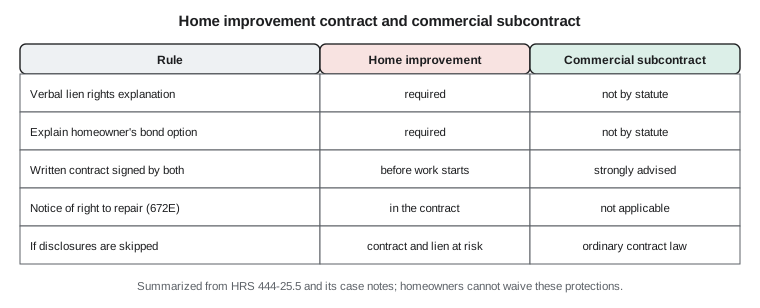
For Hamakua Line, the home improvement rules mean a standard package for every residential job: a written contract form approved by the company's lawyer, a lien and bond disclosure that the estimator walks through with the homeowner, the homeowner's signature acknowledging the explanation, and no work, not even a deposit-funded material order delivered to the site, before the contract is fully signed. Joy checks every residential file for the signed contract before she schedules the crew.
Who may claim a lien
The lien law protects those who furnish labor or material to improve real property: general contractors, subcontractors, suppliers and laborers. The lien secures the reasonable value of the unpaid labor and material furnished, within the limits of the contract, and does not include attorney fees, interest or consequential damages. An electrical subcontractor that wired a building and was not paid has the same basic right to claim a lien as the general contractor.
Hawaii does not require a preliminary notice or a notice of intent before filing, unlike many mainland states. A summary of the Hawaii rules published for subcontractors notes that no preliminary notice is required for general contractors, subcontractors, suppliers or laborers. That makes the filing deadline, not an early notice, the critical date.
The 45-day deadline and the date of completion
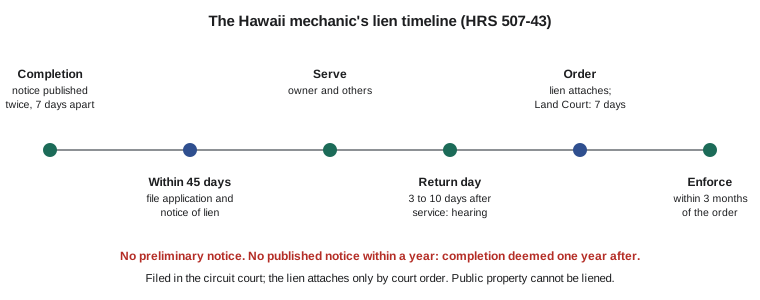
HRS 507-43 requires the lien claimant to file an application for a lien, together with a written notice of lien describing the facts of the claim, in the circuit court of the circuit where the property is located, no later than 45 days after the date of completion of the improvement. Everything turns on that date of completion, and the statute defines it through a published notice. The owner, or the contractor in some cases, may publish a notice of completion or abandonment twice, seven days apart, in a newspaper of general circulation in the county, and file an affidavit of publication with the clerk of the circuit court.
If the contractor wants to publish the notice, it must first demand in writing that the owner do so; the owner then has five days to publish before the contractor may. If no valid notice is published and filed within one year after the actual completion or abandonment, the date of completion is deemed to be one year after that event. In practice, that means a subcontractor on a project whose owner publishes a notice of completion may have only about 45 days from the second publication to file, while a subcontractor on a project with no notice may have more than a year. Contractors watch the newspapers' legal notices, or use services that do, for projects where they are owed money.
Service, the hearing and attachment
After filing, the claimant must serve a copy of the application and notice, in the same manner as a summons, on the owner, on any person with an interest in the property and on the party who contracted for the improvement if that is not the owner. If a person cannot be served, notice may be posted on the improvement. The application is returnable between three and ten days after service. On the return day, the court holds a hearing to decide whether there is probable cause to let the lien attach. Interested parties may present testimony and documents. If the owner raises a set-off or disputes the amount, the court may let the lien attach only for the net amount it finds is likely to be proved.
The lien does not attach until the court finds probable cause and enters an order directing the lien to attach, and that order cannot be entered until the contracting party, the general contractor and the owner have been served and had a chance to appear. If the property is registered in the Land Court, a certified copy of the order must be filed with the assistant registrar within seven days after it is entered. The lien then expires three months after the order is entered unless proceedings to enforce it are begun within that time. Enforcement means a lawsuit to foreclose the lien and, if the claim is proved, a sale of the property to pay it.
| Step | Deadline or rule | Source |
|---|---|---|
| Published notice of completion | Published twice, seven days apart; affidavit filed | HRS 507-43 |
| Contractor's demand | Owner has five days to publish | HRS 507-43 |
| No notice | Completion deemed one year after actual completion | HRS 507-43 |
| File application and notice of lien | Within 45 days after the date of completion | HRS 507-43 |
| Return day | 3 to 10 days after service; probable cause hearing | HRS 507-43 |
| Land Court filing | Within 7 days after the order | HRS 507-43 |
| Enforce | Within 3 months after the order directing attachment | HRS 507-43 |
What the owner can do
The process gives the owner real protections. The owner is served and may appear at the probable cause hearing to dispute the claim, show payments already made or raise defects in the work as a set-off. The court may let the lien attach for only part of the amount claimed, or not at all. Owners and general contractors can also often substitute a bond for the lien, freeing the property from the claim while the dispute continues against the bond. Lenders and title insurers watch for lien applications, because an attached lien can delay a sale or a refinance.
That balance shapes a subcontractor's strategy. A claim that is well documented, with the contract, signed change orders, invoices and proof that the work was done, is much more likely to survive the hearing than a claim built on memory. A claim that is inflated, for example by adding disputed extras or interest, risks losing credibility with the court. Leilani keeps the daily job log and change order file in a form that a lawyer could use, which is the same record that protects the company in Lessons 6 and 7.
Timing also affects leverage. An unpaid subcontractor that waits until the last week of the 45 days leaves no room to resolve the dispute by negotiation before filing. Hamakua Line's practice is to send a written payment demand as soon as an invoice is past due under the contract, to tell the general contractor and the owner when the company is preparing a lien application, and to file in time to preserve the right even if talks are still going on.
Public works
Public property cannot be subjected to a mechanic's lien. On state and county projects, unpaid subcontractors and suppliers look instead to the payment bond that the general contractor furnishes under the state procurement code, HRS chapter 103D, and to the procurement code's payment rules. The bond claim has its own notice and filing deadlines, which differ from the lien deadlines; a subcontractor on a public job should read the bond, the contract and the statute as soon as payment becomes doubtful. This course describes the public works rules only in general terms.
Protecting the right to be paid
Liens are a last resort, and the time and cost of the court process are real. The habits that matter most come earlier: a clear written contract, signed change orders, prompt invoicing in the form the contract requires, lien waivers that are exchanged only for actual payment, and attention to the project's notice of completion. Hawaii has no statutory lien waiver form, so the wording of a waiver is up to the parties. A careful contractor uses conditional waivers that take effect only when the payment clears, and limits each waiver to the work and period actually paid.
Worked problem
Counting the 45 days
The owner of a Kona warehouse publishes a notice of completion on March 2 and March 9 and files the affidavit on March 12. Hamakua Line is owed for its final invoice. What is the last day to file the application for a lien?
Show solution
- The date of completion is set by the published notice; the second publication date is March 9.
- Count 45 days from March 9: March has 22 days left after the 9th, April has 30, so 45 days lands on April 23.
- Plan to file well before April 23 to leave time for preparing the application and notice.
- Then serve the owner and others promptly so the court can set the return day.
Answer: About April 23, counting from the second publication. Confirm the exact date with counsel, because the statute's definition of the completion date controls.
from datetime import date, timedelta

second_publication = date(2027, 3, 9)
file_by = second_publication + timedelta(days=45)
print("File application and notice of lien by:", file_by)

order_entered = date(2027, 5, 10)        # illustrative date of the order
years_ahead, month_index = divmod(order_entered.month - 1 + 3, 12)
enforce_by = order_entered.replace(year=order_entered.year + years_ahead, month=month_index + 1)
print("Begin enforcement by:", enforce_by)File application and notice of lien by: 2027-04-23 Begin enforcement by: 2027-08-10
Common mistakes
MistakeRecording a lien at the Bureau of Conveyances and treating it as attached.
InsteadIn Hawaii the application is filed in circuit court, and the lien attaches only when the court orders it.
MistakeSending a preliminary notice and waiting.
InsteadHawaii requires none; the 45-day filing deadline is what matters.
MistakeStarting residential work before the contract is signed.
InsteadHRS 444-25.5 requires a fully executed contract before work begins.
MistakeSkipping the lien and bond disclosures with a homeowner.
InsteadFailure can make the contract unenforceable and defeat the lien.
MistakeFiling a lien on a county park project.
InsteadPublic property cannot be liened; use the payment bond.
Summary and key terms
- Hawaii's lien law is in HRS 507 Part II; liens secure the reasonable value of unpaid labor and material.
- Home improvement contracts need verbal lien and bond disclosures and a signed written contract before work starts.
- No preliminary notice is required; the claimant files an application and notice of lien in circuit court within 45 days after the date of completion.
- The date of completion depends on a notice published twice, seven days apart, or is deemed one year after completion.
- A probable cause hearing follows 3 to 10 days after service; the lien attaches only by court order.
- Enforcement must begin within three months of the order; public works use payment bonds instead.
- Application for a lien
- The court filing that starts a Hawaii lien claim, with the notice of lien.
- Published notice of completion
- The published notice that sets the date of completion for lien deadlines.
- Probable cause hearing
- The court hearing on whether the lien should attach.
- Order directing lien to attach
- The court order that makes the lien effective.
- Payment bond
- A surety bond that protects unpaid subcontractors and suppliers on public projects.
Practice problems
Work each problem on paper first, then reveal the answer to check.
Where is a Hawaii lien application filed?
Show answer
In the circuit court of the circuit where the property is located.
How long after the date of completion may a claimant file?
Show answer
No later than 45 days.
When does the lien attach?
Show answer
When the court finds probable cause and enters an order directing it to attach.
How long does the claimant have to begin enforcement after the order?
Show answer
Three months.
What must a contractor do before signing a home improvement contract?
Show answer
Explain lien rights and the bond option verbally and in detail, and then sign a written contract before work starts.
Lesson quiz · 5 questions
Score 60% or more to complete this lesson.
Create a free account to save your progress, take quizzes and earn a certificate.