
MELU-211 · Lesson 4 of 12 · 20 min
The exam format and the references allowed
▶ Video coming soon A video version of this lesson is on the way.
Knowing the shape of an exam changes how you study for it. A closed book test rewards memory; an open book test rewards speed in finding things. A test that weights grounding and services heavily rewards time spent there. This lesson describes the Hawaii supervising electrician examination as PSI's candidate bulletin presents it, explains what the open book rules mean in practice, and shows how Leilani turned the content outline into a study plan.
The basic numbers
PSI's Hawaii trade bulletin lists the supervising electrician exam as 70 questions in 180 minutes. The minimum passing score is 70. The exam is open book, and the reference is the 2020 edition of the National Electrical Code, NFPA 70, published by the National Fire Protection Association. The bulletin says the code book is provided at the test center. The same bulletin covers the journey worker, specialty, industrial and maintenance electrician exams, each with its own question count, time and outline, so make sure you are reading the supervising electrician section.
Two consequences follow from those numbers. First, the time works out to about two and a half minutes per question, which is generous for a question you can answer from memory and tight for one that needs a calculation and two code lookups. Second, a passing score of 70 on 70 questions means a candidate must answer roughly 49 correctly. A candidate can miss about 21 questions and still pass, which is a useful thing to remember when one hard question starts eating the clock.
| Item | Supervising electrician exam (PSI bulletin) |
|---|---|
| Questions | 70 |
| Time | 180 minutes |
| Passing score | 70 |
| Format | Open book |
| Reference | National Electrical Code, 2020 edition (NFPA 70), provided at the center |
| Fee | 95 dollars, not refundable, valid one year |
The content outline
The bulletin breaks the 70 questions into content areas and gives the number of questions in each. That outline is the most useful study document a candidate has, because it tells you where the points are. The largest areas are services, feeders and branch circuits, with 10 questions, and grounding and bonding, also with 10. Conductors and cables follow with 8. General electrical knowledge, electrical power and motors have 6 each. Raceways and boxes, special occupancies, lighting, safety information and overcurrent protection have 4 each, and low-voltage and communication circuits and illuminated signs have 2 each.
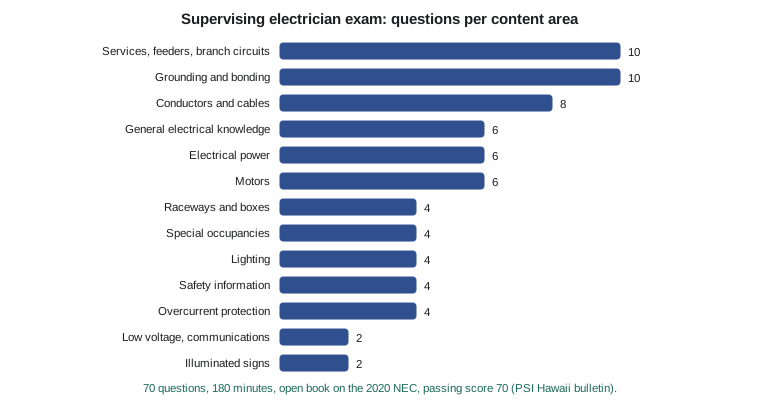
Read together, the outline says something simple: services, feeders, branch circuits, grounding, bonding and conductors make up 28 of the 70 questions, two fifths of the exam. A candidate who is fast and accurate in Articles 210, 215, 220, 230, 240, 250 and 310 has covered the core. The core courses in this series spend most of their time on exactly those articles, and MELU-102 through MELU-104 are worth reviewing before any other material.
The smaller areas still matter. Two questions on illuminated signs are two points that a candidate who has never opened Article 600 will probably lose. Four safety information questions may draw on general safety practice rather than the NEC alone, and the bulletin's reference list is the place to check what they are based on. The outline does not promise that every exam form has exactly these counts in exactly this order, but the counts are a reliable guide to emphasis.
What open book means
Open book does not mean easy. It means the exam writers expect you to look things up, and they write questions that require it: a table value, an exception, a definition in Article 100, a rule hidden in a section you do not use every day. The candidate who knows the code's structure, its chapters and articles and the way the index works, finds those answers in a minute. The candidate who does not spends five minutes and runs out of time.
Because the book is provided at the test center, it will be clean. There will be no tabs, highlights or notes. That changes how a candidate should practice. Leilani tabbed her own copy while she learned, then spent the last three weeks practicing with an untabbed copy, using only the table of contents, the index and the article numbers she had memorized. She made a short list of the articles she used most and their page ranges, memorized it, and wrote it on her scratch paper in the first minute of the exam, which the bulletin's scratch-paper rules allowed.
Check the bulletin's rules on what you may bring and what the center provides. Candidates generally may not bring their own books, notes or phones into the testing room. Calculators must meet the bulletin's rules; testing companies commonly allow silent, non-programmable calculators without printing tapes or alphabetic keyboards, and some provide an on-screen calculator. If the rule is unclear, ask PSI before test day rather than risk having a calculator taken away at the door.
The 2020 code, not the county's code
The exam tests the published 2020 NEC, not a county's amended version and not the newest edition. That distinction catches experienced electricians. A Honolulu electrician who works daily under the city's amended code may remember a local requirement and choose it over the national text; on the exam, the national text controls. An electrician who has read about changes in a newer edition must set them aside. When the bulletin names an edition, answer from that edition.
The edition the exam uses may change in future bulletins. The board's journey worker exam once used the 2008 NEC, according to its 2018 FAQ, and the current bulletin uses 2020. A candidate who tests in a later year should check the bulletin at the time of booking and study the edition it names. Lesson 5 explains how the state and counties adopt editions for enforcement, which is a separate question from which edition the exam tests.
Question styles
Most questions on licensing exams are four-option multiple choice, and the Hawaii exam is in that tradition. The questions fall into a few recognizable styles. Lookup questions ask for a specific value or rule, such as the minimum size of a conductor or the required clearance in front of equipment. Application questions describe a situation and ask which rule applies or whether an installation complies. Calculation questions ask for a load, an ampacity after adjustment, a voltage drop or a conductor size. Definition questions ask what a term in Article 100 means.
Each style has its trap. Lookup questions often have a distractor from the wrong table or the wrong column. Application questions often hinge on an exception. Calculation questions often include an answer that results from skipping one step, such as forgetting a continuous-load multiplier or a correction factor. Definition questions often offer the everyday meaning of a word rather than the code's meaning. Knowing the trap does not answer the question, but it tells you what to check before you choose.
Worked problem
A typical calculation question
A question asks for the minimum ampacity of the branch circuit conductors supplying a continuous load of 36 amperes. What steps does a careful candidate take?
Show solution
- Recognize the load as continuous, which brings in the continuous-load rule in Article 210 for branch circuits.
- Apply the multiplier of 1.25 to the continuous load: 36 times 1.25 equals 45 amperes.
- Check the question for any noncontinuous load to add at 100 of its value; none is given.
- Choose the answer of 45 amperes, and note that 36 amperes is the distractor for skipping the multiplier.
Answer: 45 amperes. The distractor at 36 amperes comes from skipping the continuous-load step.
Turning the outline into a plan
Leilani built her study plan directly from the outline. She gave each content area study time roughly in proportion to its question count, then added extra time to the areas where her practice scores were weakest. The calculator below shows the first version of that plan, for 60 hours of study. It is an example; your weights should reflect your own practice results.
# Study hours in proportion to the PSI outline (illustrative)
outline = {
    "Services, feeders, branch circuits": 10, "Grounding and bonding": 10,
    "Conductors and cables": 8, "General electrical knowledge": 6,
    "Electrical power": 6, "Motors": 6, "Raceways and boxes": 4,
    "Special occupancies": 4, "Lighting": 4, "Safety information": 4,
    "Overcurrent protection": 4, "Low voltage and communications": 2,
    "Illuminated signs": 2,
}
total_q = sum(outline.values())
hours = 60
for area, q in outline.items():
    print(f"{area}: {q} questions, {hours * q / total_q:.1f} hours")
print("Total questions:", total_q, "| correct needed for 70:", round(0.70 * total_q))Services, feeders, branch circuits: 10 questions, 8.6 hours Grounding and bonding: 10 questions, 8.6 hours Conductors and cables: 8 questions, 6.9 hours General electrical knowledge: 6 questions, 5.1 hours Electrical power: 6 questions, 5.1 hours Motors: 6 questions, 5.1 hours Raceways and boxes: 4 questions, 3.4 hours Special occupancies: 4 questions, 3.4 hours Lighting: 4 questions, 3.4 hours Safety information: 4 questions, 3.4 hours Overcurrent protection: 4 questions, 3.4 hours Low voltage and communications: 2 questions, 1.7 hours Illuminated signs: 2 questions, 1.7 hours Total questions: 70 | correct needed for 70: 49
The plan also had a speed component. Every week Leilani did one timed set of 35 questions in 90 minutes, half an exam at exam pace, using an untabbed code book. She logged the time each question took and whether she got it right, and Lesson 12 explains how she used that log.
Working on screen
PSI exams are given on a computer. Each question appears on the screen with its options, and the candidate clicks an answer. Most computer-based exams let a candidate mark a question for review, move forward and back, and see a summary of answered, unanswered and marked questions before ending the exam. The bulletin's tutorial, usually offered at the start of the session, shows the exact controls; take it even if you have used similar systems, because the few minutes it takes do not count against the exam time on most systems, and knowing where the review button is saves time later.
Unanswered questions score the same as wrong ones, so a candidate should never leave a question blank. If time is about to run out, choose an answer for every remaining question, even a guess. A guess among four options has a one-in-four chance; a blank has none. Leilani's rule was to stop work on any question at the ten-minute warning and spend the last minutes making sure every question had an answer.
Scratch paper or a whiteboard is usually provided, and the bulletin explains the rules. Use it for calculations, for the list of article locations you memorized, and for the numbers of questions you want to revisit. Write the question number beside every calculation so you can find it when you come back, and keep units on every number you write down. A dropped unit is one of the most common sources of a wrong answer on calculation questions.
Reading the score report
At the end of the session, PSI gives the candidate a score report. A passing report usually shows only that the candidate passed. A failing report usually shows the score and the candidate's performance in each content area. That breakdown is valuable, because it tells a candidate where to spend the next round of study. A candidate who scored well in grounding and poorly in motors should not spend the retest preparation reviewing grounding. Lesson 12 shows how Leilani planned to use a breakdown if she needed one.
Keep the score report. The board may need it, and a candidate who later applies elsewhere may be asked for it. Scan it and store it with the approval letter and the payment receipts in the same file.
The contractor board's exams are separate
The responsible managing employee exams given for the Contractors License Board are different tests with different bulletins. They have a business and law part and a trade part for the classification, and they draw on references such as business and law manuals and the contractor statutes and rules. Passing the supervising electrician exam does not satisfy them, and passing them does not satisfy the electrician board. Lesson 8 covers the contractor board's process, and the business and law content overlaps heavily with MELU-107 in the core series.
Common mistakes
MistakeAssuming open book means you can bring your own tabbed code.
InsteadThe bulletin says the code book is provided at the center; practice with an untabbed copy.
MistakeAnswering from the county's amended code.
InsteadThe exam tests the published 2020 NEC named in the bulletin.
MistakeSpreading study time evenly across all areas.
InsteadWeight study time by the outline; services, feeders, branch circuits, grounding and conductors carry 28 of 70 questions.
MistakeSpending ten minutes on one hard question.
InsteadAt about two and a half minutes per question, mark it and move on; about 21 misses still pass.
MistakeTreating the ES exam and the RME exams as the same test.
InsteadThey are separate exams for separate boards.
Summary and key terms
- The supervising electrician exam has 70 questions in 180 minutes, with a passing score of 70.
- It is open book on the 2020 NEC, which the test center provides.
- Services, feeders, branch circuits, grounding, bonding and conductors make up 28 of the 70 questions.
- Answer from the edition the bulletin names, not a county's amended code or a newer edition.
- Practice speed with a clean book and a timed question log.
- The contractor board's RME exams are separate.
- Open book
- An exam that allows the named reference during the test; here, a provided code book.
- Content outline
- The bulletin's breakdown of questions by area.
- NFPA 70
- The National Electrical Code, published by the National Fire Protection Association.
- Distractor
- A wrong option written to catch a common mistake.
- Article 100
- The NEC's definitions article.
Practice problems
Work each problem on paper first, then reveal the answer to check.
How many questions and minutes does the ES exam have?
Show answer
70 questions in 180 minutes.
Which NEC edition does the current bulletin name?
Show answer
The 2020 edition, provided at the test center.
Which two content areas have the most questions?
Show answer
Services, feeders and branch circuits, and grounding and bonding, with 10 each.
About how many correct answers are needed to reach 70 on 70 questions?
Show answer
About 49.
May Leilani bring her own tabbed code book?
Show answer
The bulletin says the book is provided; check its rules, and expect a clean book.
Lesson quiz · 5 questions
Score 60% or more to complete this lesson.
Create a free account to save your progress, take quizzes and earn a certificate.