
MELU-211 · Lesson 11 of 12 · 20 min
Renewal and continuing education
▶ Video coming soon A video version of this lesson is on the way.
Earning a supervising electrician license is a milestone, but the license lasts only as long as its holder keeps it current. Hawaii electrician licenses run on a fixed three-year cycle, and each renewal requires a fee and proof that the licensee has kept up with changes to the National Electrical Code. This lesson explains the renewal cycle, the continuing competency requirement, what happens when a license lapses, inactive status, and how the electrician renewal fits with the contractor license renewal described in Lesson 8.
The three-year cycle
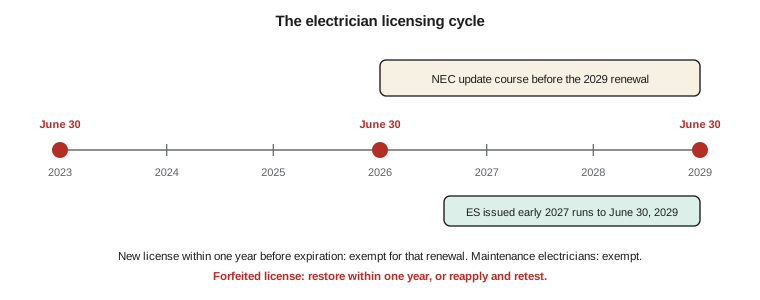
HRS 448E-8 sets the renewal schedule. Electrician licenses are renewed every three years, with renewal fees due before July 1 of the renewal year, so licenses expire on June 30. The board's FAQ lists the electrician renewal years as 2020, 2023 and 2026, and the board's continuing competency page describes the licensing period that ended June 30, 2026. The next electrician renewal is therefore due by June 30, 2029. Plumbers renew on a different three-year cycle, which is why the board's materials sometimes list two sets of years.
A license issued partway through the cycle still expires at the end of that cycle. That is why the board prorates the initial license fee: in the FAQ's example, a license issued in the first year of the cycle costs 306 dollars, one issued in the second year 204 dollars and one in the third year 102 dollars. Leilani's supervising electrician license, if issued in early 2027, will expire June 30, 2029, along with every other electrician license in the state.
Continuing competency
HRS 448E-8.5 requires every licensed electrician except maintenance electricians to show continuing competency before each renewal. The licensee must complete a course on updates to the National Electrical Code or pass an examination on those updates. The board's continuing competency page for the period that ended June 30, 2026 required licensed electricians on active status, including journey worker, supervising, specialty and industrial electricians, to complete the requirement on updates to the 2020 NEC through an approved course.
The board's page names two providers for that period: Honolulu Community College and the Hawaii Electricians Training Fund. The 2018 FAQ also listed Associated Builders and Contractors among accepted providers for electricians, and current course listings show that the Associated Builders and Contractors Hawaii chapter continues to offer an electrician continued competency course; check the board's current list before enrolling. Proof of completion can be sent to the board directly by the provider, if the licensee authorizes it, or the licensee can submit a copy of the certificate.
The board's page does not state a number of course hours, and the edition covered changes from cycle to cycle as the board updates the requirement. The course for the 2029 renewal had not been announced when this course was written. Watch the board's page for the 2026 to 2029 period, and plan to take the course in time for the provider's records to reach the board before June 30, 2029.
| Rule | Detail | Source |
|---|---|---|
| Who must comply | All licensed electricians except maintenance electricians, on active status | HRS 448E-8.5; board page |
| What is required | A course on NEC updates, or an exam on them | HRS 448E-8.5 |
| 2026 renewal content | Updates to the 2020 NEC | Board continuing competency page |
| Providers named for 2026 | Honolulu Community College; Hawaii Electricians Training Fund | Board continuing competency page |
| Exemption | New license issued within one year before the expiration date | HRS 448E-8.5 |
| Inactive status | Not subject to the requirement while inactive | Board continuing competency page |
The new-license exemption
A licensee whose license was first issued within one year before the renewal date does not have to show continuing competency for that renewal. The FAQ states it as an exemption for electricians and plumbers first licensed within twelve months before renewal, and the board's page calls it a one-time exemption. The idea is that a person who just passed an exam on the current edition has already shown competency.
Leilani's case shows how the exemption works. If her supervising electrician license is issued in March 2027, it will not be within one year of the June 30, 2029 expiration, so she will need the continuing competency course before that renewal. She also kept her journey worker license current through the 2026 renewal by taking the 2020 NEC update course in early 2026, so there was no gap to explain when she applied for the ES license. Whether a newly issued supervising license replaces the journey worker license on the board's records, or both run side by side, is a question to ask the board's staff when the license is issued.
Renewing
Renewal requires a renewal application, the renewal fee and proof of continuing competency, and renewal can be completed online. Taking the course does not renew the license automatically; the licensee must still submit the renewal and pay the fee. The 2018 FAQ listed an electrician renewal fee of 306 dollars for the 2017 to 2020 period; check the current fee schedule for the period you are renewing.
The board mails or emails renewal notices before the deadline, but a licensee who does not receive one is still responsible for renewing on time. Keep the board's records of your mailing and email addresses current. Joy sends every licensed Hamakua Line employee a reminder in January of each renewal year, again in April and once more in early June, and checks the board's online license search in July to confirm that each license shows the new expiration date.
Forfeiture and restoration
A license that is not renewed by the deadline, or whose holder does not meet the continuing competency requirement, is forfeited under HRS 448E-8. A forfeited license is not a license: the holder may not work as, or hold themselves out as, a licensed electrician, and an employer who uses the person as a licensee is risking discipline itself. The statute allows a forfeited license to be restored within one year of the forfeiture by paying the renewal fee and penalties and meeting the continuing competency requirement. The board's FAQ strongly recommends restoring within that year, because after it the person must reapply and pass the examination again.
Forfeiture also affects counting. Time during which a journey worker license is forfeited may not count as time registered as a journey worker for the four-year supervising requirement, as the example in Lesson 2 showed. And a supervising electrician whose license is forfeited cannot be named on permits, which can stop a contractor's work if that person is the only supervising electrician on staff.
Worked problem
Missing the deadline
A supervising electrician forgets to renew and her license is forfeited on July 1, 2029. She notices on September 20, 2029. What must she do, and what should her employer do in the meantime?
Show solution
- She is within one year of forfeiture, so she may restore by paying the renewal fee and penalties and showing continuing competency.
- Until the board restores the license, she may not act as a licensed supervising electrician.
- Her employer must have another supervising electrician direct the work and be named on new permits, and must recount the half rule on each site without her.
- After restoration, check the board's license search to confirm the license is active before she resumes supervising.
Answer: Restore within the year, stop supervising until restored, and have the employer cover supervision and the half rule in the meantime.
Inactive status
A licensee who will not work in the trade for a while, for example because of a move, a long illness or a change of career, may place the license on inactive status rather than let it lapse. An inactive license may not be used to work or supervise, but the holder keeps the license and can reactivate it later under the board's procedures. The board's page says inactive licensees are not subject to the continuing competency requirement while inactive; expect to meet the requirement, or a similar one, when reactivating.
Two renewals to track
For a supervising electrician who is also the RME of a C-13 contractor, there are two renewals to track: the individual electrician license, every three years on June 30, and the entity's contractor license, every two years on September 30 of even-numbered years. They come together in some years and apart in others. In 2026 both came due, the electrician license in June and the contractor license in September. In 2028 only the contractor license is due; in 2029 only the electrician license; in 2030 the contractor license again; and in 2032 both again.
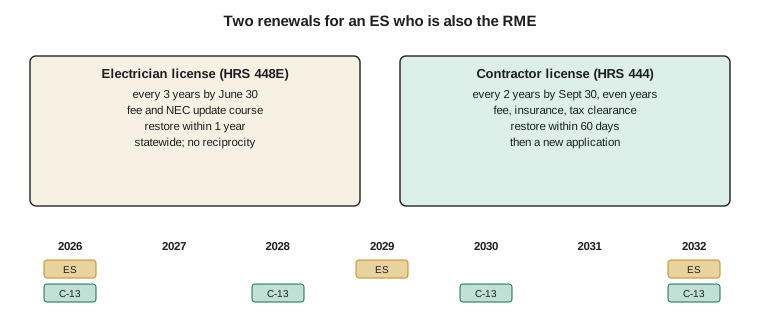
The restoration windows differ too, and the difference is easy to forget. A forfeited electrician license can be restored within one year. A forfeited contractor license can be restored only within 60 days, after which it terminates and the entity must apply as a new applicant. Missing a contractor renewal is therefore the more urgent mistake, and the company should treat the September 30 deadline as fixed.
Staying current between renewals
The continuing competency course is a minimum, and a supervising electrician who learns the code only once every three years will fall behind. New editions arrive every three years, the counties adopt them on their own timetables, and county amendments, energy code rules and utility interconnection requirements change in between. A supervising electrician is expected to know the rules in force for each job, not just the rules covered in the last course.
Leilani keeps current in a few simple ways. She reads each county building department's code adoption notices and the State Building Code Council's announcements, and she adds each change to Joy's county binder. She attends the update seminars that the training fund and trade associations run when a new edition is adopted. She reads the inspectors' correction notices from every Hamakua Line job, because a pattern of corrections is often the first sign that an inspector is enforcing a new rule. And when she is not sure, she calls the county's electrical plans examiner before the job starts, not after the inspection fails.
Keep the certificates too. Even when a provider reports completion directly to the board, a copy in the licensee's own file protects against a lost record. The board may audit renewals, and a licensee who cannot show completion when asked may face discipline for a false renewal statement.
Working beyond Hawaii
Hawaii has no reciprocity with other states for electricians, and other states generally do not grant their licenses on the strength of a Hawaii license alone. A Hawaii supervising electrician who wants to work in another state should check that state's requirements; some accept experience under a Hawaii license as qualifying experience, and some require their own examination. Within Hawaii, the license is statewide, so no county license is needed to work on another island, although each county's permit and code rules apply.
# Renewal calendar for an ES who is also the RME (illustrative)
for year in range(2026, 2034):
    due = []
    if year in range(2026, 2034, 3):
        due.append("electrician license by June 30 (restore within 1 year)")
    if year in range(2026, 2034, 2):
        due.append("contractor license by Sept 30 (restore within 60 days)")
print(year, "|", "; ".join(due) if due else "nothing due")2026 | electrician license by June 30 (restore within 1 year); contractor license by Sept 30 (restore within 60 days) 2027 | nothing due 2028 | contractor license by Sept 30 (restore within 60 days) 2029 | electrician license by June 30 (restore within 1 year) 2030 | contractor license by Sept 30 (restore within 60 days) 2031 | nothing due 2032 | electrician license by June 30 (restore within 1 year); contractor license by Sept 30 (restore within 60 days) 2033 | nothing due
Common mistakes
MistakeAssuming the continuing competency course renews the license.
InsteadThe licensee must still submit the renewal and pay the fee.
MistakeThinking a license issued in 2027 runs three years from its issue date.
InsteadAll electrician licenses expire at the end of the fixed cycle, June 30, 2029.
MistakeContinuing to supervise after a license is forfeited.
InsteadA forfeited license is not a license; stop until it is restored.
MistakeTreating the contractor restoration window like the electrician one.
InsteadA forfeited contractor license can be restored only within 60 days.
MistakeLetting a maintenance electrician skip renewal because the course does not apply.
InsteadMaintenance electricians are exempt from the course, not from renewal.
Summary and key terms
- Electrician licenses renew every three years by June 30; the last renewal was 2026 and the next is 2029.
- Initial license fees are prorated by the year of the cycle in which the license is issued.
- Before renewal, electricians other than maintenance electricians must complete a course or exam on NEC updates.
- A license first issued within one year before the expiration date is exempt from continuing competency for that renewal.
- A forfeited license may be restored within one year; after that the holder must reapply and pass the exam.
- Contractor licenses run on a separate two-year cycle with a 60-day restoration window.
- Continuing competency
- Hawaii's requirement that licensees complete an NEC update course or exam before renewal.
- Forfeited
- Expired for nonpayment or noncompliance; not usable until restored.
- Restoration
- Bringing a forfeited license back within the allowed time by paying fees and meeting requirements.
- Inactive status
- A license kept on record but not usable for work, without continuing competency while inactive.
- Licensing cycle
- The fixed three-year period ending June 30.
Practice problems
Work each problem on paper first, then reveal the answer to check.
When is the next electrician renewal deadline after 2026?
Show answer
June 30, 2029.
Which electricians are exempt from the continuing competency course?
Show answer
Maintenance electricians, and licensees first licensed within one year before the renewal date.
What did the 2026 renewal course cover?
Show answer
Updates to the 2020 NEC.
How long after forfeiture may an electrician license be restored?
Show answer
Within one year.
How long after expiration may a contractor license be restored?
Show answer
Within 60 days.
Lesson quiz · 5 questions
Score 60% or more to complete this lesson.
Create a free account to save your progress, take quizzes and earn a certificate.