
MELU-211 · Lesson 12 of 12 · 20 min
Practice exam review and test-day strategy
▶ Video coming soon A video version of this lesson is on the way.
Leilani's exam is booked for a January 2027 morning session at the PSI site nearest Hilo. She has studied the content areas in Lesson 4, and the earlier lessons have given her the Hawaii law she needs as a supervising electrician and a future RME. This last lesson is about turning knowledge into points: how to review practice exams so they actually raise your score, how to pace 70 questions in 180 minutes with a clean code book, and what to do the week before and the morning of the exam.
Practice tests are for diagnosis
A practice test is not just a score. Its real value is the list of questions you got wrong, or got right by luck, and the reasons why. A candidate who takes ten practice tests and only looks at the scores learns very little. A candidate who takes four and reviews every missed question carefully learns a great deal. Leilani keeps an error log for every timed set. For each missed or guessed question she writes the content area, the code article, the reason for the miss and the time the question took.
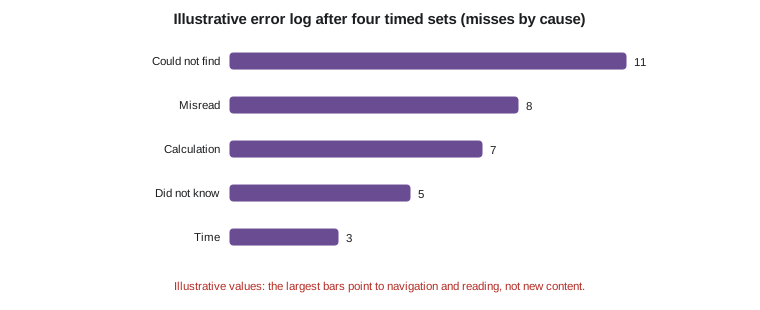
The reason for the miss is the most important column. Leilani uses five categories. Did not know means she had never learned the rule. Could not find means she knew the rule existed but could not find it in time. Misread means she answered a different question than the one asked, often by missing a word such as not, minimum or except. Calculation means she set up the problem correctly but made an arithmetic or unit error, or skipped a step. Time means she ran out of time or rushed. Each category has a different fix.
Fixing each kind of miss
Did not know is fixed by learning: read the article, work a few examples and add the rule to a short list for review. Could not find is fixed by navigation practice: use the index and the table of contents on a clean book, learn the structure of the chapters, and memorize the location of the articles you use most. Misread is fixed by a reading habit: underline the key words on scratch paper, restate the question in your own words before looking at the options, and read every option before choosing. Calculation is fixed by a written method: write each step with units, check the result against common sense and look for the distractor that comes from skipping a step. Time is fixed by pacing, described below.
Leilani's first four timed sets showed that her biggest problem was not knowledge. Her error log had more could not find and misread entries than did not know entries. That told her to spend her next weeks on navigation drills with an untabbed book and on a slower first read of each question, not on rereading the whole code. Her score on the next two sets rose by about eight points, mostly from the same content she already knew.
Pacing 70 questions in 180 minutes
The exam allows about two and a half minutes per question on average, but questions are not average. Many can be answered in under a minute from memory; some lookups take two or three minutes; a few calculations take five or more. The goal is to bank time on the quick questions and spend it on the slow ones, without letting any one question take over.
Leilani's plan uses three passes. In the first pass, which she aims to finish in about 75 minutes, she answers every question she can do from memory or with a quick lookup, and marks anything that will take more than about three minutes. In the second pass, about 70 minutes, she works the marked lookups and calculations. In the third pass, the last 35 minutes, she reviews flagged answers, checks that every question has an answer and stops changing answers unless she finds a clear error. She checks the clock at question 25, question 50 and the end of the first pass.
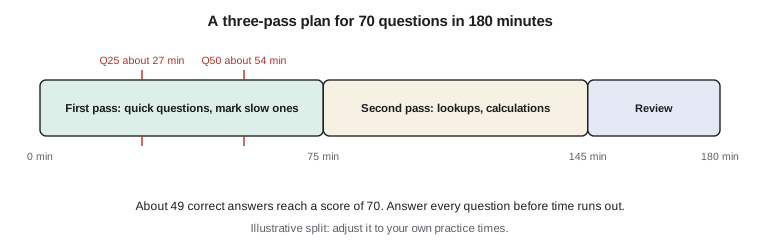
The plan must leave room for the score she needs. A score of 70 on 70 questions means about 49 correct answers. If the first pass yields 40 confident answers, the second and third passes need about 9 more from the harder questions, which is very achievable. Knowing that number keeps a hard question in proportion: no single question is worth more than any other, and a candidate who gets stuck on one should mark it and move on.
Using the code book on test day
The book at the center will be clean, so the skills that matter are the ones Leilani practiced: the index, the table of contents and the article numbers she knows by heart. In the first minute, as the bulletin's scratch-paper rules allow, she writes her short list of the articles she uses most and their places in the book: definitions in Article 100, branch circuits in 210, feeders in 215, load calculations in 220, services in 230, overcurrent protection in 240, grounding and bonding in 250, conductors in 310, motors in 430, and the chapter 9 tables. That list saves her a few seconds on every lookup.
She also knows the common lookup traps. A table may have several columns for different temperature ratings or insulation types, and the wrong column gives a plausible wrong answer. An exception may change the rule for exactly the situation the question describes. A definition may differ from everyday usage. Before choosing an answer from a table, she reads the table's title and notes, and before choosing an answer from a rule, she glances at the exceptions that follow it.
| Kind of question | First move | Trap to check |
|---|---|---|
| Memory | Answer at once | Words such as not, minimum, except |
| Lookup | Index or known article | Wrong table column or a following exception |
| Calculation | Write steps with units | A skipped multiplier or correction factor |
| Definition | Article 100 | The everyday meaning offered as a distractor |
| Hawaii law (study, not on the ES bulletin) | Recall the source | Mixing up the two boards or the county |
A last review of the Hawaii numbers
The supervising electrician exam's outline is technical, but Leilani's next exam, the contractor board's business and law part, and her daily work both depend on the Hawaii law in Lessons 1 to 11. Before her ES exam she spent one evening making a single page of the numbers she must never confuse, and she will reuse it for the RME exam. The page is worth copying in your own words.
Licensing: the ES license needs four years registered as a journey worker or equivalent experience; the journey worker license needs five years and 10,000 hours plus 240 hours of coursework. Applications: a complete application at least seven days before the board meeting; eligibility for two years from the approval letter; a PSI fee valid for one year. The exam: 70 questions, 180 minutes, a score of 70, open book on the 2020 NEC. Duties: a licensee physically present at the site whenever unlicensed people do electrical work; at least half of a contractor's electrical workers on site licensed and displaying their licenses; fines of 100 to 5,000 dollars per violation.
Contracting: the C-13 classification; an RME with four years of supervisory experience in the past ten; liability insurance of at least 100,000 and 300,000 dollars for bodily injury and 50,000 for property damage; contractor licenses expire September 30 of even years, with a 60-day restoration window. Liens: no preliminary notice; file within 45 days after the date of completion; a hearing 3 to 10 days after service; enforce within 3 months of the order. Safety: HIOSH, 8 hours for a fatality and 24 hours for hospitalization, amputation, eye loss or major property damage; the WC-1 within seven working days. Renewal: every three years by June 30, with an NEC update course, and restoration within one year.
Reading the page aloud once a day in the last week takes five minutes. It keeps the numbers distinct, so that 45 days does not become 90, and so that the two boards' renewal cycles stay separate in memory.
The week before
The last week is for review, not new material. Leilani plans one final timed set early in the week, a review of her error log and her short rule list, and two light evenings before the exam. She confirms the test site address and parking, the start time and the bulletin's identification rules, and she checks that the name on her ID matches her registration. She prepares her calculator according to the bulletin's rules, if she plans to bring one, and has a backup plan in case the center provides an on-screen calculator instead.
Sleep matters more than one more evening of study. A candidate who arrives tired loses more points to misreading than a final review could gain. Leilani plans a normal dinner, a normal bedtime and an early breakfast on exam day, and she will leave home with time to spare, because the drive from Hilo can be slowed by traffic or weather.
Test-day routine
Arrive early enough to check in calmly; the bulletin says how early. Bring only what the bulletin allows; personal items are usually stored outside the testing room. Take the tutorial, even if you know the system, and use its minutes to settle in. In the first minute of the exam, write your article list and your checkpoint times on the scratch paper. Then start the first pass and trust the plan.
During the exam, if a question seems impossible, mark it, choose your best guess for now and move on; you can come back. If anxiety rises, take three slow breaths and reread the question you are on. At the ten-minute warning, stop work on any hard question and make sure every question has an answer, because a blank scores the same as a wrong answer. When you finish, review only the questions you flagged, and change an answer only for a clear reason.
After the exam
PSI gives the score report at the end of the session. If Leilani passes, the next steps are the board's license fee and issuance, as Lesson 3 explained, followed by her RME application to the Contractors License Board and the change of RME before Dennis steps back, as Lesson 8 explained. If she does not pass, the score report's content area breakdown and her error log will tell her where to focus, and the bulletin allows a retest as soon as two business days later, depending on space, within her two-year eligibility. She has already budgeted for one retest, so a first-attempt miss would cost time and a fee, not the plan.
Worked problem
Pacing check at question 25
Leilani reaches question 25 after 33 minutes, with 4 questions marked for later. Is she on pace for her three-pass plan?
Show solution
- Her first pass is planned at about 75 minutes for 70 questions, or about 1.07 minutes per question.
- At 25 questions that is about 27 minutes; she is about 6 minutes behind.
- Four marked questions is reasonable; she should keep marking anything over three minutes rather than slowing down.
- She can recover by answering the next memory questions briskly and checking again at question 50.
Answer: About six minutes behind. Keep marking long questions and recheck at question 50; there is still time in the second and third passes.
# Pacing checkpoints for a three-pass plan (illustrative)
questions, first_pass_minutes = 70, 75
per_q = first_pass_minutes / questions
for checkpoint in (25, 50, 70):
    print(f"Question {checkpoint}: aim for about {checkpoint * per_q:.0f} minutes")
needed = round(questions * 0.70)
print("Correct answers needed for a score of 70:", needed)Question 25: aim for about 27 minutes Question 50: aim for about 54 minutes Question 70: aim for about 75 minutes Correct answers needed for a score of 70: 49
Common mistakes
MistakeOnly recording practice scores.
InsteadLog each missed or guessed question with its area, article, cause and time.
MistakeSpending the last week learning new articles.
InsteadUse the last week for review, a final timed set and rest.
MistakeLeaving hard questions blank to come back to later.
InsteadMark them with a best guess so nothing is blank if time runs out.
MistakeChanging many answers in the last minutes.
InsteadChange an answer only for a clear reason.
MistakePracticing only with a tabbed book.
InsteadThe center provides a clean book; practice navigation without tabs.
Summary and key terms
- Use practice tests to diagnose: log each miss by area, article, cause and time.
- Fix each cause differently: learning, navigation, careful reading, written calculations or pacing.
- Plan three passes over 180 minutes and check the clock at set questions.
- About 49 correct answers reach a score of 70 on 70 questions; no question is worth more than another.
- Use the clean book with a memorized list of article locations and watch for table and exception traps.
- Rest the week before, confirm the site and ID rules, and answer every question.
- Error log
- A record of missed or guessed practice questions with their causes.
- First pass
- The run through the exam that answers quick questions and marks slow ones.
- Checkpoint
- A planned time check at a set question number.
- Flag or mark
- The exam system's tool for returning to a question later.
- Distractor
- A wrong option designed to match a common error.
Practice problems
Work each problem on paper first, then reveal the answer to check.
What five causes does Leilani use in her error log?
Show answer
Did not know, could not find, misread, calculation and time.
About how many correct answers does a score of 70 on 70 questions require?
Show answer
About 49.
What should a candidate do at the ten-minute warning?
Show answer
Stop work on hard questions and make sure every question has an answer.
What fixes a could-not-find miss?
Show answer
Navigation practice with a clean book, the index and memorized article locations.
What comes after passing the ES exam for Leilani?
Show answer
The license fee and issuance, then the RME application and the change of RME.
Lesson quiz · 5 questions
Score 60% or more to complete this lesson.
Create a free account to save your progress, take quizzes and earn a certificate.