
MELU-211 · Lesson 6 of 12 · 20 min
Permits, inspections and the inspection authority
▶ Video coming soon A video version of this lesson is on the way.
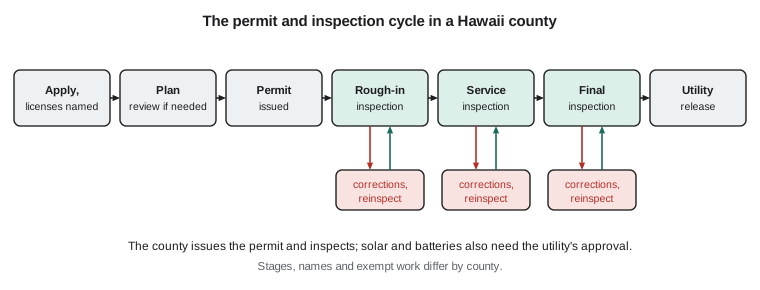
A license lets a person do or supervise electrical work. A permit lets a particular job go ahead. In Hawaii, permits and inspections belong to the counties. HRS 448E-12 keeps the counties' right to inspect electrical work under their own ordinances, and each county building department issues electrical permits, reviews plans where needed, inspects the work and releases it for connection to the utility. This lesson explains the permit and inspection cycle in general terms, the roles of the four county departments and the utility, and the habits that keep inspections from becoming delays.
The four inspection authorities
Each county has its own building department and its own rules. In the City and County of Honolulu, electrical permits are handled by the Department of Planning and Permitting, which also administers the city's electrical code in Chapter 17 of the Revised Ordinances of Honolulu. In Hawaii County, the Department of Public Works Building Division handles building, electrical and plumbing permits under the county code, with offices in Hilo and Kona. Maui County and Kauai County each run building divisions within their public works organizations. Names, portals and procedures change; check each county's pages when you start a job there.
The state does not issue electrical permits for private work. The Board of Electricians and Plumbers licenses people but does not inspect jobs, and the State Building Code Council adopts codes but does not enforce them on private projects. When an exam question asks who issues an electrical permit for a house in Kailua or a store in Kahului, the answer is the county.
Who may apply
Counties generally require that an electrical permit be obtained by a person or firm licensed to do the work, or by an owner doing work on their own property where the county and state law allow. The Contractors License Board's requirements sheet for responsible managing employees notes that an electrician license may be needed to obtain a building permit. In practice, the permit application usually asks for the contractor's license number and the name and license number of the supervising electrician responsible for the job.
That is one reason Hamakua Line needs a supervising electrician on staff. When Dennis steps back, the permit applications will carry Leilani's ES license number, and her license will be the one on file with the county for each job she supervises. The supervising electrician named on a permit is accountable for the work under it, which is why Lesson 7 stresses that a supervising electrician must not lend a name or license number to jobs they do not actually supervise.
Owner permits deserve care. Hawaii allows owner-builders in some situations under chapter 444, and counties allow some owners to obtain permits for work on their own homes, but those rules carry conditions about occupancy, sale and the use of unlicensed help. A contractor should never suggest that a customer pull an owner permit to avoid the contractor's licensing obligations; doing so can expose both the contractor and the customer to discipline and penalties.
Plan review
Many electrical permits are issued over the counter or online without plan review, especially for small residential work. Larger jobs, commercial work, services above a certain size and work that is part of a building permit usually need plans and sometimes load calculations. Some counties allow or require third-party review for certain projects to speed up the process. The county's permit pages explain which jobs need plans, what the plans must show and whether a licensed design professional must stamp them under HRS chapter 464.
Plan review is the cheapest place to find a mistake. Leilani prepares the load calculation and one-line diagram for each commercial job before the permit application goes in, using the methods in MELU-102, and has a second person check them. A plan reviewer who finds an undersized feeder on paper costs the company a day; an inspector who finds it in the field costs a week and a change order.
Inspections
Inspections follow the stages of construction. A typical sequence starts with an underground or slab inspection for conduits that will be buried or encased, continues with a rough-in inspection of the wiring before walls and ceilings are covered, includes a service inspection of the service equipment and grounding, and ends with a final inspection when the installation is complete. Large jobs may have more stages, such as separate inspections for feeders, fire alarm systems or solar and battery systems. Each county sets its own stages, request procedures and notice periods.
The contractor requests each inspection through the county's system and must have the work ready, accessible and uncovered. An inspector who arrives to find the work covered, incomplete or locked up may fail the inspection or charge a reinspection fee. Joy Tanabe schedules inspections only after Leilani confirms by text that the stage is complete, and the crew leaves a copy of the permit and the approved plans on site in a waterproof sleeve.
| Stage | What the inspector usually checks | Common reason for failure |
|---|---|---|
| Underground or slab | Conduit type, depth, supports, bends, bonding | Work covered before inspection |
| Rough-in | Boxes, cables, raceways, conductor sizes, protection | Missing nail plates or overfilled boxes |
| Service | Service equipment, grounding electrode system, bonding, clearances | Grounding electrode conductor not connected or sized wrong |
| Final | Devices, covers, labeling, GFCI and AFCI protection, panel schedule | Missing labels or incomplete directory |
Failed inspections and corrections
A failed inspection is not a penalty; it is a list of corrections. The inspector records what does not comply, usually by code section, and the contractor corrects the work and requests a reinspection. Some counties charge for reinspections, and repeated failures can affect a contractor's standing with the department. The supervising electrician should read the correction notice carefully, look up each cited section and make sure the correction actually addresses the problem rather than the symptom.
When a contractor disagrees with an inspector's reading of the code, the first step is a respectful conversation, ideally with the code section open. If that does not resolve it, the county's procedures provide for review by a supervisor and, beyond that, an appeal to a board of appeals. Honolulu's building code, for example, provides for appeals to the building board of appeals. Appeals take time, so they are best kept for real disagreements about the code rather than for convenience.
Connection to the utility
After the final inspection, or at an earlier stage where a temporary service is needed, the county notifies the electric utility that the installation is approved for connection. Most of the state is served by Hawaiian Electric, which serves Oahu, Hawaii Island, Maui County and Lanai and Molokai; Kauai is served by the Kauai Island Utility Cooperative. The utility has its own service requirements, such as meter locations, service entrance details and interconnection rules for solar and batteries, which the contractor must meet as well as the electrical code.
Solar and battery systems add a second approval track. Interconnection with the utility usually requires an application to the utility, its approval, and the county's final inspection before the system may operate. A supervising electrician running a solar job must keep both tracks moving. A system that passes the county's inspection but lacks the utility's approval may not be turned on.
Temporary power and phased jobs
Construction sites need power before the permanent service is finished. A temporary service, sometimes called a construction pole or temporary power panel, usually needs its own permit or a stage on the main permit, and its own inspection before the utility will connect it. Article 590 of the NEC covers temporary installations, including the time limits and ground-fault protection for receptacles used by workers. Temporary power is where many site injuries begin, so Leilani treats the temporary service as seriously as the permanent one and checks its ground-fault protection weekly.
Large jobs are often permitted and inspected in phases: a building shell, then tenant spaces, then later additions. Each phase may have its own final inspection and its own release. A supervising electrician should know exactly which parts of a building have been released for occupancy and which are still under construction, because energizing an unreleased area can violate the permit and endanger workers who believe it is dead.
Remote sites and neighbor islands
Hawaii's geography shapes inspections. A job on the Hamakua Coast or in Ka'u may be an hour or more from the nearest inspector's office, and a job on Lanai or Molokai depends on inspectors who travel from Maui. Inspection requests may need more notice, and a failed inspection can cost days rather than hours. Hamakua Line plans remote jobs so that several stages can be inspected on a single visit where the county allows, sends photographs ahead when the inspector asks for them, and builds an extra margin into the schedule for travel and weather.
Remote work also raises the stakes of a missed item. Leilani carries a printed copy of the county's inspection checklist for each stage and walks the job with it the day before the inspector arrives. Anything on the list that is not ready is either finished that day or the inspection is moved, because an inspector who drives ninety minutes to a job that is not ready is unlikely to be pleased, and the reinspection will be scheduled when it suits the department, not the contractor.
Records that follow the job
Keep a permit file for every job: the application, the issued permit, the approved plans and calculations, each inspection result and correction notice, the final approval and the utility release. Counties keep their own records, but a contractor's file answers questions years later, for example when a buyer's inspector asks whether a panel replacement was permitted. The supervising electrician's name on the permit stays on the county's record long after the job ends.
Work without a permit
Doing work that needs a permit without one exposes the contractor to stop-work orders, penalties under the county code, double permit fees in some counties, and orders to uncover or remove work so that it can be inspected. It can also expose the licensees to discipline: the electrician board may discipline a licensee for violating the laws that govern the trade, and permitting or aiding unlicensed work is itself a ground for discipline under HRS 448E-10. The contractor board has similar powers over contracting entities.
Worked problem
Is a permit needed?
A property manager asks Hamakua Line to replace twelve worn receptacles in a rental house with the same type, and to add a new branch circuit for a window air conditioner. Which part is likely to need a county permit?
Show solution
- Replacing devices with the same type in an existing installation is often treated as minor repair; check the county's list of work exempt from permits.
- Adding a new branch circuit is new installation work and generally requires a permit.
- The receptacle replacement may still need to meet current requirements for GFCI or tamper-resistant devices where the code requires them on replacement.
- Confirm both answers with the county before quoting the job.
Answer: The new branch circuit generally needs a permit. The like-for-like receptacle replacement may be exempt, depending on the county's rules, but must still meet the code.
Each county publishes the list of work that does not need a permit, and the lists differ. Never assume that a job exempt on one island is exempt on another.
# Inspection readiness check before calling the county (illustrative)
checklist = {
    "permit and approved plans on site": True,
    "work complete for this stage": True,
    "work uncovered and accessible": True,
    "grounding and bonding complete": False,
    "supervising electrician reviewed": True,
}
missing = [item for item, done in checklist.items() if not done]
print("Ready to call inspection:" , not missing)
for item in missing:
print("Not ready:", item)Ready to call inspection: False Not ready: grounding and bonding complete
Common mistakes
MistakeAsking the electrician board for an electrical permit.
InsteadPermits come from the county building department where the job is located.
MistakeCovering work before the rough-in inspection.
InsteadRequest and pass each inspection before covering the work.
MistakeAssuming a permit exemption on one island applies on another.
InsteadEach county sets its own list of exempt work.
MistakeTurning on a solar system after the county final but before the utility's approval.
InsteadInterconnection requires the utility's approval as well.
MistakeSuggesting an owner permit to avoid contractor licensing.
InsteadThat can expose both contractor and customer to penalties; use owner permits only where they truly apply.
Summary and key terms
- Counties issue electrical permits and inspect; HRS 448E-12 preserves their power to inspect.
- Permit applications usually name the licensed contractor and the supervising electrician.
- Larger jobs need plans; plan review is the cheapest place to find mistakes.
- Inspections follow construction stages and must be passed before work is covered.
- After the final, the county releases the job to the utility; solar and batteries also need utility approval.
- Unpermitted work brings county penalties and possible license discipline.
- Permit
- County approval for a specific job, under the county's electrical code.
- Rough-in inspection
- Inspection of wiring before walls and ceilings are covered.
- Reinspection
- A follow-up inspection after corrections, sometimes with a fee.
- Interconnection
- The utility's approval to connect a generating or storage system to its grid.
- Board of appeals
- The county body that hears disputes over code interpretation.
Practice problems
Work each problem on paper first, then reveal the answer to check.
Who issues the electrical permit for a store in Kahului?
Show answer
Maui County's building authority.
Whose license number usually appears on the permit application?
Show answer
The contractor's, and the supervising electrician responsible for the job.
What must be true before the crew covers a ceiling?
Show answer
The rough-in inspection must have passed.
Can a passed county final alone authorize a rooftop solar system to operate?
Show answer
No; the utility must also approve interconnection.
Which utility serves Kauai?
Show answer
The Kauai Island Utility Cooperative.
Lesson quiz · 5 questions
Score 60% or more to complete this lesson.
Create a free account to save your progress, take quizzes and earn a certificate.