
MELU-211 · Lesson 3 of 12 · 21 min
Applying, approval and booking the exam
▶ Video coming soon A video version of this lesson is on the way.
In many mainland states a candidate books a national exam first and applies to the licensing authority with the score report afterward. Hawaii works the other way round. The Board of Electricians and Plumbers must approve an applicant before the applicant may register for the examination, and the testing company will not schedule anyone the board has not approved. This lesson follows Leilani's application from the first form to the morning she booked her seat, and explains each deadline along the way.
The order of steps
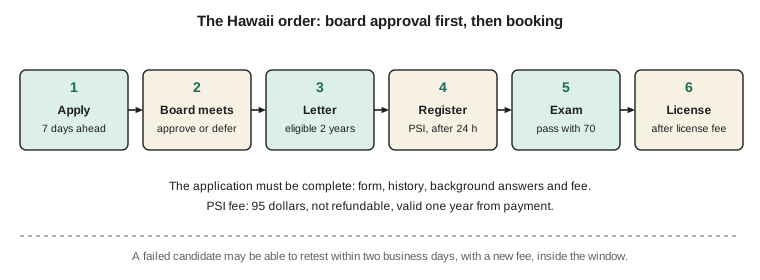
The board's application deadline and examination page sets out the sequence. The applicant files a complete application with the board, with all required information and documents, not less than seven days before the board meeting at which the applicant wants it considered. The board reviews the application at that meeting and approves it, defers it for more information, or denies it. An approved applicant receives a notice of eligibility, an approval letter, with instructions for registering directly with the examination administrator. Registration may not be possible for up to 24 hours after the letter is issued, because the board's list of eligible candidates has to reach the testing company. Eligibility for an electrician or plumber examination is valid for two years from the date the approval letter is issued.
The application
The application is filed with the Professional and Vocational Licensing Division of the Department of Commerce and Consumer Affairs, which serves as the board's office. Forms can be downloaded from the board's pages, requested by phone, or requested in writing, and many applications can now be filed online. The supervising electrician application asks for the applicant's identifying information, the journey worker license number, an employment and experience history, answers to background questions, and the application fee. The board's FAQ, last updated in 2018, lists an application fee of 40 dollars and an examination fee of 95 dollars; check the current fee schedule before paying.
A complete application is the key word in the seven-day rule. An application missing a signature, a document or the fee is not complete, and an incomplete application filed eight days before a meeting may still miss that meeting. The board's staff can tell an applicant what is missing, but the clock does not stop while the applicant fixes it. Leilani filed on September 18, 2026, well ahead of the deadline for the October meeting, and Joy Tanabe kept a copy of every page and the payment receipt.
| Item | What to check | Why it matters |
|---|---|---|
| Application form | Every question answered, signed and dated | An unsigned form is incomplete |
| Journey worker license | Number and status current | The four years are counted from the board's records |
| Experience history | Employers, dates and duties | The board may verify or ask questions |
| Background questions | Answered honestly, with explanations | A false answer is a ground for denial |
| Fee | Current amount, payable as directed | Fees change; the 2018 FAQ figures are examples |
| Filing date | At least seven days before the target meeting | Late or incomplete files wait for the next meeting |
The board meeting and approval
The board meets several times a year, and its agendas and minutes are posted on its pages. At each meeting it ratifies, approves, defers or denies applications for each license type. Minutes from early 2024, for example, list batches of journey worker, specialty, maintenance and supervising electrician applications and plumbing applications acted on at a single meeting. A deferred application is not denied; the board usually wants more information, such as an employer's confirmation or an explanation of a background answer, and the applicant can supply it for a later meeting.
The board's meeting dates are the real constraint on timing. An applicant who misses the seven-day deadline for one meeting waits for the next, which may be weeks or months away. Check the board's calendar when you plan, not after. Leilani's application went before the board at its October 2026 meeting and was approved, and her approval letter was issued a few days later.
A denial is rarer and carries rights. An applicant denied a license may ask for a hearing under the state's administrative procedure law, and the denial letter explains how. The most common reasons for trouble are missing experience, an unexplained gap in licensure and a background answer the board has questions about. Each of these is easier to fix before filing than after.
Registering with PSI
Once approved, the candidate registers with PSI Services, the testing company the board uses for electrician and plumber examinations. The board's page points candidates to PSI's Hawaii trade bulletin and to PSI's registration line. The bulletin is the candidate's contract with the testing company: it explains how to register, the identification required, the rules at the test center, the content of each exam and the reference materials. Read the whole bulletin before registering, not just the page with your exam on it.
The bulletin lists an examination fee of 95 dollars for the electrician exams, says that examination fees are not refundable or transferable, and says that a fee is valid for one year from the date of payment. A candidate who pays and then lets a year pass without testing loses the fee. That one-year limit sits inside the board's two-year eligibility window, so a candidate can lose a fee without losing eligibility.
Booking is done by date and test center. Hawaii candidates can usually choose among PSI's sites in the state, and a candidate on a neighbor island should check where the nearest site is and how often it offers sessions. Leilani's nearest site gave her a choice of several dates; she booked a morning session in January 2027, which gave her about ten weeks of focused study after approval.
Identification and test-day rules
The bulletin sets the identification rules, and a candidate who cannot meet them will not be admitted and will lose the fee. Typically a current, government-issued photo identification with a signature is required, and the name must match the registration exactly. Leilani's driver's license showed her middle initial and her registration did not; she called PSI before test day to make sure the names would be accepted, rather than finding out at the door.
The bulletin also explains what may be brought into the testing room. For an open book exam the code book is provided at the center, and candidates generally may not bring their own books, notes or electronic devices. Calculators are subject to the bulletin's rules. Lesson 4 covers the references and the calculator in more detail, because they change how a candidate studies.
Changing an appointment and special arrangements
Plans change, and the bulletin explains how to reschedule or cancel. Testing companies usually require a change to be made a set number of business days before the appointment, and a candidate who misses the window, or who does not show up, generally forfeits the fee. The exact window is in the current bulletin; read it when you book and put the last change date on your calendar. Weather, inter-island flight delays and family emergencies are real risks for neighbor island candidates, and the bulletin also explains what PSI does when a site closes, for example because of a storm.
Candidates who need testing accommodations under the Americans with Disabilities Act, such as extra time or a separate room, must ask in advance and follow the bulletin's procedure, which usually involves documentation from a qualified professional. Accommodation requests take time to process, so they should be made before booking, not a few days before the exam. A candidate whose first language is not English should also read the bulletin's language rules; the exam itself is given in English.
Using the waiting time
The weeks between filing and the board meeting are often wasted. Leilani used hers to build a study plan around the bulletin's content outline, which Lesson 4 describes, and to work through the core courses' practice problems on load calculations and grounding, the two areas where she felt weakest. She also tabbed her own copy of the 2020 National Electrical Code for practice, knowing that the code book at the test center would be clean, so that she learned the code's layout rather than her tabs. By the time her approval letter arrived, she had finished one full pass through the outline and could book a date with confidence.
A short written schedule helps. Leilani's had three columns: the date, the content area and the practice set. She studied five evenings a week for about ninety minutes and spent one longer Saturday session each week on a timed set of questions. Lesson 12 explains how she reviewed those timed sets, which matters as much as the studying itself.
If the first attempt fails
A candidate who fails receives a score report showing performance by content area. The bulletin says a failed candidate cannot schedule a new appointment on the same day as the failed exam, and that, depending on space, a candidate may be able to retest within two business days. Each attempt needs a new examination fee. A retest must fall within the two-year eligibility window; after that, the candidate must reapply to the board.
Pass rates are a reason to plan for the possibility. The board's minutes for October 2023 report three supervising electrician examinations given that month and one passed. Small numbers like these swing from month to month and say little about any one candidate, but they are a reminder that a first attempt is not guaranteed. Leilani's plan includes a retest allowance, and she has kept her study materials organized so that a second attempt would start from her weakest content areas rather than from the beginning.
After passing: the license
Passing the exam does not by itself make a candidate a supervising electrician. The board issues the license after the candidate passes and pays the license fee. The board's FAQ describes a license fee that depends on when in the three-year licensing cycle the license is issued: in its example, 306 dollars early in the cycle, 204 dollars in the middle year and 102 dollars in the last year. Because the electrician cycle ends June 30, 2029, a license issued in early 2027 falls early in the cycle. The current fee schedule controls; use the FAQ figures only to understand the pattern.
Worked problem
Fitting the timeline
A candidate's four licensed years are complete on August 20. The board's next meetings are on September 10 and November 12. When must a complete application be filed to be heard on September 10, and what is the latest date on which the candidate could sit the exam without reapplying if approved on September 10?
Show solution
- The application must be complete at least seven days before the meeting: on or before September 3.
- The candidate is eligible by then, because the four years ended August 20.
- If approved on September 10, the approval letter is issued shortly afterward; eligibility runs two years from the letter's date.
- If the letter is dated September 12, eligibility runs to about September 12 two years later.
Answer: File a complete application by September 3. If the approval letter is dated September 12, the candidate must test by about September 12 two years later.
The calculator below repeats that check for Leilani's real dates. It counts back from the board meeting to the filing deadline and forward from the approval letter to the end of eligibility and the end of the fee's one-year life.
from datetime import date, timedelta

meeting = date(2026, 10, 13)          # illustrative board meeting date
filed = date(2026, 9, 18)
letter = date(2026, 10, 16)
fee_paid = date(2026, 10, 19)

deadline = meeting - timedelta(days=7)
print("Filing deadline:", deadline, "| filed on time:", filed <= deadline)
print("Eligibility ends about:", letter.replace(year=letter.year + 2))
print("Exam fee valid until about:", fee_paid.replace(year=fee_paid.year + 1))Filing deadline: 2026-10-06 | filed on time: True Eligibility ends about: 2028-10-16 Exam fee valid until about: 2027-10-19
Common mistakes
MistakeBooking the exam with PSI before applying to the board.
InsteadThe board must approve the application first; PSI registers only approved candidates.
MistakeFiling an incomplete application seven days before a meeting.
InsteadThe rule requires a complete application at least seven days before the meeting.
MistakeAssuming eligibility lasts as long as the exam fee.
InsteadEligibility lasts two years from the approval letter; a PSI fee is valid for one year from payment.
MistakeBelieving a passing score is a license.
InsteadThe board issues the license after the candidate passes and pays the license fee.
MistakeArriving with an ID whose name does not match the registration.
InsteadCheck the bulletin's ID rules and fix name differences before test day.
Summary and key terms
- In Hawaii the board approves the application before the candidate may register for the exam.
- A complete application must be filed at least seven days before the board meeting.
- Approved candidates receive a letter and register with PSI, allowing up to 24 hours.
- Eligibility lasts two years from the approval letter; a PSI fee lasts one year from payment.
- A failed candidate may be able to retest within two business days, with a new fee.
- The license is issued after passing and paying the license fee, prorated by the year of the cycle.
- Approval letter
- The board's approval letter, with instructions for registering for the exam.
- PSI
- PSI Services, the testing company that gives Hawaii electrician exams.
- Candidate bulletin
- PSI's guide to registration, test-center rules, exam content and references.
- Deferred
- Held for more information, not denied.
- Licensing cycle
- The three-year period ending June 30 in which electrician licenses run.
Practice problems
Work each problem on paper first, then reveal the answer to check.
What must happen before Leilani can register with PSI?
Show answer
The board must approve her application and issue the approval letter.
How many days before a board meeting must a complete application be filed?
Show answer
At least seven days.
How long is eligibility valid?
Show answer
Two years from the date the approval letter is issued.
A candidate paid the PSI fee 13 months ago and never tested. Is the fee still good?
Show answer
No; the bulletin says a fee is valid for one year from payment.
Is a passing score the same as a license?
Show answer
No; the board issues the license after the candidate passes and pays the license fee.
Lesson quiz · 5 questions
Score 60% or more to complete this lesson.
Create a free account to save your progress, take quizzes and earn a certificate.