
MELU-211 · Lesson 1 of 12 · 21 min
How electrical licensing works in Hawaii
▶ Video coming soon A video version of this lesson is on the way.
Leilani Morishige has worked in the electrical trade on the Big Island for twelve years. She started in 2014 as a first-year apprentice with a small residential shop in Hilo, finished her apprenticeship in 2019, completed the electrical coursework at Hawaii Community College that the state requires of new journey workers, and in May 2021 passed the Board of Electricians and Plumbers examination and became a licensed journey worker electrician. For the last three years she has run crews for Hamakua Line Electric, LLC, an eighteen-person electrical contractor based in Hilo that works from Waimea to Pahoa. The company is invented for this course, but the questions it faces are real. Its owner, Dennis Kahananui, holds a supervising electrician license and is the responsible managing employee behind the company's C-13 electrical contractor license. Dennis is sixty-two and wants to step back. He has asked Leilani to earn her supervising electrician license, and later to qualify as the company's responsible managing employee, and this course follows her from her first question to exam day.
This is the Hawaii course in the HSM University master electrician exam prep series. The core courses, MELU-101 through MELU-107, teach the National Electrical Code skills that every master-level exam tests: navigating the code, load calculations, conductors and overcurrent protection, grounding and bonding, motors and transformers, special occupancies, and business and law. This course adds what is specific to Hawaii. Hawaii does not use the title master electrician. Its highest general electrician license is the supervising electrician license, and it is issued by a single statewide board, while the counties issue permits and inspect, and a separate state board licenses contracting businesses.
Two cautions apply to every lesson. First, licensing rules change. The facts in this course were checked in November 2026 against Hawaii Revised Statutes chapters 448E, 444, 507 and 386, the Hawaii Administrative Rules for electricians, plumbers and contractors, the pages of the Department of Commerce and Consumer Affairs, the PSI candidate bulletin for Hawaii electrical exams, the county code pages of Honolulu and Hawaii County, and the Hawaii Occupational Safety and Health Division. The lessons say so when a fact comes from an older or secondary source or could not be confirmed. Before you apply, pay a fee or book an exam, check the current pages yourself. Second, electrical codes are copyrighted. This course cites code articles and sections by number and explains them in plain words, but it never reproduces their text, tables or figures. Keep your own copy of the code your exam uses open beside you.
Three systems that work together
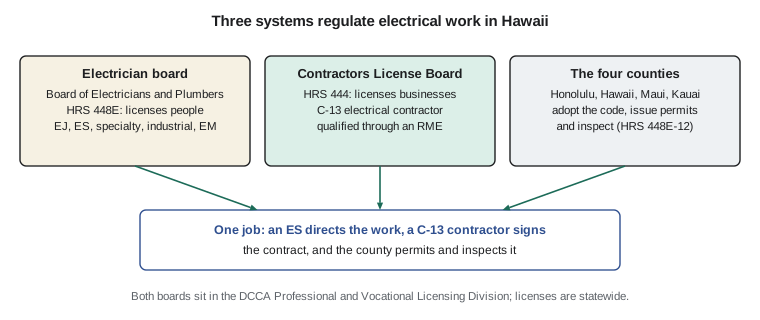
Electrical work in Hawaii is regulated by three separate systems, and most exam questions about Hawaii law start by asking which one is involved. The first licenses people. The Board of Electricians and Plumbers, created by HRS chapter 448E and administered by the Professional and Vocational Licensing Division of the Department of Commerce and Consumer Affairs, examines and licenses individual electricians and plumbers. Its licenses are statewide: a supervising electrician licensed in Honolulu may supervise work in Hilo, Kahului or Lihue without another license.
The second system licenses businesses. The Contractors License Board, created by HRS chapter 444 and administered by the same division, licenses contracting entities by classification. The electrical contractor classification is C-13. A contracting entity qualifies for its license through a responsible managing employee, a person who has passed the board's business and law and trade examinations and who manages the company's work in that classification. The third system regulates the work itself. Each of the four counties, the City and County of Honolulu, Hawaii County, Maui County and Kauai County, adopts an electrical code, issues electrical permits and inspects. HRS 448E-12 says plainly that the counties keep their power to inspect under their own ordinances.
The individual licenses
HRS 448E-4 lets the board grant nine kinds of licenses, seven of them for electricians. The two that matter most for Leilani are the journey worker electrician license, which the board's pages abbreviate EJ, and the supervising electrician license, abbreviated ES. A journey worker electrician may perform electrical work. A supervising electrician may perform it and may also direct and supervise it. The administrative rules, at HAR 16-80-4, put it the other way round: a supervising electrician license is required to direct or supervise electrical work, and at least a journey worker license is required to perform it.
Two parallel ladders cover narrower fields. The journey worker specialty electrician and supervising specialty electrician licenses cover systems such as electronic equipment, sound and communications, burglar and fire alarms, and low-voltage remote control and signal systems, with exclusions for certain one- and two-family dwelling systems. The journey worker industrial electrician and supervising industrial electrician licenses cover industrial electrical work, including high-voltage work. The maintenance electrician license covers keeping existing installations in repair and operation, with small extensions of no more than one branch circuit, but not new installations or work that needs a county permit.
| License | Code | What it allows | Experience to qualify (summary) |
|---|---|---|---|
| Journey worker electrician | EJ | Perform electrical work | 5 years and 10,000 hours, plus 240 hours of coursework |
| Supervising electrician | ES | Perform, direct and supervise | 4 years as a licensed EJ, or equivalent |
| Journey worker specialty | EJS | Perform specialty work | 3 years and 6,000 hours, plus 120 hours of coursework |
| Supervising specialty | ESS | Direct specialty work | 2 years as a licensed EJS, or equivalent |
| Journey worker industrial | EJI | Perform industrial work | 4 years and 8,000 hours, plus 200 hours of coursework |
| Supervising industrial | ESI | Direct industrial work | 3 years as a licensed EJI, or equivalent |
| Maintenance electrician | EM | Maintain existing wiring | 1 year plus 80 hours of coursework, or schooling |
The board also licenses journey worker plumbers and master plumbers, which is why its name covers both trades. Plumbing questions do not appear on the electrical exams, but the shared board explains why many rules, such as the three-year renewal and the continuing competency course, are written for both trades at once.
Who needs a license and who does not
HRS 448E-9 makes it unlawful to act as, advertise as or hold yourself out as a licensed electrician without the license. Unlicensed people may still do electrical work, but only in narrow ways. HAR 16-80-4 allows an apprentice, an electrician's helper or another unlicensed person to do electrical work in or about buildings only under the supervision of a journey worker or supervising electrician, and only within the scope of that person's license. The supervising licensee must oversee and review the work, be responsible for it, and be physically present and available at the project site at all times while the unlicensed person is working. That last phrase is the heart of many Hawaii exam questions, and Lesson 7 returns to it.
HRS 448E-13 exempts employees of regulated public utilities and cable television companies while they work for those companies, and it exempts some employees of licensed electrical contractors who do high-voltage work for a regulated utility when the utility deems them qualified. The board's 2024 minutes also mention a limited licensing exemption first created by Act 65 of 2013 and extended by Act 60 of 2018, reported to end in 2027. The details of that exemption are narrow and changing, so this course does not rely on them; check the current statute if a job seems to fall near it.
Businesses and the responsible managing employee
An electrician's license does not by itself let a person contract for electrical work. Contracting is regulated by HRS chapter 444, and a business that contracts for electrical work generally needs a contractor license in the C-13 electrical classification, or another classification that includes electrical work. The board's FAQ notes one narrow exception: a project with an aggregate contract price of 1,000 dollars or less that does not need a building permit. Every contracting entity names a responsible managing employee, often shortened to RME, who has passed the contractor board's examinations and has the required supervisory experience.
HRS 444-9.5 ties the two systems together. A licensed electrical contractor may contract for electrical work, but if its responsible managing employee is not a chapter 448E licensee, the contractor must have licensed electricians actually perform the work. The same section requires that at least half of the people a contractor has doing electrical work on a construction site hold chapter 448E licenses, and that licensed workers visibly display their licenses on their person. Lesson 8 covers contractor licensing in detail.
For Hamakua Line Electric, the split is easy to see. Dennis holds two credentials: his ES license from the electrician board, which lets him direct and supervise the work, and his status as RME on the company's C-13 license from the contractor board, which lets the company contract. When Dennis steps back, the company will need someone to take over both roles. Leilani's ES license is the first step; qualifying as RME is the second.
What stays with each job
Whatever licenses a contractor holds, the job itself is regulated by the county where it sits. The county decides which edition of the National Electrical Code applies and with what amendments, whether a permit is needed, who may apply for it, which inspections are required and when the utility may connect power. Hawaii does have a State Building Code Council that adopts a state electrical code, and Lesson 5 explains how the state code and the county codes relate. Lesson 6 covers permits and inspections.
Leilani has seen how much the county matters. Last year Hamakua Line wired a clinic remodel in Hilo, a vacation rental in Kona and a small warehouse in Kahului on Maui in the same quarter. Each job had a different permit office, a different inspector and a different checklist, and the Hilo job sat in a flood zone where Hawaii County's electrical code adds its own rules. The company's office manager, Joy Tanabe, keeps a binder with a tab for each county listing its permit portal, the code edition it enforces, how to request inspections and any special local rules.
The exam picture
The board must approve a candidate before the candidate may sit for an electrician examination, and the board contracts with a testing company to give it. Today that company is PSI Services. Its candidate bulletin for Hawaii electrical exams describes the supervising electrician exam as an open book test of 70 questions in 180 minutes, using the 2020 edition of the National Electrical Code, which the test center provides, with a passing score of 70. Lessons 3 and 4 cover the application, the booking and the exam in detail.
The contractor board has its own examinations for the responsible managing employee: a business and law part and a trade part for the classification. They are separate from the electrician exam, and passing one does not count for the other. Leilani will take the ES exam first because it is the license Hamakua Line needs most urgently: without a supervising electrician on staff, the company could not legally direct electrical work.
Enforcement
Licensing would mean little without enforcement, and Hawaii's enforcement runs through all three systems. The electrician board may deny, suspend or revoke a license and may fine a violator from 100 to 5,000 dollars for each violation under HRS 448E-10. It may also ask a circuit court to stop unlicensed work under HRS 448E-11. The contractor board disciplines contracting entities and their responsible managing employees under chapter 444. The counties enforce through the permit process: no permit, no legal work; failed inspections, no connection; and stop-work orders where work goes ahead without approval. Contracting or advertising violations can also be treated as unfair or deceptive practices under chapter 480.
For a supervising electrician, enforcement is personal. The supervising electrician is the person accountable for the work of the people under them. Dennis has told Leilani that the best protection is dull paperwork: current licenses for everyone on the crew, displayed on site; a licensed person physically present whenever an apprentice is working; permits pulled before work starts; inspections called on time; and a file for every job. Lesson 7 returns to these habits.
How this course is organized
The lessons follow Leilani's path. Lesson 2 covers eligibility for the supervising electrician license, Lesson 3 the application and booking process, and Lesson 4 the exam format and references. Lesson 5 explains the state and county electrical codes and Lesson 6 permits and inspections. Lesson 7 covers the duties of the supervising electrician, Lesson 8 contractor licensing, insurance and bonding, and Lesson 9 contracts and mechanics' liens. Lesson 10 covers safety law, HIOSH and workers compensation, Lesson 11 renewal and continuing competency, and Lesson 12 a practice review and test-day strategy. Every lesson ends with a quiz that mixes multiple choice, true or false, number, ordering and matching questions, and the course ends with a final exam.
The calculator below shows the first planning Leilani did. Dennis wants to step back as RME by the end of 2027. Leilani needs time to gather proof of her journey worker years, file her application in time for a board meeting, wait for approval, book and pass the ES exam, then gather supervisory experience records and take the contractor board's RME exams. Change the numbers to fit your own plan.
# Leilani's planning check (illustrative months)
months_until_dennis_steps_back = 14
steps = {
    "gather proof of journey worker years": 1,
    "file application before a board meeting": 1,
    "board review and approval": 1,
    "study and sit the ES exam": 3,
    "retake allowance, if needed": 1,
    "apply to contractor board as RME": 2,
    "pass RME business, law and trade exams": 3,
}
needed = sum(steps.values())
for step, months in steps.items():
    print(f"{step}: {months} months")
print(f"Total: {needed} months; margin: {months_until_dennis_steps_back - needed} months")gather proof of journey worker years: 1 months file application before a board meeting: 1 months board review and approval: 1 months study and sit the ES exam: 3 months retake allowance, if needed: 1 months apply to contractor board as RME: 2 months pass RME business, law and trade exams: 3 months Total: 12 months; margin: 2 months
Common mistakes
MistakeCalling the Hawaii license a master electrician license.
InsteadHawaii's top general electrician license is the supervising electrician (ES) license.
MistakeThinking a county issues electrician licenses.
InsteadThe Board of Electricians and Plumbers issues statewide licenses; counties issue permits and inspect.
MistakeAssuming an ES license lets a person contract for work.
InsteadContracting needs a contractor license, such as C-13, from the Contractors License Board.
MistakeBelieving an apprentice may work while the journey worker is at another site.
InsteadHAR 16-80-4 requires the licensee to be physically present and available at the project site at all times.
MistakeAssuming the whole state enforces one NEC edition on the same date.
InsteadThe state adopts a code, but each county adopts and amends it on its own schedule.
Summary and key terms
- Hawaii licenses electricians statewide through the Board of Electricians and Plumbers under HRS 448E.
- The supervising electrician (ES) license is needed to direct or supervise electrical work; the journey worker (EJ) license to perform it.
- Specialty, industrial and maintenance licenses cover narrower fields.
- The Contractors License Board licenses businesses; C-13 is the electrical contractor classification, qualified through a responsible managing employee.
- The four counties adopt the electrical code, issue permits and inspect.
- Check current statutes, rules and county pages before relying on any detail.
- ES
- Supervising electrician, the license needed to direct or supervise electrical work in Hawaii.
- EJ
- Journey worker electrician, the license needed to perform electrical work.
- HRS 448E
- The Hawaii statute on electricians and plumbers and their board.
- C-13
- The Contractors License Board classification for electrical contractors.
- RME
- Responsible managing employee, the person who qualifies a contracting entity for its license.
Practice problems
Work each problem on paper first, then reveal the answer to check.
Who issues Leilani's supervising electrician license?
Show answer
The Board of Electricians and Plumbers, through the DCCA Professional and Vocational Licensing Division.
Who issues the electrical permit for the Kona vacation rental?
Show answer
Hawaii County, where the work sits.
May a second-year apprentice pull wire alone while Leilani checks a job across town?
Show answer
No; the licensee must be physically present and available at the project site at all times.
Does Leilani's ES license let her contract with a homeowner in her own name?
Show answer
Not by itself; contracting needs a contractor license under HRS 444.
What fine range does HRS 448E-10 allow per violation?
Show answer
From 100 to 5,000 dollars.
Lesson quiz · 5 questions
Score 60% or more to complete this lesson.
Create a free account to save your progress, take quizzes and earn a certificate.