
MELU-211 · Lesson 5 of 12 · 20 min
The NEC as adopted in Hawaii and state amendments
▶ Video coming soon A video version of this lesson is on the way.
The National Electrical Code is a model code. It has no legal force anywhere until a government adopts it. In Hawaii, adoption happens in two layers: the state adopts a state electrical code based on an NEC edition with state amendments, and each county then adopts that state code, with its own amendments, as the county electrical code that its inspectors enforce. This lesson explains both layers, the deadlines that connect them, and why an electrician working on more than one island must always ask which edition applies to a given job.
The State Building Code Council
Hawaii created a State Building Code Council to bring the state's codes into a single, regularly updated system. The council is attached to the Department of Accounting and General Services, and its members include representatives of the counties, the state fire council, design professionals and the construction industry. The council adopts a state building code made up of model codes, including the building, residential, energy, plumbing and electrical codes, each with state amendments. The electrical part is the Hawaii State Electrical Code, based on the National Electrical Code.
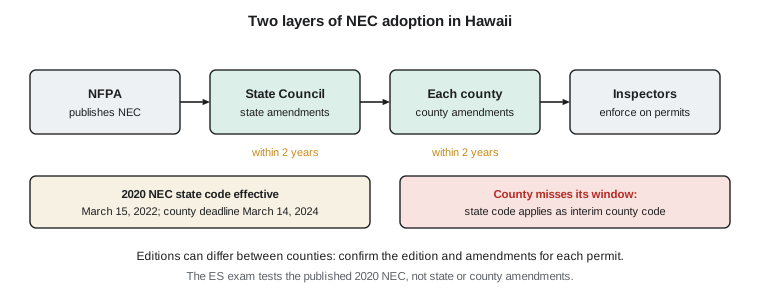
The law that created the council sets a timetable. The council's 2024 annual report summarizes it: the council must adopt each national code within two years of its publication date, or the national code becomes the state code without state amendments, and each county may then amend and adopt the state code without the council's approval within two years after the state adopts it. If a county does not act within its two years, the state code applies in that county as an interim county code until the county adopts its own.
The 2020 edition
The cycle for the 2020 NEC shows how the timetable works in practice. A notice published by Kauai County summarizes the dates. The State Building Code Council adopted the 2020 NEC as the state electrical code effective March 15, 2022. State building design had to comply by March 14, 2023. Each county had until March 14, 2024 to adopt the code with its own amendments; in a county that did not, the 2020 state code applied automatically as an interim county electrical code.
The counties did not all move at the same speed. Honolulu's Department of Planning and Permitting lists its electrical code, Chapter 17 of the Revised Ordinances of Honolulu, as based on the 2020 NEC with an effective date of March 14, 2024, while also describing the adoption with state and city amendments as pending when last checked. Hawaii County's code, Chapter 5D of the Hawaii County Code, still incorporated the 2017 NEC by reference in its July 2025 supplement, with county rules for special flood hazard areas, although the interim rule would bring in the 2020 state code where the county had not acted. Maui and Kauai each follow the same state process on their own schedules. The result is that the enforced edition can differ between counties, or be in transition, at any given moment.
This course does not say which edition each county enforces today, because that changes with each ordinance and the county pages do not always agree with each other. Before starting work, ask the county building department which edition and which amendments apply to the permit, and note the answer in the job file. Joy Tanabe's binder at Hamakua Line has a line for each county that says, in her words, the code we are building to this month, and the date she last confirmed it.
| Layer | Who adopts | What it adds | Deadline |
|---|---|---|---|
| Model code | NFPA publishes the NEC | The national text | New edition every three years |
| State electrical code | State Building Code Council | State amendments | Within two years of publication, or the national code applies |
| County electrical code | Each county council | County amendments and administration | Within two years of state adoption, or the state code applies as interim |
| Enforcement | County building department | Permits, inspections, local rules | From the county's effective date |
What state amendments do
State amendments change the national text for use in Hawaii. They may delete a section, replace a requirement with a different one, add an exception or add a new requirement. The council publishes the state electrical code as an administrative rule with its amendments, so a reader sees the NEC by reference and the amendment list as the rule's text. The state's earlier rule for the 2017 edition, for example, was titled adoption of the 2017 National Electrical Code, with a separate section of amendments to the 2017 code. The 2020 state electrical code follows the same pattern.
Some amendments are administrative. The state code generally leaves permits and inspections to the counties, because the counties issue permits and inspect. Others are technical and respond to Hawaii's conditions: high humidity and salt air near the shore, flood and tsunami zones, hurricanes and a very high rate of rooftop solar and battery storage. When an amendment exists, it controls over the national text for work in that jurisdiction.
On the exam, none of this changes the answer. PSI's supervising electrician exam tests the published 2020 NEC, and state or county amendments are not part of its reference list. A candidate should know that amendments exist and how they are adopted, because the business and law questions may ask about the adoption process, but should answer technical questions from the national text.
What county amendments do
County amendments do two jobs. The first is administrative: each county code adds its own permit rules, fees, inspection procedures, appeals and enforcement, which the NEC does not cover in detail. The second is technical: a county may add requirements for local conditions. Hawaii County's Chapter 5D is a good example of the second kind. Its flood hazard article requires service equipment and major electrical equipment to be above the inundation level unless it is in a watertight enclosure where the county's flood rules allow, requires ground-fault protection in certain circuits at or extending into the inundation level, and requires a certified flood zone elevation mark on the job site.
County codes also say how they relate to the NEC and the state code. Hawaii County's chapter, for example, says the NEC's scope and technical specifications apply where no other section of the county code covers the same matter, and that where the county chapter conflicts with the NEC or the state electrical code, the county chapter controls. It also says installations that met the rules when they were done are not violations of later changes. Honolulu's building code, as amended in 2024, refers electrical matters to Chapter 17 and adds its own requirements for things such as stationary storage battery systems that cross the line between building and electrical rules.
Energy and solar rules that reach electrical work
Some county rules that affect electricians are not in the electrical code at all. Honolulu's 2023 energy code ordinance, for example, adopted the state energy code with city amendments that require electrical work in new homes: a dedicated receptacle or junction box for electric vehicle charging in certain garages, and an electrical panel with space reserved for a solar system of a minimum size. A supervising electrician who reads only the electrical code may miss these requirements, and an inspector will not.
Leilani learned this on a Honolulu job when the inspector asked where the reserved solar breaker space was. The panel met the electrical code, but the energy code required the reserved space, and the job failed its final until the panel schedule was changed. Since then, Hamakua Line's estimating checklist has a line for energy code electrical items in each county.
State buildings and the next edition
The state code has one more direct use. State building design had to comply with the 2020 state electrical code by March 14, 2023, a year after it took effect. State agencies that build schools, offices and other facilities therefore work to the state code with state amendments, and their plans and specifications usually name the code edition. A contractor bidding state work should read the specifications closely; the edition they name, not the county's, is the one the design was prepared under, although the job may still need county permits where county rules apply.
Newer NEC editions follow the same path. The NFPA published the 2023 edition in 2022 and is publishing the 2026 edition on its regular three-year cycle. This course could not confirm when the council acted, or will act, on those editions, or what the resulting county deadlines are. The two-year rules mean that each new edition reaches Hawaii's counties some years after publication, and that the enforced edition can trail the newest published one by one or two cycles. Watch the council's notices, posted by the Department of Accounting and General Services, and the county building departments' pages for adoption dates.
The exam edition moves on its own schedule too. The board and its testing company decide when to update the bulletin, and they may do so before or after the counties change their enforced edition. That is why the bulletin is the only reliable guide to which code to study, and why a candidate who passes on one edition still needs to learn the changes that come later. Lesson 11 explains how Hawaii's continuing competency course covers those updates at each renewal.
Reading an amendment
Amendments are written against the section numbers of a specific edition. An amendment that says section 210.8 is amended means section 210.8 of that edition, and the same section number may cover different text in another edition. When a new edition is adopted, the state and counties must rewrite their amendments to match its numbering. Read amendments with the matching edition open, and do not carry a remembered amendment from one edition to the next without checking.
Which edition applies to a job
The edition that applies to a job is generally the one in force in that county when the permit application is filed, unless the county's ordinance says otherwise. A job permitted under one edition usually continues under it even if a new edition takes effect during construction, and an existing installation that met the rules when it was installed is not usually a violation just because a later code changed. Changes to an existing installation, however, are generally made under the code in force at the time of the change.
Worked problem
Choosing the edition
Hamakua Line applies for a permit in a county on February 1. The county's ordinance adopting a newer edition takes effect March 1. Rough-in inspection is in April. Which edition governs the job?
Show solution
- Find the rule in the county's ordinance on applications filed before the effective date.
- Usually, an application filed before the effective date is reviewed and inspected under the edition in force when it was filed.
- Confirm with the county, and note the edition on the permit file.
- If the county allows, the contractor may choose to build to the newer edition, but must then follow it consistently.
Answer: Usually the edition in force on February 1, when the application was filed. Confirm with the county and record the answer.
The calculator below checks the two-year deadlines for an edition. It is a planning tool; the official dates come from the council's notices and each county's ordinance.
from datetime import date

state_effective = date(2022, 3, 15)        # 2020 NEC state electrical code
county_deadline = date(state_effective.year + 2, 3, 14)
print("County adoption deadline:", county_deadline)

for county, adopted in {"County A": date(2024, 1, 10), "County B": None}.items():
    if adopted and adopted <= county_deadline:
        print(county, "adopted its own amended code on", adopted)
    else:
print(county, "state code applies as interim county code after", county_deadline)County adoption deadline: 2024-03-14 County A adopted its own amended code on 2024-01-10 County B state code applies as interim county code after 2024-03-14
Common mistakes
MistakeAssuming the NEC applies automatically the day it is published.
InsteadIt has force only when the state and county adopt it, on their own schedules.
MistakeBelieving all four counties always enforce the same edition.
InsteadEach county adopts the state code on its own timetable, with its own amendments.
MistakeAnswering exam questions from a county amendment.
InsteadThe exam tests the published 2020 NEC.
MistakeIgnoring energy code electrical requirements.
InsteadCounty energy codes can require EV-ready and solar-ready electrical work.
MistakeAssuming a county that misses its deadline has no code.
InsteadThe state code applies as an interim county code.
Summary and key terms
- The State Building Code Council adopts the Hawaii State Electrical Code from the NEC with state amendments.
- The council must adopt within two years of a national code's publication, or the national code becomes the state code.
- Each county may amend and adopt the state code within two years; otherwise the state code applies as interim.
- The 2020 NEC took effect as the state code on March 15, 2022, with a county deadline of March 14, 2024.
- County codes add administrative rules and local technical rules, such as Hawaii County's flood rules.
- Confirm the edition for each job with the county; answer exam questions from the published edition.
- State Building Code Council
- The state body that adopts the state building codes, including the electrical code.
- Hawaii State Electrical Code
- The NEC as adopted by the state with state amendments.
- Interim county code
- The state code applied in a county that has not adopted its own within the deadline.
- Inundation level
- The flood level used by Hawaii County's electrical rules for special flood hazard areas.
- ROH Chapter 17
- Honolulu's electrical code chapter in the Revised Ordinances of Honolulu.
Practice problems
Work each problem on paper first, then reveal the answer to check.
Who adopts the state electrical code in Hawaii?
Show answer
The State Building Code Council.
What happens if a county does not adopt the state code within two years?
Show answer
The state code applies in that county as an interim county code.
When did the 2020 NEC take effect as the state electrical code?
Show answer
March 15, 2022.
Which edition should Leilani use for a technical question on the ES exam?
Show answer
The published 2020 NEC named in the bulletin.
Where would you find Hawaii County's flood rules for electrical equipment?
Show answer
In Chapter 5D of the Hawaii County Code.
Lesson quiz · 5 questions
Score 60% or more to complete this lesson.
Create a free account to save your progress, take quizzes and earn a certificate.