
MELU-211 · Lesson 7 of 12 · 21 min
Duties and responsibilities of the Supervising Electrician License holder
▶ Video coming soon A video version of this lesson is on the way.
A supervising electrician license is more than a higher grade of journey worker license. It is the license the law requires of the person who directs and supervises electrical work, and with that authority comes responsibility for the work of everyone under the licensee's supervision. This lesson sets out what the statutes and rules require of a supervising electrician in Hawaii, how those duties interact with the contractor's duties under chapter 444, and the habits that keep a supervising electrician out of disciplinary trouble.
What the license authorizes
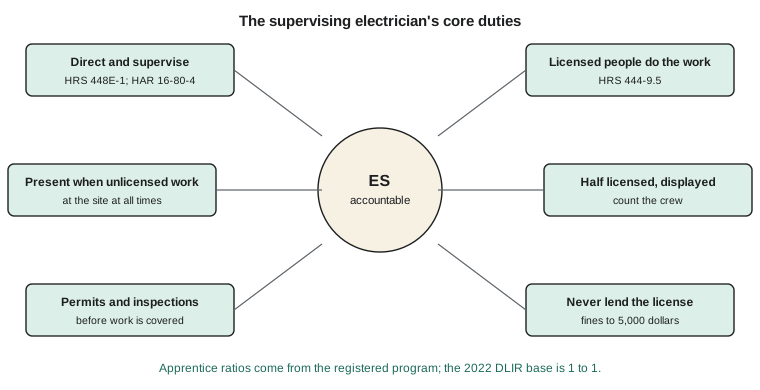
HRS 448E-1 describes a supervising electrician as a person who may direct and supervise electrical work and may also perform it. HAR 16-80-4 adds the other half: directing or supervising electrical work requires a supervising electrician license. A journey worker electrician may perform electrical work, and may supervise apprentices and helpers on the job within the scope of the journey worker license, but the person who directs the work as a whole, plans it and takes responsibility for it at the level of the job, must be a supervising electrician.
The specialty and industrial ladders work the same way within their fields. A supervising specialty electrician directs specialty work, such as fire alarm or communications systems, and a supervising industrial electrician directs industrial work. A general supervising electrician license covers the general field; whether it also covers a particular specialty system depends on the scope definitions in the rules, and a supervising electrician unsure of the boundary should ask the board before taking on the work.
Supervising unlicensed workers
Apprentices and helpers are essential to every electrical contractor, and Hawaii law allows them to work, but only under licensed supervision. HRS 448E-9 says apprentices and trainees need no license while they work under a properly licensed supervisor. HAR 16-80-4 explains what supervision means. An apprentice, electrician's helper or other unlicensed person may do electrical work in or about buildings only under the supervision of a journey worker or supervising electrician and within the scope of that licensee's license. The supervising licensee must oversee, review and be responsible for the work, and must be physically present and available at the project site at all times while the unlicensed person is working.
Physically present and available at the project site at all times is a demanding standard. It means the licensee is on the same site, not at the shop, not at another job down the road and not reachable only by phone. If the licensed person leaves the site, the unlicensed workers stop electrical work until a licensed person is back. The rules define the project site as the location where the electrical work is being done. For a large site with several buildings, a careful contractor treats each work area as needing a licensee nearby, so that the supervision is real.
Apprentices registered under the state's apprenticeship law in chapter 372 also work under apprenticeship standards that set ratios of apprentices to journey workers. The Department of Labor and Industrial Relations publishes the ratios approved for each program. Its June 2022 schedule lists a base ratio for electricians of one apprentice to one journey worker in both the union and non-union programs it shows, with a progressive scale for larger crews. Public works jobs may have different prevailing ratios. Ratios belong to the apprenticeship program and the job; the supervising electrician should know the ratio that applies before staffing a crew.
The licensed-worker rule on construction sites
HRS 444-9.5 adds a rule that applies to contractors and that every supervising electrician must help enforce. At least half of the individuals a contractor has performing electrical work on a construction site must be licensed under chapter 448E. Licensed workers on the site must visibly display their licenses on their person, and during a site inspection only workers displaying a license count toward the half. The board may waive the rule in a county with too few licensed workers. The same section requires a contractor whose responsible managing employee is not a chapter 448E licensee to have licensed people perform the electrical work.
The arithmetic is simple and often tested. A crew of six doing electrical work needs at least three licensed workers displaying their licenses. A crew of seven needs at least four, because three is less than half of seven. Apprentices and helpers count in the total but not as licensed workers.
Worked problem
Checking the crew
On Monday, Leilani's crew at a Hilo clinic includes herself (ES), two journey workers (EJ), three apprentices and one helper. One journey worker left his license card in his truck in Waimea. Does the crew meet HRS 444-9.5, and may the apprentices work?
Show solution
- Count everyone performing electrical work: 1 + 2 + 3 + 1 = 7.
- Half of 7 is 3.5, so at least 4 licensed workers are needed.
- Licensed and displaying: Leilani and one journey worker = 2. The second journey worker is licensed but not displaying, so he does not count during an inspection.
- The crew falls short. The fix is to reduce the unlicensed workers doing electrical work to 2 or fewer while only 2 licensees are displaying, or to get the card to the site. Apprentices may work only with a licensee physically present, which Leilani is.
Answer: The crew does not meet the half rule as it stands. Two unlicensed workers must stop electrical work, or the missing card must be brought to the site.
Permits, plans and the code
The supervising electrician is the person a county expects to answer for the job. Permit applications commonly name the supervising electrician, and inspectors expect that person to know the installation and the corrections. The supervising electrician should make sure that the job has the permits it needs before work starts, that the work follows the approved plans and the code edition in force, that each inspection is requested and passed before work is covered, and that corrections are completed and reinspected. Lesson 6 covered the county process; the duty here is personal: the supervising electrician's name is on it.
Good supervision includes technical review. Leilani walks every job at least once a day when crews are working, checks the work against the plans and the code, and corrects problems before the inspector sees them. She keeps a short log for each job with the date, the areas she checked and anything she told the crew to fix. If a question ever arises about what she supervised, the log answers it.
Never lend the license
One of the most serious violations a supervising electrician can commit is lending the license: letting a contractor or another person use the license number on permits or in bids for work the licensee does not actually direct and supervise. It is a common temptation, because a company that loses its supervising electrician may offer to pay someone to keep the name on file. It is also a direct route to discipline. HRS 448E-10 lists permitting or aiding unlicensed work and violating the chapter or the board's rules among the grounds for discipline, and it allows fines of 100 to 5,000 dollars for each violation, along with suspension or revocation.
The same rule protects the licensee. A supervising electrician whose number appears on a permit is answerable to the county for that job. If the work is defective or unsafe, the county, the board and possibly a court will look to the licensee whose name is on the paperwork. Dennis tells every new supervisor at Hamakua Line the same thing: if you did not supervise it, your number does not go on it.
| Duty | Source | What it looks like on the job |
|---|---|---|
| Direct and supervise electrical work | HRS 448E-1; HAR 16-80-4 | Plan the work, assign crews, review the installation |
| Supervise unlicensed workers in person | HAR 16-80-4; HRS 448E-9 | Physically present and available at the site at all times |
| Keep at least half of electrical workers licensed | HRS 444-9.5 | Count the crew; licensees display their cards |
| Follow apprenticeship ratios | Chapter 372 standards; DLIR schedule | Check the program's ratio before staffing |
| Work under permits and pass inspections | County codes | Permits before work; inspections before cover |
| Do not lend the license | HRS 448E-10 | Your number only on work you supervise |
Discipline
HRS 448E-10 gives the board power to suspend or revoke a license or to fine a licensee after notice and a hearing, and to deny issuance or renewal. The grounds include fraud or deceit in obtaining a license, gross negligence or misconduct in the work, deceptive advertising, permitting or aiding unlicensed work, and violating the chapter or the board's rules. Discipline is public, and it can follow a licensee into the contractor board's review of a responsible managing employee.
Most complaints start with a customer, an inspector or a competitor. A customer complains that the work was poor or unfinished; an inspector reports repeated failures or work without permits; a competitor reports unlicensed workers on a site. The best defense is the same set of habits that make good work: licensed crews, real supervision, permits, inspections and records. HRS 448E-11 also lets the board ask a court to stop unlicensed work, and HRS 448E-9 makes holding oneself out as licensed without a license unlawful, including through advertising.
Training the next licensees
Supervision is also teaching. Every apprentice on a Hawaii crew is working toward the 10,000 hours and the coursework that lead to the journey worker exam, and the supervising electrician decides what each apprentice learns. A supervising electrician who keeps apprentices on the same simple tasks for years slows their progress and, in the long run, makes it harder for the company to meet the half rule. Leilani rotates her apprentices through underground, rough-in, service and finish work, and signs off each apprentice's monthly hours report only after checking that the hours match the work actually done.
Accurate hours matter to the apprentice's future application. When an apprentice applies for the journey worker exam, the board may ask employers to confirm the experience, and a supervising electrician who signed inflated hours is answerable for the statement. Keep hours records honest and specific: dates, job, tasks and the licensee who supervised.
Records that protect the licensee
A supervising electrician's records should show four things for each job: who was on the crew and which of them were licensed; who supervised and when; which permits and inspections applied and how each turned out; and what corrections were made. Hamakua Line keeps a daily crew sheet with each worker's license number, signed by the licensee in charge, and stores it with the permit file. If a complaint arrives a year later, the crew sheet answers the question of whether the half rule and the presence rule were met that day.
Working with the contractor
A supervising electrician is usually an employee of a licensed contractor rather than the contractor itself. The duties overlap but are not the same. The contractor is responsible to the contractor board for its license, insurance, contracts and business conduct, and to the customer under the contract. The supervising electrician is responsible to the electrician board for the electrical work, and to the county for the work under each permit. When the contractor's interests conflict with the code, such as pressure to cover work before inspection to meet a schedule, the supervising electrician's license is on the line. Leilani's answer to that pressure is to call the inspector and ask for the earliest slot, not to cover the work.
# Half-licensed check under HRS 444-9.5 (illustrative)
import math
crew = {"ES": 1, "EJ displaying": 1, "EJ not displaying": 1, "apprentices": 3, "helpers": 1}
total = sum(crew.values())
licensed_displaying = crew["ES"] + crew["EJ displaying"]
needed = math.ceil(total / 2)
print(f"Workers doing electrical work: {total}")
print(f"Licensed and displaying: {licensed_displaying}; needed: {needed}")
print("Meets the half rule:", licensed_displaying >= needed)Workers doing electrical work: 7 Licensed and displaying: 2; needed: 4 Meets the half rule: False
Common mistakes
MistakeSupervising an apprentice by phone from another job.
InsteadThe licensee must be physically present and available at the project site at all times.
MistakeCounting a journey worker who is not displaying a license toward the half rule.
InsteadDuring a site inspection only workers displaying a license count.
MistakeRounding half of seven down to three.
InsteadAt least half of seven is four licensed workers.
MistakeLetting a former employer keep your license number on permits.
InsteadLending a license is a ground for discipline and fines.
MistakeTreating apprenticeship ratios as optional.
InsteadRegistered programs set ratios that apply on the job; public works may differ.
Summary and key terms
- A supervising electrician license is required to direct or supervise electrical work.
- Unlicensed workers may work only under a licensee who is physically present and available at the site at all times.
- At least half of a contractor's electrical workers on a construction site must be licensed and display their licenses.
- Apprenticeship programs set ratios, with a base of one apprentice to one journey worker in the 2022 schedule.
- The supervising electrician answers for permits, inspections and corrections on jobs they supervise.
- Never lend a license; the board may fine 100 to 5,000 dollars per violation and suspend or revoke.
- Physically present
- On the project site, available to the unlicensed worker, at all times while that person works.
- Project site
- The location where the electrical work is being performed.
- Half rule
- The HRS 444-9.5 requirement that at least half of a contractor's electrical workers on site be licensed.
- License lending
- Letting others use your license for work you do not supervise.
- Chapter 372
- Hawaii's apprenticeship law.
Practice problems
Work each problem on paper first, then reveal the answer to check.
Leilani leaves the site for an hour. What must the apprentices do?
Show answer
Stop electrical work unless another licensee stays physically present and available.
A crew of nine does electrical work. How many licensed workers must display their licenses?
Show answer
At least five.
Who may direct and supervise electrical work in Hawaii?
Show answer
A supervising electrician.
What is the base electrician apprentice ratio in the 2022 DLIR schedule?
Show answer
One apprentice to one journey worker, with a progressive scale.
Name one ground for discipline under HRS 448E-10.
Show answer
Permitting or aiding unlicensed work; others include fraud, gross negligence and deceptive advertising.
Lesson quiz · 5 questions
Score 60% or more to complete this lesson.
Create a free account to save your progress, take quizzes and earn a certificate.