
MELU-211 · Lesson 2 of 12 · 21 min
Eligibility for the Supervising Electrician License
▶ Video coming soon A video version of this lesson is on the way.
Before Leilani could book an exam, she had to answer a simpler question: was she eligible at all? In Hawaii, eligibility is set by statute rather than by a testing company or a county. HRS 448E-5 lists the minimum qualifications for every electrician and plumber license the board issues, and HRS 448E-5.5 adds that every applicant must pass the board's examination. The board decides whether an applicant meets the minimums before it lets the applicant sit for the exam. This lesson works through the supervising electrician requirements, the journey worker requirements that come before them, and the kinds of proof the board expects.
The supervising electrician requirement
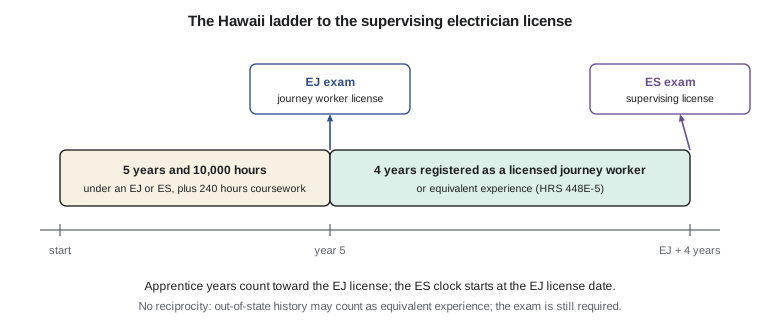
The supervising electrician requirement in HRS 448E-5 is short. An applicant must have been registered with the board as a journey worker electrician for at least four years, or must have equivalent experience. That is the whole statutory test, but each part carries weight. The four years run from the date the board licensed the applicant as a journey worker, not from the start of the applicant's apprenticeship. Time spent as an apprentice or helper counts toward the journey worker license, and then the four-year clock starts again for the supervising license.
For Leilani the arithmetic was simple. The board issued her journey worker license in May 2021, so she reached four years as a licensed journey worker in May 2025. By the time she filed her application in September 2026 she had more than five years. She had also kept her license active through the 2023 and 2026 renewals, which mattered: a lapsed license raises questions about whether the time counts, and the safest course is to keep the license current throughout.
Equivalent experience
The words or equivalent experience open a second path. The administrative rules define equivalent experience for the supervising level, and the board's FAQ explains it in plain terms: generally, a license from another jurisdiction whose requirements are substantially equivalent to Hawaii's. A supervising or master-level electrician licensed in another state, or a journey-level electrician licensed elsewhere for the required time, may ask the board to treat that history as equivalent. The board decides case by case, and it looks at what the other jurisdiction required, not only at the title of the license.
Hawaii has no reciprocity agreements with other states. The board's FAQ says so directly: all applicants must meet the same requirements and pass Hawaii's examination. An electrician who moves to Hawaii with a master license from another state does not receive a Hawaii license by endorsement. At most, the board may accept the experience behind that license as equivalent and let the applicant sit for the supervising electrician exam.
The journey worker requirements that come first
Most supervising electricians come up through the journey worker license, so its requirements shape the whole ladder. For applications under the current version of HRS 448E-5, which took effect July 1, 2013, a journey worker electrician applicant must be at least eighteen years old, must have at least five years of full-time experience, or the equivalent, and no fewer than 10,000 hours in residential or commercial wiring under the supervision of a journey worker or supervising electrician, and must have completed 240 hours of electrical academic coursework accepted by a University of Hawaii community college that offers an appropriate program.
The coursework requirement came from Act 35 of 2010 and applies to applications filed after the 2013 change. Before that date the statute required the five years and 10,000 hours without the coursework. Honolulu Community College keeps the list of approved curricula, and the board adds programs from time to time; its January 2024 minutes, for example, added several mainland technical college programs to the list. Courses that are not on the list can be submitted to Honolulu Community College for review, with proof of completion, program and course descriptions and a fee.
Leilani's own path followed the standard pattern. Her apprenticeship ran from 2014 to 2019, which gave her more than five years and well over 10,000 hours under licensed journey workers and supervising electricians. Her related classroom training at Hawaii Community College covered the 240 hours of electrical academic coursework. She passed the journey worker exam in May 2021 on her second attempt and has been licensed ever since.
| Step | Requirement | Source |
|---|---|---|
| Journey worker applicant | Age 18 or older | HRS 448E-5 |
| Journey worker applicant | 5 years full-time or equivalent, and at least 10,000 hours, under a licensed EJ or ES | HRS 448E-5 |
| Journey worker applicant | 240 hours of approved electrical academic coursework | HRS 448E-5 (since July 1, 2013) |
| Journey worker applicant | Pass the board's journey worker exam | HRS 448E-5.5 |
| Supervising applicant | 4 years registered as a licensed EJ, or equivalent experience | HRS 448E-5 |
| Supervising applicant | Pass the board's supervising electrician exam | HRS 448E-5.5 |
The other ladders
The specialty and industrial ladders follow the same shape with shorter times. A journey worker specialty electrician needs three years and at least 6,000 hours of experience plus 120 hours of coursework, and a supervising specialty electrician needs two years as a licensed journey worker specialty electrician or equivalent experience. A journey worker industrial electrician needs four years and at least 8,000 hours of industrial electrical experience plus 200 hours of coursework, and a supervising industrial electrician needs three years as a licensed journey worker industrial electrician or equivalent. A maintenance electrician needs one year of maintenance wiring experience plus 80 hours of coursework, or two years of electrical schooling with at least 1,000 hours of hands-on laboratory work.
The ladders do not cross freely. Time as a licensed specialty journey worker counts toward the supervising specialty license, not toward the general supervising electrician license. An exam question that offers a shortcut, such as two years as a specialty journey worker leading to a general ES license, is testing whether you know that each ladder stands on its own.
Worked problem
Counting the four years
Kalani was licensed as a journey worker electrician on March 3, 2023. His license lapsed on June 30, 2023 because he forgot to renew, and the board restored it on September 15, 2023 after he paid the fees and completed the continuing competency course. When does he reach four years as a licensed journey worker?
Show solution
- The statute counts years registered with the board as a journey worker electrician.
- From March 3, 2023 to June 30, 2023 he was licensed; from July 1 to September 14, 2023 his license was forfeited.
- A cautious count leaves out the gap of about two and a half months.
- Four years from March 3, 2023 is March 3, 2027; adding the gap moves the date to about mid-May 2027.
Answer: About mid-May 2027 on a cautious count. Ask the board how it treats the forfeiture before filing, and keep the license current to avoid the question.
Proving the experience
For a supervising electrician applicant who holds a Hawaii journey worker license, the board's own records prove the license date. The application still asks for an employment history, and the board may ask the applicant's employers to confirm the work. For an applicant claiming equivalent experience, the proof is heavier: a verified copy of the other jurisdiction's license, its history and status, a description of the other jurisdiction's requirements, and employer statements describing the work.
Joy Tanabe, Hamakua Line's office manager, keeps an employment file for every electrician on the payroll: hire date, license number and expiration, the dates of each license renewal, and the job list for each year. When Leilani filed her application, Joy printed the payroll summary that showed Leilani's continuous employment since 2021 and a list of the major projects she had run. None of it was strictly required for a Hawaii journey worker with a clean record, but it answered the board's likely questions before they were asked.
The board also asks about the applicant's history. Applications generally ask whether the applicant has been convicted of a crime, disciplined by any licensing authority or had a license denied, and the board may consider the answers under the general licensing laws. An honest yes with an explanation is far better than a false no that the board discovers later; a false statement on an application is itself a ground for denial or discipline under HRS 448E-10.
What does not count
Several kinds of experience do not help a supervising electrician applicant, and exam questions often use them as wrong answers. Experience in a different trade, such as plumbing or general carpentry, does not count. Time as an apprentice counts toward the journey worker license but cannot be counted a second time toward the supervising license. Work done without the required supervision, such as an unlicensed person wiring alone, is not qualifying experience and may itself have been a violation. Owning an electrical contracting business does not substitute for the four licensed years.
Experience in another state is the exception that needs care. It may count as equivalent experience if the other state's license requirements were substantially equivalent, but the applicant must show it. An electrician who worked for eight years in a state with no statewide license may have trouble showing a license history the board can compare, and should talk to the board's staff before relying on that experience.
Planning around eligibility
Because the supervising requirement is measured in licensed years, it is easy to plan. A journey worker who knows the date of their license can calculate the earliest filing date, and can use the waiting time to study. The calculator below shows the check Leilani did before she filed. It also shows why keeping the journey worker license current matters: a gap of even a few months can push the date back.
# Supervising electrician eligibility check (illustrative dates)
from datetime import date

ej_license_date = date(2021, 5, 14)
gaps_in_days = 0          # days the EJ license was forfeited, if any
required_years = 4

earliest = date(ej_license_date.year + required_years,
                ej_license_date.month, ej_license_date.day)
earliest = date.fromordinal(earliest.toordinal() + gaps_in_days)
filing_date = date(2026, 9, 18)

print("Earliest eligibility:", earliest)
print("Planned filing date:", filing_date)
print("Eligible on filing date:", filing_date >= earliest)Earliest eligibility: 2025-05-14 Planned filing date: 2026-09-18 Eligible on filing date: True
A candidate who is a few months short can still prepare the application, study and choose a board meeting date, so that the application goes in as soon as the four years are complete. Lesson 3 explains how the board's meeting schedule and the seven-day filing rule affect that timing.
Looking ahead: the RME requirement is different
Leilani's second goal, becoming the responsible managing employee for Hamakua Line's C-13 license, has its own eligibility rule, and it is easy to confuse with the ES rule. The Contractors License Board does not count licensed years. Its October 2025 requirements sheet asks for at least four years of supervisory experience within the past ten years, shown by at least three notarized experience certificates and a project list, and it counts only on-site supervision of the applicant's own crew. A journey worker who ran crews for four years might meet the contractor board's supervisory test even before reaching four licensed journey worker years, and a supervising electrician who never ran a crew might not meet it at all.
The two boards also look at different evidence. The electrician board checks its own license records and the applicant's employment history. The contractor board wants people who watched the applicant supervise, such as owners, general contractors or project managers, to sign notarized certificates describing the projects, dates and the applicant's role. Leilani started collecting those certificates early, from Dennis and from two general contractors whose projects she had run, so that the RME application would be ready soon after her ES exam. Lesson 8 returns to the contractor board's process.
A practical way to keep both requirements straight is to keep two separate logs. The first records license dates and renewals, which answer the electrician board's questions. The second records each job the candidate supervised, with the client, the address, the dates, the crew size and the scope of work, which answers the contractor board's questions. Candidates who keep only a pay stub history often find that it proves employment but not supervision.
Common mistakes
MistakeCounting apprenticeship years toward the four ES years.
InsteadThe four years are years registered as a licensed journey worker electrician.
MistakeAssuming a mainland master license transfers by reciprocity.
InsteadHawaii has no reciprocity agreements; the board may treat qualifying history as equivalent experience, and the applicant still takes the exam.
MistakeForgetting the 240-hour coursework rule for journey workers.
InsteadSince July 1, 2013, journey worker applicants need 240 hours of approved electrical academic coursework.
MistakeUsing specialty journey worker years for the general ES license.
InsteadEach ladder stands on its own; specialty years count toward the supervising specialty license.
MistakeHiding a past disciplinary action on the application.
InsteadA false statement is itself a ground for denial or discipline; disclose and explain.
Summary and key terms
- An ES applicant needs four years registered as a Hawaii journey worker electrician, or equivalent experience.
- Equivalent experience generally means a license from a jurisdiction with substantially equivalent requirements; Hawaii has no reciprocity.
- A journey worker applicant needs age 18, five years and 10,000 hours of supervised work, and 240 hours of approved coursework.
- Specialty, industrial and maintenance licenses have their own shorter ladders that do not cross over.
- Keep the journey worker license current; gaps complicate the count.
- Every applicant must also pass the board's examination.
- Equivalent experience
- Experience the board accepts in place of the Hawaii licensed years, usually under a substantially equivalent license elsewhere.
- Registered
- Licensed by the board; the ES clock runs from the journey worker license date.
- Approved coursework
- Electrical academic courses accepted through a University of Hawaii community college, listed by Honolulu Community College.
- Reciprocity
- Acceptance of another state's license without examination; Hawaii has none for electricians.
- HRS 448E-5
- The statute section listing minimum qualifications for each license.
Practice problems
Work each problem on paper first, then reveal the answer to check.
Leilani was licensed as a journey worker in May 2021. When did she first meet the four-year requirement?
Show answer
May 2025.
A master electrician from another state moves to Oahu. Can she get a Hawaii ES license without an exam?
Show answer
No; Hawaii has no reciprocity. She may ask the board to treat her history as equivalent experience and then take the exam.
How many hours of supervised experience does a journey worker applicant need?
Show answer
At least 10,000 hours, over at least five years of full-time work or the equivalent.
Do years as a licensed journey worker specialty electrician count toward the general ES license?
Show answer
No; they count toward the supervising specialty license.
Which college keeps the list of approved coursework?
Show answer
Honolulu Community College, for the University of Hawaii community colleges.
Lesson quiz · 5 questions
Score 60% or more to complete this lesson.
Create a free account to save your progress, take quizzes and earn a certificate.