
MELU-211 · Lesson 10 of 12 · 20 min
Workplace safety law and OSHA for electrical contractors
▶ Video coming soon A video version of this lesson is on the way.
Electrical work is among the most dangerous trades in construction. Shock, arc flash, falls from ladders and roofs, heat illness and struck-by injuries from equipment all appear in the injury records every year. Hawaii regulates workplace safety through its own state plan, the Hawaii Occupational Safety and Health Division, known as HIOSH, and requires employers to insure their workers through the workers compensation system. This lesson explains the legal framework, the reporting clocks a supervising electrician must know, and the safety practices that keep a crew working and a license clean.
A state plan state
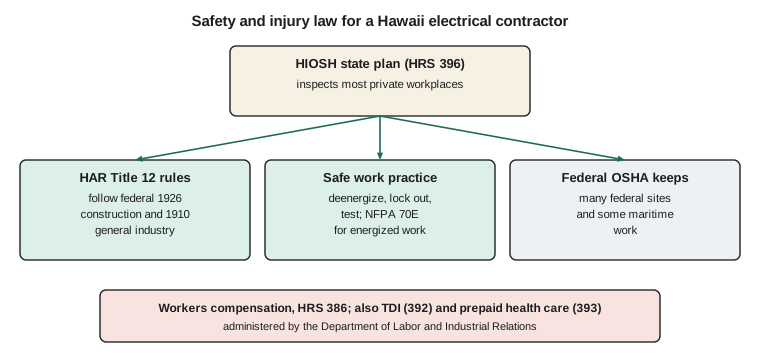
The federal Occupational Safety and Health Act lets states run their own occupational safety and health programs, called state plans, if they are at least as effective as the federal program. Hawaii has a state plan administered by HIOSH within the Department of Labor and Industrial Relations under HRS chapter 396. For most private and public employers in Hawaii, HIOSH, not federal OSHA, inspects workplaces, issues citations and handles complaints. Federal OSHA keeps jurisdiction over some workplaces, such as many federal facilities, and over certain maritime work; a contractor on a military base or a pier should check which agency covers the job.
HIOSH's standards are adopted in the Hawaii Administrative Rules, Title 12, and largely follow the federal standards, including the construction standards that correspond to 29 CFR Part 1926 and the general industry standards that correspond to 29 CFR Part 1910. Hawaii may add its own requirements or differ in detail, so the HIOSH rules, not the federal text, are the ones to check for a Hawaii job. A supervising electrician should know the electrical subpart of the construction standards, the rules for ladders and fall protection, excavation, scaffolds and lockout, and the rules for hazard communication.
Electrical safe work practices
The core electrical rule in the construction standards is that employees must not work on or near energized circuits unless they are protected, and that equipment must be deenergized and locked out or tagged out before work where that is feasible. The general industry standards add detailed lockout and tagout requirements for servicing equipment. NFPA 70E, the Standard for Electrical Safety in the Workplace, is the consensus standard that explains how to establish an electrically safe work condition, how to assess shock and arc flash risk, and how to choose protective equipment; safety agencies often treat it as evidence of what is feasible and recognized, even where it is not adopted word for word.
For a supervising electrician, the practical rule is simple: deenergize, lock out, test for absence of voltage and only then work. Energized work should be the rare exception, justified in writing, done by qualified people with the right equipment and a written plan. Leilani's crews carry personal locks and tags, a voltage tester that is checked on a known source before and after each test, and arc-rated clothing rated for the work they do. She signs off every energized work permit herself, and the answer is usually no.
Hawaii's other hazards
Hawaii adds its own risks to the usual list. Heat and sun exposure are year-round, and attics and rooftops can be extremely hot; crews need water, shade, rest breaks and a plan for acclimatizing new workers. Rooftop solar work combines electrical hazards with fall hazards, and a photovoltaic array is energized whenever light reaches it, so it cannot be simply switched off at the panel. Salt air corrodes equipment and enclosures, which can make older installations behave unpredictably. Remote sites can be far from emergency care, which makes first aid training and a clear emergency plan more important.
Reporting serious injuries to HIOSH
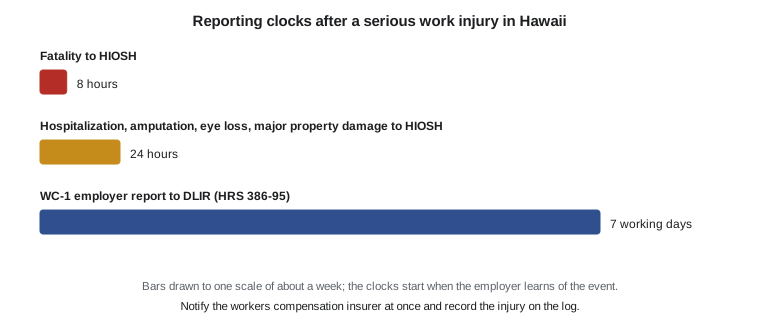
HIOSH requires employers to report the most serious events quickly. Its recordkeeping fact sheet says a fatality must be reported within 8 hours, and an inpatient hospitalization, an amputation or the loss of an eye must be reported within 24 hours. The same fact sheet lists property damage above 25,000 dollars among the events with a 24-hour deadline, which is a Hawaii addition to the federal list. The clocks start when the employer learns of the event, and the report can be made by phone or in person to HIOSH.
Employers covered by the recordkeeping rules must also record work-related injuries and illnesses that meet the recording criteria on the injury log, complete an incident report for each, and post the annual summary at the workplace each year. Smaller employers and some low-hazard industries are partly exempt from routine recordkeeping, but construction employers above the size threshold are not, and no employer is exempt from the serious-event reporting rules.
Workers compensation
Hawaii's workers compensation law, HRS chapter 386, requires nearly every employer to provide coverage for its employees, through an insurance policy, through approved self-insurance or, in narrow cases, through an exclusion. The Contractors License Board requires proof of that coverage for a contractor license, as Lesson 8 explained, and a lapse forfeits the license. Coverage pays medical care and wage-loss benefits for work injuries without regard to fault.
The employer must report work injuries to the Department of Labor and Industrial Relations. HRS 386-95 requires an employer to report an injury that causes at least one day of lost work or needs medical treatment beyond first aid within seven working days after the employer learns of it, using the department's employer's report of industrial injury, often called the WC-1. The director may fine an employer that willfully fails to file a required report up to 5,000 dollars. The employee also has deadlines for giving notice and filing a claim, which this course describes only generally; check the current law when an injury occurs.
Hawaii also requires employers to provide temporary disability insurance for off-the-job injuries and illnesses under HRS chapter 392, and health care coverage for eligible employees under the Prepaid Health Care Act, HRS chapter 393. These are separate from workers compensation, but a contractor who sets up payroll for a new company must arrange all three.
| Event or report | Deadline | To whom | Source |
|---|---|---|---|
| Work-related fatality | 8 hours | HIOSH | HIOSH fact sheet |
| Inpatient hospitalization, amputation, loss of an eye | 24 hours | HIOSH | HIOSH fact sheet |
| Property damage above 25,000 dollars | 24 hours | HIOSH | HIOSH fact sheet |
| Injury with a day of lost work or treatment beyond first aid | 7 working days | DLIR, on the WC-1 | HRS 386-95 |
| Recordable injury or illness | Entered on the log promptly | Employer's records | HAR Title 12 |
Worked problem
Which reports are due?
At 2:00 p.m. on a Tuesday, a Hamakua Line apprentice falls from a ladder and is admitted to Hilo Medical Center overnight with a broken wrist. Which reports are due, and when?
Show solution
- The apprentice was admitted as an inpatient, which is a 24-hour HIOSH event: report by 2:00 p.m. Wednesday.
- The injury will cause lost work and needed treatment beyond first aid, so the employer's report of industrial injury is due to DLIR within seven working days.
- Notify the workers compensation insurer at once, and record the injury on the injury log.
- Preserve the ladder and the scene, take photographs and gather statements for the incident investigation.
Answer: A 24-hour report to HIOSH, a WC-1 to DLIR within seven working days, notice to the insurer and a log entry.
Inspections, citations and penalties
HIOSH may inspect a workplace after a serious event, a complaint, a referral or as part of a planned program. Inspectors may review records, talk to workers and observe the work. If HIOSH finds violations it may issue citations with penalties and abatement dates, and the employer may contest them through the state's procedures. Penalty amounts change and are adjusted over time, so this course does not list them; what matters for the exam and for practice is that the employer is responsible for the conditions of its workplace, and that the supervising electrician on site is often the person who controls those conditions.
On a multi-employer construction site, more than one employer may be cited for the same hazard: the employer whose workers were exposed, the employer that created the hazard and the employer responsible for correcting it. An electrical subcontractor whose temporary wiring creates a shock hazard for other trades may be cited even though its own workers were not exposed. That is why Leilani inspects temporary power on every site weekly, as Lesson 6 described, and fixes problems the same day.
Qualified persons and training
The electrical safety standards use the idea of a qualified person: someone who has the skills and knowledge related to the construction and operation of the equipment and has received safety training to recognize and avoid the hazards involved. Only qualified persons may work on or near exposed energized parts, and the employer must be able to show the training that makes each worker qualified for the tasks assigned. A license is evidence of knowledge but is not, by itself, proof of safety training for a particular task; an experienced journey worker who has never worked on medium-voltage equipment is not qualified for it just because of the license.
Training should be documented. Hamakua Line keeps a training record for each worker listing the topics covered, the date, the trainer and the worker's signature: electrical safe work practices, lockout and tagout, arc flash protective equipment, ladder and fall protection, heat illness, hazard communication and first aid and CPR. New hires and apprentices get the basics before their first day in the field, and the whole company reviews one topic in a short tailgate meeting each week. The records answer HIOSH's first questions after an incident, and they help the company show general contractors that its crews are trained.
After an injury
When an injury happens, the first duty is care. Get the injured worker to medical treatment, call emergency services if needed and secure the area so no one else is hurt. Then preserve the scene, notify the supervisor and the office, and start the reports in the table above. Within a day or two, the supervising electrician should investigate with the crew to find out what happened and why, focusing on causes rather than blame, and decide what will change so it does not happen again.
Return to work matters too. Workers compensation pays benefits while a worker recovers, but a planned return to modified duty, such as material handling or job-site layout instead of ladder work, often helps the worker recover and keeps the crew's skills on the job. The treating physician's restrictions control, and the insurer's adjuster can help arrange modified work. Treat injured workers fairly; retaliating against a worker for reporting an injury or a safety concern is unlawful and invites both a complaint and a citation.
A written safety program
A contractor's written safety program pulls these duties together. For an electrical contractor it usually includes a hazard assessment process, electrical safe work procedures with lockout and tagout, an energized work permit process, fall protection and ladder rules, heat illness prevention, hazard communication, a first aid and emergency plan for each site, training records and the steps for reporting and investigating injuries. Many general contractors and public agencies ask for the program before a subcontractor may bid, and HIOSH looks for it after an injury.
from datetime import datetime, timedelta

learned = datetime(2026, 11, 17, 14, 0)    # Tuesday 2:00 p.m.
print("Fatality report to HIOSH by:", learned + timedelta(hours=8))
print("Hospitalization report to HIOSH by:", learned + timedelta(hours=24))

# seven working days, skipping weekends (holidays ignored in this sketch)
day, count = learned.date(), 0
while count < 7:
    day += timedelta(days=1)
    if day.weekday() < 5:
        count += 1
print("WC-1 to DLIR by:", day)Fatality report to HIOSH by: 2026-11-17 22:00:00 Hospitalization report to HIOSH by: 2026-11-18 14:00:00 WC-1 to DLIR by: 2026-11-26
Common mistakes
MistakeCalling federal OSHA about a serious injury on a private Hilo job site.
InsteadHawaii has a state plan; report to HIOSH unless the site is under federal jurisdiction.
MistakeWaiting until the next week to report an overnight hospitalization.
InsteadReport an inpatient hospitalization to HIOSH within 24 hours.
MistakeTreating the WC-1 as optional for minor injuries with lost time.
InsteadAn injury with a day of lost work or treatment beyond first aid must be reported within seven working days.
MistakeTurning off the inverter and treating a solar array as dead.
InsteadModules produce voltage whenever light reaches them; follow the array's shutdown and lockout procedures.
MistakeAssuming only the employer of the injured worker can be cited.
InsteadOn multi-employer sites, the creating and correcting employers may also be cited.
Summary and key terms
- Hawaii runs its own safety and health program, HIOSH, under HRS 396; federal OSHA keeps some federal and maritime sites.
- HIOSH rules in HAR Title 12 largely follow the federal construction and general industry standards.
- Deenergize, lock out and test before work; energized work is a justified exception, guided by NFPA 70E.
- Report a fatality within 8 hours and hospitalization, amputation, eye loss or property damage above 25,000 dollars within 24 hours.
- Workers compensation under HRS 386 is required; the WC-1 is due within seven working days.
- Temporary disability insurance and prepaid health care are separate employer duties.
- HIOSH
- The Hawaii Occupational Safety and Health Division, which runs the state plan.
- State plan
- A state program approved to enforce occupational safety and health instead of federal OSHA.
- WC-1
- The employer's report of industrial injury filed with DLIR.
- NFPA 70E
- The consensus standard for electrical safety in the workplace.
- Multi-employer site
- A site where several employers' workers and hazards overlap, and several may be cited.
Practice problems
Work each problem on paper first, then reveal the answer to check.
Which agency enforces workplace safety on a private construction site in Kona?
Show answer
HIOSH, Hawaii's state plan.
How soon must a fatality be reported?
Show answer
Within 8 hours.
How soon must an inpatient hospitalization be reported?
Show answer
Within 24 hours.
When is the WC-1 due?
Show answer
Within seven working days after the employer learns of a qualifying injury.
What are two Hawaii employer insurance duties besides workers compensation?
Show answer
Temporary disability insurance and prepaid health care coverage.
Lesson quiz · 5 questions
Score 60% or more to complete this lesson.
Create a free account to save your progress, take quizzes and earn a certificate.