
MELU-211 · Lesson 8 of 12 · 20 min
Contractor licensing, insurance and bonding
▶ Video coming soon A video version of this lesson is on the way.
Hamakua Line Electric's customers sign contracts with the company, not with Dennis or Leilani personally. The company can sign those contracts because it holds a contractor license from the Contractors License Board in the C-13 electrical classification. That license rests on a responsible managing employee, on insurance and on the company's continuing compliance with chapter 444. This lesson explains how the contractor system works, what the responsible managing employee does, the insurance and bonding requirements, renewal, and how the contractor and electrician systems fit together.
Who needs a contractor license
HRS chapter 444 requires a contractor license to act as a contractor in Hawaii, which broadly means undertaking, offering or bidding to do construction work for others. Electrical work done for a customer is construction work, so an electrical business that contracts for it needs a license in a classification that includes electrical work. The specialty classification for electrical contractors is C-13. General contractors may also contract for projects that include electrical work, but the electrical work itself must still be performed by licensed electricians, and many general contractors subcontract it to a C-13 contractor.
The board's FAQ for electricians notes the narrow exception for small projects: a project with an aggregate contract price of 1,000 dollars or less that does not require a building permit. The exception is narrow because nearly all real electrical work needs a permit or costs more than that, and because splitting one job into several small contracts to stay under the limit is not permitted. An electrician who does side jobs for customers on weekends without a contractor license is contracting without a license, and risks the penalties in chapter 444 as well as discipline by the electrician board.
The responsible managing employee
A contracting entity, whether a corporation, a limited liability company, a partnership or a sole proprietor, qualifies for its license through a responsible managing employee, or RME. The RME is the person who has the experience and has passed the exams, and who is responsible for the entity's operations in the licensed classification. A sole proprietor is usually their own RME. The RME must be employed by the entity, and an RME who leaves takes the qualification with them, so the entity must replace the RME to keep the license.
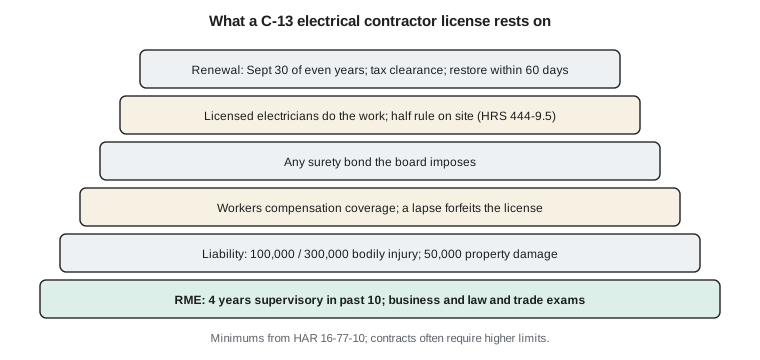
The board's requirements sheet for an RME applicant, updated in October 2025, lists the main conditions. The applicant must be at least eighteen, of good reputation for honesty, truthfulness, financial integrity and fair dealing, and employed by a licensed contracting entity. The applicant must have at least four years of supervisory experience within the past ten years in the classification, shown by at least three notarized certificates of experience and a project list. Only on-site supervision of the applicant's own crew counts. The applicant must pass a written examination in two parts: Part I on business and law and Part II on the trade. The board must approve the application before the applicant may register for the exams, and the applicant must pass within six months of approval or file a new application.
The board's exam page says the contractor examinations have been given by PSI since January 2023, while the October 2025 requirements sheet still names Prometric. Follow the testing company named in your approval letter; the letter is the controlling document for registration.
RME and supervising electrician
For a C-13 contractor the RME and the supervising electrician are often the same person, as Dennis is at Hamakua Line, but the law does not require it. HRS 444-9.5 says that if the RME is not licensed under chapter 448E, the contractor must use chapter 448E licensees to perform the electrical work. A contractor whose RME is not an electrician therefore needs licensed supervising and journey worker electricians on staff to direct and do the work, and the half rule still applies on site.
Leilani plans to hold both roles, which gives Hamakua Line the simplest structure: one person who can sign the company's contracts as RME and direct the electrical work as supervising electrician. She has the supervisory experience from her years as a crew leader, and she has collected notarized certificates from Dennis and two general contractors. Her plan is to file the RME application shortly after she receives her ES license, so that the company can change its RME before Dennis steps back.
Insurance
A contractor must carry insurance continuously while licensed. HAR 16-77-10 lists the supporting documents for a license application and sets minimum liability and property damage coverage: bodily injury coverage of at least 100,000 dollars for each person and 300,000 dollars for each occurrence, and property damage coverage of at least 50,000 dollars for each occurrence. The applicant must also show workers compensation coverage, through a certificate from an authorized insurer, authorization as a self-insurer under chapter 386, or an exclusion from that chapter.
These are minimums for licensing, not recommendations. Many general contractors, owners and public agencies require far higher limits in their contracts, along with additional insured endorsements and waivers of subrogation. Hamakua Line carries limits well above the state minimums because its general contractor customers require them. The board's renewal page links to an online portal for submitting insurance certificates, and the board's requirements sheet warns that a lapse in liability or workers compensation coverage causes the license to be forfeited automatically; if coverage is not reinstated within 60 days, a new application is required.
| Coverage | Minimum for licensing (HAR 16-77-10) |
|---|---|
| Bodily injury, each person | 100,000 dollars |
| Bodily injury, each occurrence | 300,000 dollars |
| Property damage, each occurrence | 50,000 dollars |
| Workers compensation | Certificate from an authorized insurer, self-insurance or exclusion |
| Surety bond | Only if the board imposes one |
Bonds and the recovery fund
Hawaii does not require every contractor to post a license bond. HAR 16-77-10 requires an applicant to furnish any surety bond the board imposes, which the board may do, for example, where an applicant's financial history raises concerns. Bonds required by contracts are a separate matter: public works and many large private jobs require performance and payment bonds, and homeowners may ask for a bond, as Lesson 9 explains.
The Contractors Recovery Fund is the state's protection for consumers harmed by licensed contractors. Contractors pay into it when they are licensed and at renewal; the requirements sheet lists recovery fund fees of 74 dollars or 148 dollars depending on the timing. A homeowner who wins a judgment against a licensed contractor for certain kinds of misconduct and cannot collect may apply to the fund for payment, and the contractor whose conduct led to a payment must repay the fund or lose the license.
Applying, fees and credit
The entity's application includes its business registration, the RME's information and approval, insurance and workers compensation documents, and credit reports. The requirements sheet asks for a complete credit report for each officer, partner, manager or member, issued within the past six months and covering at least five years. It lists a nonrefundable application fee of 50 dollars, a license fee of 260 dollars and the recovery fund fee, with other fees for renewals and restorations. Fees change; check the current schedule.
Insurance and bonds are different tools
Exam questions often test whether a candidate can tell insurance from a bond. Liability insurance protects the contractor: when the contractor's work causes injury or property damage to others, the insurer defends and pays covered claims, up to the policy limits, on the contractor's behalf. Workers compensation insurance protects the contractor's employees: it pays medical care and wage benefits for work injuries regardless of fault, and in return generally limits the employee's right to sue the employer. A surety bond protects someone else, such as the owner or the state. If the contractor fails to perform or to pay, the surety pays the protected party and then has the right to recover what it paid from the contractor.
That last point is the key difference. An insurer that pays a covered claim does not normally recover the payment from its own policyholder. A surety that pays on a bond expects the contractor to repay it, which is why sureties check a contractor's finances and often require personal indemnity agreements from the owners. A bond is a form of credit, not insurance for the contractor.
Advertising and the license number
Chapter 444 and the board's rules regulate how contractors advertise. Contractors generally must include their license number in advertising, and an unlicensed person may not advertise as a contractor. Deceptive advertising is a ground for discipline. The same principle applies to electricians under HRS 448E-9 and 448E-10: a person may not advertise as a licensed electrician without the license. Hamakua Line's trucks, website, business cards and proposals all carry its contractor license number, and Joy checks each new ad before it runs.
Business registration and taxes
The contracting entity must also be properly registered and in good standing with the Department of Commerce and Consumer Affairs business registration division, and must hold the general excise tax license required of businesses in Hawaii. The tax clearance needed for renewal confirms that the entity has filed its returns and paid its taxes. A company that falls behind on taxes may find that it cannot renew its contractor license, which stops it from contracting, so the office manager's tax calendar is as important as the licensing calendar.
Renewal
Contractor licenses run on a two-year cycle that is different from the electricians' three-year cycle. The board's renewal page says licenses expire on September 30 of every even-numbered year; the current period runs from October 1, 2026 to September 30, 2028. Renewal requires the renewal fee, current insurance on file and, for active entities and sole proprietors, a current tax clearance from the Department of Taxation, dated within six months of renewal and showing the same name as the license. A license not renewed by the expiration date is forfeited, and the holder may not practice. A forfeited license may be restored within 60 days with restoration fees; after that, the license terminates and the holder must apply as a new applicant.
Because the two cycles differ, a company like Hamakua Line has two sets of renewal dates to track: its contractor license every second September 30, and each electrician's license every third June 30. Joy keeps both in the same calendar with reminders ninety days ahead.
Worked problem
Changing the RME
Dennis plans to stop being Hamakua Line's RME on December 31, 2027. Leilani's RME application is approved in March 2027 and she passes both exam parts in May 2027. What should the company do, and when?
Show solution
- Leilani must be an employee of the entity and approved as its RME before Dennis's qualification ends.
- The company files the change of RME with the board, with Leilani's approval and exam results, well before December 31, 2027.
- Insurance, workers compensation and tax clearance stay in the entity's name and must remain current.
- Dennis can remain an employee and supervising electrician after he stops being RME, if the company wants.
Answer: File the RME change soon after May 2027 so the board records Leilani as RME before Dennis steps back; keep the entity's insurance and tax clearance current.
# Two renewal cycles at Hamakua Line (illustrative)
contractor_years = list(range(2026, 2035, 2))      # Sept 30, even years
electrician_years = list(range(2026, 2035, 3))     # June 30, every 3 years
for year in range(2026, 2035):
    items = []
    if year in electrician_years: items.append("electrician licenses due June 30")
    if year in contractor_years: items.append("contractor license due Sept 30")
print(year, "; ".join(items) if items else "-")2026 electrician licenses due June 30; contractor license due Sept 30 2027 - 2028 contractor license due Sept 30 2029 electrician licenses due June 30 2030 contractor license due Sept 30 2031 - 2032 electrician licenses due June 30; contractor license due Sept 30 2033 - 2034 contractor license due Sept 30
Common mistakes
MistakeDoing side jobs for pay on an ES license alone.
InsteadContracting requires a contractor license under HRS 444, apart from the small, permit-free exception.
MistakeAssuming every Hawaii contractor posts a license bond.
InsteadA bond is required only if the board imposes one; contracts may require others.
MistakeLetting liability insurance lapse for a month.
InsteadA lapse forfeits the license automatically; reinstate within 60 days or reapply.
MistakeConfusing the contractor and electrician renewal cycles.
InsteadContractor licenses renew every two years on September 30 of even years; electrician licenses every three years on June 30.
MistakeAssuming the RME must be the supervising electrician.
InsteadNot required; if the RME is not a 448E licensee, licensed electricians must perform the work.
Summary and key terms
- A business that contracts for electrical work needs a contractor license, usually C-13.
- The license rests on an RME with four years of supervisory experience in the past ten and passing business and law and trade exams.
- Minimum liability insurance is 100,000 dollars each person and 300,000 each occurrence for bodily injury and 50,000 for property damage.
- Workers compensation coverage is required; a lapse forfeits the license.
- Bonds are required only if the board imposes them; the recovery fund protects consumers.
- Contractor licenses expire September 30 of even years and need a current tax clearance to renew.
- Contractors License Board
- The state board that licenses contracting entities under HRS 444.
- C-13
- The electrical contractor classification.
- RME
- Responsible managing employee, who qualifies the entity for its license.
- Contractors Recovery Fund
- A state fund that pays certain unpaid judgments against licensed contractors.
- Tax clearance
- A certificate from the Department of Taxation required for renewal.
Practice problems
Work each problem on paper first, then reveal the answer to check.
What classification does an electrical contractor hold?
Show answer
C-13.
How much supervisory experience does an RME applicant need?
Show answer
At least four years within the past ten years.
What are the minimum bodily injury limits?
Show answer
100,000 dollars each person and 300,000 dollars each occurrence.
When do contractor licenses expire?
Show answer
September 30 of every even-numbered year.
If an RME is not an electrician, who must perform the electrical work?
Show answer
Electricians licensed under chapter 448E.
Lesson quiz · 5 questions
Score 60% or more to complete this lesson.
Create a free account to save your progress, take quizzes and earn a certificate.