
MELU-210 · Lesson 9 of 12 · 19 min
Contracts and mechanics' liens in Georgia
▶ Video coming soon A video version of this lesson is on the way.
In the spring after Darnell passed, Calloway Electric finished the electrical work on a small medical office building on Northside Drive for a general contractor that then stopped paying its subcontractors. Calloway was owed a little over forty-one thousand dollars, including retainage. Ruth had seen this before. She pulled the job file, called the company's lawyer, and put a date on the whiteboard in red: ninety days after Calloway's last day of work on the site. "Miss that date," she told Darnell, "and the lien is gone. Everything else we can argue about." This lesson covers the contract basics a Georgia electrical contractor needs, the state's mechanics' lien law including the deadlines that decide whether a lien survives, the 2021 changes to lien waivers, and how public projects differ.
Contract basics
Every job starts with an agreement, and the clearer the agreement, the fewer the disputes. A good electrical contract identifies the parties and the property, describes the scope of work and what is excluded, sets the price or the method of pricing, states the payment schedule and any retainage, explains how changes are approved and priced, sets the schedule, and addresses warranties, insurance, permits and dispute resolution. Georgia law does not require a written contract for a lien, but the business guide on the exam's reference list treats a written contract as the foundation of good practice, and so did Ruth.
Change orders deserve particular care. Most disputes on electrical jobs start with extra work: a customer who adds circuits, an owner who moves walls, a general contractor who changes the equipment schedule. A written change order signed before the extra work begins, with a description, a price or pricing method, and any schedule effect, is the contractor's best protection. Calloway's foremen carried change order forms in their trucks and were not allowed to start extra work without one, except in a genuine emergency, in which case the form followed the same day.
Before the job: protecting yourself up front
The best lien is the one you never need. Before signing a contract with a new customer or general contractor, a careful subcontractor checks who owns the property, whether there is a construction lender, whether the general contractor has a reputation for paying on time, and whether the project is bonded. It reviews the payment terms, the retainage, any clause that makes payment depend on the general contractor being paid first, and the dispute resolution clause. It keeps billing current, documents every change, and follows up promptly on late payments rather than waiting months. Ruth credited most of Calloway's good collection record to those habits rather than to the lien law.
When payment does slow down, early, professional communication often solves the problem. A call to the general contractor's project manager, then a letter, then a conversation with the owner, each with the lien dates in mind, usually brings payment or at least information. The lien law is the backstop that gives those conversations weight, because every party knows that a properly filed lien clouds the owner's title and can block a sale or refinancing.
Who can claim a lien
Georgia's lien statute gives lien rights to those who improve real property, including contractors, subcontractors, lower-tier subcontractors, suppliers of materials, laborers, design professionals and equipment rental companies, subject to the conditions in the statute. A lien gives the claimant a security interest in the property itself, so an unpaid contractor can ultimately force a sale of the property to collect, after following the statutory steps. The aggregate of liens on a property generally cannot exceed the contract price for the improvement. Lien rights apply to private projects; on public projects, payment bonds take their place, as discussed below.
The notice of commencement and preliminary notice
Georgia uses an optional notice of commencement system. According to the statute and practitioner summaries, the owner, the owner's agent or the general contractor may file a notice of commencement with the clerk of superior court within 15 days after work physically begins. When a notice of commencement has been filed, subcontractors, suppliers and others who do not have a contract directly with the owner must give a preliminary notice of lien rights within 30 days of the filing of the notice of commencement or of first furnishing labor or materials, whichever is later, to preserve their lien rights. A general contractor may file a preliminary notice but is generally not required to.
For a subcontractor like Calloway, the practical rule was to check the county records at the start of every job for a notice of commencement and, if one had been filed, to file and serve the preliminary notice on time. Jen did that for every commercial job as part of the contract setup, using the form in the statute, and kept the filing receipt in the job file. On the Northside Drive job, the general contractor had filed a notice of commencement, and Jen's preliminary notice, filed within the 30 days, preserved Calloway's lien rights.
The claim of lien and the deadlines
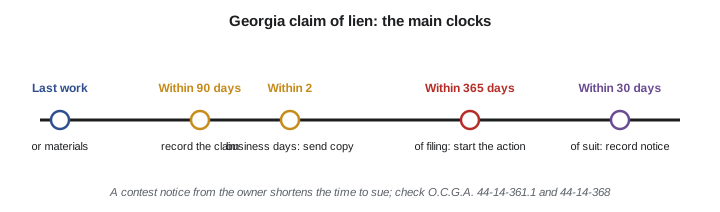
The central deadline is the claim of lien. Under O.C.G.A. 44-14-361.1, the claim must be filed with the clerk of superior court in the county where the property is located within 90 days after the completion of the work or the furnishing of the materials or services. The claim must be in the form the statute requires, including a prominent statement that the claim expires and is void 395 days from the date of filing unless a notice of commencement of lien action is filed. A copy of the claim must be sent to the owner within two business days after filing, by registered or certified mail or statutory overnight delivery, as the statute specifies.
Filing the claim is not the end. The claimant must start an action to enforce the lien within 365 days after the claim is filed, and within 30 days after starting the action must file a notice of commencement of lien action with the clerk, identifying the lawsuit and the lien. If the owner or another party files and serves a notice of contest of lien, the time to start the enforcement action shortens to 60 days after the claimant receives the notice of contest. Each step has its own form requirements, and courts in Georgia have generally enforced the deadlines strictly.
| Step | Deadline (summary) | Source |
|---|---|---|
| The notice of commencement (optional, owner or contractor) | Within 15 days after work physically begins | O.C.G.A. 44-14-360 and following |
| Preliminary notice (subcontractors and suppliers, when a notice of commencement is filed) | Within 30 days of the filing or first furnishing, whichever is later | O.C.G.A. 44-14-360 and following |
| Claim of lien | Within 90 days after completing the work | O.C.G.A. 44-14-361.1 |
| Copy to the owner | Within 2 business days after filing | O.C.G.A. 44-14-361.1 |
| Enforcement action | Within 365 days after filing the claim | O.C.G.A. 44-14-361.1 |
| The notice of commencement of lien action | Within 30 days after starting the action | O.C.G.A. 44-14-361.1 |
| After a notice of contest | Action within 60 days of receiving the contest | O.C.G.A. 44-14-368 |
# Georgia lien deadlines from the last day of work (study aid; counting rules simplified)
from datetime import date, timedelta

def add_business_days(d, n):
    while n:
        d += timedelta(days=1)
        if d.weekday() < 5:
            n -= 1
    return d

last_work = date(2027, 4, 2)
claim_deadline = last_work + timedelta(days=90)
filed = date(2027, 6, 14)  # the day Calloway files
copy_by = add_business_days(filed, 2)
suit_by = filed + timedelta(days=365)
expires = filed + timedelta(days=395)
print("Last work:", last_work.isoformat())
print("File claim by:", claim_deadline.isoformat())
print("Claim filed:", filed.isoformat(), "| send owner copy by:", copy_by.isoformat())
print("Start enforcement action by:", suit_by.isoformat())
print("Claim expires if no notice of lien action:", expires.isoformat())Last work: 2027-04-02 File claim by: 2027-07-01 Claim filed: 2027-06-14 | send owner copy by: 2027-06-16 Start enforcement action by: 2028-06-13 Claim expires if no notice of lien action: 2028-07-13
The script turns the statutory periods into calendar dates for the Northside Drive job. Real deadlines can turn on details the script ignores, such as which day counts as the last day of work, holidays, and how a court counts business days, so the company's lawyer confirmed each date. The point of the exercise is to put every date on the calendar the day the problem appears, not the week before it expires.
Lien waivers and the 2021 changes
Owners, lenders and general contractors routinely ask subcontractors to sign lien waivers in exchange for payment. Georgia requires that lien waivers and releases use the statutory forms: an interim waiver and release for progress payments and a waiver and release upon final payment. Amendments that took effect on 1 January 2021 changed how those waivers work. According to practitioner summaries of the amendments, a waiver now waives only lien and payment bond rights to the extent stated, and does not waive other claims for payment such as a breach of contract claim. The deadline to file an affidavit of nonpayment, the document a claimant files when it signed a waiver but was not paid, was extended from 60 to 90 days after the waiver was signed. The forms themselves were revised, so waivers on old forms should not be used.
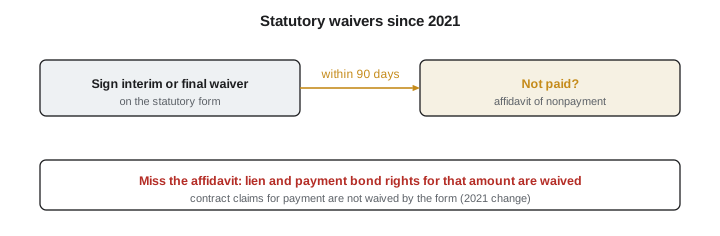
The practical effect is still serious. A subcontractor that signs a waiver in anticipation of a payment that never arrives must file an affidavit of nonpayment within 90 days, or its lien and bond rights for that amount are waived, even though it may still sue on the contract. Calloway's rule was never to sign a waiver for more than the payment actually received, to calendar 90 days from every waiver signed for a payment not yet received, and to file the affidavit on day 80 if the money had not arrived.
Retainage and prompt payment
Many contracts withhold a share of each progress payment, called retainage, until the job is complete. Georgia's Prompt Pay Act, in Chapter 11 of Title 13, sets rules for the timing of payments between owners, contractors and subcontractors on private projects and limits retainage, and separate statutes govern public projects. The details, including the payment periods, the limits on retainage and the interest on late payments, are in the statutes and are the subject of exam questions drawn from the business guide. Read the current statutes and the contract together, because many contracts set their own terms within what the law allows.
Public projects and payment bonds
Liens cannot attach to public property, so Georgia law protects subcontractors and suppliers on public works through payment bonds, required on public works contracts above thresholds set by statute. A subcontractor that is not paid makes a claim against the payment bond under the procedures and deadlines in the bond statutes, which differ from the lien deadlines. Calloway's county library and school jobs were all bonded, and Jen kept a copy of each payment bond and the notice requirements in the job file at the start of the project.
Worked problem
Protecting the Northside Drive claim
Calloway's last work on the Northside Drive building was on 2 April. The general contractor filed a notice of commencement, and Jen filed and served a preliminary notice on time. Calloway signed an interim waiver on 15 March for a progress payment of eighteen thousand dollars that was never paid. What must Calloway do to protect its lien rights for the full amount?
Show solution
- File an affidavit of nonpayment within 90 days of the 15 March waiver, because the payment was not received.
- File the claim of lien in the county where the property is located within 90 days of 2 April.
- Send a copy of the claim to the owner within two business days of filing.
- Start the enforcement action within 365 days of filing, sooner if a notice of contest is received.
- Within 30 days of starting the action, file the notice of commencement of lien action.
Answer: Affidavit of nonpayment, claim of lien within 90 days, copy to the owner, and the follow-up deadlines, with a lawyer's help.
Common mistakes
MistakeWaiting to talk to a lawyer until the 90 days are almost gone.
InsteadPut the lien dates on the calendar as soon as payment problems appear, and get advice early.
MistakeSigning a waiver for a payment not yet received and forgetting it.
InsteadCalendar 90 days from the waiver and file an affidavit of nonpayment if payment does not arrive.
MistakeUsing an old waiver form.
InsteadUse the current statutory forms revised in 2021.
MistakeFiling a lien on a county building.
InsteadPublic projects use payment bonds; follow the bond claim procedure instead.
Summary and key terms
- A written contract with clear scope, payment terms and change order procedures prevents most disputes.
- When a notice of commencement is filed, subcontractors and suppliers must give a preliminary notice within 30 days of the filing or first furnishing, whichever is later.
- The claim of lien must be filed within 90 days of completing the work, with a copy to the owner within two business days.
- The enforcement action must start within 365 days of filing (60 days after a notice of contest), with a notice of lien action within 30 days of suit.
- Since 2021, statutory waivers waive only lien and bond rights, and the affidavit of nonpayment deadline is 90 days.
- Claim of lien
- The document recorded in the county records to assert a lien on the property.
- Commencement notice
- The notice of commencement: an optional filing by the owner or contractor identifying the project and parties.
- Preliminary notice of lien rights
- A notice subcontractors and suppliers give when a notice of commencement has been filed.
- Affidavit of nonpayment
- A filing that preserves lien and bond rights after a waiver was signed but payment was not received.
- Retainage
- A share of each payment withheld until the work is complete.
Practice problems
Work each problem on paper first, then reveal the answer to check.
Within how many days after completing the work must a Georgia claim of lien be filed?
Show answer
Within 90 days.
How long after filing the claim does the claimant have to start an enforcement action, absent a notice of contest?
Show answer
365 days.
What changed in 2021 about the affidavit of nonpayment deadline?
Show answer
It was extended from 60 to 90 days after the waiver was signed.
Lesson quiz · 5 questions
Score 60% or more to complete this lesson.
Create a free account to save your progress, take quizzes and earn a certificate.