
MELU-210 · Lesson 1 of 12 · 19 min
How electrical licensing works in Georgia
▶ Video coming soon A video version of this lesson is on the way.
Ruth Calloway founded Calloway Electric in Macon in 1991 with a borrowed truck, a used pipe bender and a Georgia Class II electrical contractor license she had earned the year before. Thirty-five years later the company employs eighteen people, keeps three service vans on the road, and does a steady mix of commercial fit-outs, light industrial work and residential service changes across Bibb, Houston, Jones and Monroe counties. On a cool Tuesday morning in October, Ruth asked her field supervisor, Darnell Hayes, to stay after the weekly safety meeting. "I'm sixty-six," she said. "Every permit this company pulls goes out under my license. If Calloway Electric is going to outlast me, somebody here has to sit the state exam and hold that license. I want it to be you."
Darnell had twelve years in the trade. He started as a helper on a Warner Robins housing development, finished his training through a technical college program while working, and had spent the last six years running crews on commercial and industrial jobs for Calloway. He had worked through the master electrician core courses on the National Electrical Code, load calculations, grounding and bonding, motors and transformers, special occupancies, and business and law. This course takes that preparation and applies it to Georgia: who licenses electrical contractors, what the two license classes allow, how the state exam works, which edition of the NEC applies and with which Georgia amendments, how permits and inspections are handled, and the Georgia law on contracts, liens, insurance, workers' compensation, safety and renewal.
The agencies involved
Georgia regulates electrical contractors through a board that sits inside the Secretary of State's office. The Secretary of State's Professional Licensing Boards division handles the administrative side for dozens of professions: it receives applications, collects fees, issues and renews licenses, and maintains the public license lookup. The policy body for construction trades is the State Construction Industry Licensing Board, created by Chapter 14 of Title 43 of the Georgia Code. That board is divided into divisions, one for each group of trades, and the Division of Electrical Contractors handles electrical contractor licensing. Other divisions handle plumbers, conditioned air contractors, low-voltage contractors and utility contractors, each with its own exams and rules.
The Division of Electrical Contractors is made up mostly of licensed electrical contractors, with other members set by statute, and it meets regularly to review applications, approve candidates for the exam, decide disciplinary matters and adopt rules. Its rules appear in Chapter 121 of the Rules and Regulations of the State of Georgia, which covers application requirements, the two license classes, examinations, renewal, continuing education and discipline. When you study, keep the two layers separate in your mind: the statute in Title 43, Chapter 14 sets the framework and the penalties, and the Board rules fill in the details such as experience requirements and continuing education hours.
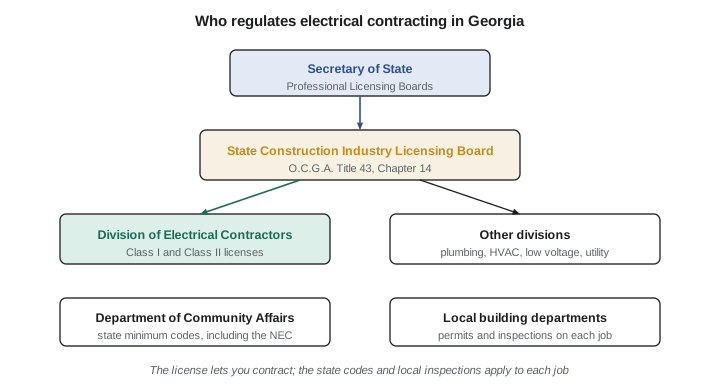
Two other bodies matter to every electrical contractor even though they do not issue licenses. The Department of Community Affairs, usually called DCA, adopts the state minimum standard codes, including the National Electrical Code and the Georgia amendments to it. Local governments, through their building departments, issue permits and perform inspections and enforce those codes on each job. A Georgia license therefore lets you contract for electrical work anywhere in the state, but each job is still governed by the state codes as adopted, by any local amendments a jurisdiction is allowed to make, and by the local permit and inspection process.
Contractors, not electricians
One feature of Georgia's system surprises people who move in from other states. The Board's own guidance says plainly that it licenses electrical contractors, not electricians. There is no statewide journeyman electrician license and no statewide master electrician license of the kind issued in states such as Texas or Alabama. The person who must be licensed is the one who contracts for electrical work: who offers, bids or agrees to perform it for others, and who takes responsibility for it. The electricians who do the work on the job are employees of a licensed contractor and work under the license holder's supervision, subject to any local rules where they work.
That design has practical effects. A skilled electrician in Georgia can work for years without holding any state license, as long as he or she works for a licensed contractor. The moment that electrician wants to take side jobs, bid work in his or her own name, or start a company, a contractor license becomes necessary. Some cities and counties also have their own registration or certification rules for people who pull permits or work on certain jobs, so a contractor who works in many jurisdictions should check each one's requirements. Darnell had never needed a state license as a supervisor at Calloway, because every permit went out under Ruth's license.
| Question | Georgia's answer (summary) |
|---|---|
| Who must be licensed? | The person who engages in electrical contracting |
| Is there a statewide journeyman license? | No; the Board licenses contractors, not electricians |
| Is the contractor license statewide? | Yes, issued by the Division for use across Georgia |
| Who adopts the electrical code? | The Department of Community Affairs (state minimum codes) |
| Who issues permits and inspects? | Local building departments |
Class I and Class II
Georgia issues two classes of electrical contractor license, and the difference is the size and type of electrical system the holder may contract for. A Class I license is restricted: under the Board's rule it is limited to single-phase electrical installations that do not exceed 200 amperes at the service drop or the service lateral. A Class II license is unrestricted and covers all electrical contracting work, including the three-phase services, large feeders, motors and transformers found in commercial and industrial buildings. A Class II holder may also perform anything a Class I holder may perform.
For Calloway Electric the choice was obvious. The company's best customers were a regional dental group with a three-phase 400-ampere service at its Riverside Drive clinic, a distribution company with a 480Y/277-volt service at a warehouse off Forsyth Road, and several restaurants with three-phase kitchen equipment. None of that work fits under a Class I license. Darnell's friend Tasha Greene, who runs a residential crew in Warner Robins and wired mostly new houses with 200-ampere single-phase services, was considering a Class I license instead. Lesson 2 covers the eligibility rules for each class in detail.
Company and license holder
A Georgia electrical contractor license is issued to an individual, not to a company. A corporation, partnership or limited liability company may engage in electrical contracting only if a licensed person is actually engaged in the business on a full-time basis, and the business must notify the Division immediately when that person leaves. That is why Ruth's license mattered so much: Calloway Electric, Inc. could not lawfully contract for electrical work without a license holder working there full time. Lesson 7 covers the license holder's duties and the rules for qualifying a business, and Lesson 8 covers the insurance, workers' compensation and other business requirements that apply to an electrical contracting company in Georgia.
The license holder does not have to own the company. Many Georgia electrical companies are owned by one person and qualified by another, and the law cares mainly that the license holder is really engaged in the business and supervises the electrical work. Ruth planned to keep owning Calloway Electric for a few years after Darnell passed, then sell him part of the company over time. Their plan illustrates a pattern common across the state: ownership and qualification can be separated, but the license cannot simply be lent to a business where the holder does not work.
Unlicensed contracting
Contracting for electrical work without the required license violates Georgia law. Unlicensed contractors face criminal penalties and civil fines, and Georgia courts have held that contracts made by unlicensed persons in licensed trades can be unenforceable, which may leave the unlicensed contractor unable to collect payment or file a lien. A person who is not licensed also may not advertise as an electrical contractor unless the work will actually be done by a licensed contractor. Licensed contractors face discipline if they help unlicensed people evade the law, for example by pulling permits for work they do not supervise.
Ruth had a story about this too. After a spring storm in 2019, a homeowner in north Macon hired a man with a pickup truck and a business card to replace a damaged meter base and service entrance. The work failed inspection, the utility refused to reconnect, and the homeowner called Calloway Electric to redo it. The man with the business card had pulled no permit and held no license, and the homeowner never recovered the money she had paid him. "Every time that happens," Ruth told Darnell, "it costs a customer money and it costs our trade some trust."
# Which Georgia license class fits each job? (simplified study aid)
jobs = [
    ("Service upgrade at a house on Ingleside Avenue", 1, 200),
    ("New service for the Riverside Drive dental clinic", 3, 400),
    ("Detached garage subpanel fed from a 200 A house service", 1, 200),
    ("Warehouse service off Forsyth Road", 3, 800),
    ("New 320 A single-phase service for a large house", 1, 320),
]
for job, phases, amps in jobs:
    class_one_ok = phases == 1 and amps <= 200
    needed = "Class I or Class II" if class_one_ok else "Class II only"
print(f"{job}: {phases}-phase, {amps} A -> {needed}")Service upgrade at a house on Ingleside Avenue: 1-phase, 200 A -> Class I or Class II New service for the Riverside Drive dental clinic: 3-phase, 400 A -> Class II only Detached garage subpanel fed from a 200 A house service: 1-phase, 200 A -> Class I or Class II Warehouse service off Forsyth Road: 3-phase, 800 A -> Class II only New 320 A single-phase service for a large house: 1-phase, 320 A -> Class II only
The calculator applies the scope line from the Board's rule: single-phase and not over 200 amperes at the service drop or lateral. The large house with a 320-ampere single-phase service shows that the rule is about ampacity as well as phase. A residential job can still require a Class II license if the service is larger than 200 amperes. Exam questions about scope often describe a job in a sentence and ask which license class may contract for it.
Worked problem
Choosing a license class
Tasha's crew builds about forty houses a year in Houston County, all with 200-ampere single-phase services. A builder has asked her to bid two houses with 400-ampere single-phase services and a small retail building with a 208Y/120-volt three-phase service. Which license class does she need for each type of job?
Show solution
- The 200-ampere single-phase houses fall within the Class I limit.
- The 400-ampere single-phase houses are single-phase but exceed 200 amperes at the service, so they fall outside Class I.
- The retail building has a three-phase service, which is outside Class I regardless of size.
- A Class II license covers all three types of job.
Answer: Class I covers the 200-ampere houses only; the larger houses and the retail building require Class II.
The rest of this course
Lesson 2 covers eligibility for each license class, and Lesson 3 walks through the application, approval and booking process. Lesson 4 explains the exam format and the reference books allowed. Lesson 5 covers the NEC as adopted in Georgia with the state amendments, and Lesson 6 covers permits and inspections. Lessons 7 and 8 deal with the license holder's duties and the business requirements. Lesson 9 covers contracts and Georgia's lien law, including the 2021 changes to lien waivers. Lesson 10 covers safety law and OSHA, Lesson 11 covers renewal and continuing education, and Lesson 12 pulls the course together with practice questions and a test-day plan.
Throughout the course you will follow Darnell from the day Ruth asks him to take the exam to the day he walks out of the testing center, along with Tasha on the Class I path and the rest of the Calloway Electric team: Jen Okafor, who runs the office and the permit desk, and Caleb Moss, a young electrician who wants to understand the business side. Their jobs are fictional, but the questions they face are the ones Georgia contractors face every week.
Common mistakes
MistakeAssuming Georgia has a statewide journeyman or master electrician license.
InsteadRemember that the Board licenses electrical contractors, not electricians; some localities have their own rules.
MistakeThinking a Class I license covers any house.
InsteadCheck the service: Class I is limited to single-phase installations not exceeding 200 amperes at the service drop or lateral.
MistakeTreating the license as belonging to the company.
InsteadThe license is issued to an individual who must be actually engaged in the business full time.
MistakeConfusing the code adopter with the licensing board.
InsteadDCA adopts the state minimum codes; the Division of Electrical Contractors licenses contractors; local departments inspect.
Summary and key terms
- Georgia licenses electrical contractors through the Division of Electrical Contractors of the State Construction Industry Licensing Board, administered by the Secretary of State.
- The Board licenses contractors, not electricians; there is no statewide journeyman license.
- Class I is restricted to single-phase installations not exceeding 200 amperes at the service drop or lateral; Class II is unrestricted.
- The license is issued to an individual, and a business may contract only with a licensed person engaged in it full time.
- DCA adopts the state codes, including the NEC with Georgia amendments, and local departments issue permits and inspect.
- Division of Electrical Contractors
- The division of the State Construction Industry Licensing Board that licenses electrical contractors in Georgia.
- Class I license
- A restricted license limited to single-phase installations not exceeding 200 amperes at the service drop or service lateral.
- Class II license
- An unrestricted electrical contractor license covering all electrical contracting.
- DCA
- The Georgia Department of Community Affairs, which adopts the state minimum standard codes.
- State minimum standard codes
- The construction codes adopted statewide by DCA, including the NEC with Georgia amendments.
Practice problems
Work each problem on paper first, then reveal the answer to check.
A company wants to wire a 600-ampere single-phase service for a large estate. Which class of license must its license holder hold?
Show answer
Class II, because the service exceeds 200 amperes even though it is single-phase.
Who adopts the Georgia amendments to the NEC?
Show answer
The Department of Community Affairs, as part of the state minimum standard codes.
Darnell has worked for licensed contractors for twelve years without a state license. Was that lawful?
Show answer
Yes. Georgia licenses contractors; electricians working as employees of a licensed contractor do not need a state license, subject to any local rules.
Lesson quiz · 5 questions
Score 60% or more to complete this lesson.
Create a free account to save your progress, take quizzes and earn a certificate.