
MELU-210 · Lesson 2 of 12 · 19 min
Eligibility for the Electrical Contractor License (Class I and II)
▶ Video coming soon A video version of this lesson is on the way.
A week after their conversation, Ruth handed Darnell a folder with a printed copy of the Board's rule on the statewide electrical contractor license, Rule 121-3-.01, and a blank experience log. "Before you spend a dollar on books," she said, "make sure the Board will let you sit the exam. Read the rule, then write down every job you've run and what you did on it." Darnell spent two evenings at his kitchen table matching his work history against the rule. This lesson follows the same process: what the Board requires before it approves a candidate, how the requirements differ between Class I and Class II, how experience and education are counted, and how references work.
The basic requirements
According to the Board's rule, an applicant for either class of statewide electrical contractor license must be at least 21 years old, submit a completed application with the required fees, provide three references on the Board's form, and show the required experience. At least one of the three references must come from a licensed electrical contractor, who must include his or her license number. After the Board approves the application, the candidate must pass the appropriate examination with a minimum score of 70. Those elements apply to both classes; the difference between Class I and Class II lies in the kind of installation experience the applicant must document.
The age requirement is rarely an obstacle, because the experience requirement takes several years to meet. The references deserve more thought. A reference from a licensed electrical contractor carries weight because that person can speak to the applicant's work and knows what the Board expects. Darnell asked Ruth for one reference, a general contractor he had worked with on the dental clinic for another, and a former supervisor from his first job for the third, and he confirmed that Ruth's license number was current on the Secretary of State's license lookup before she signed.
Fees are a separate matter. The rule says only that applicants pay the fees required by the Board; the amounts appear in the Board's fee schedule and on the application form, and the exam fee is paid to the testing vendor when the candidate schedules. Fees change from time to time, so this course does not quote them. Budget for the application fee, the exam fee, the reference books and a review course if you plan to take one, and remember that application and exam fees are generally not refundable once paid. Darnell's estimate for the whole process, including books and tabs, came to a little over a thousand dollars, which Calloway Electric agreed to pay as part of Ruth's succession plan.
Primary experience
Both classes require a minimum of four years of what the rule calls primary experience. In plain terms, primary experience is hands-on experience in electrical work of the kind a contractor directs: installing, altering and repairing electrical systems, under the supervision of a licensed contractor or in a comparable role. The rule also allows a limited amount of secondary experience or education to count, but only at reduced value. According to the rule, up to one year of the requirement may come from secondary experience or education, credited at fifty out of every hundred hours, so two years of qualifying education or secondary experience can supply at most one year of the four.
The phrase secondary experience generally covers related work that is not direct electrical installation, such as estimating, design support or teaching, and education covers formal training such as a technical college electrical program. The application asks the applicant to describe experience in enough detail for the Board to judge it, so a vague entry such as "electrician, 2016 to 2020" is weaker than a list of projects with dates, system sizes and duties. Ruth's advice to Darnell was to write the log as if the Board member reading it had never heard of Calloway Electric.
| Element | Class I | Class II |
|---|---|---|
| Minimum age | 21 | 21 |
| Primary experience | At least 4 years | At least 4 years |
| Installation areas to document | Five of the listed areas (a) to (g), plus (h) | All of the listed areas (a) to (h) |
| Systems above single-phase 200 A | Not required | Must be documented |
| References | Three, one from a licensed electrical contractor | Three, one from a licensed electrical contractor |
| Exam score | At least 70 | At least 70 |
The installation areas
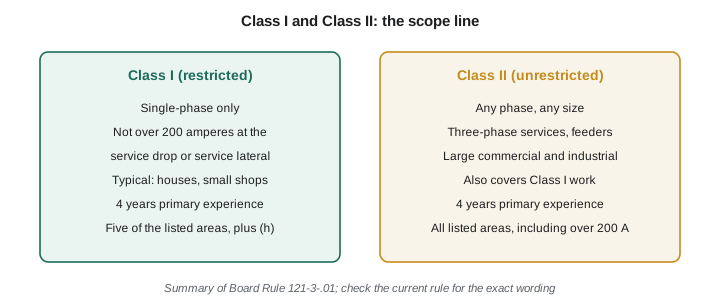
Beyond the four years, the rule requires applicants to document experience in specific categories of installation work, listed in the rule as items (a) through (h). The categories cover the main kinds of work a contractor directs, and the exact list is in the rule itself, so read it rather than relying on a summary. The key difference between the classes is how many categories must be covered. A Class I applicant must document experience in at least five of the items (a) through (g), plus item (h). A Class II applicant must document experience in all of items (a) through (h) and must also document installations in excess of single-phase, 200-ampere systems.
The extra requirement for Class II follows from the scope of the license. A contractor who will be responsible for three-phase services, large feeders, motor control centers and transformers should have done that kind of work. Darnell's log showed the 400-ampere three-phase service at the Riverside Drive dental clinic, two 480Y/277-volt services at warehouses, a motor control center replacement at a feed mill in Jones County, and several transformer installations for restaurant kitchens. Tasha's log, by contrast, was almost entirely residential: services, branch circuits, house panels and a handful of small detached garages. Her experience fit the Class I list well, but it would not support a Class II application.
The contracting experience alternative
The rule includes an alternative route to the primary experience requirement. According to the rule, six years of electrical contracting experience can substitute for the primary experience requirement, with education credited at fifty out of every hundred hours and no more than two years based on education. An applicant using this route must provide at least one reference from a licensed architect, professional engineer or electrical engineer, who must include his or her license number. This route suits people who have run an electrical contracting business in another state, or who have worked in contracting roles that the Board recognizes, and who can document that work.
Georgia does not currently offer licensure by reciprocity. The Board's FAQ states that it does not offer reciprocity as of May 2026, so a contractor licensed in another state must still apply, show eligibility and pass the Georgia exam. A contractor moving from Alabama or South Carolina with years of experience can often qualify under the primary experience route or the contracting alternative, but should expect to take the full Georgia exam.
Building the experience record
The strongest applications have three features. First, the dates add up: each period of employment has a start and end date, gaps are explained, and part-time work is identified. Second, the work matches the rule: each required installation area is supported by at least one specific job, with the system size and the applicant's role. Third, the references are consistent with the log: a reference who supervised the applicant from 2018 to 2022 should not be describing work from 2015.
# Check an experience log against the Class II eligibility summary (study aid)
log = [  # (years of primary experience, area letters documented, worked above 1-phase 200 A?)
    (2.0, "abcd", False),
    (2.5, "abefgh", True),
    (1.5, "cdh", True),
]
education_years = 1.0  # technical college program

primary = sum(y for y, _, _ in log)
education_credit = min(education_years * 0.5, 1.0)  # half credit, capped at one year
total = primary + education_credit
areas = set("".join(a for _, a, _ in log))
above_200 = any(big for _, _, big in log)

print("Primary years:", primary)
print("Education credit:", education_credit)
print("Total toward 4 years:", total, "OK" if total >= 4 else "SHORT")
print("Areas documented:", "".join(sorted(areas)))
print("All of a-h:", "OK" if areas >= set("abcdefgh") else "MISSING " + "".join(sorted(set("abcdefgh") - areas)))
print("Above single-phase 200 A:", "OK" if above_200 else "MISSING")Primary years: 6.0 Education credit: 0.5 Total toward 4 years: 6.5 OK Areas documented: abcdefgh All of a-h: OK Above single-phase 200 A: OK
The code adds up primary experience, applies the half-credit rule to education with its one-year cap, and checks that every installation area and the above-200-ampere requirement are covered. It is a planning aid only. The Board decides eligibility from the application and the references, and an applicant who is close to the line should describe the experience carefully rather than rounding up.
Worked problem
Counting education
Caleb Moss has three years of primary experience with Calloway Electric and completed a two-year electrical construction program at a technical college before that. How much experience can he count toward the four-year requirement under the summary in this lesson?
Show solution
- Primary experience counts in full: 3 years.
- Education counts at half value: 2 years of education gives 1 year of credit.
- The cap on secondary experience and education is 1 year, so the full 1 year counts.
- Total: 3 + 1 = 4 years.
Answer: Caleb reaches 4 years, but he still needs the installation areas, the references and Board approval.
Darnell's log, line by line
Darnell organized his log by employer and then by project, because that is how his references would remember him. Each line gave the dates, the address or project name, the system voltage and service size, his role, and the installation areas the job demonstrated. Writing it that way exposed a gap he had not noticed: almost all of his early experience was residential, and his strongest commercial work had come in the last six years. That was enough for Class II, but it meant the Calloway references would carry most of the weight, so he asked Ruth to describe specific jobs rather than writing a general letter.
| Period | Employer and role | Typical systems | Why it matters |
|---|---|---|---|
| 2014 to 2017 | Helper, then electrician, residential builder | 120/240 V single-phase, 200 A | Supports the residential areas |
| 2017 to 2020 | Electrician, Calloway Electric | Mixed residential and light commercial | Adds commercial branch circuits and feeders |
| 2020 to 2026 | Field supervisor, Calloway Electric | 208Y/120 V and 480Y/277 V three-phase, up to 800 A | Supports the above-200 A requirement |
The table shows the kind of progression the Board expects to see for a Class II applicant: growing responsibility and growing system size. An applicant whose entire history is on one kind of job can still qualify, but should make sure every required area is covered by real, documented work and should be ready to answer follow-up questions.
When experience is short
Some people discover while filling in the log that they are not yet eligible, or that they qualify for Class I but not Class II. The sensible response is to plan rather than stretch. A candidate a few months short can simply wait and keep documenting work. A candidate missing a particular installation area can ask an employer for a role on a job that covers it, such as a motor control project or a transformer installation. A candidate with mostly residential experience can apply for Class I now and work toward Class II later, because nothing prevents a Class I holder from applying for Class II once the additional experience is documented.
Tasha chose that path. She would apply for Class I, start contracting in her own name for the builders she already worked with, and spend the next few years taking on some light commercial work under another contractor's Class II license to build the record she would need. Darnell admired the plan: it kept her honest with the Board and gave her a business in the meantime.
What the Board looks at
When the Board reviews an application, it is deciding whether the applicant has the experience the rule requires and is eligible to sit the exam. It may ask for more information, for example a clearer description of a job or another reference, and an applicant who is denied can usually reapply with better documentation. The Board does not test knowledge at this stage; that is the job of the exam. Applications that are complete, consistent and specific move faster, and Jen at Calloway's office had seen enough of them to tell Darnell that a missing signature or an outdated form was the most common cause of delay.
Applicants also make a series of statements on the application: about criminal history, prior discipline in other states, and lawful presence in the United States, which Georgia requires for professional licenses. Questions about criminal history are answered honestly; a conviction does not automatically bar licensure, but failing to disclose one can. Lesson 3 covers the application and booking steps in order.
Common mistakes
MistakeCounting two years of technical college as two years of experience.
InsteadEducation counts at half value, and secondary experience plus education is capped at one year of the four.
MistakeApplying for Class II with only residential single-phase experience.
InsteadClass II requires documented experience in all listed areas and with systems above single-phase 200 amperes.
MistakeGetting all three references from coworkers.
InsteadAt least one reference must come from a licensed electrical contractor who provides a license number.
MistakeAssuming an out-of-state license transfers.
InsteadGeorgia does not currently offer reciprocity; out-of-state contractors apply and take the Georgia exam.
Summary and key terms
- Both classes require age 21, a completed application and fees, three references and a passing exam score of 70.
- Both classes require at least four years of primary experience; up to one year may come from secondary experience or education at half credit.
- Class I applicants document five of the listed areas (a) to (g) plus (h); Class II applicants document all areas and work above single-phase 200 amperes.
- Six years of electrical contracting experience can substitute for primary experience, with a reference from an architect or engineer.
- Georgia does not currently offer reciprocity.
- Primary experience
- Hands-on electrical installation experience of the kind the rule requires, counted in full.
- Secondary experience
- Related experience that counts at reduced value toward the requirement.
- Installation areas
- The categories of work listed in the rule as items (a) through (h).
- Reference
- A statement on the Board's form from a person who knows the applicant's work.
- Reciprocity
- Recognition of another state's license without the full exam; not currently offered in Georgia.
Practice problems
Work each problem on paper first, then reveal the answer to check.
An applicant has three and a half years of primary experience and one year of qualifying education. Does the applicant reach four years?
Show answer
Yes. The education counts at half value, giving half a year, so the total is 3.5 + 0.5 = 4 years, exactly the minimum.
Which class requires documented work on systems above single-phase 200 amperes?
Show answer
Class II.
What must a reference from a licensed electrical contractor include?
Show answer
The contractor's license number.
Lesson quiz · 5 questions
Score 60% or more to complete this lesson.
Create a free account to save your progress, take quizzes and earn a certificate.