
MELU-210 · Lesson 6 of 12 · 19 min
Permits, inspections and the inspection authority
▶ Video coming soon A video version of this lesson is on the way.
Jen Okafor's desk at Calloway Electric faced a whiteboard divided into columns, one for each jurisdiction where the company had open permits: Macon-Bibb County, Warner Robins, Houston County, Jones County, Forsyth and Monroe County. Each column held a stack of magnets, one per job, colored by status: applied, issued, rough-in passed, final passed. "The license lets us do the work," she told Darnell on his first afternoon learning the permit desk. "The permit is how each city or county knows we did it right. Every one of these places does it a little differently." This lesson covers who issues electrical permits in Georgia, the usual sequence of inspections, how the utility fits in, the role of the inspector, and what a license holder must watch for.
Who issues permits
Georgia's state minimum codes, including the NEC with Georgia amendments, apply statewide, but enforcement happens at the local level. Most cities and counties operate building departments that issue permits, review plans where required, and inspect work. In a consolidated government such as Macon-Bibb County, one department serves the whole county. In other places, a city and the surrounding county each run their own departments, and the job address decides which one has jurisdiction. Some smaller jurisdictions contract with a neighboring government or a private firm to provide inspection services. The state fire marshal's office has a role for certain occupancies, and state agencies may have their own review for state-owned buildings.
The first question on any new job is therefore not just what the code requires but who will enforce it. Jen's rule was to confirm jurisdiction from the parcel record before the estimate went out, because a city boundary can split a neighborhood and a job just outside a city limit falls under the county. A permit pulled in the wrong jurisdiction wastes the fee and the time, and work started without the right permit can be stopped.
Applying for a permit
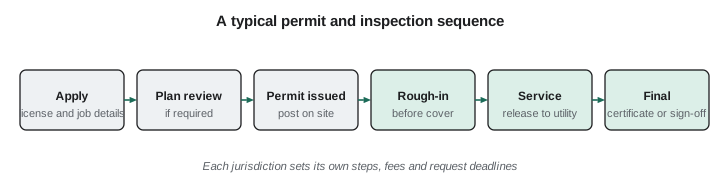
Electrical permits are generally issued to a licensed electrical contractor, who provides the license number and accepts responsibility for the work. Applications are increasingly handled through online portals, and they usually ask for the job address, the owner, the scope of work, the service size, the number of circuits or devices, and the value of the work, which often determines the fee. Larger projects may require plans, a load calculation, a panel schedule or a riser diagram. For new buildings, the electrical permit is often tied to the general building permit, and the electrical contractor may need to be listed on the building permit before the electrical permit is issued.
Because the permit carries the license holder's name and number, the license holder is answerable for the work done under it. Lesson 7 covers that responsibility in detail, including the rule against pulling permits for work the license holder does not supervise. Jen's permit applications always carried Ruth's license number, and the office had a standing rule that no permit was pulled until Ruth or a designated supervisor had reviewed the scope.
| Item | Typical requirement (varies by jurisdiction) |
|---|---|
| Applicant | Licensed electrical contractor, with license number |
| Scope of work | Service size, number of circuits or devices, new or existing |
| Fee basis | Value of work, number of circuits, or a fee schedule |
| Documents | Plans, load calculation or riser diagram for larger jobs |
| Posting | Permit card or number available at the job site |
| Expiration | Permits usually expire if work does not start or is abandoned for a period set locally |
The usual inspections
Most jurisdictions inspect electrical work at least twice: a rough-in inspection after the boxes, raceways, cables and conductors are installed but before walls and ceilings are covered, and a final inspection when the work is complete and devices, fixtures and panels are installed. New services and service changes usually need a service inspection before the utility will connect power. Larger jobs may add inspections for underground raceways before backfill, slab or under-floor work, and for specific systems such as fire alarm or emergency power. Temporary power for construction typically has its own permit and inspection.
Inspection requests normally go through the portal or by phone by a cutoff time, often the afternoon before. The inspector checks the work against the adopted code and the permit. If the work passes, the inspector records the approval; if not, the inspector writes a correction notice describing the items to fix, and the contractor requests a reinspection, sometimes with an additional fee. A pattern of failed inspections costs time, money and reputation, so Calloway's foremen used a checklist before every request: boxes and supports, conductor sizes and terminations, grounding and bonding, GFCI and AFCI protection under the Georgia amendments, labeling, and working space at panels.
Plan review on commercial jobs
Commercial projects such as the Riverside Drive dental clinic usually go through plan review before the permit is issued. The design professional or the contractor submits electrical drawings showing the service and distribution equipment, panel schedules, the load calculation, the grounding and bonding design, emergency and exit lighting, and any special systems. The reviewer checks the drawings against the adopted code and returns comments, which the designer answers before the permit is issued. On design-build jobs, the electrical contractor may prepare the drawings; on others, an engineer of record prepares them and the contractor builds from them.
For the clinic, the engineer's drawings showed a 400-ampere, 208Y/120-volt three-phase service, a distribution panel feeding six branch panels, dedicated circuits for dental chairs, compressors and imaging equipment, and a small emergency lighting system. The plan reviewer asked for a revised load calculation after the owner added a second imaging room, and the change delayed the permit by a week. Darnell built that week into the schedule rather than letting the crew start work that might need to change. He also noted that any work under Article 517 on a health care facility would need checking against the Georgia amendments taking effect in 2027 if the project ran late.
Changes, expirations and closing permits
Permits are issued for a defined scope. If the scope grows, for example from a kitchen remodel to a service change, the contractor revises the permit before doing the extra work. Most jurisdictions set rules for permit expiration if work does not start within a set period or stops for too long, and some charge to renew an expired permit. An open permit that is never finaled can surface years later when the property is sold, and the buyer's inspector or lender asks why. Calloway's practice was to close every permit with a final inspection, even on small jobs, and to keep the approval record in the job file.
When a contractor leaves a job before it is finished, for example because the owner fires the contractor or a dispute stops the work, the contractor should notify the building department so the permit can be transferred or closed and the next contractor can take responsibility. Leaving a permit open in your name for work you no longer control exposes the license to problems you cannot fix.
Keeping the customer informed
Customers rarely understand the inspection process. A homeowner sees a crew finish the rough wiring and wonders why the drywall can't go up the next day; a store owner wonders why the utility won't connect power after the electrician says the job is done. Explaining the sequence at the start, with realistic dates, avoids frustration. Jen sent every residential customer a one-page sheet describing the inspections their job would need and what each one meant, and the number of angry phone calls on Monday mornings dropped noticeably.
The utility and reconnection
Georgia's electricity is supplied by Georgia Power, by electric membership corporations (EMCs) and by municipal utilities. Each sets its own service requirements: meter base types, service entrance locations, clearances, and the documents it needs before connecting power. For a new service or a service change, the utility usually requires a release from the local inspection authority showing that the service passed inspection. The contractor coordinates the timing so that the inspection, the release and the utility's work happen in the right order, especially on service changes where the customer is without power.
Darnell had learned the hard way that utility requirements and the NEC are not the same thing. On his first service change as a supervisor, he installed a meter base that met the code and passed inspection, but the EMC serving the property required a different meter base for its metering equipment, and the job lost a day while the crew swapped it. Since then, every service job at Calloway started with a call to the serving utility and a copy of its current service requirements in the job folder.
# Track inspection results across jobs (illustrative data)
jobs = {
    "Ingleside Ave remodel": ["rough-in: pass", "final: pass"],
    "Riverside Dr dental clinic": ["underground: pass", "rough-in: fail", "rough-in: pass", "service: pass"],
    "Forsyth Rd warehouse": ["slab: pass", "rough-in: pass"],
}
total = fails = 0
for job, results in jobs.items():
    f = sum(1 for r in results if r.endswith("fail"))
    total += len(results); fails += f
    print(f"{job}: {len(results)} inspections, {f} failed")
print(f"First-time pass rate: {total - fails} of {total} inspections")Ingleside Ave remodel: 2 inspections, 0 failed Riverside Dr dental clinic: 4 inspections, 1 failed Forsyth Rd warehouse: 2 inspections, 0 failed First-time pass rate: 7 of 8 inspections
A log like this, kept for every open permit, shows which crews and job types fail inspections and why. Jen reviewed Calloway's log every month with Ruth. When the dental clinic rough-in failed on a missing bonding jumper at a metal raceway transition, the foreman added that item to the crew's checklist and the company's pass rate improved the next month.
Working with inspectors
Inspectors are public officials enforcing the adopted code. A good working relationship rests on preparation, accuracy and respect. Have the work ready when the inspector arrives, have the permit and approved plans on site, and have someone present who knows the job. If you disagree with a correction, ask the inspector to cite the code section, consider whether the reading is reasonable, and if necessary take the question to the building official in writing. Never cover work that has not been inspected, and never misrepresent what was installed.
Inspectors also talk to one another and remember contractors. A contractor known for clean, ready work and honest answers spends less time on reinspections and gets the benefit of the doubt on close calls. A contractor known for cutting corners gets inspected closely on every job. Ruth told Darnell that the Macon-Bibb inspectors had once asked her to speak at a training session for new inspectors, which she took as the best compliment the company had ever received.
Homeowners and exemptions
Most jurisdictions allow homeowners to obtain permits and do electrical work on their own single-family homes, subject to conditions such as living in the home and doing the work personally. That is an exception to the requirement to hire a licensed contractor, not a license. A homeowner who hires an unlicensed person to do the work is not covered by the exemption, and a contractor should never pull a permit in a homeowner's name for work the contractor is doing. The details, including whether the homeowner must take a short test or sign an affidavit, are set locally.
Inspections on the exam
The law and administration questions on the exam may ask about the purpose of permits and inspections, the responsibilities of the contractor who pulls a permit, and the relationship between the contractor, the owner and the authority having jurisdiction. The business guide on the reference list covers these topics in general terms, and the NEC itself contains the rules that give the authority having jurisdiction the power to interpret the code and approve equipment. Expect questions framed as scenarios: who is responsible when work fails inspection, what happens if work is covered before inspection, or who may approve an alternative method. Answer from the references, not from habits learned in one jurisdiction.
Worked problem
Choosing the right jurisdiction and sequence
Calloway is asked to replace a damaged 200-ampere service at a house just outside the Warner Robins city limits, served by an EMC. The homeowner wants power back as quickly as possible. What should Jen and Darnell confirm before the crew leaves the shop?
Show solution
- Confirm jurisdiction from the parcel record: outside the city limits, so the county department issues the permit.
- Pull the county electrical permit under the license holder's number.
- Call the EMC for its service requirements and how it receives inspection releases.
- Schedule the crew, the service inspection request and the EMC reconnection in sequence.
- Have the permit, utility requirements and checklist in the job folder.
Answer: County permit, EMC requirements and a coordinated inspection and reconnection schedule.
Common mistakes
MistakePulling a permit in the city when the job is in the county.
InsteadConfirm jurisdiction from the parcel record before applying.
MistakeAssuming the utility accepts any code-compliant meter base.
InsteadGet the serving utility's current service requirements before ordering equipment.
MistakeCovering work before the rough-in inspection.
InsteadNever cover work until it has passed inspection.
MistakePulling a permit in the homeowner's name for contractor work.
InsteadHomeowner permits cover only homeowners doing their own work; contractors use their own license.
Summary and key terms
- The state codes apply statewide, but local building departments issue permits and inspect.
- Permits are issued to licensed contractors, who are answerable for the work under them.
- Typical inspections include rough-in, service and final, with more for larger jobs.
- Utilities (Georgia Power, EMCs, municipal utilities) set their own service requirements and usually need an inspection release.
- Homeowner permits are a local exemption for homeowners doing their own work.
- Permit
- Authorization from the local department to perform specific electrical work.
- Rough-in inspection
- An inspection before wiring is concealed.
- Correction notice
- An inspector's list of items that must be fixed before approval.
- EMC
- An electric membership corporation, a member-owned utility common in rural Georgia.
- Inspection release
- The local department's notice to the utility that a service passed inspection.
Practice problems
Work each problem on paper first, then reveal the answer to check.
Which inspection must happen before walls are covered?
Show answer
The rough-in inspection.
What usually must happen before the utility connects a new service?
Show answer
The service must pass inspection and the department must release it to the utility.
May a contractor pull a homeowner permit for a customer?
Show answer
No; homeowner permits are for homeowners doing their own work.
Lesson quiz · 5 questions
Score 60% or more to complete this lesson.
Create a free account to save your progress, take quizzes and earn a certificate.