
MELU-210 · Lesson 7 of 12 · 19 min
Duties and responsibilities of the Electrical Contractor License (Class I and II) holder
▶ Video coming soon A video version of this lesson is on the way.
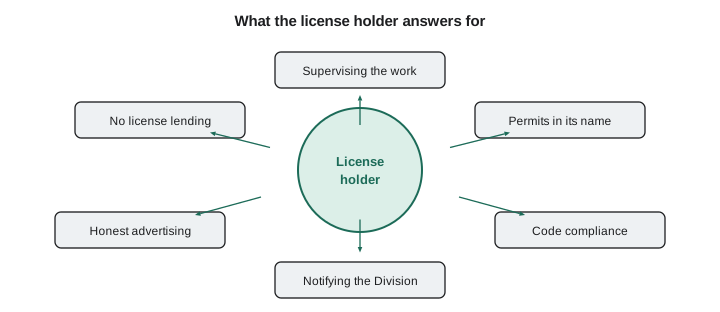
In February, a month before his exam, Darnell spent a Saturday morning in Ruth's office going through the company's files on two old disputes. One was a complaint to the Board from 2009, filed by a customer whose new subpanel had been installed by an employee who left the company soon after. The other was a lawsuit over a restaurant fire in 2014 that turned out to have started in equipment Calloway had not installed. "Neither one went anywhere," Ruth said, "but both times the first question was the same: who held the license, and what did that person know about the work? When you pass, the answer will be you." This lesson covers what the license holder answers for in Georgia: supervising the work, permits, the relationship with the business, honest dealing, cooperation with the Board, and the grounds for discipline.
The license and the business
Georgia law ties a business's ability to do electrical contracting to a licensed individual. Under Title 43, Chapter 14, a partnership, limited liability company or corporation may engage in electrical contracting only if a person holding the license is actually engaged in the performance of that business on a full-time basis. The business must notify the Division immediately when that person leaves. The application process asks business applicants to identify their partners, members or officers, so the Board knows who stands behind the company as well as who holds the license.
The phrase actually engaged on a full-time basis is the heart of the rule. A license holder who works elsewhere and lets a company use the license number for permits is not actually engaged in that business, and both the license holder and the company risk discipline and penalties. The law is designed to make sure that a real, qualified person stands behind the electrical work done under each license. Calloway's own policy put that into practice: the license holder approves every permit, reviews every set of plans before bidding and visits every commercial job at least once a week.
Supervising the work
The license holder is responsible for the electrical work done under the license, whether he or she installs it personally or supervises employees who do. Supervision does not mean standing beside every electrician, which is impossible for a company with several crews, but it does mean having systems that ensure the work meets the code: qualified foremen, clear scopes, inspection checklists, a way to answer code questions quickly, and a habit of reviewing failed inspections and complaints. The bigger the company, the more the license holder depends on those systems and on the people who run them.
Supervision also means saying no. Customers sometimes ask a contractor to skip a permit, cover work before inspection, use a cheaper method that does not meet the code, or reuse equipment that is not suitable. Employees sometimes want to cut corners to finish a job before the weekend. A license holder who goes along puts the license on the line for someone else's convenience. Ruth's rule, which Darnell planned to keep, was that any request to bend a rule went straight to the license holder, who would explain the reason, offer a compliant alternative, and decline the job if the customer insisted.
| Responsibility | What it looks like in practice |
|---|---|
| Supervise the work | Qualified foremen, checklists, code questions answered, inspections tracked |
| Control permits | No permit pulled without the license holder's review |
| Stay engaged full time | Work in the business; never lend the license |
| Notify the Division | Report changes such as leaving the business, as the law and rules require |
| Deal honestly | Accurate advertising, contracts and representations |
| Cooperate with the Board | Respond to inquiries and investigations promptly and truthfully |
Permits and the license number
Every permit pulled under a license is a representation by the license holder that he or she is responsible for the work. Pulling a permit for work you do not supervise, for example for an unlicensed friend or for a company that does not employ you, is one of the most common reasons for discipline in licensed trades. It helps an unlicensed person evade the law, misleads the building department, and leaves the license holder responsible for work he or she never saw. Darnell knew of a contractor in another county who had lost his license after pulling dozens of permits for a man who did the work without supervision.
Control of the license number is therefore part of the job. The license number appears on permits, proposals, contracts and often on trucks and advertising. A license holder should know where it is used, should be able to see every permit pulled under it, and should keep login credentials for permit portals restricted to people who are authorized. When an employee leaves, change the passwords. When the license holder leaves a company, notify the Division and make sure the company stops using the number.
Advertising and representations
Under Chapter 14, a person who is not licensed may not advertise as an electrical contractor unless the work will actually be done by a licensed contractor. For licensed contractors, the general rule is simply honesty: advertising, proposals and contracts should accurately describe who will do the work, what license applies, and what the customer is getting. Misrepresenting a license class, for example by advertising commercial work under a Class I license, or claiming a license that has lapsed, invites both discipline and disputes. The license class matters here too. A Class I holder who bids a three-phase service is contracting outside the scope of the license, which is no different in principle from contracting without one.
Changes and notices
The Board needs current information about each license holder. The law requires notice when a license holder leaves a business, and the Board's rules and the licensing system require license holders to keep their contact information current. Other changes, such as a new business name, a change in the business entity or a change of address, should be reported as the current rules and forms require. A license holder who changes companies should make sure the old company stops using the license and the new company is properly connected to it before any permit is pulled.
Calloway's transition plan illustrates the point. Once Darnell's license was issued, the company would update its records so that Darnell became the license holder associated with Calloway Electric, Inc., while Ruth kept her own license active for a period as a backup. Jen would update the permit portals, the insurance certificates, the proposal templates and the truck lettering in a single week, using a checklist so nothing was missed. Lesson 8 covers the business side of that change in more detail.
# Audit where a license number is used (illustrative records)
records = [
    ("permit", "Macon-Bibb", "Ingleside Ave remodel", "Ruth Calloway"),
    ("permit", "Warner Robins", "Watson Blvd tenant space", "Ruth Calloway"),
    ("portal login", "Houston County", "office account", "former employee"),
    ("proposal template", "office", "residential service", "Ruth Calloway"),
    ("truck lettering", "fleet", "van 3", "Ruth Calloway"),
]
needs_action = [r for r in records if r[3] not in ("Ruth Calloway", "Darnell Hayes")]
print("Records reviewed:", len(records))
for kind, where, what, who in needs_action:
print(f"ACTION: {kind} at {where} ({what}) is controlled by {who}")Records reviewed: 5 ACTION: portal login at Houston County (office account) is controlled by former employee
The audit found one problem: a permit portal login still controlled by a former employee. That is exactly the kind of gap that leads to permits pulled without the license holder's knowledge, and it took Jen five minutes to fix once she found it.
Building the supervision system
At eighteen people and three crews, Calloway Electric was already too large for Ruth to see every connection. Over the years she had built a system that let her supervise without being everywhere. Each job had a foreman responsible for the crew, the materials and the inspections. Every commercial job started with a scope meeting where the foreman, the estimator and the license holder walked the drawings together. Foremen called the license holder, not each other, with code questions that affected the design. Every failed inspection was reported the same day, with the inspector's notes, and discussed at the Monday meeting. And every new electrician spent his or her first month on a crew led by one of the two most experienced foremen.
Darnell planned to keep that system and add two things he had wanted as a supervisor: a short written checklist for each common job type, and a monthly site visit to every residential crew, not just the commercial ones. He also planned to stop doing so much of the field work himself. A license holder who spends every day pulling wire has no time left for the plans, permits, inspections and people that supervision requires. Ruth told him it had taken her ten years to learn that lesson, and she hoped it would take him less.
Records the license holder should keep
Records protect the license holder. When a complaint, an insurance claim or a lawsuit arrives years after a job, the question is always what was installed, under which permit, and what the inspector approved. A good job file contains the contract and change orders, the permit, the approved plans if any, the inspection results, photographs of the work before it was covered, the panel schedules, and correspondence with the customer. Calloway kept job files for at least as long as its insurance agent and lawyer recommended, and longer for commercial work, because claims involving buildings can surface long after the work is finished.
Photographs have become the most useful record of all. A few photographs of each wall before drywall, each panel before the cover goes on and each service before backfill take minutes and answer questions that no paperwork can. When the 2014 restaurant fire claim arrived, Ruth's photographs of the kitchen wiring showed that the equipment involved had been connected by another contractor after Calloway finished, and the claim against the company was dropped.
Grounds for discipline
Georgia's licensing law gives the Board power to refuse, suspend, revoke or limit a license, to issue public or private reprimands, and to impose fines, after notice and an opportunity for a hearing. Grounds in the general licensing law and Chapter 14 include obtaining a license by fraud or misrepresentation, unprofessional or dishonest conduct, gross negligence or incompetence, violating the licensing statutes or the Board's rules, aiding unlicensed practice, and certain criminal convictions. The precise list is in the statutes, and the Board decides each case on its facts. Discipline is public, so a sanction can follow a contractor into bids, bonding and insurance.
Complaints usually start with a customer, an inspector or another contractor. The Board investigates, often by asking the license holder for a written response and documents. The right approach is to respond promptly, truthfully and with records: the permit history, inspection results, contracts, change orders and correspondence. Ignoring a Board inquiry turns a manageable complaint into a disciplinary problem on its own. When a complaint involves serious allegations, the license holder should consult a lawyer before responding.
Duties to customers sit alongside duties to the Board. Georgia contract law, consumer protection law and the common law of negligence all apply to electrical contractors, so a contractor who does careless work can face a lawsuit for damages even when the Board takes no action. The license holder's supervision system is therefore protection on two fronts: it keeps the license in good standing, and it reduces the chance of injuries, fires and claims. Insurance, covered in Lesson 8, pays for some of those claims, but it does not pay a fine or restore a revoked license.
Worked problem
A friend asks for a favor
Shortly after Darnell's license is issued, a former coworker who now works alone asks Darnell to pull a permit for a basement finish the coworker is wiring for a customer. The coworker offers to pay the permit fee and a few hundred dollars for the trouble. Darnell would not see the job. What should he do?
Show solution
- Identify the issue: pulling a permit for work he does not supervise misrepresents responsibility for the work.
- Recognize the risk: it helps an unlicensed person contract, which is a ground for discipline.
- Offer a lawful alternative: Calloway could bid the job, or the coworker could work under a licensed contractor who supervises the job.
- Decline the request and keep a short note of the conversation.
Answer: Decline; offer to bid the job through Calloway or refer the coworker to a lawful arrangement.
Common mistakes
MistakeLending a license number to a company where you do not work.
InsteadThe license holder must be actually engaged in the business full time.
MistakeLetting several people share a permit portal login.
InsteadRestrict access to authorized people and change credentials when staff leave.
MistakeBidding three-phase work under a Class I license.
InsteadStay within the scope of your license class.
MistakeIgnoring a letter from the Board about a complaint.
InsteadRespond promptly and truthfully with records; consult a lawyer for serious allegations.
Summary and key terms
- A business may do electrical contracting only with a licensed person actually engaged in it full time, and must notify the Division when that person leaves.
- The license holder is responsible for the work under the license and must supervise it through real systems.
- Every permit is a representation of responsibility; never pull permits for work you do not supervise.
- Advertising and representations must be honest, and work must stay within the license class.
- The Board can discipline license holders for fraud, negligence, rule violations and aiding unlicensed practice.
- License holder
- The individual who holds the Georgia electrical contractor license and answers for work under it.
- Full-time engagement
- Actual, ongoing work in the business, required for a license holder who qualifies a company.
- Aiding unlicensed practice
- Helping an unlicensed person contract, for example by pulling permits for them.
- Reprimand
- A formal disciplinary statement by the Board, public or private.
- Scope of license
- The work a license class allows; Class I is limited, Class II is unrestricted.
Practice problems
Work each problem on paper first, then reveal the answer to check.
What must a business do when its license holder leaves?
Show answer
Notify the Division immediately, as Chapter 14 requires.
Why is pulling a permit for a friend's job a problem?
Show answer
It represents responsibility for work you do not supervise and aids unlicensed contracting.
Name two possible Board sanctions.
Show answer
Reprimand, fine, suspension, revocation or limitation of the license.
Lesson quiz · 5 questions
Score 60% or more to complete this lesson.
Create a free account to save your progress, take quizzes and earn a certificate.