
MELU-210 · Lesson 12 of 12 · 27 min
Practice exam review and test-day strategy
▶ Video coming soon A video version of this lesson is on the way.
Twelve weeks after his approval letter arrived, Darnell sat at the conference table at Calloway Electric on a Saturday morning with his reference books stacked beside him, a calculator, a timer and a practice set of eighty questions. Ruth had insisted he take one full four-hour practice session under exam conditions before the real thing. After three months of study, she told him, it was time to find out what four hours with those books actually felt like. This lesson pulls the course together: a study plan, a review of the topics most likely to appear, worked practice questions from both the technical and the business sections, and a plan for exam day.
A twelve-week plan
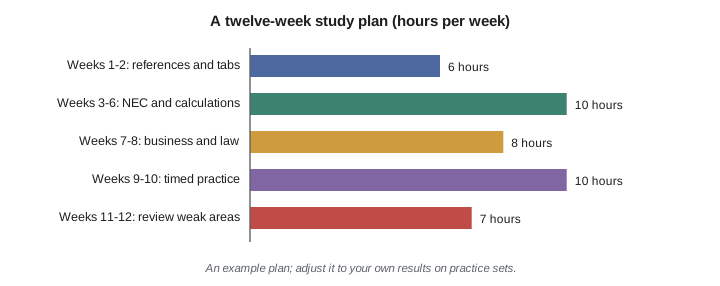
Most candidates who pass the Georgia exam on the first try follow some version of the same plan. They spend the first weeks getting to know the references and tabbing them, the middle weeks working through the technical content and calculations, a dedicated block on business and law, and the last weeks on timed practice and weak areas. Darnell's plan, built with Ruth, devoted more time to the code and calculations than to anything else, but he protected two full weeks for the business guide, Circular E and Part 1926, because thirty questions come from them and they are the area where experienced electricians most often lose points.
| Weeks | Focus | Output |
|---|---|---|
| 1-2 | Get the references; tab the NEC, business guide and Part 1926 | Tabbed books and a lookup log |
| 3-6 | NEC: wiring methods, services, feeders, grounding, motors, transformers, special occupancies | Calculation notebook and timed lookups |
| 7-8 | Business guide, Circular E, Part 1926; Georgia law from this course | Summary sheets by topic (for study, not the exam room) |
| 9-10 | Full timed practice sessions | Scores by content area |
| 11-12 | Weak areas, final tab adjustments, rest before exam day | Confidence and a test-day plan |
Technical review: the calculations that keep coming back
Across the technical areas of the outline, the same few calculations appear again and again: Ohm's law and power, single-phase and three-phase current, voltage drop, conductor sizing with correction and adjustment, motor branch-circuit sizing, transformer current and protection, box and conduit fill, and dwelling and commercial load calculations. The master electrician core courses covered each one in detail. In the last weeks, the goal is speed and accuracy: knowing which formula applies, which table or article to open, and how to check an answer for reasonableness before moving on.
# Quick practice: transformer and three-phase current (illustrative values)
import math
kva = 75
for volts in (208, 480):
    amps = kva * 1000 / (math.sqrt(3) * volts)
    print(f"{kva} kVA at {volts} V three-phase: {amps:.1f} A")

# Single-phase current and voltage drop (illustrative: 2-wire, K = 12.9 for copper)
load_amps, length_ft, cmil, volts = 40, 150, 10380, 240
vd = 2 * 12.9 * load_amps * length_ft / cmil
print(f"Voltage drop: {vd:.1f} V, or {vd / volts * 100:.1f} in every 100 volts")75 kVA at 208 V three-phase: 208.2 A 75 kVA at 480 V three-phase: 90.2 A Voltage drop: 14.9 V, or 6.2 in every 100 volts
The first result, about 208 amperes on the 208-volt side of a 75 kVA transformer and about 90 amperes on the 480-volt side, is a number worth knowing by heart, because it lets you check transformer questions quickly. The voltage drop example uses the common approximate formula with a constant for copper and an illustrative conductor area; on the exam, take conductor properties from the references and apply the method the question asks for.
Business and law review
The thirty law and administration questions draw on the business guide, Circular E, Part 1926 and the Georgia law covered in this course. The topics that come up most often include business organization, contracts and change orders, lien law and lien waivers, insurance and bonds, payroll taxes and records, employment law basics, OSHA recordkeeping and construction standards, financial statements and ratios, and the licensing rules themselves. Many of these questions are direct lookups if the books are well tabbed, but a few require a calculation, such as an incident rate, a payroll tax amount or a simple financial ratio.
| Topic | Main reference | Georgia points from this course |
|---|---|---|
| Licensing | This course; Board rules | Class I limits, eligibility, renewal and CE |
| Liens and waivers | Business guide; Georgia statutes | 90 days, 2 business days, 365 days, 30 days, 90-day affidavit |
| Insurance and workers' compensation | Business guide | Three-employee rule; 21-day Board report |
| Payroll taxes | Circular E | Deposit schedules, withholding, forms |
| Safety | Part 1926; recordkeeping rules | 8-hour and 24-hour OSHA reports, 300A posting |
| Financial management | Business guide | Working capital, ratios, job costing |
# Quick practice: business calculations (illustrative values)
current_assets, current_liabilities = 640_000, 410_000
print("Current ratio:", round(current_assets / current_liabilities, 2))
print("Working capital:", current_assets - current_liabilities, "dollars")

cases, hours = 3, 75_000
print("Incident rate:", round(cases * 200_000 / hours, 2))

contract, retain_share, billed = 180_000, 0.10, 120_000
print("Retainage held on billings:", round(billed * retain_share), "dollars")Current ratio: 1.56 Working capital: 230000 dollars Incident rate: 8.0 Retainage held on billings: 12000 dollars
These are the kinds of short calculations that appear in the business section: a current ratio of about 1.56, working capital of 230,000 dollars, an incident rate of 8.0 and retainage of 12,000 dollars on 120,000 dollars billed at a one-in-ten retainage. Each takes less than a minute if you know the formula, which is why it pays to practice them until they are automatic.
Worked practice questions
Worked problem
Class I scope
A homeowner asks a Class I contractor to replace a 200-ampere single-phase service with a 320-ampere single-phase service for a new electric vehicle charger and heat pump. May the Class I contractor take the job?
Show solution
- Class I is limited to single-phase installations not exceeding 200 amperes at the service drop or lateral.
- The new service is single-phase but exceeds 200 amperes.
- The job is outside the Class I scope.
Answer: No; a Class II license holder must contract for the 320-ampere service.
Worked problem
Lien deadline
A subcontractor's last day of work on a private project was 10 May. The project had no notice of commencement. What is the latest date to file the claim of lien, and what must follow within two business days?
Show solution
- Count 90 days from the completion of the work: 10 May plus 90 days is 8 August.
- File the claim with the clerk of superior court in the county where the property is located by that date.
- Send a copy to the owner within two business days after filing, by a method the statute allows.
Answer: File by 8 August (confirm the count with a lawyer), then send the owner a copy within two business days.
Worked problem
Workers' compensation threshold
A new LLC has two members who exempt themselves from coverage and one employee. Must it carry workers' compensation in Georgia?
Show solution
- Georgia requires coverage for employers regularly employing three or more people.
- According to the State Board, members count toward the three even if they exempt themselves.
- Two members plus one employee equals three.
Answer: Yes; the business reaches the three-person threshold.
Worked problem
OSHA reporting
An employee suffers an amputation of a fingertip on a job on Thursday afternoon. What must the employer report to OSHA, and by when?
Show solution
- Amputations must be reported to OSHA within 24 hours.
- The case must also be recorded on the 300 log within seven calendar days.
- The insurer must receive the first report of injury immediately.
Answer: Report to OSHA within 24 hours; record it and report it to the insurer as well.
Reviewing a practice session
A practice session is only as useful as the review that follows it. After his first full four-hour session, Darnell scored 71 out of 100 on the practice set, which felt like a pass until Ruth asked him to sort the misses. He had lost six points on grounding and bonding, five on motors, four on load calculations and nine across the business questions, mostly on payroll taxes and lien waivers. Only three of his misses came from not knowing the material; the rest came from slow lookups, misread questions and arithmetic slips. That breakdown changed his plan for the next two weeks more than any score could have.
| Cause of miss | What it looks like | Fix |
|---|---|---|
| Did not know it | No idea where to look | Study the topic, then retest it within a week |
| Slow lookup | Found the answer but ran out of time | Add or move tabs; practice timed lookups |
| Misread the question | Answered a different question than the one asked | Underline the ask; restate it before calculating |
| Arithmetic slip | Right method, wrong number | Write each step; check the result for reasonableness |
| Changed a right answer | First choice was correct | Change only with a specific reason found in the references |
Keep a running log of every practice miss with its cause, the reference and the page where the answer lives, and the time it took. Over several sessions the log shows patterns: a chapter that always takes too long, a kind of question you misread, a formula you keep inverting. Those patterns are where the last weeks of study pay off most. A candidate who moves from 71 to 80 on practice sets usually does it by fixing lookups and reading habits, not by learning large amounts of new material.
Using the references efficiently
The exam allows the listed references, and the candidates who use them well treat them like tools on a truck: each has a place, and the hand goes to it without searching. Permanent tabs are generally allowed, while loose notes and inserted pages generally are not; check the current PSI handbook for the exact rules before tabbing, because books that do not meet them may be refused at check-in. Darnell used one tab color for NEC chapters, another for the tables he used most, a third for the business guide chapters and a fourth for Part 1926 subparts. He kept the number of tabs manageable, because a book with too many tabs is as slow as a book with none.
Learn the indexes too. Many questions are answered fastest by going to the index with a key word, then to the article, then to the section. For the business guide, the table of contents and chapter summaries often lead to the answer faster than the index. For Circular E, know where the deposit rules, the wage bracket method and the forms are. For Part 1926, know the subpart letters for the topics electrical contractors meet most: electrical, ladders, scaffolds, fall protection, excavations and personal protective equipment.
Worked problem
Reading the ask
A question gives a 60-ampere continuous load and asks for the minimum overcurrent device rating, not the conductor size. A candidate sizes the conductor and picks that answer. What went wrong?
Show solution
- The question asked for the overcurrent device rating.
- For a continuous load, the device generally must be rated for the continuous load at the increased factor the code requires; confirm the rule in the NEC.
- The candidate solved a related question instead of the one asked.
Answer: Underline what the question asks for before starting; here it was the device rating, not the conductor.
Exam day
Prepare the night before: books in a bag, identification in your wallet, calculator with fresh batteries, the testing center address in your phone, and a lunch if the center allows it. Sleep matters more than a last evening of cramming. Arrive early, check in calmly, and let the staff inspect the books. Use the tutorial to learn the screen. In each part, set your checkpoints in the first minute, work steadily, flag slow questions, and leave the last half hour for the flagged ones. Answer every question, because a blank is certainly wrong and a guess may not be.
Between the parts, eat something, drink water and walk around if you can. Do not spend the break replaying questions from Part I; they are finished. Part II deserves the same attention as Part I, and fatigue is the enemy late in an eight-hour day. Darnell's practice sessions had taught him that his accuracy dropped in the last hour, so he planned a two-minute pause every hour to stretch, look away from the screen and reset.
After the exam
Darnell walked out of the testing center in March with a passing score. On the drive home he called Ruth, who had already chilled a bottle of sparkling cider in the shop refrigerator. The next week Jen began the transition checklist: the license record, the company's connection to the license, the permit portals, the insurance certificates, the surety, the proposal templates and the truck lettering. A month later Tasha passed her Class I exam and filed the papers for her own company in Warner Robins. Caleb asked Darnell to sign his first experience log.
If you do not pass on the first try, read the score report by content area, adjust the plan, and schedule the retake inside the approval window. Remember that after two failures, a Board-approved review course is required before a third attempt. Many good contractors passed on their second try; what matters is the plan you follow afterward.
Common mistakes
MistakeDoing practice questions without a timer.
InsteadPractice under exam conditions, including at least one full four-hour session.
MistakeStudying only the NEC.
InsteadProtect time for the business guide, Circular E and Part 1926; they supply thirty questions.
MistakeLeaving flagged questions until there is no time left.
InsteadSet checkpoints and reserve the last half hour of each part for review.
MistakeCramming the night before.
InsteadPack the night before, sleep well, and arrive early.
Summary and key terms
- Follow a plan: references and tabs, technical content, business and law, timed practice, then weak areas.
- Practice the recurring calculations until they are fast: currents, voltage drop, conductor sizing, motors, transformers, fill and load calculations.
- Learn the business calculations: ratios, working capital, incident rates, retainage and payroll.
- Know the Georgia points: Class I limits, eligibility, the exam format, the 2023 NEC with Georgia amendments, lien deadlines, workers' compensation and renewal.
- On exam day, set checkpoints, flag slow questions, answer everything and rest between parts.
- Timed practice
- Practice questions answered under exam time limits with the references.
- Lookup log
- A record of where answers were found and how long each lookup took.
- Current ratio
- Current assets divided by current liabilities.
- Working capital
- Current assets minus current liabilities.
- Score report
- The exam result showing performance by content area.
Practice problems
Work each problem on paper first, then reveal the answer to check.
What is the three-phase current of a 45 kVA transformer at 208 volts, to the nearest ampere?
Show answer
45,000 / (1.732 x 208) = about 125 amperes.
A company has current assets of 300,000 dollars and current liabilities of 200,000 dollars. What is its current ratio?
Show answer
1.5.
How many scored questions are on each Georgia electrical contractor exam, and what is the passing score?
Show answer
140 scored questions; a scaled score of 70.
Lesson quiz · 5 questions
Score 60% or more to complete this lesson.
Create a free account to save your progress, take quizzes and earn a certificate.