
MELU-210 · Lesson 4 of 12 · 19 min
The exam format and the references allowed
▶ Video coming soon A video version of this lesson is on the way.
Darnell's first look at the PSI candidate handbook for the Division of Electrical Contractors surprised him in two ways. The exam was longer than he expected, eight hours in two parts, and the reference list included more than the code book. "I figured it would be all NEC," he told Ruth. She laughed. "Thirty of those questions are about running a business and following the law. That's where good electricians fail." This lesson covers the exam format, the content outline and how many questions come from each area, the approved reference books, the rules for using them, and a pacing plan for two long sessions.
The basic format
Both the Class I and Class II exams have 140 scored questions. Each exam also includes a number of beta questions, which are new questions being tried out for future forms; they look like the others but do not count toward the score. According to the handbook, the Class I exam includes 15 beta questions for a total of 155, and the Class II exam includes 22 beta questions for a total of 162. Because the beta questions are mixed in with the scored ones and cannot be identified, answer every question as if it counts.
The exam lasts eight hours in total, split into two four-hour parts with a break between them. The time limit includes the beta questions. The questions are multiple choice and delivered by computer at a PSI testing center. The minimum passing score is a scaled score of 70. Scaling adjusts for small differences in difficulty between exam forms, so a scaled 70 does not necessarily mean exactly 98 of 140 correct, but it represents the same passing standard on every form.
Computer delivery has a few practical consequences. Questions appear one at a time on screen, and the testing software normally lets candidates move forward and back within a part and mark questions to revisit, but check the handbook for the features available on your exam. Once a part ends, its questions are closed, so anything flagged in Part I must be settled before the four hours run out. Take the short tutorial offered at the start of the session seriously, even if it seems obvious, because it shows exactly how marking and reviewing work on that system.
| Feature | Class I | Class II |
|---|---|---|
| Scored questions | 140 | 140 |
| Beta (unscored) questions | 15 | 22 |
| Total questions | 155 | 162 |
| Time | 8 hours: two 4-hour parts | 8 hours: two 4-hour parts |
| Passing score | Scaled 70 | Scaled 70 |
| Format | Limited reference, computer-based | Limited reference, computer-based |
The content outline
The handbook divides each exam into two main areas. The first, Regulations, Laws and Administrative Functions, has 30 scored questions on both exams, divided into complying with laws, complying with regulations, complying with administrative requirements, and planning and organizing work. The second, Technical Functions, has 110 scored questions on both exams, divided into maintaining basic electrical circuits, installing and maintaining controls and devices, rotating equipment, transformers, interior electrical systems, and special equipment, conditions and locations.
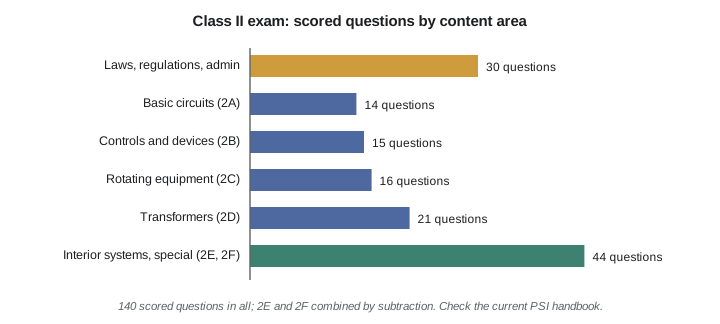
The two exams weight the technical subareas differently, which tells you something about each license. According to the handbook's outline, the Class I exam has 21 questions on basic circuits and 22 on controls and devices, while the Class II exam has 14 and 15. The Class II exam has 16 questions on rotating equipment and 21 on transformers, against 9 and 7 on the Class I exam. In other words, the Class II exam spends far more time on motors and transformers, the equipment that distinguishes commercial and industrial work. The handbook's layout does not give clear separate counts for interior systems and special equipment, so check the current handbook; by subtraction, they share the remaining technical questions.
# Content outline from the handbook (scored questions)
outline = {
    "Laws, regulations, admin": (30, 30),
    "Basic circuits (2A)": (21, 14),
    "Controls and devices (2B)": (22, 15),
    "Rotating equipment (2C)": (9, 16),
    "Transformers (2D)": (7, 21),
}
total = 140
for cls, idx in (("Class I", 0), ("Class II", 1)):
    listed = sum(v[idx] for v in outline.values())
    print(f"{cls}: listed {listed}, remaining for 2E and 2F: {total - listed}")
    for area, counts in outline.items():
        share = round(counts[idx] / total * 100)
print(f" {area}: {counts[idx]} questions, about {share} of every 100")Class I: listed 89, remaining for 2E and 2F: 51 Laws, regulations, admin: 30 questions, about 21 of every 100 Basic circuits (2A): 21 questions, about 15 of every 100 Controls and devices (2B): 22 questions, about 16 of every 100 Rotating equipment (2C): 9 questions, about 6 of every 100 Transformers (2D): 7 questions, about 5 of every 100 Class II: listed 96, remaining for 2E and 2F: 44 Laws, regulations, admin: 30 questions, about 21 of every 100 Basic circuits (2A): 14 questions, about 10 of every 100 Controls and devices (2B): 15 questions, about 11 of every 100 Rotating equipment (2C): 16 questions, about 11 of every 100 Transformers (2D): 21 questions, about 15 of every 100
The output shows that interior electrical systems and special equipment, conditions and locations together account for 51 scored questions on the Class I exam and 44 on the Class II exam. Those areas lean heavily on the NEC chapters covered in the master electrician core courses: wiring methods, branch circuits, feeders, services, grounding, and the special occupancies and equipment articles. Combined with the 30 law and administration questions, they show where most study time should go.
The approved references
The Georgia exam is a limited-reference exam. Candidates may bring the books on the handbook's approved list, and only those books; they may bring as many or as few of them as they like. According to the handbook, the list for exams through 31 December 2026 is:
- American Electricians' Handbook, 17th edition (2021), McGraw-Hill.
- Contractors Guide to Business, Law, and Project Management, Georgia Construction Industry Licensing Board edition, 5th edition, NASCLA.
- Employer's Tax Guide, IRS Circular E, 2025 or 2026.
- Code of Federal Regulations, Title 29, Part 1926 (OSHA construction standards), latest available edition.
- The Georgia State Electrical 2023 National Electrical Code, or the NFPA National Electrical Code Handbook.
- Printreading Based on the 2020 NEC, American Technical Publishers.
- Ugly's Electrical References, 2023 edition.
Note that the code book is the 2023 NEC, matching the edition Georgia has adopted, and that the business and law questions are drawn largely from the Georgia edition of the NASCLA contractors guide, the IRS employer's tax guide and the OSHA construction standards. A candidate who brings only the code book gives up three of the main sources for the thirty law and administration questions. Darnell bought every book on the list, including a separate copy of Part 1926 rather than relying on a summary.
Rules for the books
The handbook explains what candidates may and may not do with their references. Notes, handwritten material and photocopies of material not on the list are not allowed. Books are inspected at check-in. Permanent tabs and highlighting are commonly allowed in limited-reference exams, but read the handbook's exact wording on tabs, highlighting and writing in the margins before you prepare your books, and remove anything it prohibits. A book rejected at check-in is a book you cannot use for eight hours.
Darnell followed a simple tabbing plan. In the code book he tabbed each chapter and the articles that come up most often in calculations: branch circuits, feeders, services, overcurrent protection, grounding and bonding, conductors, motors, transformers and the Chapter 9 tables. In the business guide he tabbed each chapter by topic: business organization, lien law, contracts, insurance, labor law, safety and financial management. In Part 1926 he tabbed the subparts most relevant to electrical contractors: the general safety provisions, personal protective equipment, ladders, scaffolds, electrical, and excavations. He kept the tabs on the edge of the page with short, printed labels so he could find them under pressure.
Pacing two four-hour parts
Eight hours is a long time to concentrate. The total of 155 or 162 questions in 480 minutes works out to roughly three minutes per question on average, which sounds generous until you meet a load calculation that takes eight minutes or a business question that sends you searching through three chapters of the guide. The answer is a plan. Read each question once, answer it if you can, and flag it if you need more than a few minutes. Move on, finish the part, then return to the flagged questions in the time you saved.
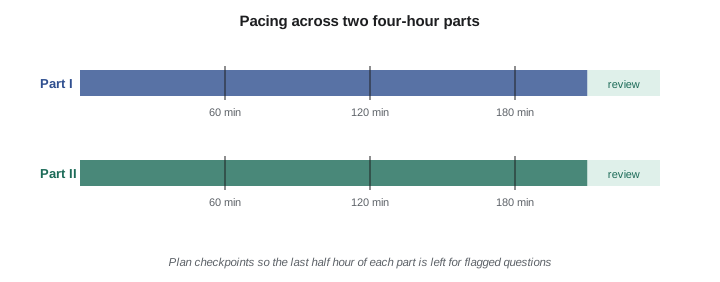
Checkpoints help. If a part contains about half the questions, a candidate who has answered about a quarter of them at the one-hour mark, half at two hours and three quarters at three hours will finish with roughly thirty minutes to spare for review. The handbook and the screen tell you how many questions are in each part; work out your own checkpoints in the first minute and write them on the scratch material the center provides, if any. Never leave a question blank: there is no stated penalty for a wrong answer, so a guess is better than nothing.
Worked problem
Setting checkpoints
Suppose Part I of Darnell's Class II exam contains 81 questions. He wants to leave 30 minutes at the end for flagged questions. How many questions should he have answered at 60, 120 and 180 minutes?
Show solution
- Working time before review: 240 - 30 = 210 minutes.
- Rate: 81 questions / 210 minutes = about 0.39 questions per minute.
- At 60 minutes: about 23 questions; at 120 minutes: about 46; at 180 minutes: about 69.
- If he falls behind a checkpoint, he flags slow questions sooner.
Answer: About 23, 46 and 69 questions, leaving 30 minutes for review.
Calculators and scratch material
Many technical questions require arithmetic, and the handbook explains which calculators are allowed and what scratch material, if any, the testing center provides. Rules on calculators in licensing exams usually allow a silent, non-programmable, non-printing calculator and prohibit devices with text storage or communication features, but follow the current handbook exactly. Bring a calculator you already know well, with fresh batteries, and practice every calculation in this course on that calculator. Fumbling with the square-root or memory keys on a new device wastes minutes you will want later.
A practice routine with the books
Knowing the material is not the same as finding it quickly. The most useful practice for a limited-reference exam is to answer questions with the books open and a timer running, then record where the answer was found. After a few weeks, patterns appear: some articles and chapters come up again and again, and some tabs are never used. Darnell kept a simple log for each practice session with three columns: the question topic, the reference and page where he found the answer, and the time it took. Any lookup that took more than four minutes earned a new tab or a note in his study plan, and any tab he never used came off.
Practice also builds a feel for which questions to skip. A lookup that should take a minute but is still unresolved at three minutes is a candidate for flagging. A long calculation that you know how to do but that takes time can be done in the review period. Candidates who refuse to move on from a hard question tend to run out of time with easy questions still unanswered.
Reading the score report
If a candidate does not pass, the score report breaks performance down by content area. That breakdown is the best study guide available, because it comes from the actual exam rather than from a practice test. A candidate who scored well on technical functions but poorly on laws and regulations should spend most of the next study period with the business guide, Circular E and Part 1926. Tasha, who would sit the Class I exam a month after Darnell, planned to use the same approach on her practice tests: score each one by content area and adjust the next week's study to match.
What the questions look like
Technical questions range from short code lookups to multi-step calculations: the minimum size of a grounding electrode conductor for a given service, the ampacity of a conductor after temperature correction and adjustment, the full-load current of a motor and the size of its branch-circuit protection, or the primary and secondary currents of a transformer. Law and administration questions test the content of the business guide and the other references: what a contract must contain, when a lien must be filed, how payroll taxes are deposited, what records OSHA requires. Many questions are written so that a candidate who knows where to look can find the answer, which is why tabbing and practice with the books matter as much as memory.
Common mistakes
MistakeBringing only the NEC to the exam.
InsteadBring every approved reference; thirty questions come from law, business, tax and safety sources.
MistakeSpending ten minutes on one calculation early in the part.
InsteadFlag slow questions and return to them after reaching the end of the part.
MistakeUsing handwritten notes in the margins of the code book.
InsteadNotes and handwritten material are not allowed; check the handbook rules on tabs and highlighting.
MistakeIgnoring the beta questions.
InsteadBeta questions cannot be identified, so answer every question carefully.
Summary and key terms
- Both exams have 140 scored questions plus beta questions (15 for Class I, 22 for Class II), in two four-hour parts.
- The passing standard is a scaled score of 70.
- Thirty questions cover laws, regulations and administration; 110 cover technical functions, with Class II weighted toward motors and transformers.
- Approved references include the 2023 NEC, the Georgia NASCLA contractors guide, Circular E, 29 CFR 1926, the American Electricians' Handbook, a printreading text and Ugly's.
- Plan checkpoints and leave time at the end of each part for flagged questions.
- Beta question
- An unscored trial question mixed into the exam.
- Limited-reference exam
- An exam where only the listed reference books may be used.
- Content outline
- The handbook's list of exam areas and the number of questions from each.
- Checkpoint
- A planned number of questions answered by a set time.
- Circular E
- The IRS Employer's Tax Guide, used for payroll tax questions.
Practice problems
Work each problem on paper first, then reveal the answer to check.
How many scored questions are on the Class II exam?
Show answer
140, plus 22 beta questions.
Which edition of the NEC is on the current reference list?
Show answer
The 2023 NEC as adopted in Georgia, or the NFPA NEC Handbook.
Which technical areas carry more questions on the Class II exam than on the Class I exam?
Show answer
Rotating equipment and transformers.
Lesson quiz · 5 questions
Score 60% or more to complete this lesson.
Create a free account to save your progress, take quizzes and earn a certificate.