
MELU-210 · Lesson 3 of 12 · 19 min
Applying, approval and booking the exam
▶ Video coming soon A video version of this lesson is on the way.
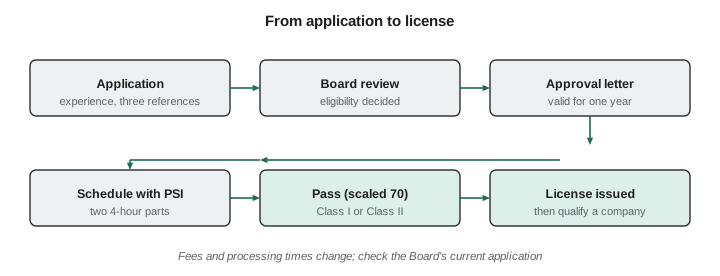
With his experience log finished, Darnell sat down with Jen Okafor in the Calloway Electric office to assemble the application. Jen had handled renewals, permits and insurance certificates for the company for fifteen years, and she kept a binder of every licensing form Ruth had ever filed. "The application is the easy part," she told him. "The hard part is making sure nothing comes back. A form missing one signature can cost you a month." This lesson walks through the steps from application to exam day in order: preparing the application, the Board's review and approval, scheduling with the testing vendor, what to bring and what happens if you need to reschedule or retake.
Step 1: preparing the application
Applications for the electrical contractor license are submitted to the Board through the Secretary of State's licensing system, which in recent years has used an online portal for most professions. The application asks for personal information, the license class sought, the applicant's employment and experience history, the three references on the Board's form, answers to questions about criminal history and prior discipline, and the information Georgia requires to verify lawful presence in the United States for a professional license. The fee is paid with the application. Some items, such as references or verification documents, may be submitted as uploads or on paper depending on the current process.
Jen's checklist for Darnell had six lines: the completed application in the correct class; the experience log consistent with the dates on the application; three signed reference forms, including Ruth's with her license number; proof of identity and the lawful presence documents; the application fee; and a copy of everything for Calloway's own files. She also had Darnell read every question on the criminal history and discipline pages twice. An honest disclosure with an explanation is far better than an omission the Board discovers later.
| Item | What to check |
|---|---|
| License class | Class I or Class II, matching the experience documented |
| Experience history | Dates, employers, roles and installation areas consistent with the references |
| References | Three on the Board's form; one from a licensed electrical contractor with license number |
| Background questions | Answered completely and honestly, with explanations where needed |
| Identity and lawful presence | Documents required for professional licensing in Georgia |
| Fee | Paid with the application; generally not refundable |
Background questions and lawful presence
Two parts of the application deserve particular care. The background questions ask about criminal convictions, pending charges, and discipline or license denials in Georgia or elsewhere. Georgia, like most states, considers the nature of an offense, how long ago it happened and whether it relates to the work, so a conviction is not an automatic bar. What does create problems is an answer that turns out to be incomplete. If a question applies, answer yes and attach a short, factual explanation and any court documents the application asks for.
Georgia law also requires applicants for professional licenses to show that they are lawfully present in the United States, usually through a sworn affidavit and a secure, verifiable document such as a driver's license or passport, following the instructions on the application. The details are set by state law and the Secretary of State's procedures rather than by the electrical Division, and they apply to most licensed professions in Georgia. Jen's tip was to scan the documents before starting the online application, so the session would not time out while Darnell searched for his passport.
Keeping a paper trail
Every licensing step produces a record: the submitted application, the payment receipt, the reference forms, emails from the Board, the approval notice, the PSI confirmation and the score report. Keep them together, either in a folder on the company's server or in a binder like Jen's. They answer questions later, for example when a reference asks whether the Board ever received the form, when a bank or bonding company asks for proof of licensure, or when the license comes up for renewal and you need the license number and issue date. Jen labeled the folder for Darnell with the year, the license class and his name, and added a page tracking each date: application submitted, information requested, approval received, exam booked and exam taken.
Working while you wait
The weeks between application and approval are good study time. The reference books do not change while the Board reviews the application, and the content outline in the PSI handbook is public, so a candidate can start tabbing the code book, working practice calculations and reading the business and law reference long before the approval letter arrives. Darnell used the waiting period to order the books, buy a set of tabs and work through the business reference one chapter a night. By the time the approval came in December, he had already finished one pass through the Georgia business and law material, which freed the twelve weeks of his formal plan for the code and calculations.
Step 2: review and approval
Once the application is complete, the Board's staff and the Division review it. The Division decides whether the applicant meets the eligibility requirements in the rule and may approve the applicant to sit the examination, ask for more information or deny the application. Review takes time because the Division meets on a schedule, so an application submitted just after a meeting may wait several weeks. Applicants who are approved receive an approval letter or notice with instructions for scheduling the exam.
According to the Board's FAQ, exam approval letters are valid for one year. That matters for planning. A candidate who is approved in January and then puts off studying until the following spring may find the approval has expired and need to reapply. Darnell's approval arrived in early December. He and Ruth agreed on a twelve-week study plan, which would put his exam in March, comfortably inside the one-year window and before Calloway's busy season.
If the Division asks for more information, respond quickly and completely. Typical requests are for a clearer description of experience in one of the required installation areas, a replacement reference form with a missing signature or license number, or documents explaining an answer on the background questions. A denial is not necessarily permanent; an applicant can usually reapply once the gap is fixed, for example after gaining the missing experience.
Step 3: scheduling with PSI
Georgia uses PSI, a national testing company, to deliver the electrical contractor exams. After approval, the candidate follows the instructions in the approval notice and the PSI candidate handbook to register and schedule a date and testing center. The exam fee is paid to PSI, and the handbook explains the payment options. The current handbook for the Division of Electrical Contractors covers both the Class I and Class II exams and lists the testing rules, the approved reference books and the content outline, all of which Lesson 4 covers in detail.
Testing centers fill up, especially near the end of the year and in spring, so schedule early once you know your study timeline. Choose a testing center you can reach without stress on exam morning. The Georgia exam is long, two four-hour parts with a break, so an early start time, a short drive and a plan for lunch all help. Darnell booked a Saturday morning at a center north of Macon, drove there the week before to time the trip, and checked where to park.
Rescheduling and missed appointments
According to the PSI handbook, a candidate may reschedule once at no charge with at least two business days' notice. Additional reschedules, late cancellations and missed appointments can mean forfeiting the exam fee and paying again, so read the handbook's rules before booking and keep the confirmation email. Emergencies happen; the handbook explains what documentation PSI accepts for a missed exam due to illness or other serious causes.
# Is a reschedule request early enough? (two business days' notice; weekends skipped)
from datetime import date, timedelta

def business_days_between(start, end):
    days, d = 0, start
    while d < end:
        d += timedelta(days=1)
        if d.weekday() < 5 and d < end:
            days += 1
    return days

exam = date(2027, 3, 13)   # a Saturday exam (illustrative)
for request in [date(2027, 3, 8), date(2027, 3, 10), date(2027, 3, 11)]:
    n = business_days_between(request, exam)
print(request.isoformat(), "business days before exam:", n, "-> OK" if n >= 2 else "-> too late")2027-03-08 business days before exam: 4 -> OK 2027-03-10 business days before exam: 2 -> OK 2027-03-11 business days before exam: 1 -> too late
The script counts full business days between the request and the exam date. The handbook's exact counting rule may differ, for example on holidays or the time of day, so treat the calculation as a reminder to act early rather than a precise answer. The safest approach is to reschedule as soon as you know you cannot make the date.
Step 4: what to bring
The PSI handbook requires two forms of identification at check-in. One must be a current government-issued photo identification with the candidate's name and signature, such as a driver's license, passport or military identification. The second must show the candidate's name and signature, such as a signed credit card or an employment identification card. Temporary identification is not accepted. If the name on the registration differs from the name on the identification, bring proof of the change, such as a marriage certificate or court order. Candidates also sign a roster at the testing center.
The Georgia exam is a limited-reference exam, so candidates also bring their approved reference books. The handbook sets rules for what those books may contain: generally, tabs and highlighting are allowed, but loose notes, handwritten material and unlisted photocopies are not. The center inspects the books before the exam. Lesson 4 lists the approved references and explains how to prepare them.
Exam day itself follows a predictable pattern. Candidates check in, show identification, sign the roster, store personal items in a locker, and have their reference books inspected. Part I runs for four hours, followed by a break, then Part II runs for four hours. Plan for a full day, eat a proper breakfast, bring a lunch if the center allows it to be stored, and leave your phone in the car or the locker. Darnell's practice runs at home followed the same schedule, so the real day felt familiar.
Step 5: results and retakes
The handbook describes how and when results are reported. The minimum passing score is a scaled score of 70 for each exam. A candidate who fails receives a score report showing performance by content area, which is the best guide to what to study next. Under Georgia law and the Board's rules, a candidate who fails the exam twice must complete a Board-approved review course before a third attempt. According to the handbook, once the candidate has completed that course, no further courses are required for later attempts.
Darnell treated the retake rule as one more reason to prepare properly the first time. A failed attempt would cost the exam fee, weeks of extra study, and possibly the approval window, and a second failure would add the cost and time of a review course. He also knew several good electricians who had passed only on their second or third try, usually because they had underestimated the business and law questions or had not practiced using the references under time pressure.
Worked problem
Planning around the approval window
Tasha received her Class I approval on 1 June. She wants to finish a large subdivision before she studies, which will take until the end of October. If her approval is valid for one year, what is the latest month she should plan to sit the exam, allowing one retake if needed?
Show solution
- The approval is valid until about 1 June of the following year.
- Studying from November to January puts a first attempt in late January or February.
- If she fails, she can study the weak areas and retake within the window, for example in April.
- Leaving the first attempt until May would leave no room for a retake inside the window.
Answer: Plan the first attempt by February, leaving time for a retake before the approval expires.
After you pass
Passing the exam is the last test, but not the last step. The Board issues the license after it receives the passing result and any remaining requirements are met, and the new license appears in the Secretary of State's public lookup. A license holder who will qualify a business must then make sure the business is properly set up, insured and connected to the license, as Lessons 7 and 8 describe. Darnell's plan was to keep working under Ruth's license until his own was issued and the company's paperwork was updated, so that no permit would be pulled under a license that was not yet active.
Common mistakes
MistakeWaiting to study until after the approval arrives, then letting it expire.
InsteadPlan the study schedule as soon as you apply; approval letters are valid for one year.
MistakeBringing only a driver's license to the testing center.
InsteadPSI requires two forms of identification, one a government-issued photo ID with signature.
MistakeRescheduling the day before the exam and expecting no charge.
InsteadThe free reschedule requires at least two business days' notice.
MistakeAssuming unlimited retakes without conditions.
InsteadAfter two failures, Georgia requires a Board-approved review course before a third attempt.
Summary and key terms
- Apply through the Secretary of State's licensing process with experience, three references, background answers, lawful presence documents and the fee.
- The Division reviews eligibility and approves candidates to sit the exam; approval letters are valid for one year.
- PSI delivers the exam; the candidate schedules and pays the exam fee to PSI.
- One reschedule is free with at least two business days' notice; bring two forms of identification and the approved references.
- The passing score is a scaled 70; after two failures a Board-approved review course is required before a third attempt.
- Approval letter
- The Board's notice that a candidate may schedule the exam, valid for one year.
- PSI
- The testing company that delivers Georgia's electrical contractor exams.
- Candidate handbook
- PSI's document describing the exam rules, references, content outline and policies.
- Scaled score
- A score adjusted so that 70 represents the passing standard across exam forms.
- Review course
- A Board-approved course required before a third attempt after two failures.
Practice problems
Work each problem on paper first, then reveal the answer to check.
How long is an exam approval letter valid, according to the Board's FAQ?
Show answer
One year.
What two kinds of identification does PSI require?
Show answer
A current government-issued photo ID with name and signature, and a second ID showing name and signature.
A candidate has failed twice. What must happen before the third attempt?
Show answer
The candidate must complete a Board-approved review course.
Lesson quiz · 5 questions
Score 60% or more to complete this lesson.
Create a free account to save your progress, take quizzes and earn a certificate.