
MELU-210 · Lesson 8 of 12 · 19 min
Contractor licensing, insurance and bonding
▶ Video coming soon A video version of this lesson is on the way.
The week after Darnell's license was issued, Jen called a meeting in the conference room with Ruth, Darnell, the company's insurance agent and its accountant. On the table were the company's certificate of insurance, its workers' compensation policy, a stack of bond files from public jobs, the corporate records from the Secretary of State and the occupation tax certificates from four local governments. "A license is one piece," the agent said. "The rest of this is what lets you sign a contract on Monday." This lesson covers the business requirements that sit alongside the license in Georgia: setting up and registering the business, local business taxes, general liability and other insurance, workers' compensation, and bonds.
Setting up the business
Many electrical contractors operate as corporations or limited liability companies, which are formed by filing with the Corporations Division of the Georgia Secretary of State and must file annual registrations to stay in good standing. A sole proprietor may operate under his or her own name or under a trade name, which Georgia generally requires to be registered with the clerk of superior court in the county where the business operates. The choice of structure affects personal liability, taxes and how the business can be sold, and it should be made with professional advice. Whatever the structure, the license rules from Lesson 7 apply: the business needs a licensed person actually engaged in it full time.
Beyond the Secretary of State, a contracting business typically registers with the Georgia Department of Revenue for withholding and sales and use tax as applicable, with the Georgia Department of Labor for state unemployment insurance once it has employees, and with the IRS for an employer identification number and federal payroll taxes. The IRS Employer's Tax Guide, Circular E, is on the exam's reference list for exactly this reason: the business and law section of the exam includes payroll tax questions. Lesson 12 includes practice questions drawn from it.
Local business licenses and occupation taxes
Georgia cities and counties generally require businesses located in their jurisdiction to obtain an occupation tax certificate, often called a business license, and pay a local occupation tax. Some jurisdictions also ask contractors from outside to register before they pull permits. These are local tax and registration requirements, not substitutes for the state electrical contractor license, and they vary widely. Calloway held occupation tax certificates in Macon-Bibb County, where its office was, and registered with the building departments in the other jurisdictions where it pulled permits. Jen tracked each renewal date on the same calendar as the insurance and license renewals.
| Requirement | Agency (typical) | What it covers |
|---|---|---|
| Business entity and annual registration | Secretary of State, Corporations Division | Corporations and LLCs |
| Electrical contractor license | Division of Electrical Contractors | The license holder |
| Occupation tax certificate | City or county | Local business tax and registration |
| Withholding and sales tax | Georgia Department of Revenue | State taxes as applicable |
| Unemployment insurance | Georgia Department of Labor | Employers |
| Federal payroll taxes | IRS (Circular E) | Employers |
| Workers' compensation | Insurer; State Board of Workers' Compensation | Employers with three or more regular employees |
General liability insurance
Commercial general liability insurance covers claims that the contractor's work or operations caused bodily injury or property damage to others, such as a fire that starts in a connection the contractor made or a customer who trips over a cord on the job. It usually includes completed operations coverage, which matters for electrical work because problems may appear long after the job is finished. Policies have per-occurrence and aggregate limits, deductibles and exclusions, and contractors often add an umbrella policy for higher limits.
Check the Board's current application and rules for any insurance the Board itself requires. In practice, almost every customer, general contractor and public owner requires proof of general liability insurance before work starts, usually through a certificate of insurance naming the customer as certificate holder and sometimes as additional insured. Large general contractors often specify minimum limits and endorsements in their subcontracts. Calloway's agent reviewed every subcontract's insurance requirements before Ruth signed, because a requirement the policy did not meet could make the company liable for the gap.
Other coverages complete the picture: commercial auto insurance for the vans, inland marine or equipment coverage for tools and materials, and professional liability for contractors who do design work. A contractor who installs fire alarm or security systems may need specific coverage for that work. The agent's job is to match the coverage to what the company actually does.
Workers' compensation
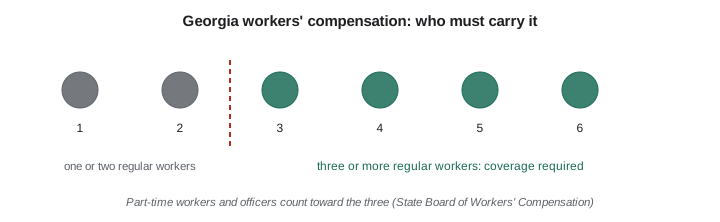
Georgia's workers' compensation law requires employers who regularly employ three or more people, part-time or full-time, to carry workers' compensation insurance or be approved to self-insure. According to the State Board of Workers' Compensation, corporate officers and LLC members count toward the three even if they exempt themselves from coverage. Workers' compensation pays medical bills and part of lost wages for employees injured on the job, and in exchange it generally limits the employee's right to sue the employer for the injury.
Employers must post a notice of compliance and the employee bill of rights, along with a panel of physicians from which injured employees choose a doctor, and must post the insurer's name. When an employee is injured, the employer reports it to the insurer right away on the Board's first report form. According to the State Board, injuries involving seven or more days of lost time must be reported to the Board within 21 days. Failing to carry coverage can bring civil penalties, increased benefits to the employee, and criminal charges for willful refusal; the State Board's employer page lists the ranges.
Workers' compensation also matters between contractors. A general contractor can become responsible for compensation to a subcontractor's employees if the subcontractor is uninsured, which is why general contractors demand certificates of workers' compensation coverage from every subcontractor. Calloway required the same from its own subcontractors, such as the excavation company that dug its trenches, and Jen kept a list of every certificate with its expiration date.
# Does the business need workers' comp under Georgia's three-employee rule? (study aid)
companies = {
    "Tasha's new Class I company": ["Tasha (owner, exempt officer)", "electrician", "helper (part-time)"],
    "Two-person shop": ["owner", "electrician"],
    "Calloway Electric": ["employee"] * 18,
}
for name, people in companies.items():
    n = len(people)  # officers and part-time workers count toward the three
print(f"{name}: {n} counted -> {'coverage required' if n >= 3 else 'below the threshold'}")Tasha's new Class I company: 3 counted -> coverage required Two-person shop: 2 counted -> below the threshold Calloway Electric: 18 counted -> coverage required
The first line is the one that surprises people. Tasha planned to exempt herself as an officer of her new company, but under the State Board's guidance she still counts toward the three, so her company with one electrician and one part-time helper must carry coverage. Many small contractors also carry coverage below the threshold, because general contractors and customers demand it.
Employees, subcontractors and classification
Whether a worker is an employee or an independent contractor affects payroll taxes, unemployment insurance, overtime and workers' compensation. Federal and state agencies look at the real relationship, such as who controls how the work is done, who supplies tools and whether the worker runs an independent business, not just what the parties call it. An electrician who works only for one contractor, on that contractor's schedule, with that contractor's tools, is almost always an employee. Misclassifying employees as contractors to avoid taxes and insurance can bring back taxes, penalties and workers' compensation liability, and the exam's business section treats classification as a basic topic.
Hiring also brings paperwork: federal Form I-9 to verify eligibility to work, federal and state withholding certificates, new hire reporting to the state, and the payroll records required by federal wage and hour law. Electricians paid by the hour generally earn overtime at one and a half times the regular rate for hours over forty in a workweek under federal law. Calloway's accountant handled payroll, but Darnell learned the basics because the license holder is often the first person an employee asks about pay, and because Circular E and the business guide are on the exam.
Financial statements and the surety
Bonding companies and many large customers want to see a contractor's financial statements, often prepared or reviewed by an outside accountant. The figures they look at most closely are working capital, net worth, debt, and the profitability of jobs in progress, usually shown on a work-in-progress schedule that compares each job's estimated cost and revenue with what has been billed and spent so far. A contractor who bills ahead of the work, or who hides losing jobs, may look healthy on a single statement but alarms an experienced surety. Calloway's accountant prepared statements every year and a work-in-progress schedule every quarter, and Ruth reviewed them with the surety once a year whether or not a bond was pending.
The same numbers help the license holder run the company. A falling working capital figure warns that the company is taking on more work than its cash can carry; a job whose cost to date is running ahead of the share of the work completed warns of a loss before the job is finished. Lesson 12's practice set includes simple financial ratio questions of the kind the business guide explains.
Reviewing coverage every year
A contractor's insurance should change as the business changes. Adding a fire alarm division, buying a bucket truck, taking on design-build work or hiring a crew in a new county can each create risks the old policy does not cover. Calloway's agent met with Ruth every year before renewal to walk through the year's work, claims and plans. Darnell attended the meeting for the first time that spring and was surprised by how many questions concerned his own plans, such as the solar and battery work he hoped to add.
Changes in ownership or license holder also need attention. When the license holder changes, as at Calloway, the agent should update the company's records, and some policies or bonds may require notice to the insurer or surety. Certificates issued to customers before the change remain valid for the policy period, but new certificates should reflect current information. Jen's transition checklist included a call to the agent and a letter to the surety on the day Darnell's license became the company's qualifying license.
Bonds
A surety bond is a three-party agreement in which a surety company guarantees the contractor's obligation to an owner or others. Bid bonds guarantee that a bidder will sign the contract if awarded the job. Performance bonds guarantee that the contractor will complete the work. Payment bonds guarantee that the contractor will pay its subcontractors and suppliers. On private projects, bonds are required only if the contract requires them. On public projects, Georgia law requires performance and payment bonds on public works contracts above thresholds set in state law, and those payment bonds take the place of lien rights, because liens cannot attach to public property.
Bonding capacity depends on the contractor's financial strength, experience and character. A surety reviews financial statements, work in progress and the owner's personal finances, and usually requires the owners to sign an indemnity agreement promising to repay the surety for any losses. Calloway had built its bonding capacity over twenty years of public school and county work. When Ruth eventually sold part of the company to Darnell, the surety would want to review the new ownership and his personal finances, a step the accountant put on the transition plan.
Worked problem
Getting ready for a new subcontract
A general contractor sends Calloway a subcontract for the electrical work on a county library. It requires a certificate of general liability insurance with stated limits and the county as additional insured, a certificate of workers' compensation, and performance and payment bonds for the full subcontract amount. What should Jen and Darnell do before signing?
Show solution
- Send the insurance requirements to the agent and confirm the policy limits and endorsements meet them.
- Request certificates naming the general contractor and the county as required.
- Confirm the workers' compensation certificate is current.
- Ask the surety for the bonds and confirm the company has the bonding capacity.
- Check that the subcontract's other terms, such as payment and retainage, are acceptable (Lesson 9).
Answer: Confirm insurance, workers' compensation and bonding with the agent and surety before signing.
Common mistakes
MistakeTreating a city business license as a substitute for the state license.
InsteadThe occupation tax certificate is a local tax registration; the state license is separate.
MistakeExempting yourself as an officer and assuming the company is below three employees.
InsteadOfficers and LLC members count toward the three even if they exempt themselves.
MistakeSigning a subcontract without checking its insurance requirements.
InsteadHave the agent confirm the policy meets the limits and endorsements required.
MistakeExpecting to file a lien on a public project.
InsteadPublic projects rely on payment bonds; liens do not attach to public property.
Summary and key terms
- A contracting business registers its entity, local occupation taxes, state and federal taxes and unemployment insurance, in addition to the license.
- General liability insurance with completed operations coverage is required by almost every customer; check any Board requirement.
- Workers' compensation is required for employers regularly employing three or more people, counting officers and part-time workers.
- Report injuries to the insurer promptly; lost-time injuries of seven days or more go to the Board within 21 days.
- Public works contracts above state thresholds require performance and payment bonds.
- Occupation tax certificate
- A local business tax registration issued by a Georgia city or county.
- Certificate of insurance
- A document showing a contractor's insurance coverage to a customer or general contractor.
- Completed operations
- Liability coverage for claims arising after the work is finished.
- Panel of physicians
- The list of doctors an injured employee chooses from under Georgia workers' compensation.
- Payment bond
- A surety bond guaranteeing payment to subcontractors and suppliers, used in place of liens on public projects.
Practice problems
Work each problem on paper first, then reveal the answer to check.
A company has an owner who exempts himself and two employees. Must it carry workers' compensation?
Show answer
Yes; the owner counts toward the three regular employees.
Within how many days must a seven-day lost-time injury be reported to the Board?
Show answer
Within 21 days of learning of the disability.
What protects a subcontractor's right to payment on a public project?
Show answer
The payment bond required for public works contracts.
Lesson quiz · 5 questions
Score 60% or more to complete this lesson.
Create a free account to save your progress, take quizzes and earn a certificate.