
MELU-210 · Lesson 11 of 12 · 19 min
Renewal and continuing education
▶ Video coming soon A video version of this lesson is on the way.
Two years after Darnell's license was issued, an email from the Secretary of State's licensing system arrived in early April reminding him that his electrical contractor license was due for renewal by the end of June. He opened the folder where he kept his continuing education certificates and counted: four hours from a code update course the first spring, four from a business and safety course the second. "Eight hours, two years, done," he told Jen. She checked one more thing: whether he had reported the courses in the new tracking system the Board had begun using in 2026. He had not. This lesson covers the renewal cycle, the continuing education requirement and how to meet it, recordkeeping and reporting, and what happens when a license lapses.
The renewal cycle
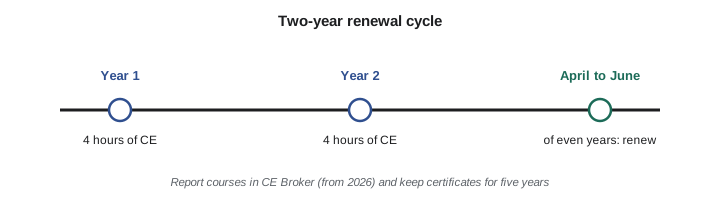
Georgia electrical contractor licenses renew every two years. According to the Board's FAQ, the renewal period runs from April through June of even-numbered years, and licenses can be renewed online through the Secretary of State's licensing portal. Renewal requires a completed renewal application, the renewal fee, and completion of the required continuing education before applying. A license that is not renewed by the deadline lapses, and the holder may not contract for electrical work until it is reinstated.
Because the cycle is tied to even-numbered years rather than the date each license was issued, a newly licensed contractor's first renewal may come sooner than two years after licensure, depending on when the license was issued. Check the expiration date shown on the license record and plan the continuing education accordingly. Jen kept a single calendar for the company with every license, certificate, insurance policy and occupation tax renewal, color-coded by agency, and reviewed it on the first business day of every month.
How many hours
According to the Board's continuing education page and FAQ, each licensee must complete four hours of approved continuing education per year, a total of eight hours per two-year renewal period. The courses must be completed before the licensee applies for renewal. The requirement applies to both Class I and Class II license holders.
| Item | Requirement (summary) |
|---|---|
| Renewal frequency | Every two years |
| Renewal window | April through June of even-numbered years |
| Continuing education | 4 hours per year, 8 hours per renewal period |
| Timing | Completed before applying for renewal |
| Reporting | CE Broker, starting 1 January 2026 |
| Certificates | Kept for five years; no certificate, no credit |
What counts
The Board's continuing education page lists the subject categories that approved courses should address: codes and standards; business law, insurance and finance; safety and OSHA compliance; materials and installation methods; and theoretical content related to the scientific knowledge used in electrical contracting. The page does not set a minimum number of hours in a particular category, but courses must be approved, and the Board's rule and the Secretary of State's published provider list identify who may offer them. The page notes that courses given by equipment manufacturers specifically to promote their own products are not approved.
In practice, most Georgia electrical contractors meet the requirement with courses from approved providers, including code update courses when a new NEC or new Georgia amendments take effect, business and safety courses, and courses on new technologies. Check that a course and its provider appear on the current approved list before paying for it, especially online courses advertised nationally, because a course approved in another state is not necessarily approved in Georgia.
Reporting and records
Starting 1 January 2026, according to the Board's continuing education page, licensees must register and report continuing education in CE Broker, an online tracking system, which can be done with a free basic account. Licensees must also keep their certificates of completion for five years, and a class without a certificate receives no credit. The combination of the reporting system and the five-year record rule means the Board can audit renewals and ask a licensee to prove the hours claimed.
Darnell's lesson from his first renewal was simple: report each course in the tracking system the week he took it, and save the certificate to the company server the same day. Jen added a column to the renewal calendar for each license holder showing hours completed and hours reported, so that nobody would reach June with hours taken but not recorded.
# Continuing education tracker for one renewal period (illustrative)
courses = [
    ("2025-03-14", "Code update: 2023 NEC and Georgia amendments", 4, True),
    ("2026-02-20", "Business, insurance and OSHA for contractors", 4, False),
]
required_per_year = 4
years = 2
done = sum(h for _, _, h, _ in courses)
reported = sum(h for _, _, h, r in courses if r)
print(f"Hours completed: {done} of {required_per_year * years}")
print(f"Hours reported in the tracking system: {reported}")
for d, title, h, r in courses:
    if not r:
print(f"Report before renewal: {d} {title} ({h} h)")Hours completed: 8 of 8 Hours reported in the tracking system: 4 Report before renewal: 2026-02-20 Business, insurance and OSHA for contractors (4 h)
The tracker shows the situation Jen caught: all eight hours completed, but four not yet reported. Fixing it took Darnell ten minutes with the certificate in hand. Without the certificate, the hours would not have counted.
Renewal step by step
A smooth renewal follows the same steps every two years. In January of the renewal year, check the license record for the expiration date and confirm that the contact information the Board holds is current, because renewal reminders go to the address and email on file. By March, make sure all the required continuing education hours are completed and reported. In April, as soon as the window opens, log in to the portal, complete the renewal application, answer the background questions honestly, and pay the fee. Then check the license lookup a few days later to confirm the new expiration date appears.
The background questions on a renewal application deserve the same care as those on the original application. A renewal may ask about criminal charges, discipline in other states or other matters that arose since the last renewal. Answer accurately and attach explanations where needed. A renewal that is approved on a false answer can be revoked later, and the false answer becomes a disciplinary problem of its own.
Audits
Licensing boards in many professions audit a sample of renewals by asking licensees to prove the continuing education they claimed, and Georgia's move to a tracking system and its five-year certificate rule make audits straightforward. An audited licensee who cannot produce certificates faces the loss of credit for those hours and possible discipline for an inaccurate renewal. The defense is simple: keep the certificates, keep them where you can find them, and report each course promptly. Darnell kept a folder for each renewal period containing the certificates, the reporting confirmations and a copy of the renewal receipt.
Renewal is a good time for a business check
Because renewal happens on a fixed schedule, many contractors use it as the occasion for a broader review of the business requirements from Lesson 8. Is the company's registration with the Secretary of State current? Are the occupation tax certificates renewed in every jurisdiction where the company keeps an office? Do the insurance certificates on file with customers and building departments reflect current policies? Does the permit portal list only current employees? Is the license number on trucks, proposals and the website correct? Jen's renewal checklist for Calloway covered all of those items, and every two years it turned up at least one small problem worth fixing.
The renewal is also a natural time to think about the next two years: what work the company wants to do, what training the crews need, whether any foreman is ready to start working toward a license, and what code changes are coming. Ruth and Darnell held their renewal planning meeting each April, and it usually produced the list of courses the company would pay for over the following cycle.
Changes between renewals
Some changes cannot wait for renewal. As Lesson 7 explained, a business must notify the Division immediately when its license holder leaves, and license holders must keep their contact information current. A change of business name, a change of entity, or a move to a new company should be handled as the current rules and forms require, at the time it happens. Waiting until the next renewal to report a change can leave the Board with the wrong information for up to two years, and can leave a company contracting without a properly connected license holder.
Lapsed licenses and reinstatement
A license that is not renewed on time lapses. The Secretary of State's forms distinguish between reinstating a license that has lapsed for less than three years and one that has lapsed for three years or more, and the form for the longer period indicates that an examination is required. In other words, a contractor who lets a license lapse for several years may have to qualify and pass the exam again. A lapsed license also means the company has no lawful license holder, so permits cannot be pulled and contracts may be at risk until the license is reinstated or another license holder is in place.
Some licensees also stop contracting for a period, for example while working for a utility or an owner. The Board's rules address active and inactive status; check them before letting a license lapse, because maintaining a license in good standing is usually far easier than reinstating it later. Ruth planned to keep her own license active for several years after Darnell took over, completing the continuing education each year, so that Calloway would have a backup license holder.
Choosing courses well
Eight hours every two years is a small requirement, and it is easy to treat it as a box to tick with the cheapest course available. A better approach is to choose courses that match the work the company does and the changes coming. A contractor doing mostly commercial work might take a course on the Georgia amendments one year and a course on arc flash risk assessment the next. A residential contractor might focus on the dwelling GFCI and AFCI rules, surge protection and energy storage. A contractor planning to bid public work might take a course on bonds, lien law and payment claims. Each of those courses meets the requirement and also makes the business better.
Format matters too. Classroom courses at a technical college or trade association allow questions and conversation with other contractors, which often teaches as much as the course itself. Approved online courses are convenient for busy contractors and can be taken in short sessions. Whichever format you choose, confirm the approval, complete the course, save the certificate and report it.
Continuing education as a business tool
Continuing education is a requirement, but it is also an opportunity. Contractors who learn about new technologies early, such as energy storage, load management for electric vehicle charging and smart panels, can offer those services before competitors do. Code update courses prepare crews for changes before the inspectors start enforcing them. Business courses on contracts, liens and insurance often pay for themselves the first time they prevent a mistake. Calloway paid for its foremen to attend the same code update courses as the license holder, even though only the license holder needed the hours, because the people installing the work needed the knowledge most.
Some local jurisdictions, other licenses and other states carry their own education requirements. A contractor who also holds a low-voltage license, a license in another state or a local certificate must meet each one's requirements, and a course approved for one may not count for another. A single calendar for every license, with its renewal date and education rules, prevents surprises.
Worked problem
Planning a first renewal
Tasha's Class I license was issued in September of an odd-numbered year. When is her first renewal window, and how many hours of continuing education should she plan for before it?
Show solution
- Renewals occur from April through June of even-numbered years.
- Her license was issued in September of an odd year, so the next renewal window is April to June of the following year, about nine months later.
- The requirement is stated as four hours per year; check the rules on how it applies to a partial first period.
- The safe plan is to complete and report the hours the rules require for her first period well before April, and keep the certificates.
Answer: Her first renewal comes the following spring; confirm the hours required for a partial first period and finish them early.
Common mistakes
MistakeTaking the hours but not reporting them in the tracking system.
InsteadReport each course in CE Broker and keep the certificate for five years.
MistakeAssuming any online electrical course counts.
InsteadCheck that the course and provider are approved for Georgia electrical contractors.
MistakeLetting a license lapse for years and expecting a simple renewal.
InsteadA license lapsed three years or more requires reinstatement with an examination.
MistakeWaiting until late June to start the renewal.
InsteadRenew early in the April to June window, with continuing education already complete.
Summary and key terms
- Georgia electrical contractor licenses renew every two years, from April through June of even-numbered years.
- Licensees complete four hours of approved continuing education per year, eight per renewal period, before renewing.
- Approved courses cover codes, business law and finance, safety, materials and methods, and theory; product promotion courses are not approved.
- From 2026, courses are reported in CE Broker, and certificates are kept for five years.
- A license lapsed three years or more requires reinstatement with an examination.
- Renewal period
- The two-year cycle ending in the spring of even-numbered years.
- Continuing education
- Approved courses licensees must complete to renew.
- CE Broker
- The online system Georgia uses from 2026 to track continuing education.
- Lapsed license
- A license not renewed by the deadline.
- Reinstatement
- The process to restore a lapsed license, which can require an exam after three years.
Practice problems
Work each problem on paper first, then reveal the answer to check.
How many hours of continuing education are required per renewal period?
Show answer
Eight hours: four per year.
When is the renewal window?
Show answer
April through June of even-numbered years.
How long must certificates of completion be kept?
Show answer
Five years.
Lesson quiz · 5 questions
Score 60% or more to complete this lesson.
Create a free account to save your progress, take quizzes and earn a certificate.