
MELU-210 · Lesson 5 of 12 · 19 min
The NEC as adopted in Georgia and state amendments
▶ Video coming soon A video version of this lesson is on the way.
The first job Darnell ran after he started studying was a kitchen and laundry remodel in a 1960s house on Ingleside Avenue, a small job Ruth sent his way so he could see the residential side again. The homeowner wanted new countertop receptacles, a dishwasher and a relocated washer. When Darnell sat down to plan the circuits, he realized that the answers depended on more than the NEC he had studied in the core courses. Georgia had adopted that edition, then amended it, and the amendments touched exactly the rules he needed: ground-fault and arc-fault protection, and receptacles at a kitchen island. This lesson explains how Georgia adopts the NEC, which edition and amendments apply in late 2026, how local amendments fit in, and how to find out which version governs a particular job.
How Georgia adopts codes
Georgia has a statewide system of construction codes called the state minimum standard codes. The Department of Community Affairs, acting with advice from a state codes advisory committee, adopts national model codes and Georgia amendments to them. Some codes are mandatory everywhere in the state; others are permissive and apply only where a local government chooses to enforce them. The National Electrical Code is one of the mandatory codes, so the NEC with the Georgia amendments applies across the state whether or not a city or county has its own inspection program.
DCA updates the codes in cycles. It reviews new editions of the model codes, proposes Georgia amendments, gives public notice and an opportunity for comment, and announces the new codes and their effective dates in memos, usually effective on 1 January of a given year. Contractors and inspectors learn about changes through those memos, through trade associations and through local building departments. Ruth kept a copy of each DCA memo in the office binder, because a customer would occasionally ask why a rule had changed between two jobs a year apart.
The current edition
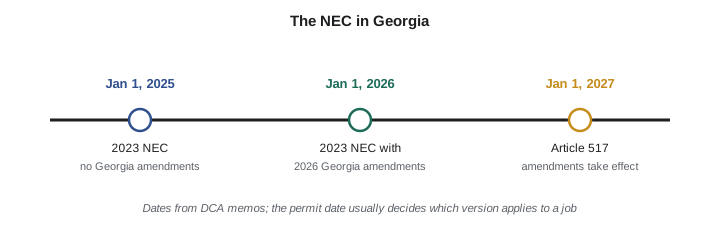
According to DCA's memos, Georgia adopted the 2023 edition of the NEC effective 1 January 2025, initially with no Georgia amendments. DCA then adopted Georgia amendments to the 2023 NEC effective 1 January 2026. DCA's amendment packet also includes amendments to Article 517, which covers health care facilities, with a later effective date of 1 January 2027. The PSI reference list for the electrical contractor exams names the Georgia State Electrical 2023 NEC, which matches the adopted edition.
The 2026 edition of the NEC was published by the National Fire Protection Association in 2025. As of late 2026 Georgia had not announced its adoption, and the Georgia electrical contractor exam continued to use the 2023 edition. When DCA does adopt the 2026 NEC, it will announce the effective date and any Georgia amendments in a memo, and the exam reference list will change on its own schedule. Watch both, because the exam may lag behind the code that inspectors enforce or move ahead of it for a short period.
What the 2026 Georgia amendments address
DCA's packet of Georgia amendments to the 2023 NEC is short, and almost every item concerns dwelling units and occupancies where people sleep. In plain terms, according to the packet, the amendments address these topics: a definition of townhouse (row house) for single-family attached units; the list of dwelling locations requiring ground-fault circuit-interrupter protection; ground-fault protection for certain appliances; ground-fault protection for outdoor outlets at dwellings, with exceptions; the list of dwelling rooms requiring arc-fault circuit-interrupter protection; the receptacle requirement for kitchen islands and peninsulas, with an exception for certain situations; and surge-protective devices for services and feeders, where the Georgia version exempts one- and two-family dwellings. Each change modifies a specific section of the 2023 NEC, and the packet states the modified text.
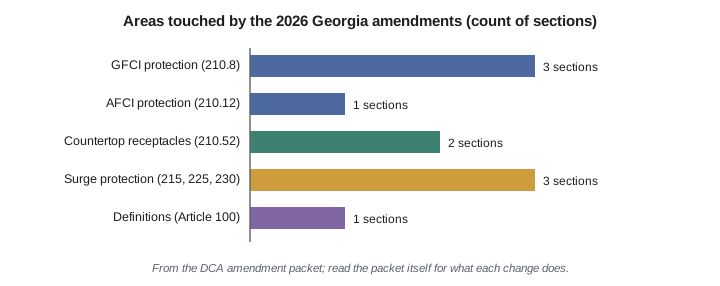
The direction of each change matters as much as its topic. Some Georgia amendments adjust the national rule to reflect conditions or preferences in the state, for example by narrowing a requirement or adding an exception, and some keep or expand a requirement. The only way to know which way a particular amendment goes, and by how much, is to read it alongside the 2023 NEC section it modifies. On the exam, a question that turns on one of these sections may depend on the Georgia version, which is why the reference list names the Georgia State Electrical 2023 NEC.
| Topic | NEC area (2023) | What to check in the packet |
|---|---|---|
| Townhouse definition | Article 100 | How the term applies to single-family attached units |
| GFCI locations at dwellings | 210.8(A) | Which locations are listed and any exceptions |
| GFCI for appliances | 210.8(D) | Which appliances are listed |
| Outdoor outlets at dwellings | 210.8(F) | Scope, exceptions for lighting and HVAC equipment |
| AFCI locations | 210.12(B) | Which rooms and areas are listed |
| Island and peninsula receptacles | 210.52(C) | The required receptacle and the exception |
| Surge protection | 215.18, 225.42, 230.67 | Occupancies covered and the one- and two-family exemption |
Reading an amendment packet
A DCA amendment packet is organized by code section. For each change it identifies the section of the model code being modified and then states what is deleted, added or replaced. Read it with the code book open to the same section, because an amendment that says only "add an exception" or "revise item 4" makes sense only next to the original text. Pay attention to the effective date at the top of the packet and to any section with its own later date, such as the Article 517 changes. Mark the amended sections in your own working copy of the code so you do not apply the national text by habit. Many Georgia contractors keep a printed packet folded inside the front cover of the code book they carry to job sites.
When Darnell first read the packet, he made a one-page summary for the Calloway crews listing each amended section, a one-line description of the change in his own words, and the job types it affected: new houses, remodels, apartments, or hotels and similar buildings. He posted it in the shop and walked the foremen through it at a Monday safety meeting. Two weeks later a foreman called him from a townhouse job to ask whether the Georgia definition made the units one-family dwellings for the surge-protection exemption. The answer required reading the definition and the amendment together, which was exactly the habit the summary was meant to build.
Code questions on the exam
Most technical questions on the Georgia exam test the NEC itself rather than the Georgia amendments: conductor sizing, overcurrent protection, grounding, motor circuits, transformer protection, box fill, conduit fill, and the special occupancy articles. The master electrician core courses cover those topics in detail. The amendments matter on questions about the specific sections they change, and they matter every day on real jobs. A sound approach is to study the national 2023 NEC thoroughly, then learn the handful of Georgia changes and tab them in the Georgia code book you will bring to the exam.
Staying current
Code changes arrive on a predictable rhythm. NFPA publishes a new NEC every three years, and DCA reviews each new edition, proposes Georgia amendments, takes comment and announces an effective date, often well after the national publication. Contractors stay current by reading DCA's memos and public notices, attending continuing education courses on code changes, following trade association updates, and asking local inspectors about upcoming changes. Lesson 11 explains how continuing education fits into license renewal; code update courses are one of the most practical ways to meet it.
Applying the amendments: the Ingleside kitchen
On the Ingleside Avenue remodel, Darnell worked through the amended sections one at a time. For the countertop and laundry receptacles and the dishwasher, he read the Georgia version of the ground-fault sections alongside the national text to see which locations and appliances required protection. For the island the homeowner wanted, he read the Georgia version of the island and peninsula receptacle rule and its exception. For the new laundry and the family room circuits, he checked the Georgia arc-fault list. He wrote the answers on the permit drawing so the inspector could see his reasoning, and he added a short note citing the Georgia amendment where it differed from the national rule.
The service was a 200-ampere single-phase service in good condition, so the remodel did not trigger a service change. The surge-protection amendments did not apply to this house in any case, because the Georgia version exempts one- and two-family dwellings. A year earlier, on a 24-unit apartment building in north Macon, the same amendments had been the reason Calloway installed surge-protective devices at the service and the feeders, a detail that had surprised the developer and that Darnell explained by pointing to the Georgia text.
# Which version of the NEC governs a job? (simplified: based on the permit application date)
from datetime import date

versions = [
    (date(2025, 1, 1), "2023 NEC, no Georgia amendments"),
    (date(2026, 1, 1), "2023 NEC with 2026 Georgia amendments"),
]

def version_for(applied):
    current = "Earlier edition (check DCA history)"
    for start, name in versions:
        if applied >= start:
            current = name
    return current

for job, applied in [("Apartment building", date(2025, 6, 2)),
                     ("Ingleside Ave remodel", date(2026, 10, 19)),
                     ("Old warehouse permit", date(2024, 11, 5))]:
print(f"{job} (applied {applied.isoformat()}): {version_for(applied)}")Apartment building (applied 2025-06-02): 2023 NEC, no Georgia amendments Ingleside Ave remodel (applied 2026-10-19): 2023 NEC with 2026 Georgia amendments Old warehouse permit (applied 2024-11-05): Earlier edition (check DCA history)
The script uses the permit application date, which is the common rule for which edition applies, but jurisdictions differ on details such as whether the date of application or the date of issue controls and how transition periods work. Health care work also has the separate Article 517 date in 2027. For a job that straddles a change, ask the building department in writing which version it will enforce.
Local amendments
Georgia's system allows local governments, under procedures set by state law, to adopt local amendments to the state minimum codes, and DCA asks local governments with amendments on file to review them when the state codes change. In practice, most electrical work in Georgia follows the state version of the NEC without local changes, but a contractor working in several jurisdictions should check each one. The building department's website or permit counter will usually tell you whether local amendments apply. Jen kept a one-page sheet for each jurisdiction Calloway worked in, listing the inspection office, the permit portal and any local amendments or policies.
Other codes interact with the NEC on many jobs. The International Building Code and International Residential Code, also adopted by DCA with Georgia amendments and updated to the 2024 editions effective 1 January 2026, govern fire-resistance ratings, egress and structural matters that affect how wiring is installed, such as penetrations through rated walls. The fire code, adopted by the State Fire Safety Commissioner, affects fire alarm and emergency systems. The energy code affects lighting controls. An electrical contractor does not need to master those codes, but should recognize when a question on a job, or on the exam, really belongs to one of them.
Interpretations and the authority having jurisdiction
The NEC gives the authority having jurisdiction, in Georgia usually the local building official or electrical inspector, the power to interpret the code and approve equipment and methods. Two inspectors may read an unclear section differently, and the contractor's job is to know the code well enough to discuss it professionally. When a disagreement cannot be settled on site, the usual path is a written request to the building official and, if necessary, the local appeals process. Ruth's rule was simple: argue the code, never the person, and put anything important in writing.
Worked problem
Island receptacle question
A homeowner wants a small kitchen island with a flat surface and no practical place to mount a receptacle above the counter. Darnell needs to know whether a receptacle is required and where it may go. What steps should he follow?
Show solution
- Identify the governing code: the permit date shows the 2023 NEC with the 2026 Georgia amendments.
- Read the 2023 NEC rule for island and peninsular countertop receptacles.
- Read the Georgia amendment to that rule and its exception for situations without a mounting option above the counter.
- Measure the island against the size thresholds in the governing text.
- Note the code section and the Georgia amendment on the plan and confirm with the inspector if the reading is unclear.
Answer: The answer depends on the Georgia version of the rule and the island's dimensions; read both texts and document the decision.
Common mistakes
MistakeUsing the national 2023 NEC text without checking the Georgia amendments.
InsteadRead the DCA amendment packet; several dwelling rules are modified in Georgia.
MistakeAssuming the 2026 NEC applies because it has been published.
InsteadGeorgia applies the edition DCA adopts; as of late 2026 that is the 2023 NEC with Georgia amendments.
MistakeApplying the surge-protection amendments to a single-family house.
InsteadThe Georgia version exempts one- and two-family dwellings; read the amendment for its scope.
MistakeForgetting the separate Article 517 effective date.
InsteadThe health care amendments take effect on 1 January 2027.
Summary and key terms
- DCA adopts the NEC as a mandatory state minimum code, with Georgia amendments.
- The 2023 NEC took effect on 1 January 2025; Georgia amendments took effect on 1 January 2026.
- The amendments concern dwelling GFCI and AFCI protection, island receptacles, surge protection, and a townhouse definition; Article 517 changes follow in 2027.
- The permit date usually decides which version governs a job; ask the department about transitions.
- Local amendments are possible under state procedures; check each jurisdiction.
- State minimum standard codes
- Codes adopted by DCA that apply statewide in Georgia.
- Georgia amendment
- A DCA change to a model code section, published in an amendment packet.
- Mandatory code
- A state minimum code that applies everywhere in Georgia.
- Authority having jurisdiction
- The official responsible for enforcing and interpreting the code, usually the local building official.
- Local amendment
- A change adopted by a local government under the state's procedures.
Practice problems
Work each problem on paper first, then reveal the answer to check.
Which edition of the NEC applies in Georgia in late 2026?
Show answer
The 2023 NEC with the Georgia amendments effective 1 January 2026.
Do the Georgia surge-protection amendments apply to a new one-family house?
Show answer
No; the Georgia version exempts one- and two-family dwellings.
When do the Article 517 amendments take effect?
Show answer
1 January 2027.
Lesson quiz · 5 questions
Score 60% or more to complete this lesson.
Create a free account to save your progress, take quizzes and earn a certificate.