
MELU-210 · Lesson 10 of 12 · 18 min
Workplace safety law and OSHA for electrical contractors
▶ Video coming soon A video version of this lesson is on the way.
On a hot afternoon in July, a Calloway apprentice named Luis was pulling wire in the attic of a strip center on Pio Nono Avenue when he became dizzy and confused. His foreman got him down the ladder, into the shade and onto the phone with a nurse line, and he recovered after an hour of rest, water and cooling. Nobody was seriously hurt, but the incident led to a long Monday meeting. Ruth asked Darnell to lead it. "When you hold the license," she said, "you're the one the crews look to on safety. And you're the one OSHA calls." This lesson covers the federal safety law that applies to Georgia electrical contractors, the OSHA construction standards on the exam's reference list, the injury recordkeeping and reporting rules, electrical safety practice, and the safety program that ties it together.
Who enforces safety law in Georgia
Private-sector workplaces in Georgia are covered by federal OSHA, the Occupational Safety and Health Administration of the United States Department of Labor, rather than by a state-run plan of the kind found in some other states. Federal OSHA sets the standards, inspects workplaces, investigates complaints and serious incidents, and issues citations and penalties. The construction standards in Part 1926 apply to construction work, including electrical installation, alteration and repair, and the general industry standards in Part 1910 apply to other work such as maintenance in existing facilities. Many electrical contractors work under both, depending on the job.
The law's basic structure is simple. The general duty clause of the federal OSHA Act requires employers to provide a workplace free from recognized hazards likely to cause death or serious harm. Specific standards add detailed requirements for particular hazards. Employers must also train workers, keep injury records, report serious incidents and allow workers to raise safety concerns without retaliation. The exam's law and administration section draws questions from Part 1926, which is on the reference list, so Darnell spent a full week of his study plan with it.
The Part 1926 subparts electrical contractors use most
Part 1926 is divided into subparts by topic. The ones an electrical contractor uses most often include the general safety and health provisions, which cover training, first aid and housekeeping; personal protective equipment; fire protection; scaffolds; fall protection; excavations; stairways and ladders; and the electrical subpart, which covers installation safety requirements, safety-related work practices, and safety-related maintenance and environmental considerations. The electrical subpart includes requirements on ground-fault protection or an assured equipment grounding conductor program for temporary power on construction sites, and on lockout and tagging of circuits.
| Topic | Where to look in Part 1926 | Typical questions |
|---|---|---|
| Training, first aid, housekeeping | General safety and health provisions | Competent person, first aid availability |
| Personal protective equipment | PPE subpart | Eye, face, head and foot protection |
| Ladders | Stairways and ladders subpart | Ladder extension above landings, inspection |
| Fall protection | Fall protection subpart | When protection is required, systems allowed |
| Excavations | Excavations subpart | Protective systems, competent person |
| Electrical | Electrical subpart | GFCI or assured grounding program, lockout and tagging |
On the exam, most Part 1926 questions ask for a specific requirement in a specific situation: when a ladder must extend above the landing it serves, when fall protection is required at a given height, when a trench needs a protective system, or what a ground-fault program must include. Tabbing the subparts by topic and practicing lookups pays off here more than memorizing.
Recordkeeping and reporting
Under 29 CFR Part 1904, employers covered by the recordkeeping rule must record work-related injuries and illnesses that meet the recording criteria on the OSHA 300 log, complete an incident report such as Form 301 for each recordable case, and prepare an annual summary on Form 300A. The summary must be posted in the workplace from 1 February to 30 April of the following year, and the records must be kept for five years. Employers with ten or fewer employees at all times during the previous calendar year are generally partially exempt from keeping the log, though they must still report serious incidents. Certain larger establishments must also submit data electronically by 2 March each year.
All employers must report serious incidents to OSHA: a work-related fatality within 8 hours, and an inpatient hospitalization, amputation or loss of an eye within 24 hours. Those reports are separate from the workers' compensation report to the insurer and the State Board covered in Lesson 8. A single serious injury can therefore require three reports with three different deadlines: to OSHA, to the insurer and, for lost time of seven days or more, to the State Board within 21 days.
| Report or record | To whom | When |
|---|---|---|
| Fatality | OSHA | Within 8 hours |
| Inpatient hospitalization, amputation or loss of an eye | OSHA | Within 24 hours |
| Recordable case on the 300 log | Kept by the employer | Within 7 calendar days of learning of it |
| Annual summary (300A) | Posted at the workplace | 1 February to 30 April |
| First report of injury | Workers' compensation insurer | Immediately on learning of the injury |
| Seven or more days of lost time | State Board of Workers' Compensation | Within 21 days |
Measuring safety performance
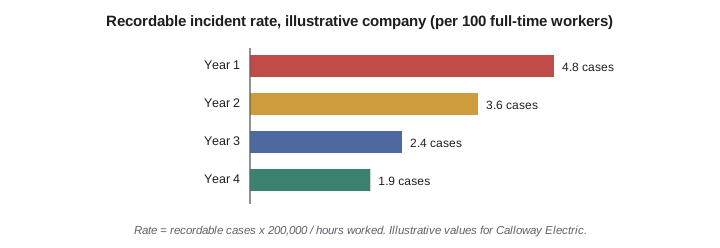
Customers, general contractors and insurers often ask for a contractor's safety record, usually the total recordable incident rate and the experience modification rate on workers' compensation. The incident rate standardizes the number of recordable cases to a base of 200,000 hours, which represents 100 full-time workers working a year. It lets a company compare its record with others of different size and track its own improvement.
# Total recordable incident rate (TRIR) = recordable cases x 200,000 / hours worked
years = {  # illustrative Calloway figures
    "2023": (2, 41600),
    "2024": (1, 38200),
    "2025": (1, 39800),
    "2026": (2, 40100),
}
for year, (cases, hours) in years.items():
    rate = cases * 200_000 / hours
print(f"{year}: {cases} cases, {hours:,} hours -> TRIR {rate:.2f}")2023: 2 cases, 41,600 hours -> TRIR 9.62 2024: 1 cases, 38,200 hours -> TRIR 5.24 2025: 1 cases, 39,800 hours -> TRIR 5.03 2026: 2 cases, 40,100 hours -> TRIR 9.98
The figures show why small companies must read their rates carefully. With about forty thousand hours a year, a single recordable case moves Calloway's rate by about five points. A customer comparing rates should look at several years and the nature of the cases, and a contractor should be ready to explain them. The 2026 rate rose because Luis's heat illness, which required medical treatment beyond first aid, was recordable.
Electrical safety practice
The leading electrical hazards for electricians are shock, arc flash and arc blast, and the falls and burns that follow them. The OSHA standards require safe work practices and protective equipment, and the national consensus standard NFPA 70E, Standard for Electrical Safety in the Workplace, describes how to meet those requirements in detail: establishing an electrically safe work condition by lockout and verification, assessing shock and arc flash risk, choosing protective equipment, and limiting energized work to justified cases with a written permit. OSHA often uses NFPA 70E as evidence of recognized hazards and feasible protections.
Calloway's rule was that work is done de-energized unless the license holder approves an energized work permit, and that every crew carries a voltage tester, a lockout kit and arc-rated clothing suitable for the work it does. Darnell added a short verification step to the crews' checklist: test the tester on a known source before and after verifying absence of voltage. It added thirty seconds to each lockout and, he hoped, prevented a mistake that could not be undone.
Heat, ladders and the everyday hazards
Georgia summers make heat one of the most common hazards on electrical jobs, especially in attics, on roofs and in unconditioned buildings. Federal OSHA had proposed a heat injury and illness prevention standard but, as of late 2026, had not adopted a final rule, and enforcement relied on the general duty clause and OSHA's emphasis programs. Whatever the regulatory status, the practical measures are well known: water, rest and shade; acclimatization for new and returning workers; scheduling the hottest work for the morning; and training crews to recognize heat illness and respond. After Luis's episode, Calloway added a weekly heat forecast to the Monday meeting and put coolers and cooling towels on every truck.
Ladders, falls, cuts and strains cause more injuries on electrical jobs than electricity does. A safety program that addresses ladder selection and setup, fall protection on roofs and lifts, hand protection when stripping and pulling, and safe lifting of reels and equipment will prevent most of the injuries a contractor sees. The Part 1926 subparts on ladders and fall protection are among the most tested on the exam for the same reason.
Inspections, citations and multi-employer sites
OSHA inspections usually start in one of a few ways: a serious incident report, a worker complaint, a referral from another agency, or a programmed inspection under one of OSHA's emphasis programs, which have included construction falls and heat. The compliance officer presents credentials, holds an opening conference, inspects the site, interviews workers and reviews records, and holds a closing conference. Citations, if any, describe the violation, the standard, the abatement date and the proposed penalty, and the employer has a limited time to contest them. A contractor should have a plan for inspections: who meets the officer, where the safety program and training records are kept, and when to call a lawyer.
Construction sites usually involve several employers, and OSHA's multi-employer citation policy can hold more than one of them responsible for a hazard: the employer who created it, the employer whose workers are exposed, the employer responsible for correcting it, and the controlling employer, usually the general contractor, who has general supervisory authority over the site. An electrical subcontractor whose temporary power creates a hazard for other trades can be cited even if none of its own workers was hurt. That is one reason general contractors insist on safety programs and training records from every subcontractor.
Workers' rights and retaliation
Federal law protects workers who report injuries, raise safety concerns or file complaints with OSHA from retaliation, and OSHA's recordkeeping rule requires employers to have a reasonable procedure for reporting injuries and to tell workers about their right to report without fear. A safety program that punishes people for reporting injuries drives problems underground and can itself violate the law. Calloway treated near-miss reports as useful information rather than as admissions: each one was discussed at the Monday meeting without blame, and procedures changed when the same kind of event happened twice.
Lockout on the Forsyth Road warehouse
When the distribution company asked Calloway to add a feeder for a new conveyor line at the Forsyth Road warehouse, the work required shutting down part of an existing 480Y/277-volt switchboard. Darnell's plan followed the lockout procedure in the company's program: identify every source, notify the customer's maintenance staff, open and lock the disconnects with each worker's own lock, verify absence of voltage with a tested meter, apply grounds where required, and only then begin work. The customer wanted the shutdown kept to two hours on a Saturday, so the crew prepared everything they could beforehand. The work finished on time, and the restoration followed the same steps in reverse.
The safety program
A written safety program puts all of this into one place: the company's policies, the training each worker receives, the inspections of tools and equipment, the procedures for lockout, ladders, fall protection, excavations and heat, the reporting process for injuries and near misses, and the names of the people responsible. Many general contractors require a written program and evidence of training before a subcontractor starts work. The program also protects the license holder: it shows the company took its duties seriously if an incident occurs.
Worked problem
Reporting a serious injury
A Calloway electrician falls from a ladder on a Tuesday morning and is admitted to the hospital overnight with a broken wrist. He is expected to miss three weeks of work. What reports must the company make, and by when?
Show solution
- OSHA: an inpatient hospitalization must be reported within 24 hours.
- Insurer: the first report of injury goes to the workers' compensation insurer immediately.
- OSHA 300 log: record the case within seven calendar days, since it involves days away from work.
- State Board: with seven or more days of lost time, report within 21 days of learning of the disability.
Answer: OSHA within 24 hours, the insurer immediately, the 300 log within seven days, and the State Board within 21 days.
Common mistakes
MistakeAssuming Georgia runs its own private-sector OSHA plan.
InsteadPrivate employers in Georgia are covered by federal OSHA.
MistakeTreating the workers' compensation report as the OSHA report.
InsteadSerious incidents also require a separate report to OSHA within 8 or 24 hours.
MistakeLeaving Part 1926 at home on exam day.
InsteadPart 1926 is on the reference list and supplies many law and administration questions.
MistakeCalculating an incident rate per worker instead of per 200,000 hours.
InsteadUse cases times 200,000 divided by hours worked.
Summary and key terms
- Federal OSHA covers private-sector workplaces in Georgia; Part 1926 governs construction work.
- Key Part 1926 subparts for electrical contractors cover general safety, PPE, ladders, fall protection, excavations and electrical work.
- Record injuries on the 300 log, post the 300A from 1 February to 30 April, and keep records five years.
- Report fatalities within 8 hours and hospitalizations, amputations or eye loss within 24 hours.
- The incident rate is recordable cases times 200,000 divided by hours worked.
- OSHA
- The federal Occupational Safety and Health Administration, which enforces workplace safety law in Georgia's private sector.
- 29 CFR Part 1926
- The federal OSHA construction standards, on the exam's reference list.
- OSHA 300 log
- The employer's log of recordable work-related injuries and illnesses.
- Incident rate
- Recordable cases standardized to 200,000 hours worked.
- NFPA 70E
- The consensus standard for electrical safety in the workplace.
Practice problems
Work each problem on paper first, then reveal the answer to check.
Within how many hours must a work-related fatality be reported to OSHA?
Show answer
Within 8 hours.
A company had 3 recordable cases in 60,000 hours. What is its incident rate?
Show answer
3 x 200,000 / 60,000 = 10.0.
When must the OSHA 300A summary be posted?
Show answer
From 1 February to 30 April of the following year.
Lesson quiz · 5 questions
Score 60% or more to complete this lesson.
Create a free account to save your progress, take quizzes and earn a certificate.